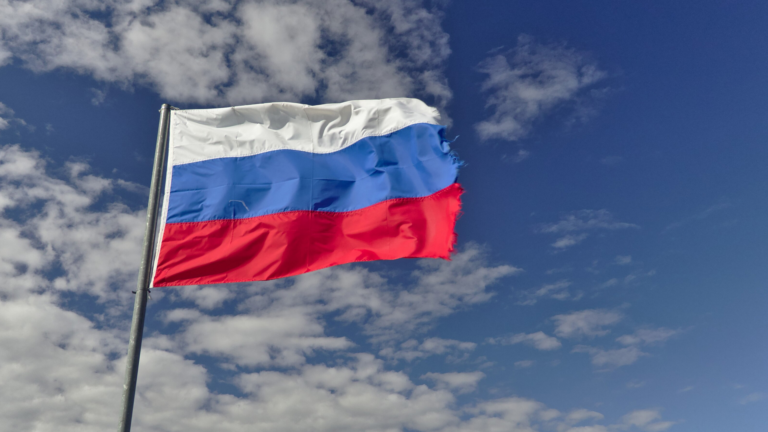




NEW YORK (Aug. 6, 2026) — The Human Rights Foundation (HRF) condemns the decision by the Prosecutor General’s Office of the Russian Federation to officially designate HRF and its work as “undesirable.” The designation, announced today, criminalizes HRF work inside Russia and threatens anyone who engages with it, including Russian citizens living abroad, with fines and imprisonment.
As basis for the designation, the official announcement expressly states: “The organization implements the Tyranny Tracker project, which is an interactive map that shows the degree of states’ commitment to democratic values. The Russian Federation, according to its creative creators, has received the status of a ‘fully authoritarian regime.’”

“To substantiate its claims [that Russia’s government is authoritarian]” — the official announcement continues — “[HRF] spends its resources on the dissemination of information that discredits the Armed Forces of the Russian Federation, [and] supports organizations whose activities have already been recognized as undesirable in our country.“
We couldn’t have said it better ourselves, said HRF Chief Legal and Policy Officer Javier El-Hage. By criminalizing our organization — even threatening with imprisonment those who collaborate with us — for having a research project that documents how Putin’s dictatorship is a ‘fully authoritarian regime,’ the Kremlin does nothing but confirm our assessment. We accept this designation as a badge of honor.
HRF’s Tyranny Tracker is a qualitative global democracy index that tracks the authoritarian actions of 176 countries and territories worldwide across three pillars (electoral competition, freedom of dissent, and institutional accountability) and 45 indicators, ultimately classifying them as democratic, hybrid authoritarian, or fully authoritarian regimes. Developed by HRF’s legal and policy team as an internal research project over a decade and launched to the public this past February in New York with the crucial support of The Reynolds Foundation, the Tyranny Tracker finds that 76% of the world’s population live under authoritarianism.
Among other activities cited as basis for the designation, the Russian government mentions HRF’s impact litigation and sanctions advocacy work, saying that “HRF is involved in the development of recommendations for the US administration on the introduction of sanctions against Russian citizens, [and] tracking financial flows from the Russian Federation in order to further freeze Russian assets abroad.”
HRF is proud to advocate for wrongfully imprisoned dissidents across the world, including, for example, the former lawyers of late Russian opposition leader Alexei Navalny, Alexei Liptser and Vadim Kobzev, said HRF Chief Advocacy Officer Roberto González. We don’t normally publicize our sanctions-related work, but we appreciate the shout-out from the Kremlin, as it only encourages us to do more of it, and be even more effective at it.
With this designation, HRF joins more than 300 organizations on the registry of “undesirable organizations” maintained by Russia’s Ministry of Justice, including Yale University, Stanford University’s Center for Russian, East European and Eurasian Studies, UC Berkeley, and Tufts University’s Fletcher School of Law and Diplomacy.
Under Russia’s “undesirable organizations” legislation, in force since 2015, the regime treats virtually any interaction with a designated organization as punishable: working or volunteering for it, speaking at or attending its events, reposting its publications, linking to its website, or citing its research. A first violation carries a fine under Article 20.33 of the Code of Administrative Offenses of Russia, while a repeat violation within a year triggers criminal liability under Article 284.1 of Russia’s Criminal Code. Donating to a designated organization is prosecuted as a crime outright, and organizing its activities is punishable by up to six years in prison. The Russian government has a history of applying the law retroactively.
HRF calls on democratic governments to reject the Kremlin’s attempt to export its censorship beyond Russia’s borders and to impose real costs on the officials who suppress dissent and criticism of the regime both inside and outside the country. HRF’s initiatives serving activists, journalists, and political prisoners, including the Tyranny Tracker, will continue without interruption.