



NEW YORK (Sept. 10, 2026) — With support from the Human Rights Foundation (HRF), the Australian Strategic Policy Institute (ASPI) has released a landmark research report detailing how Venezuela is poised to quickly acquire Chinese AI-enabled surveillance tools and integrate them into its systems of state control.
The report, “Warning signals: Venezuela and the risk of Chinese AI-enabled digital authoritarianism,” reveals that Venezuela is primed to become one of the first countries to import China’s new generation of large language model (LLM)-based AI systems for surveillance and control — and the most advanced adopter in the Western Hemisphere.
Key Findings
A First of Its Kind Agreement for Chinese AI
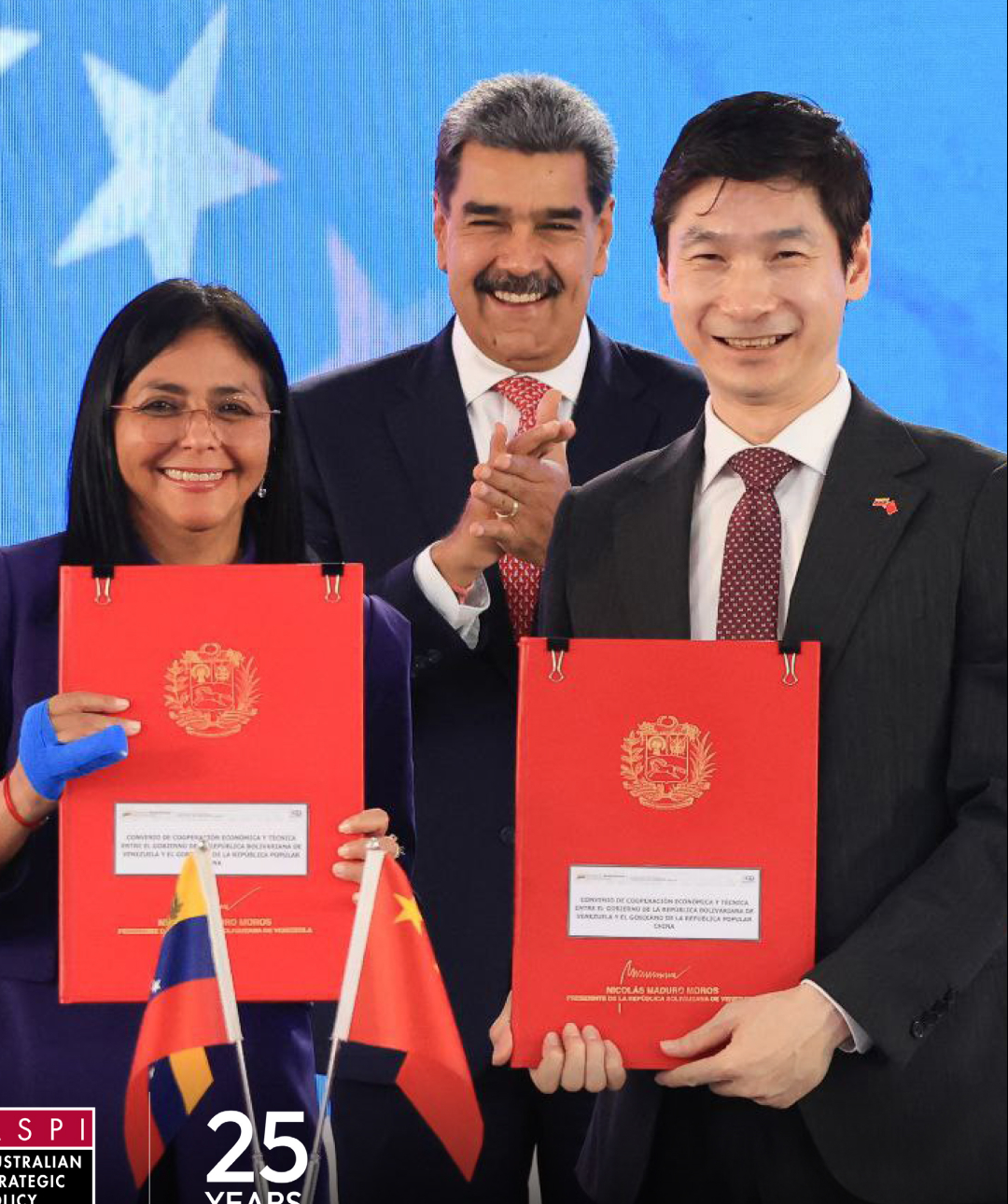
In July 2025, the Venezuelan regime signed a memorandum of understanding with iFlytek, a Chinese firm on the US Entity List since 2019 and a supplier of LLM systems to China’s own censorship and judicial automation apparatus. Negotiated by Delcy Rodríguez, then vice president and now acting president, it is Venezuela’s first known agreement for Chinese AI capability rather than Chinese hardware.
Openly Stated Intent to Use AI for Surveillance and Control
The regime’s leaders have stated their intent to use Chinese AI for surveillance and control, including through a national command room established in January 2025. That command room manages a confederated system of local data rooms collecting information on citizen complaints, welfare distribution, and grassroots political activity.
From Infrastructure to Intelligence
Two decades of importing Chinese cameras, networks, identity systems, and command centers have produced an integrated technology stack — the perfect landing place for next-generation, AI-enabled surveillance and repression.
Rodríguez’s Role in the Surveillance Apparatus
As executive vice president, Rodríguez was the highest civilian authority with formal oversight of SEBIN, Venezuela’s domestic intelligence agency, and oversaw expansion of the commune system, a key part of Venezuela’s infrastructure of political surveillance and control. Without outside pressure, specifically from the United States, she cannot be expected to take autonomous steps toward dismantling it.
A Narrow but Crucial Window
The AI layer is signaled, but not yet built. If the iFlytek agreement is implemented on top of existing infrastructure, AI would make Venezuela’s repression cheaper, faster, and harder to see. That escalation is preventable now; it will be far harder to reverse once built.
Venezuela’s laws and institutions have already been shaped to accommodate this ambition to enhance domestic surveillance and to counter weapons of Western “cognitive warfare.” The United States’ current leverage over the interim regime provides a critical opportunity to dismantle China’s potential grip on Venezuela’s digital infrastructure before it is built.
The “Warning signals” report is a resource for policymakers, technology companies, civil society, and media seeking to understand the rapid evolution of Venezuela’s AI-driven surveillance ambitions and develop effective strategies to prevent the further entrenchment of technology-enabled authoritarianism.
REPORT
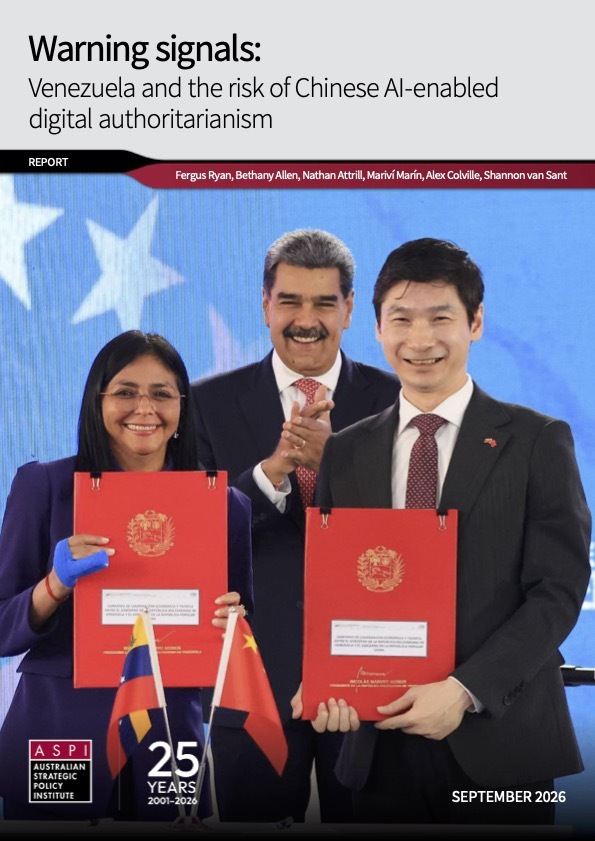
Warning signals: Venezuela and the risk of Chinese AI-enabled digital authoritarianism
This research was funded through HRF’s AI for Individual Rights program, the world’s first initiative to expose autocrats’ use of AI as a tool of repression and support open-source AI tools in the hands of dissidents.
Join the Author in Washington, D.C.
The report’s lead author, Bethany Allen, will present ASPI’s findings at “Authoritarians on the Brink: China’s AI Surveillance Infrastructure in Venezuela,” a free public event hosted by PubKey on Tuesday, Sept. 15, from 6 to 8 p.m. EDT in Washington, D.C. Allen will expose how Chinese companies and state-linked technology providers have enabled the development of Venezuela’s surveillance architecture, and share new developments in AI cooperation between the two authoritarian regimes. The evening includes a live Q&A with the author. Admission is free and open to the public; registration is required here.
About the Australian Strategic Policy Institute
The Australian Strategic Policy Institute (ASPI) was formed in 2001 as an independent, nonpartisan think tank. Its core aim is to provide the Australian government with fresh ideas on Australia’s defense, security, and strategic policy choices. ASPI is responsible for informing the public on a range of strategic issues, generating new thinking for the government, and harnessing strategic thinking internationally.