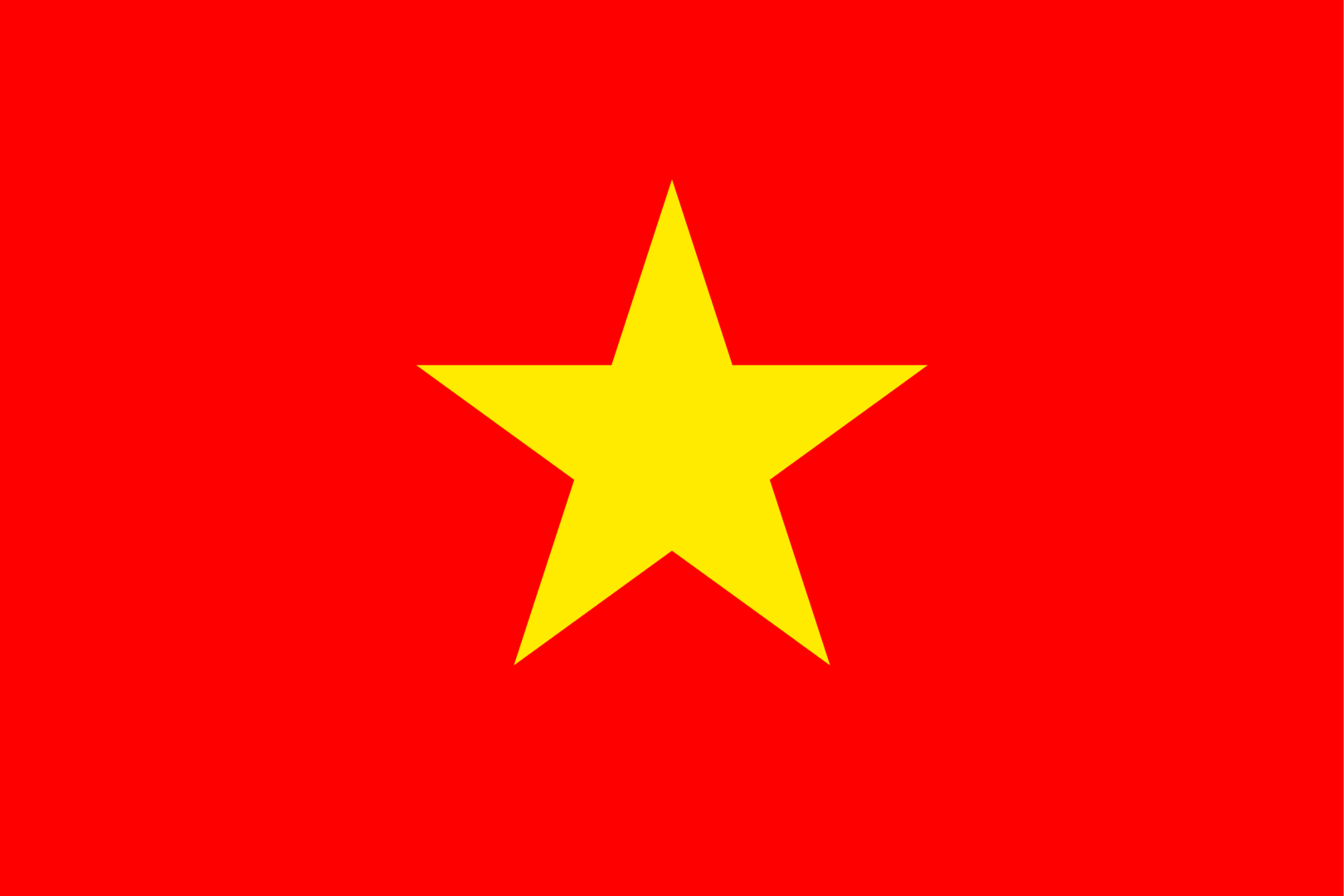
HRF classifies Vietnam as ruled by a fully authoritarian regime.
The Communist Party of Vietnam (CPV) has been the sole ruling party since 1976 and maintains absolute control over all branches of government except the parliament. CPV General Luong Cuong took the role of President in October 2024, shortly after CPV General Secretary To Lam began his first term in August 2024, and also served as President of Vietnam until October 2024, following the re-election of former President Nguyen Phu Trong as CPV General Secretary for a third term in January 2021. Lam’s tenure was characterized by severe crackdowns, extensive centralization of authority, and transnational repression of dissent. He has intensified pressure on journalists, civil society actors, and critics while consolidating power through reforms in the judiciary, legislature, and executive. Elections and state institutions largely operate as instruments of party control rather than as mechanisms for accountability or public participation.
Key Highlights
National elections are a sham. The Communist Party of Vietnam (CPV) is the sole existing political party and has ruled uninterrupted since the founding of the Socialist Republic of Vietnam in 1976. There is no mainstream opposition. The few “independent” candidates – a term that refers to CPV members who are self-nominating, non-CPV members nominated by the party, or self-nominating non-CPV members – that contest elections are subject to prior vetting by the regime and its affiliated organizations. The regime exerts tight control over electoral oversight.
Independent media, civil society leaders, organizations, and regular people face overt and systematic retaliation if they openly criticize the regime. The vast majority of formally registered media outlets are controlled by the regime. Civil society organizations may only work in non-politically sensitive areas and are prone to regime intimidation. Dissidents risk surveillance, harassment, arbitrary arrest and detention, and physical attacks. The regime has been implicated in several transnational attacks against exiled Vietnamese dissidents.
Institutions largely fail to serve as independent checks on the regime. Vietnamese courts operate within the framework of a people’s court system mandated to serve the regime and its interests, depriving it of the power to review regime policies. The regime exercises absolute control over judicial appointments, removals, and disciplinary action. Courts regularly impose harsh sentences on dissidents without adhering to fair trial standards. The legislative branch is firmly captured, with the National Assembly lacking independence due to the Communist Party’s control over candidate nominations and electoral processes, effectively eliminating genuine political competition. Executive authority is similarly subordinated to party rule, a dynamic reinforced by recent administrative reforms that consolidate power vertically and eliminate intermediate levels of government, further reducing opportunities for independent oversight.