Source: Tyranny Tracker
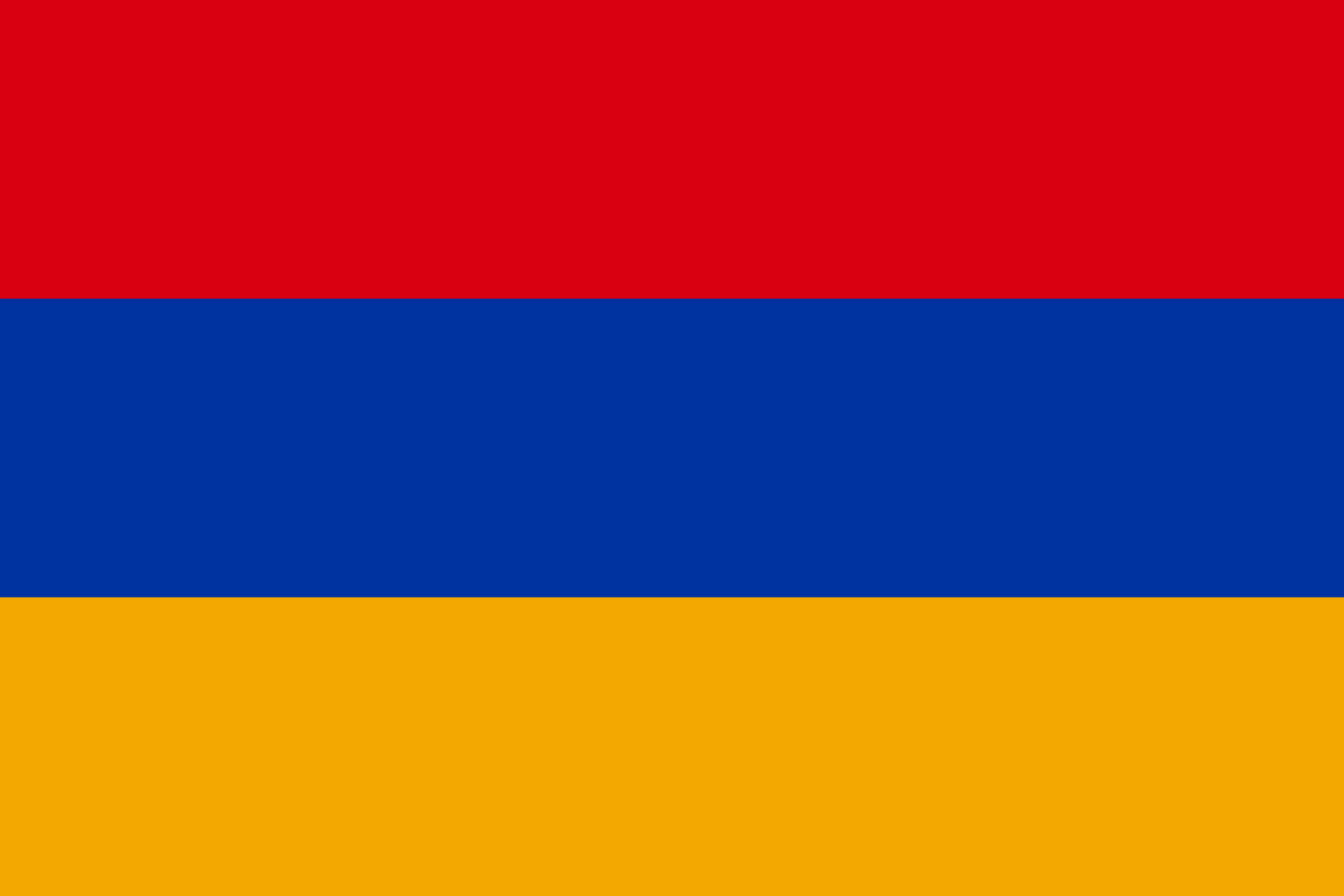
HRF classifies Armenia as democratic.
Armenia declared independence from the Soviet Union in 1991. For many years, its post-Soviet history was marked by the dominance of the Republican Party under Presidents Robert Kocharyan (1998–2008) and Serzh Sargsyan (2008–2018), whose rule relied on oligarchic networks and systematic electoral manipulation. A turning point came with the 2018 “Velvet Revolution,” a mass nonviolent protest movement led by current Prime Minister Nikol Pashinyan. It resulted in the ouster of Serzh Sargsyan, who had sought to extend his hold on power, and ushered in a democratization process marked by the first free and competitive elections in decades, along with an anti-corruption campaign. Following the 2015 constitutional reform, the country completed its transition from a semi-presidential to a parliamentary system, in which executive power is concentrated in the hands of the prime minister. Armenia’s unicameral parliament, the National Assembly, has 107 seats elected through a proportional election system. 71 of its seats are currently held by Pashinyan’s Civil Contract party.
Armenia has traditionally had a close relationship with Moscow: it has been a member of the Eurasian Economic Union (EAEU) since 2015 and is a founding member of the Collective Security Treaty Organization (CSTO). However, following CSTO’s inaction during Azerbaijan’s incursions into Armenia’s sovereign territory in 2021–2022 and Moscow’s reluctance to help Armenia during Baku’s military operation that reclaimed control over the disputed Nagorno-Karabakh region in late 2023, Yerevan began pursuing a more diversified foreign policy, deepening cooperation with the European Union and the United States, an ongoing source of political tension in its relations with Moscow.
Armenian national elections are largely free and fair. The electoral process is open, allowing even the incumbent’s strongest rivals to run without interference. Strict anti-fraud measures and biometric technology have effectively stopped systemic cheating. This has led to genuine competition where the ruling party’s support has noticeably declined, and a strong parliamentary opposition is present.
Independent media, political leaders, civil society leaders, organizations, and members of the general public are largely free to openly criticize or challenge the government. However, the state has launched a coordinated attack on the Armenian Apostolic Church, prosecuting religious leaders involved in politics. Additionally, police have increasingly used excessive force against protesters, while authorities now use administrative rules to block journalists from parliament and punish critical speech.
Institutions are somewhat independent but frequently constrained by the government. The executive uses disciplinary bodies to dismiss judges who criticize reforms or assert independence, creating fear within the judiciary. As a result, courts often fail to check the government, automatically approving the detention of activists and Armenian Apostolic Church clergy without proper evidence.
Hit enter to search or ESC to close