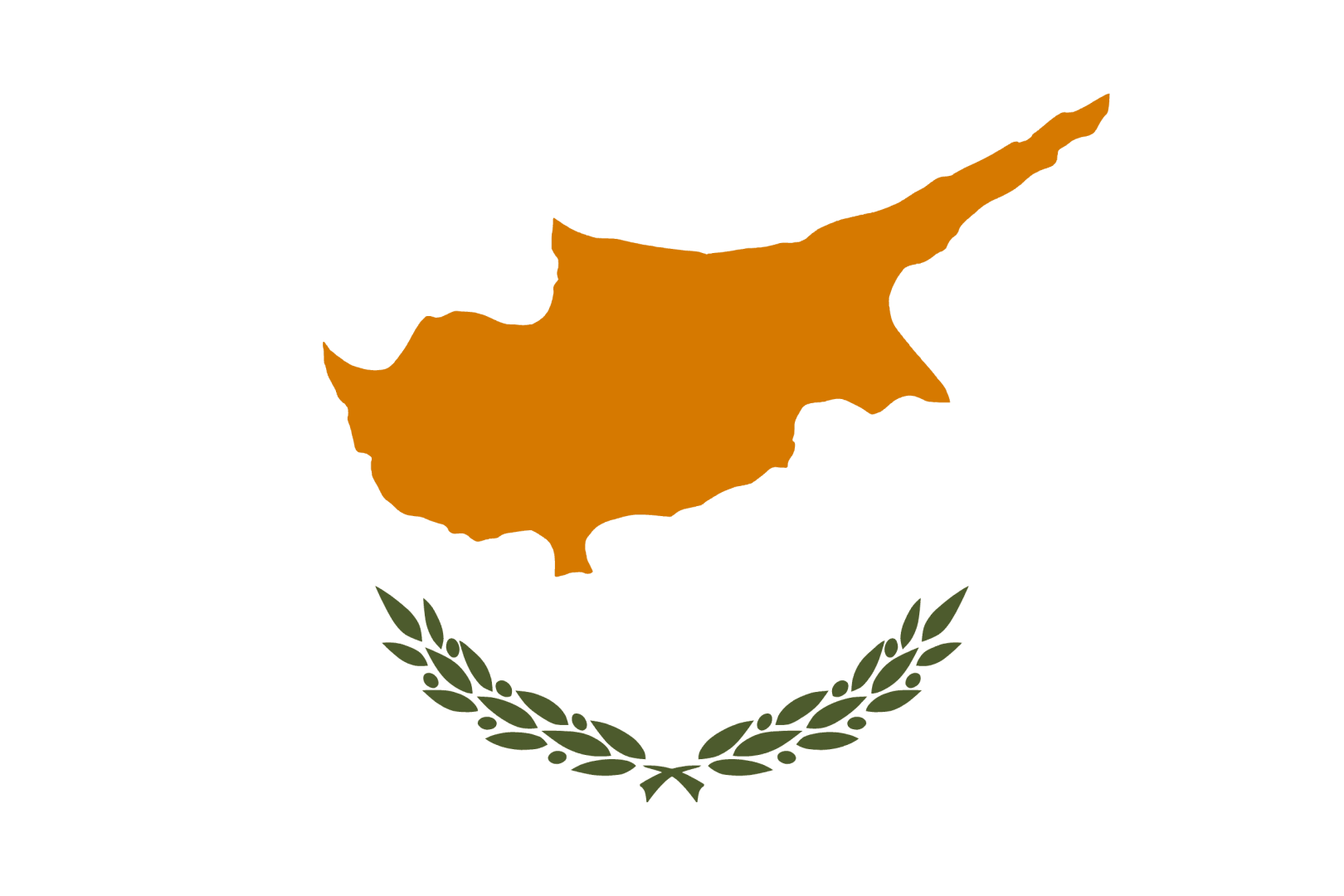
Source: Tyranny Tracker
HRF classifies the Republic of Cyprus as democratic.
The Republic of Cyprus is a presidential representative democratic republic located on the island of Cyprus in the eastern Mediterranean. Although the Republic of Cyprus claims de jure sovereignty over the entire island, effective control has been divided since 1974, with the north administered by the self-declared Turkish Republic of Northern Cyprus, recognized only by Turkey, alongside the UN Buffer Zone and the UK Sovereign Base Areas. In the Republic of Cyprus, executive authority is vested in an elected president who serves as both head of state and head of government and governs through a Council of Ministers. Legislative power resides in the unicameral House of Representatives (“Βουλή των Αντιπροσώπων Voulī́ tōn Antiprosṓpōn”), elected for five-year terms: 56 seats are filled by proportional representation from the Greek Cypriot community, alongside three non-voting observer members representing the Maronite, Latin Catholic, and Armenian minorities, while 24 seats allocated to the Turkish Cypriot community remain vacant due to the island’s de facto division. The party system is traditionally dominated by a “classic quartet” comprising the centre-right Democratic Rally (DISY), the left-wing Progressive Party of Working People, the centrist Democratic Party, and the social-democratic United Democratic Union of Centre, resulting in a competitive multiparty landscape that often requires cross-party cooperation.
In the Republic of Cyprus, national elections are largely free and fair. Cyprus has long held competitive presidential elections with multiple candidates and regular transfers of power among liberal-conservative, centrist, communist, and independent political forces, reflected in consistently narrow margins of victory. Similarly, the Cypriot government has not unfairly hindered the electoral campaigns and elections take place in a pluralistic environment, with open access to media and extensive public debate, even though the electoral framework remains complex and outdated.
Independent media, political leaders, civil society leaders, organizations, and members of the general public are largely free to openly criticize or challenge the Cypriot government. There is no general ban on CSO activity, and organisations are able to register, advocate, and operate across a wide range of issues. Similarly, Cyprus maintains a generally vibrant and pluralistic media environment in which independent outlets can freely report and criticize the government without systematic retaliation. Public demonstrations are common and occur largely unobstructed.
Institutions are independent and largely serve as effective checks on the governing authority. Cyprus continues to operate a constitutionally independent judicial system that guarantees fair trial rights and an Attorney-General independent from the executive, and the government has not pursued reforms that abolish or seriously weaken judicial independence. Similarly, executive and oversight bodies in Cyprus continue to operate and perform their functions largely independently, although some practical limitations remain, and reforms to further strengthen their autonomy are still pending. As a result, judicial, legislative, and executive institutions in Cyprus have generally demonstrated the capacity to hold government officials accountable, and there is no pattern of frequent or unfair failure to do so.
Hit enter to search or ESC to close