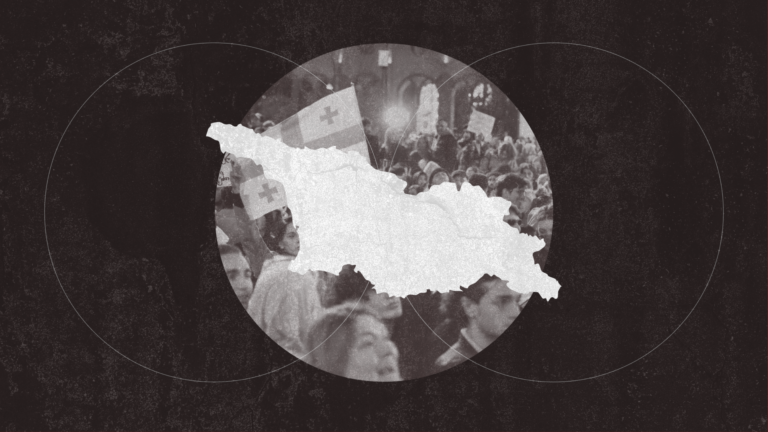
HRF classifies Georgia as ruled by a hybrid authoritarian regime.
Georgia, a parliamentary republic, gained independence from the Soviet Union in April 1991 after 70 years as a Soviet republic with limited autonomy. From the outset, internal turmoil, authoritarian legacies, and separatist conflicts in Abkhazia and South Ossetia—distinct ethnic enclaves in the Caucasus—hindered democratic progress. In 2003, the peaceful Rose Revolution ousted the incumbent president, Eduard Shevardnadze, whose 1992–2003 leadership was marred by corruption, electoral fraud, and government inefficiency. Mikheil Saakashvili and his party, the United National Movement (UNM), came to power the following year, winning the presidential and parliamentary elections. Saakashvili and the UNM pursued an openly pro-Western course, which aggravated relations with Russia. Ostensibly protecting the vulnerable population of South Ossetia, Russia invaded Georgia in 2008, initiating a bloody 5-day war. It ended in Georgia’s defeat and Russia’s formal recognition of the breakaway territories of Abkhazia and South Ossetia as independent states. Deeply unpopular by then, Saakashvili and the UNM lost to the Georgian Dream (GD) coalition in 2012. Initially hailed as a harbinger of democratization, GD has overseen a steady erosion of electoral integrity and a shrinking of civic space.
Key Highlights
In Georgia, electoral competition is significantly skewed to the point where the mainstream political opposition has an unlikely, although realistic chance to win. The Georgian Dream (GD) party, in power since 2012, has systematically engaged in anti-democratic tactics, including illegal voter mobilization and judicial persecution of prominent political opponents. The ruling party also commands significant and unfair incumbent advantages, from the abuse of administrative resources for political campaigning to the disproportionate control over the state agency overseeing elections. As a testament to the uneven playing field these measures have created, the opposition boycotted the second round of the 2020 legislative elections and called for an annulment of the results of the 2024 parliamentary elections.
Independent media, civil society and political leaders, and members of the general public have been seriously and unfairly hindered in their ability to openly criticize or challenge the regime, as evident in the recent dismissals of critical journalists from publicly owned media outlets and the increasing judicial persecution of political opponents. At the same time, the regime has heavily limited civic space through the adoption of draconian “foreign agents” legislation and cracked down on dissenting demonstrations.
Reflecting the GD’s protracted consolidation of power, institutions are somewhat independent, occasionally checking the executive’s actions, but frequently constrained by the regime. The ruling party has significantly undermined the judiciary’s independence by politicizing the appointment and dismissal of magistrates, among other measures. As a result, the courts have enabled the persecution of opposition leaders and dissidents, as well as failed to guarantee effective legal remedies for electoral irregularities. The GD has also captured essential oversight bodies, reducing them to mere extensions, rather than independent checks, of the executive.