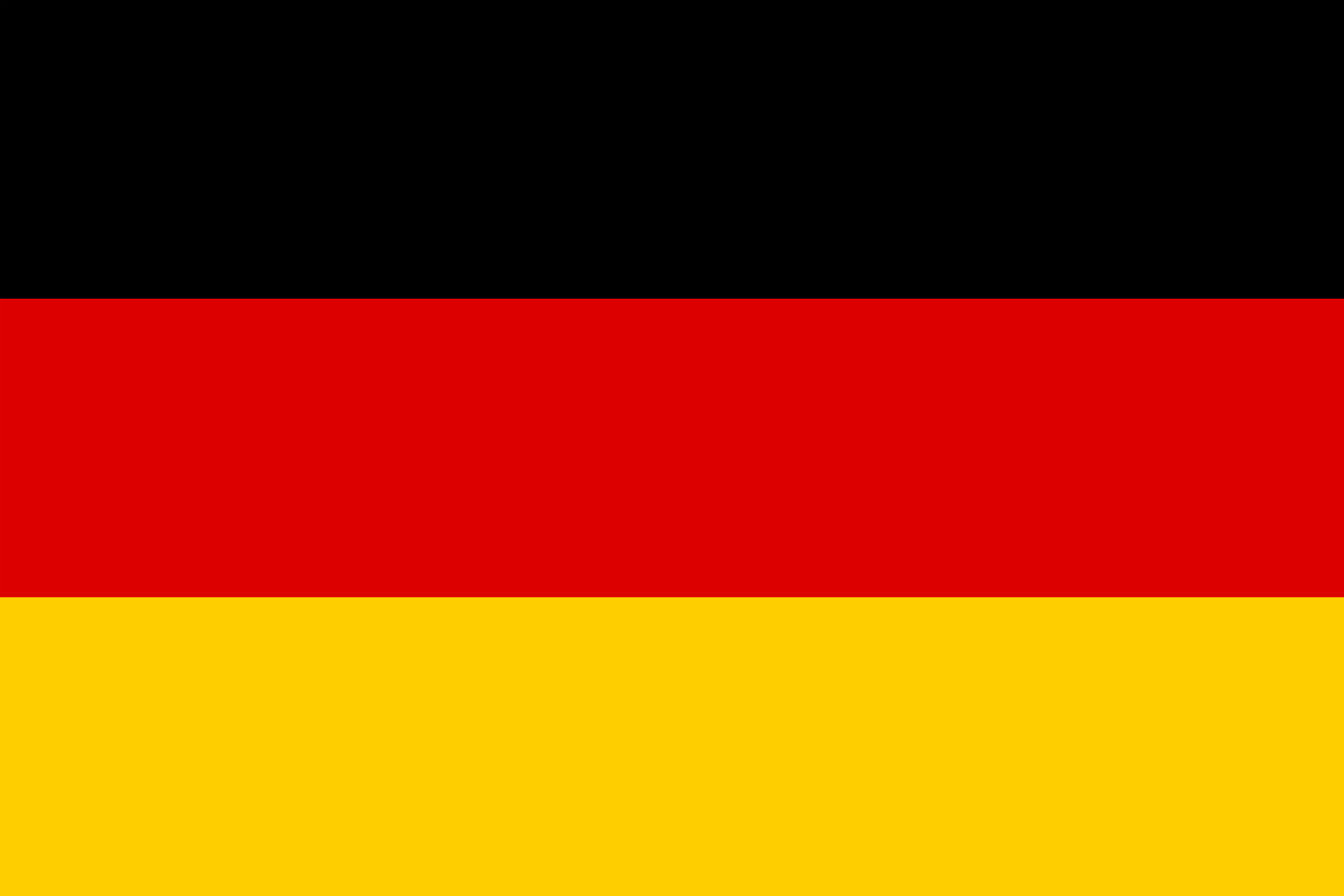
Source: Tyranny Tracker
HRF classifies Germany as democratic.
Germany is a federal parliamentary republic in Central Europe. After the fall of the Nazi regime in 1945, Germany was partitioned and underwent a period of Allied occupation. During this time, West Germany established a democratic constitutional order with the 1949 Basic Law, while East Germany, officially called the German Democratic Republic (GDR), developed as a Soviet-aligned socialist state. The country reunified in 1990 following the 1989 peaceful collapse of the GDR and the emblematic Berlin Wall that had previously divided the city between the two states. Reunification effectively extended West Germany’s institutional framework across the entire state. Since that time, Germany has maintained competitive multiparty elections, stable coalition governments, and robust protections for civil liberties and minority rights, while playing a central role in the European Union, which it co-founded.
Starting in the 2010s, the country has faced challenges related to economic uncertainty, migration, and rising popular discontent with the political status quo, which had been historically dominated by the Christian Democrats on the center-right and the Social Democrats on the left. The rise of the nationalist Alternative for Germany (AfD) party and a thwarted 2022 coup plot by the Reichsbürger group, which aspired to restore centralized authoritarian rule, have prompted concerns about the resilience of the country’s consolidated democracy. Nonetheless, mainstream parties across the political spectrum have successfully isolated extremist groups, while independent institutions have proved capable and willing to guarantee the constitutional order of the post–Cold War German state.
National elections are largely free and fair. While two main parties have been dominant since Germany reunified in 1990—the Christian Democrats (CDU) and the Social Democrats (SPD)—multiple other parties typically hold seats in the lower house of Parliament, the Bundestag. Equitable media representation and sound campaigning regulations contribute to highly competitive elections.
Independent media, political leaders, civil society leaders, organizations, and regular people are largely free to criticize or challenge the government openly. Germany has one of the most extensive ecosystems of publicly funded and politically independent media outlets, well-regarded for their impartial coverage. While journalists enjoy relative safety, those covering sensitive topics (such as migrant rights) have faced harassment by law enforcement on some occasions. Freedom of assembly is generally upheld, yet some of the federal states, such as Bavaria, have resorted to arbitrary measures, such as “preventive detention,” to obstruct activists or have issued blanket bans on pro-Palestinian demonstrations, drawing criticism from international watchdogs. Some speech laws introduced in the last decade have also sparked concerns about digital censorship.
Institutions are independent and largely serve as effective checks on the government. The Federal Constitutional Court has intervened adequately to uphold the freedom of dissent when controversial new laws have threatened to undermine it. The courts also generally hold political elites accountable for abuses of office or criminal speech, eroding fundamental constitutional rights.
Hit enter to search or ESC to close