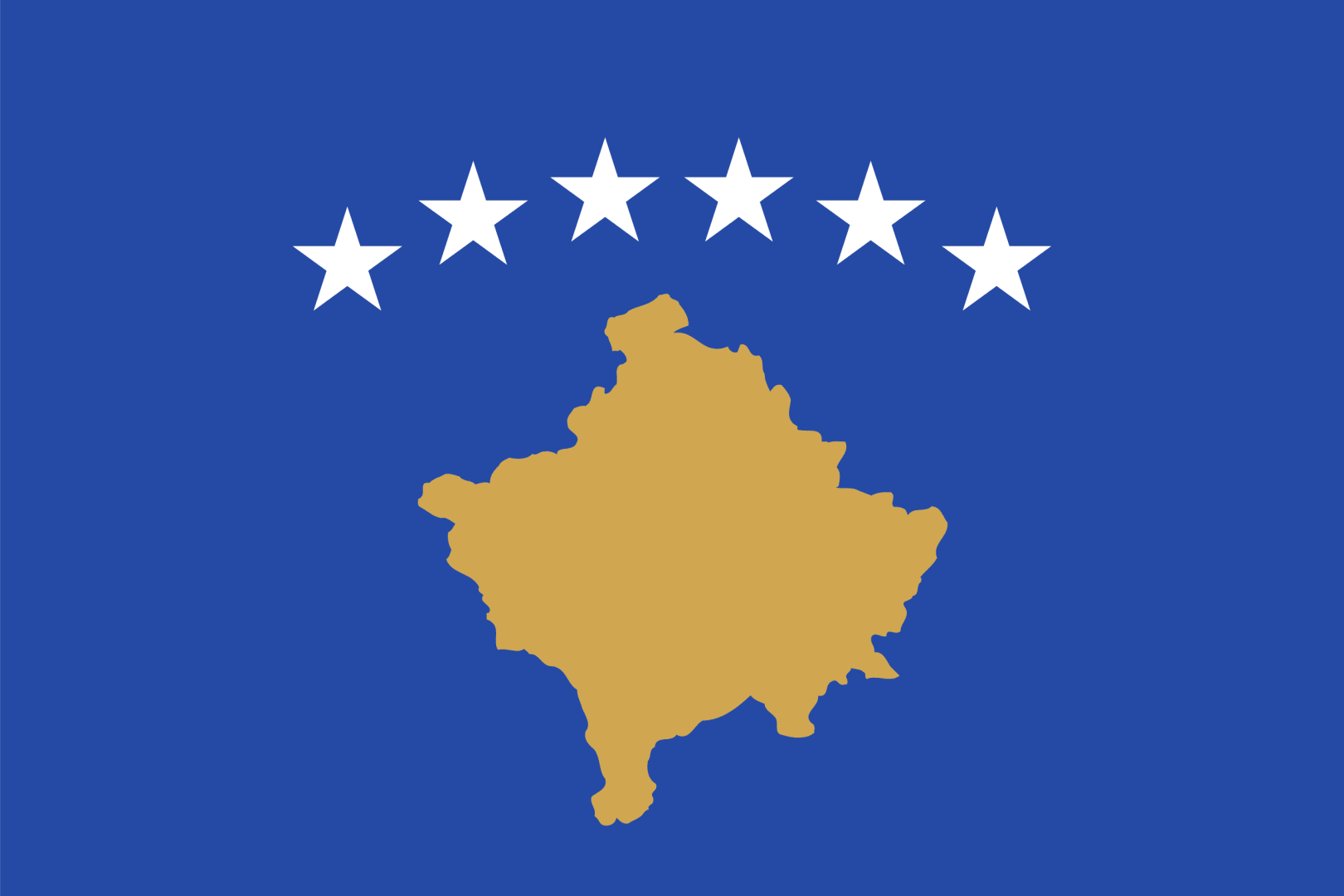
Source: Tyranny Tracker
HRF classifies Kosovo as democratic.
Kosovo declared independence unilaterally in 2008 after years of internationally mediated negotiations with Serbia regarding possible autonomy had failed to bring about a compromise. Part of the former Yugoslavia for most of the 20th century, Kosovo maintained a distinct Albanian minority despite the Yugoslav regime’s policies of displacing and persecuting ethnic Albanians. The region’s longtime secessionist struggles culminated in the 1998-1999 Kosovo war against the forces of the Yugoslav Federal Army. Following sustained NATO air strikes against Serbia, the political center of what remained of Yugoslavia at the time, in 1999, the belligerents signed the Kumanovo Agreement, which mandated a withdrawal of the Yugoslav armed forces. Under the Agreement, a United Nations Mission de facto governed Kosovo, facilitating the establishment of “provisional institutions for self-governance,” including a legislature, a judicial branch, and public administration agencies. Kosovo has a 120-member, unicameral national assembly (Kuvendi) serving 4-year terms. Under Kosovo’s unique institutional framework, which aims to ensure power-sharing between hitherto rival ethnic groups and protect minority rights, the Kuvendi has seats reserved for minority representatives: 10 for ethnic Serbs and 10 for other communities. The President is formally the head of state but has primarily ceremonial functions. The left-leaning Vetëvendosje (LVV) party, led by Albin Kurti, has been continuously in office since 2021.
In Kosovo, national elections are largely free and fair. The European Union, which has monitored every election since the signing of the 2013 Agreement on normalizing relations between Serbia and Kosovo, has generally appraised the electoral process positively. The anti-establishment, left-leaning LVV party has won four consecutive parliamentary elections (2019, 2021, February 2025, December 2025). Nonetheless, its electoral victories did not always entail full governing mandates due to internal splintering or unsuccessful cabinet negotiations with other political parties in parliament. The LVV has refrained from skewing the electoral playing field in its favor while in office, despite occasionally benefiting from its access to administrative resources.
Independent media, political leaders, civil society leaders, organizations, and members of the general public are largely free to openly criticize or challenge the government. Albin Kurti’s second cabinet (2021 – Present) pursued significant reforms aimed at bolstering the independence of Kosovo’s already diverse media sector, including a much-needed leadership change in the public broadcaster, the RTV, and an effort to enable a more speedy legal remedy for journalists who suffered harassment or physical assault. Nonetheless, these accomplishments were somewhat offset by the politicized appointment of the RTV’s new Director in 2023, the lack of significant reforms to the state agencies overseeing the media sector, and the temporary suspension of an independent broadcaster’s license in 2023, subsequently successfully contested in court. Civil society is robust, and freedom of assembly is generally respected.
Institutions are somewhat independent but frequently constrained by the government. Plagued by political influence, the judiciary frequently and unfairly sides with the government when reviewing challenges to government policies or interests. Public officials implicated in corruption, abuse of power, or war crimes have frequently evaded accountability, including by publicly intimidating and harassing senior members of the judiciary. Still, there are some indications that, under an ambitious new Strategic Plan for the Judiciary (2021-2026) adopted by the Kurti government, substantive improvements are underway.
Hit enter to search or ESC to close