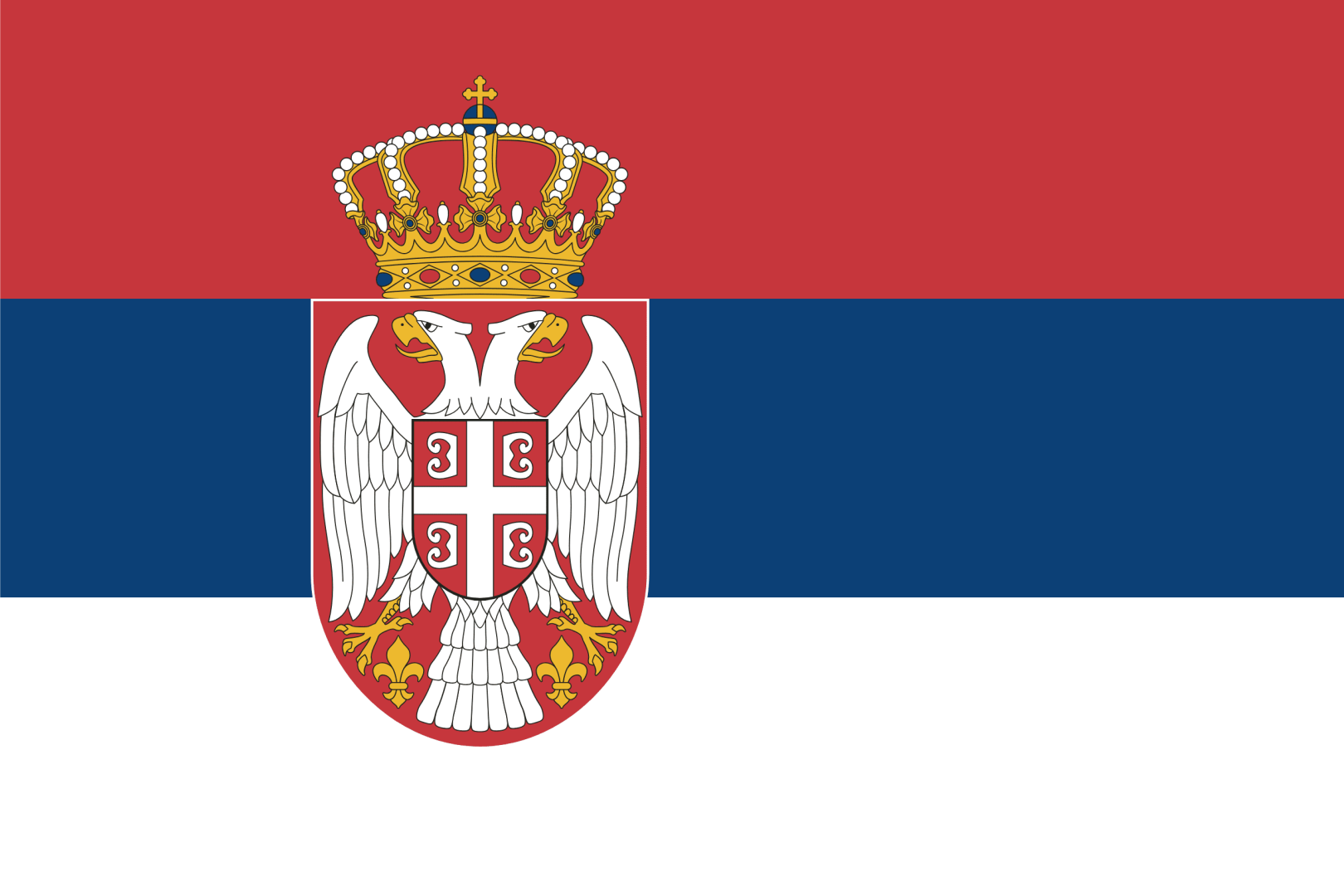
HRF classifies Serbia as ruled by a hybrid authoritarian regime.
Serbia is a parliamentary republic with a unicameral, 250-member National Assembly elected for four-year terms. Executive power rests with a cabinet subject to parliamentary oversight. The president is formally the head of state and exercises mostly ceremonial powers. As one of the six constituent republics forming the Socialist Federal Republic of Yugoslavia (1945-1992), Serbia remained in a federal union with Montenegro following the dissolution of Yugoslavia in 1992. The dissolution brought a series of armed conflicts and crises in the 1990s, marked by systematic violations of human rights and international law. In 2006, Serbia gained its independence de jure when Montenegro, also a former Yugoslavian republic, declared independence and thus ended the state union between the two countries. From 1989 to 2000, Serbia was ruled by Slobodan Milošević, whose increasingly repressive rule led to mass protests and his ultimate defeat in the 2000 presidential elections. Since then, the country has held competitive multiparty elections. However, since coming to power in 2012, the Serbian Progressive Party (SNS) and its de facto leader, Aleksandar Vučić, have steadily undermined Serbia’s democratic gains.
Key Highlights
Electoral competition in Serbia is significantly skewed in favor of the regime, to the point where the real, mainstream opposition has a highly unlikely, although realistic chance to win. The ruling Serbian Progressive Party (SNS), in power since 2012, enjoys significant and unfair campaign advantages that seriously undermine the opposition’s ability to compete, including significant overrepresentation in the media and abuse of public resources. The opposition’s discontent with its inability to compete equitably under such circumstances culminated in a boycott of the 2020 parliamentary elections. Following the parliamentary election in December 2023, marred by allegations of fraud and assessed by international observers as “dominated” by the SNS due to “systemic advantages”, the mainstream opposition organized mass protests and called for a rerun with enhanced oversight.
Independent media and organizations are seriously and unfairly hindered in their capacity to openly criticize or challenge the regime. Independent media outlets that challenge the SNS’s policies face obstruction by the powerful Regulatory Body for Electronic Media (REM), whose executive Council consists almost exclusively of pro-regime officials directly appointed by a parliamentary majority. Gratuitous legal persecution initiated by members of Parliament and other elites and frequent intimidation campaigns by non-state actors plausibly affiliated with the regime also pose significant threats to independent journalism. While the regime has refrained from shutting down major dissenting organizations, new “anti-terror” legislation, introduced in 2020, imposed arbitrarily strict reporting requirements for NGOs that receive foreign funding and introduced hefty penalties for non-compliance. Civil society leaders are also frequently subjected to verbal harassment by regime officials and smear campaigns in pro-regime media. Members of the general public can generally dissent freely, as demonstrated by large pro-democracy demonstrations in recent years. Nonetheless, law enforcement used excessive force against protesters on several notable occasions in the fall of 2025, prompting international criticism.
Serbian institutions are somewhat independent but frequently constrained by the regime. While the ruling party has adopted certain internationally endorsed practices that strengthen judicial independence, it has also weakened the independence and operational capacity of the specialized prosecution, responsible for politically sensitive cases. Similarly, the courts have played a dual role, at times enabling and at other times constraining regime officials’ infringements on freedom of dissent. Finally, the capture of key oversight institutions has further insulated party officials from accountability for electoral violations, the misuse of public funds, and other abuses of power. This pattern, in which institutions are neither fully independent nor thoroughly hollowed out, is a salient characteristic of Serbia’s regime.