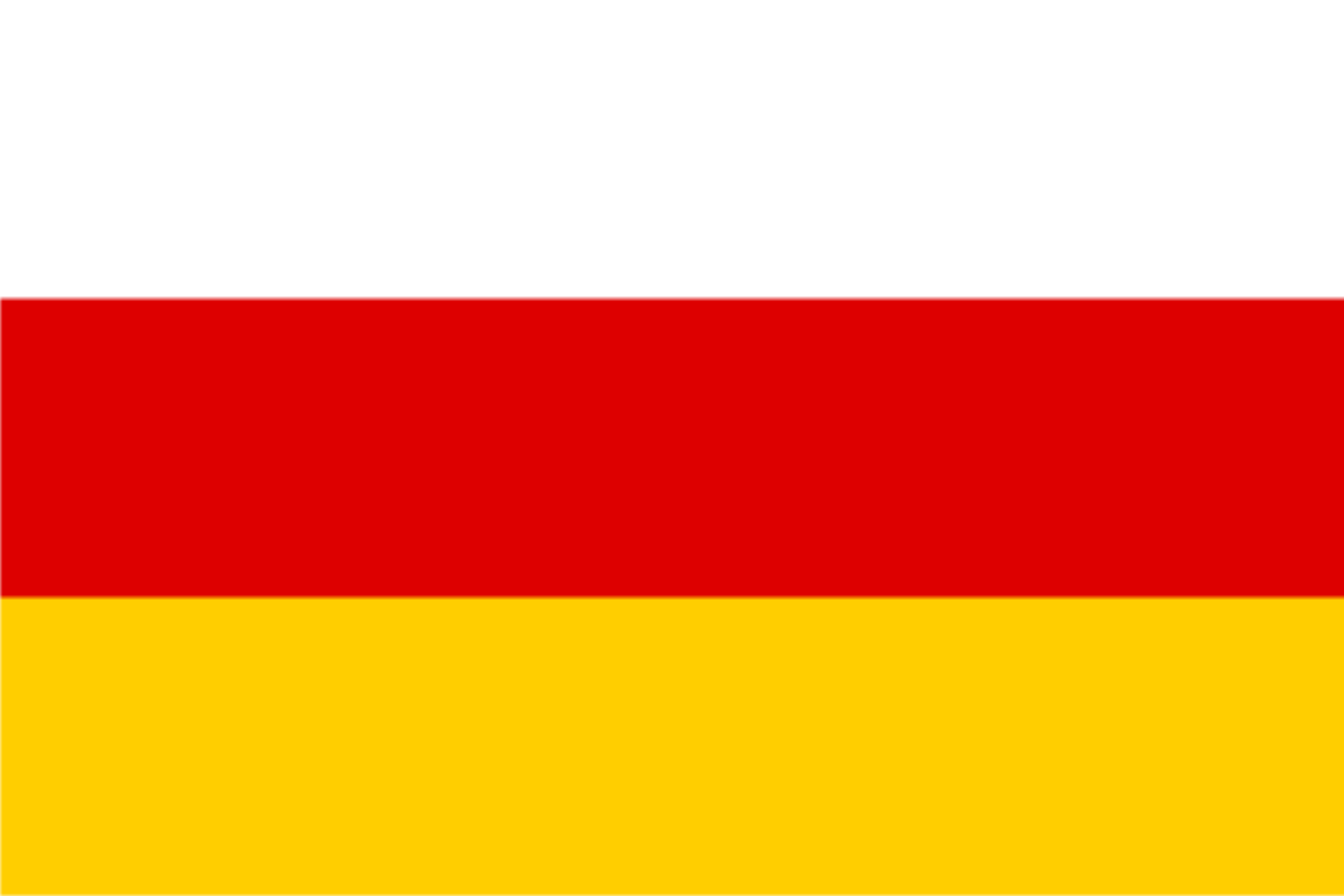
Source: Tyranny Tracker
HRF classifies the breakaway territory of South Ossetia as ruled by a fully authoritarian regime.
South Ossetia is a breakaway territory in the Southern Caucasus. It first declared independence from Georgia in 1990, spurring an armed conflict that lasted until a Russia-Georgia ceasefire (the Sochi Agreement) was signed in 1992. Despite the establishment of a tripartite peacekeeping force consisting of Georgian, Ossetian, and Russian forces, sporadic hostilities persisted – and at times escalated, particularly during the first presidential term of Mikheil Saakashvili (2004-2007), as the government aspired to restore the territorial integrity of Georgia. The conflict culminated in a five-day war between Georgia and Russia in 2008. Invoking a responsibility to protect its citizens abroad (which by then constituted a majority of Ossetians owing to Russia’s pervasive “passportization” policy), Russia deployed troops to Sоuth Ossetia, which most of the international community considers to be Georgian sovereign territory. While an internationally-brokered treaty between Georgia and Russia formally ended the conflict on August 12th, 2008, and stipulated demilitarization of the conflict zone and international monitoring, Russia’s decision to recognize South Ossetian independence on August 26th and ongoing military presence on its territory have precluded the normalization of relations between the breakaway region and Georgia.
South Ossetia is signatory to numerous bilateral agreements with Russia, impacting border protection, immigration and customs, education, and cultural policies, among other key areas of state policy. Its extreme economic dependence on Russia (which provides upwards of 90% of the state budget in the form of international aid) also heavily circumscribes the space for independent policy-making. At the same time, Russia has no direct territorial claims on South Ossetia and formally recognizes its sovereignty, distinguishing its relationship from that with other contested territories that have been forcibly incorporated into the Russian Federation, such as Crimea and the Eastern Donbas.
Formally, South Ossetia functions as a presidential republic with a unicameral parliament, but in practice, power is concentrated in the executive. The de facto constitution, modeled after Russia’s, grants the president sweeping powers, including control over judicial appointments. Alan Gagloev, the current de facto president elected in 2022, governs with a legislature that typically acts as a rubber stamp. The political system is unstable and characterized by frequent crises, yet electoral outcomes remain strictly managed to ensure the exclusion of anti-Russian or genuinely independent candidates.
National elections are a sham, to the point where the real, mainstream political opposition does not have a realistic chance to meaningfully compete and possibly win. The de facto regime completely dominates the political arena, using its tight grip on state resources and the media to predetermine election results. Genuine opposition candidates are routinely blocked from running through manipulated legal procedures, and the total lack of independent election monitors allows the ruling elites to orchestrate the vote without any scrutiny.
Independent media, political leaders, civil society leaders, organizations, and members of the general public face overt and systematic retaliation if they openly criticize or challenge the de facto regime. Although protests generally take place without violent dispersals or crackdowns, dissent is still constrained through other forms of pressure, including physical intimidation and economic coercion against independent media, as well as restrictive laws used to financially cripple civil society groups that do not align with the de facto regime.
Institutions largely fail to serve as independent checks on the regime. The political system is highly centralized around the presidency, with key state functions often outsourced to Russia. Because the executive has unchecked power to appoint loyalists, the courts and government agencies operate without autonomy and are plagued by nepotism. As a result, the justice system is deeply flawed and selective, routinely allowing severe abuses by law enforcement to go unpunished.
Hit enter to search or ESC to close