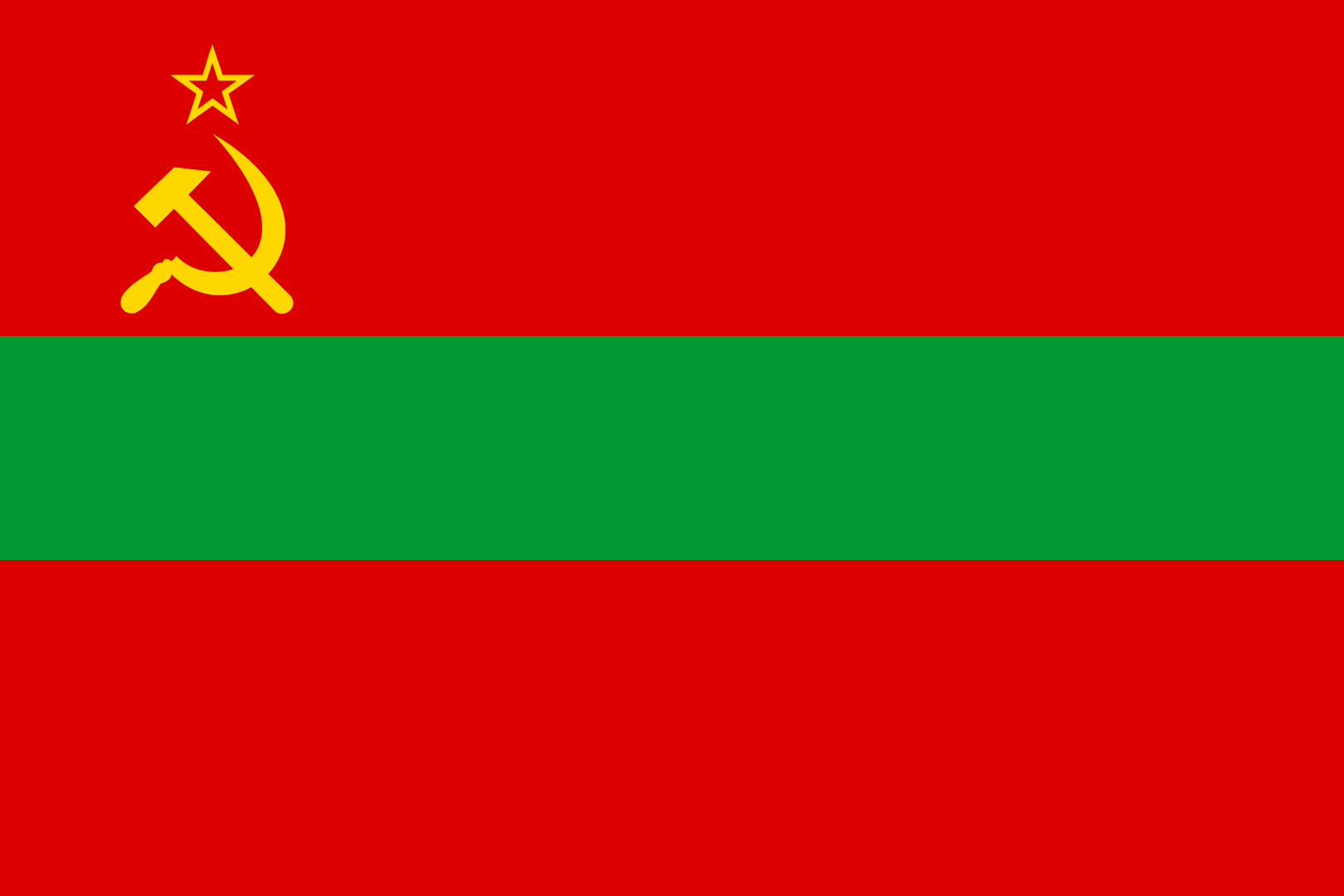
Source: Tyranny Tracker
HRF classifies the breakaway region of Transnistria as ruled by a fully authoritarian regime.
Transnistria (also known as the Pridnestrovian Moldavian Republic) is a breakaway territory situated along Moldova’s eastern border with Ukraine. In 1991, amid the dissolution of the Soviet Union, Transnistria announced its independence from Moldova. This unilateral move was rejected by Moldova and the international community. The political standoff quickly escalated into an armed conflict, in which remnants of Russia’s 14th Army, stationed in Moldova as part of the former Soviet Union’s armed forces, directly supported the separatists through arms supplies, logistical support, and direct artillery fire against Moldovan forces. The fighting ended with a ceasefire agreement, signed between Russia and Moldova in July 1992. The ceasefire established a tripartite peacekeeping force, composed of Moldovan, Russian, and Transnistrian troops, effectively freezing the conflict. In 2006, Transnistria held an independence referendum that reasserted its secession from Moldova. The referendum was considered illegal by most of the international community, effectively turning Transnistria into an unrecognized de facto state that functions independently but lacks any global legal status.
Despite periodic negotiations mediated by the OSCE, Transnistria remains unrecognized internationally and is widely regarded as part of Moldova’s sovereign territory. The de facto regime is heavily dependent on Moscow, both economically and militarily. In addition, the Russian Federation maintains a permanent deployment of about 1,500 troops in the region, which the Council of Europe declared tantamount to an “occupation” in a 2022 resolution. In addition, some estimates suggest that about 200,000 (or about 55%) of Transnistrian residents hold Russian citizenship, reflecting the Kremlin’s longstanding policy of passportization in contested territories in what it perceives to be its sphere of influence.
The current de facto leader, President Vadim Krasnoselsky, first elected in 2016 and re-elected in 2021, maintains close ties to Russia and to the Renewal Party (Obnovlenie), which has dominated Transnistria’s political landscape for nearly two decades.
Elections in Transnistria are a sham, to the point where the real, mainstream political opposition does not have a realistic chance to meaningfully compete and possibly win. The de facto regime ensures the ruling party’s dominance by utilizing opaque administrative barriers and judicial persecution to exclude genuine opposition candidates from the ballot. This lack of competition is compounded by the symbiotic relationship between the political leadership and the Sheriff – an economic conglomerate which monopolized media and financial resources to tilt the playing field. Consequently, electoral cycles are characterized by a total absence of meaningful campaigning and a prevalence of districts where incumbents run unopposed.
Independent media, political leaders, civil society leaders, organizations, and members of the general public face overt and systematic retaliation if they openly criticize or challenge the regime. Dissent is silenced through a comprehensive strategy that combines the monopolization of the information space by allied oligarchic structures with a climate of impunity for extrajudicial violence against prominent critics. The de facto administration further suppresses independent activity by weaponizing vague anti-extremism legislation to imprison dissidents, enforcing legal restrictions that criminalize civic activism, and utilizing restrictive authorization rules to effectively ban public protests.
Institutions largely fail to serve as independent checks on the de facto governing authority. The judiciary lacks structural autonomy due to the executive’s direct control over appointments and the legal system’s operational dependence on Russia, its patrol state. Rather than upholding the rule of law, the courts actively enable political repression by conducting non-transparent trials and issuing politically motivated convictions. Ultimately, judicial bodies function as a protective shield for the executive’s coercive apparatus, ensuring total impunity for state-sanctioned abuses and preserving the political and economic monopoly of the ruling elite.
Hit enter to search or ESC to close