HRF classifies Turkmenistan as ruled by a fully authoritarian regime.
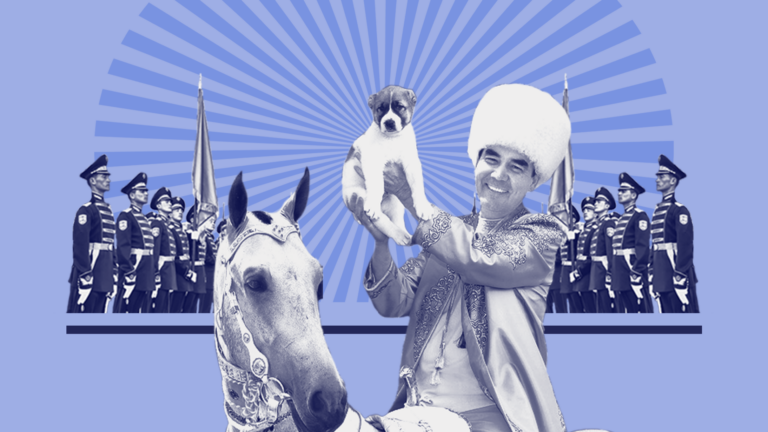
The country declared independence on October 27, 1991, following the collapse of the Soviet Union. Power was initially seized by Saparmurat Niyazov, who established an eccentric personality cult and ruled as “President for Life” until his death in 2006. He was succeeded by Gurbanguly Berdimuhamedov, who maintained the repressive system while gradually establishing his own dynasty. In March 2022, Gurbanguly handed the presidency to his son, Serdar Berdimuhamedov, completing the first dynastic succession in post-Soviet Central Asia. However, the elder Berdimuhamedov retains significant control as the “National Leader” and Chairman of the Halk Maslahaty (People’s Council), a representative body re-established in 2023 with wide-ranging powers that effectively supersede the president. Formally, Turkmenistan is a presidential republic, but in practice, all branches of government are subordinate to the executive and the Berdimuhamedov family. The legislature (Mejlis) is dominated by the ruling Democratic Party of Turkmenistan (DPT) and two proxy parties, lacking any genuine opposition. The judiciary is completely subservient to the regime, serving as a tool for political repression.
Key Highlights
In Turkmenistan, national elections are a sham, to the point where the real, mainstream political opposition does not have a realistic chance to meaningfully compete and possibly win. The elections are characterized by the manipulation of constitutional norms to ensure dynastic succession. The regime precludes meaningful competition by preventing independent candidates from accessing the ballot and engaging in widespread voting irregularities to manufacture desired results. Furthermore, the ruling power leverages state resources to secure unfair campaign advantages, rendering genuine political contestation impossible.
Independent media, political leaders, civil society leaders, organizations, and members of the general public face overt and systematic retaliation if they openly criticize or challenge the regime. Critics face severe retaliation in an environment defined by the enforced disappearance of dissidents and a state monopoly on information. The administration enforces a complete ban on independent civil society and public assembly, effectively eradicating domestic opposition. This repression extends transnationally, as the regime actively pursues and intimidates critics living in exile to silence any challenge to its authority.
Institutions largely fail to serve as independent checks on the regime. The executive branch utilizes the judiciary as a coercive tool to silence dissent and guarantees impunity for state officials involved in human rights violations. Moreover, the administration has restructured the constitutional order to formalize dynastic control over the legislature and maintain the absolute subservience of the judicial system to the presidency.