HRF classifies Iraq as ruled by a Hybrid Authoritarian regime.
Iraq’s transition to a federal parliamentary democracy began with the overthrow of Saddam Hussein’s 24-year-long authoritarian regime in 2003. Since then, the country has made notable strides towards establishing democratic institutions, including the drafting of a new constitution, holding routine elections, and the formation of a representative government. Iraq’s political landscape is marked by constitutional guarantees for a multi-party system, competitive elections, and a framework for the peaceful transition of power. However, constraints on freedom of dissent and institutional accountability persist. From October 2022 to November 2025, the Iraqi governing authority was led by Prime Minister Mohammed Shia al-Sudani, who assumed his position following a prolonged political deadlock of nearly a year, which occurred after the October 2021 parliamentary elections. In November 2025, his political party won the general elections. However, given Iraq’s consociational governance system, dictated by a multi-stage negotiation process, requiring the nominee to achieve cross-segment legitimacy rather than just a parliamentary plurality, by December 2025, it remained unclear whether his victory would be sufficient to guarantee the incumbent’s reappointment.
Key Highlights
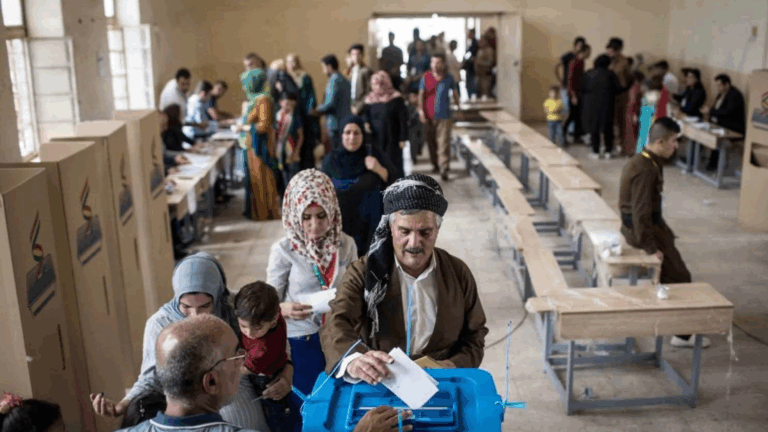
National elections are largely free and fair. Regular parliamentary elections have taken place since 2005, with the 2021 parliamentary elections representing the largest infusion of independent candidates in Iraq’s modern history. The post-2003 political system, though often criticized for its ethno-sectarian power-sharing mechanisms (known as Muhasasa), ensures that the country’s diverse partisan, religious, and ethnic groups are generally represented in the Council of Representatives (CoR). The freedom to form political parties is robust, resulting in hundreds of registered parties and shifting alliances, reflecting an open, albeit fragmented, political environment.
Independent media, political leaders, civil society leaders, organizations, and members of the general public are seriously and unfairly hindered in their ability to openly criticize or challenge the regime. While individuals are afforded some space to criticize the regime, vaguely worded provisions in the penal code are often instrumentalized by the political elite to target and prosecute journalists, activists, and protesters, directly contradicting the fundamental right to free speech enshrined in the new constitution.
Institutions are somewhat independent but frequently constrained by the regime. Iraq’s institutions exist in a precarious and frequently constrained state, where constitutional powers are consistently undermined by the interests of the dominant political elite and sectarian political blocs. The Federal Supreme Court (FSC) acts as a critical, yet selective, check, often intervening decisively to safeguard electoral integrity and limit executive overreach. However, the FSC has consistently avoided issuing broad rulings that would dismantle the ethno-sectarian power-sharing system, the perceived root of institutional corruption. Moreover, the legislature’s oversight function is often selective and partisan, and junior courts and anti-corruption bodies are frequently subject to political interference and coercion.