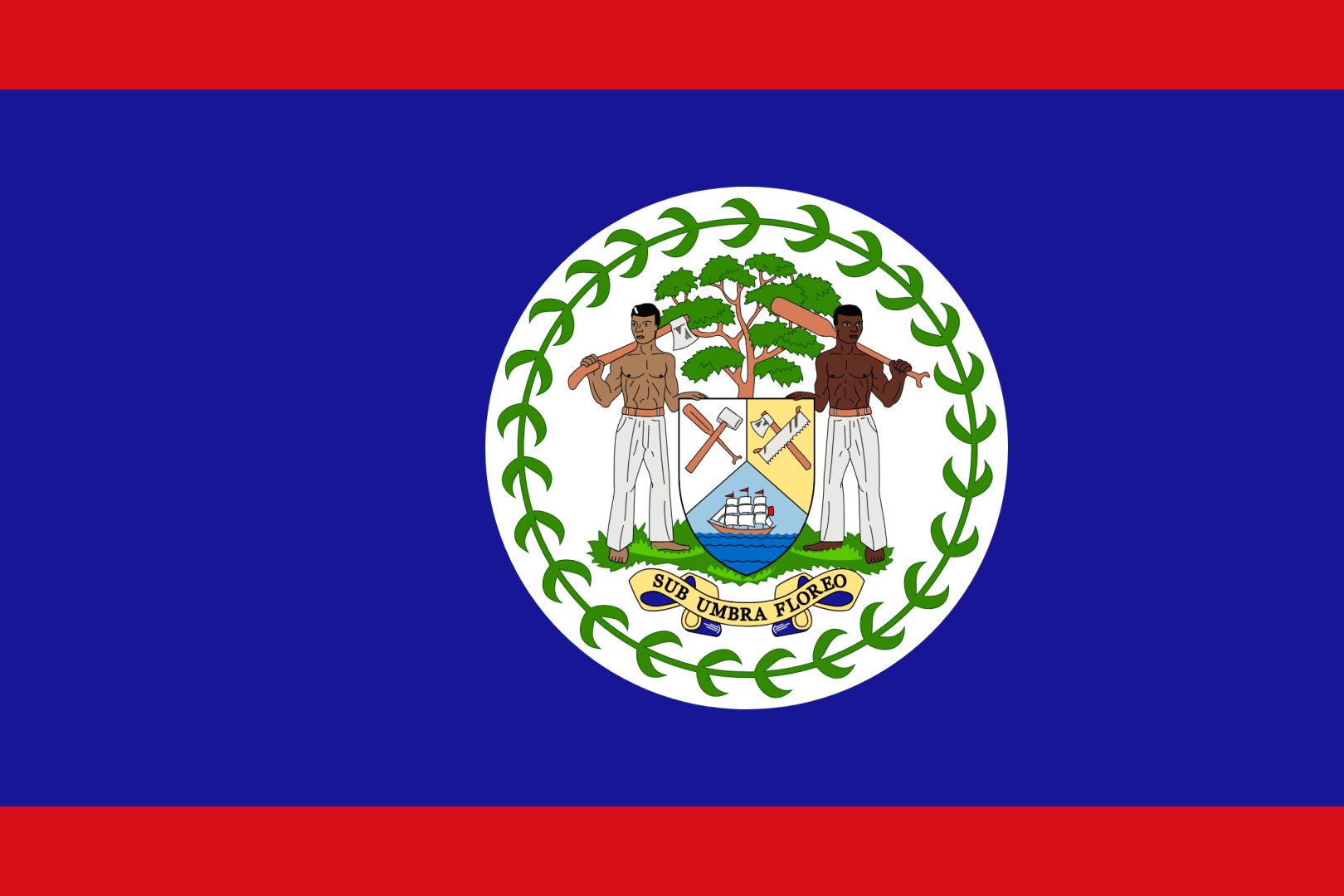
The foundations of Belize’s parliamentary democracy emerged in the decades prior to the country’s full independence from the United Kingdom in 1981. Starting in the 1950s, protests against British rule sparked political transformations: universal adult suffrage was established in 1954, and then, in 1964, a new Constitution laid the groundwork for Belizean self-governance. After Belize attained full independence in 1981, the center-left People’s United Party (PUP) became one of the country’s mainstream parties, alongside the center-right United Democratic Party (UDP). Currently, Belize retains the British monarch as its head of state, but the role of the monarch is limited and does not interfere with the country’s democratic governance. Elections take place at least every five years, but can occur more frequently. Since 2020, the PUP has led Belize under the leadership of Prime Minister Johnny Briceño. Non-state actors, such as organized crime groups, are active in the country and present a threat to the public as well as to civil society actors and public servants.
Key Highlights
National elections in Belize are largely free and fair. The two mainstream parties, the center-left People’s United Party (PUP) and the right-wing United Democratic Party (UDP), regularly compete for seats in the National Assembly. Belize’s primary electoral organism, the Elections and Boundaries Commission (EBC), effectively manages elections; however, the EBC’s oversight capacities are limited. There is room for improving Belize’s electoral framework, which would further empower the EBC and bolster its independence. Moreover, widespread clientelist practices and corruption undermine general trust in the electoral process. Independent electoral missions invited to observe elections in Belize have nonetheless found elections to be generally free and fair.
Independent media, political leaders, civil society leaders, organizations, and regular people in Belize are largely free to openly criticize or challenge the government. Media companies and civil society organizations (CSOs) operate freely and are able to act as government watchdogs. Occasional infringements upon the rights of dissidents have been reported, including police harassment of journalists at work. However, rights violations against dissidents are usually investigated, and perpetrators are sometimes held accountable. The right to peacefully assemble is guaranteed by the Belizean Constitution and generally upheld by the government.
Institutions are independent and serve as a check on the government. Oversight institutions and courts are able to act and issue decisions that are unfavorable to the party in power. Nonetheless, significant delays and a relative lack of transparency can weaken institutions’ abilities to serve as a check on the party in power. Necessary institutional reform has also faced significant delays. Recent reform undertaken by the incumbent party does not appear to have substantially addressed judicial weaknesses, but it has not undermined the judiciary’s independence or operational efficiency either.