Source: Tyranny Tracker
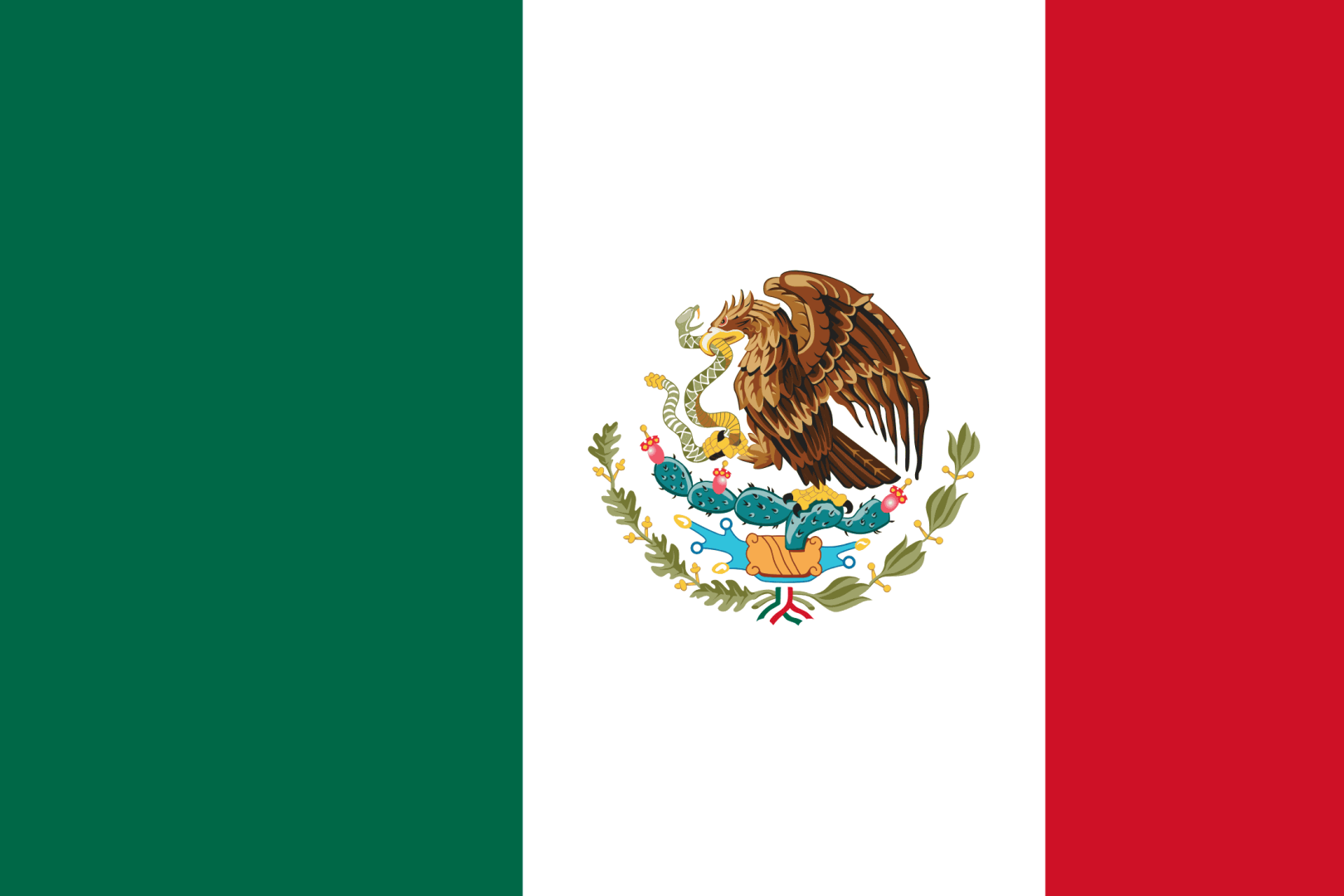
HRF classifies Mexico as democratic.
For much of the 20th century, Mexico’s government was dominated by the Institutional Revolutionary Party (PRI), which held uninterrupted control over the presidency and state institutions for seven decades until its defeat in the 2000 election. The transition marked the beginning of a more pluralistic political era, with the rise of competitive elections and the gradual construction of autonomous institutions. During the 1990s and early 2000s, organized criminal groups expanded their territorial and institutional influence in parts of the country. Following the federal government’s militarized campaign against drug cartels launched in 2006, violence intensified and cartel fragmentation increased competition for local control, contributing to heightened coercive influence over municipal governments, police forces, and local political actors in certain regions. These security challenges unfolded alongside continued democratic competition at the national level. Andrés Manuel López Obrador, a longtime opposition leader who lost presidential bids in 2006 and 2012, came to power in 2018 under the banner of the newly created National Regeneration Movement (Morena) party. In 2024, his chosen successor, Claudia Sheinbaum, won the presidency by a wide margin and now governs with a Morena-led supermajority in both chambers of Congress. For the first time since democratization, a single coalition has the power to amend the Constitution without opposition support. Morena has used this majority to advance sweeping judicial reforms, including restructuring the federal judiciary and introducing the popular election of judges, as well as to weaken or absorb autonomous oversight bodies such as the national transparency institute, raising concerns about the concentration of power and the durability of institutional checks.
National elections in Mexico are largely free and fair. Major opposition candidates continue to run and campaign across the country. Independent electoral institutions such as the National Electoral Institute (INE) and the Electoral Tribunal of the Federal Judiciary (TEPJF) maintain operational integrity, and international observers have been allowed to monitor elections without restrictions. While the ruling party benefits from structural advantages –– such as presidential interventions in favor of ruling party candidates, biased media coverage, and the instrumentalization of state resources –– these practices, though serious, have not yet reached the threshold of sustained or systematic obstruction. Electoral competition remains viable, though increasingly uneven.
Independent media, civil society organizations, political leaders, and regular citizens in Mexico are largely free to openly criticize or challenge the government. Public dissent remains widespread and visible, exemplified by mass mobilizations such as the Democracy March in early 2024, which drew tens of thousands of anti-government protesters across the country and proceeded peacefully without state repression. Critical media outlets and NGOs continue to operate, and major opposition parties regularly denounce government policies without facing legal bans, harassment, or retaliation. However, there are some isolated cases with serious repression of protests and legal attacks against dissenters, including the use of excessive force against feminist demonstrators, the criminalization of environmental activists, and documented surveillance of journalists and human rights defenders using Pegasus spyware. While these incidents highlight real risks, they remain limited in scope and do not yet constitute a sustained or systematic assault on dissent.
Institutions are independent and largely serve as effective checks on the government. Mexican courts continue to exercise review authority over executive and legislative actions, including politically sensitive cases. Most notably, the Supreme Court invalidated key provisions of the government’s 2023 “Plan B” electoral reform. However, their independence is under growing pressure. President López Obrador’s repeated public attacks on the press and opposition figures, including the unlawful disclosure of personal data belonging to journalists, have not resulted in meaningful legal sanctions. Courts have also not produced definitive accountability in the face of credible evidence that military forces used Pegasus spyware to surveil journalists. In addition, the abolition of several autonomous agencies in early 2025 and a constitutional reform mandating the popular election of judges raise concerns about future judicial autonomy. Taken together, these developments suggest a potential trajectory toward weakened institutional oversight, though courts presently remain capable of constraining government action.
Hit enter to search or ESC to close