Source: Tyranny Tracker
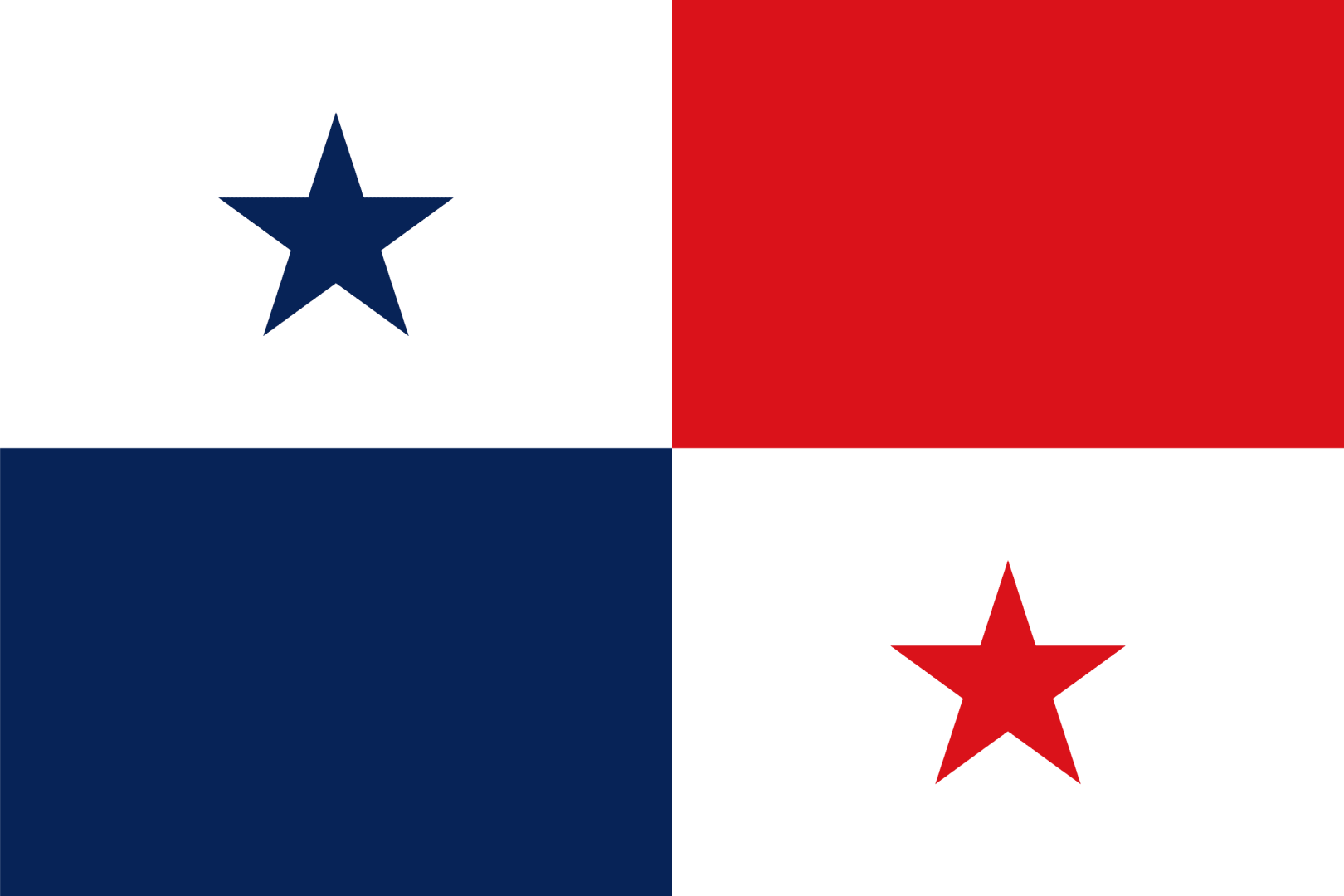
HRF classifies Panama as democratic.
Panama is a presidential republic that has been characterized by peaceful alternations of power between the mainstream parties since 1994, the year in which the country initiated its transition to democracy after over two decades of de facto military rule. In 1968, Omar Torrijos rose to power after a military coup against former president Arnulfo Arias Madrid; Torrijos ruled the country until his death in 1981. Panama’s military dictatorship then came to an end in 1989, during the rule of Manuel Noriega, when the United States invaded Panama and deposed Noriega. Guillermo Endara, who had decisively won the May 1989 election at the head of the opposition coalition Democratic Alliance of the Civilian Opposition (ADOC) that the Noriega regime arbitrarily annulled, was sworn in as president on December 20, 1989, shortly after the US invasion began and at the insistence of the American government. The removal of Noriega resulted in a lasting regime change, though at the cost of a military invasion by a foreign power, which caused mass displacement and hundreds of civilian deaths. At the end of Endara’s term, in 1994, Panama saw its first peaceful alternation of power in decades, and the center-left Democratic Revolutionary Party (PRD) emerged as one of the country’s leading parties, along with the center-right Panameñista Party. The PRD was originally founded by Torrijos, but underwent significant restructuring to democratize its institutions. Since 2009, newer parties have emerged and succeeded in garnering public support, producing a new multi-party system in Panama. The Realizing Goals (RM) Party has led Panama under the leadership of President José Mulino since 2024.
National elections in Panama are largely free and fair. Large mainstream parties, such as the PRD, the Panameñista party, and Democratic Change (CD), regularly compete for the presidency as well as for seats in the National Assembly, along with smaller parties like the Another Way Movement (MOCA) party. The Electoral Tribunal is the independent judicial body responsible for ensuring that the Electoral Code is respected and that elections are free and fair. While the Electoral Tribunal generally operates in an effective and transparent manner, there is room for improving Panama’s electoral framework and expanding the Electoral Tribunal’s oversight capacities.
Independent media, political leaders, civil society leaders, organizations, and regular people in Panama are largely free to openly criticize or challenge the government. Media companies and civil society organizations and associations (CSOs) operate freely and are able to act as government watchdogs. Nonetheless, judicial harassment is an issue that affects the independent press. Some of this harassment is perpetrated by government officials who take retaliatory legal action against the press for critical media coverage. Notwithstanding the need to improve press safeguards, Panamanians are able to openly express criticism of the government. The right to peacefully assemble is guaranteed by the Panamanian Constitution and generally upheld by the government, although excessive use of state force against protesters has also been reported.
Institutions are independent and serve as a check on the government. Oversight institutions and courts are able to act and issue decisions that are unfavorable to the party in power. Moreover, the independence of the courts serves to mostly protect Panama’s electoral integrity and the rights of dissidents. However, procedural delays and operational opacity can occasionally hinder Panamanian institutions’ ability to act effectively.
Hit enter to search or ESC to close