



How Tisza Won
For years, Hungary was considered one of central and eastern Europe’s great democratic success stories after the fall of the Iron Curtain. The 16-year reign of Viktor Orbán’s Fidesz party, however, led to significant democratic backsliding. In the spring of 2026, opposition leader Péter Magyar and his Tisza party defeated Orbán and Fidesz in elections, ushering in hope for a possible return to a democratic trajectory in Hungary. In this two-part series marking 100 days since Tisza’s win, HRF experts examine Magyar’s victory and the challenges and opportunities that lie ahead for the country’s new leadership.
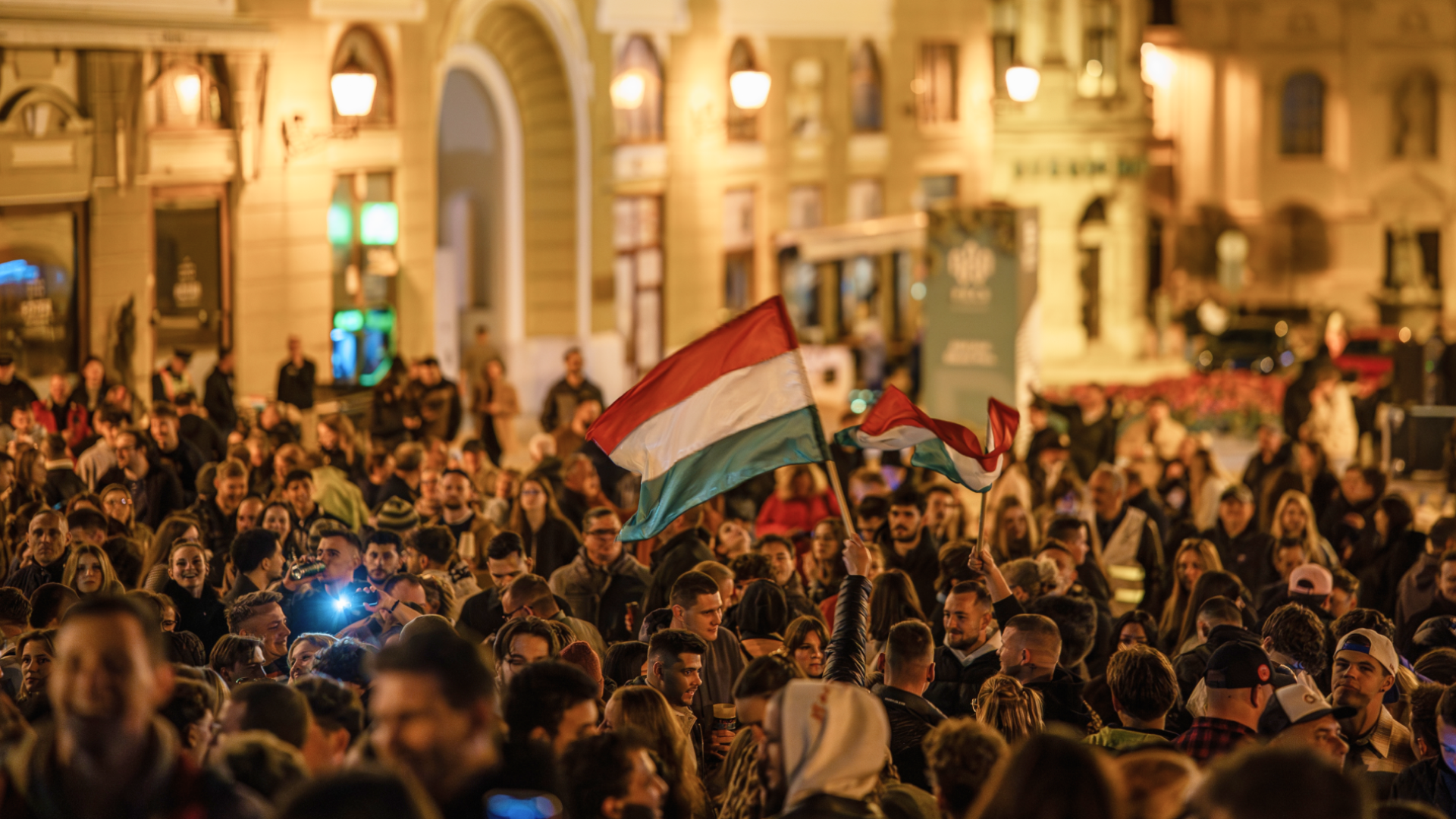
On Sunday, April 12, a few hours after the polls closed, Viktor Orbán took the stage at a closed rally in Budapest and delivered a brief speech to supporters, conceding defeat in Hungary’s national election. As he thanked voters, crowds poured into the capital’s streets to celebrate the end of his 16-year rule. His challenger, Péter Magyar, a former regime insider who broke with the government in early 2024, had emerged as Orbán’s main opponent after his Respect and Freedom Party (Tisza) overtook the ruling Fidesz in the polls later that year. With record turnout, the April election delivered a landslide victory to Tisza, enabling it to form a government backed by a supermajority in the country’s National Assembly.
Magyar’s victory surprised many international observers. Orbán had spent years reshaping the electoral playing field through mechanisms designed to systematically favor Fidesz in successive elections, leading many analysts to doubt whether an opposition party had a realistic chance of winning — let alone of securing a two-thirds parliamentary majority. Yet the 2026 election in Hungary proved that hybrid regimes are not unbreakable, offering important lessons for opposition forces around the world seeking to dislodge authoritarian incumbents.
Fidesz Tilts the Playing Field
Chief among the mechanisms that have placed Fidesz at a repeated electoral advantage has been the unequal distribution of voters across electoral districts. Gerrymandered districts introduced in 2011 disproportionately benefited Fidesz candidates while diluting the voting power of opposition parties. In 2024, the Hungarian parliament passed a new redistricting law intended to account for demographic shifts, which redrew more than one-third of the country’s constituencies and reallocated two seats from Budapest to the more Fidesz-friendly county of Pest. Opposition parties and international monitors argued that the change risked further weakening representation in the opposition-leaning capital for partisan gain.
Another hurdle facing opposition parties has been an expanded electorate following the introduction of non-resident citizenship in 2011. Through this reform, the Orbán government extended suffrage rights to ethnic Hungarians living in neighboring countries. Since 2014, this bloc has comprised around half a million eligible voters who overwhelmingly supported Orbán. In 2026, Fidesz and its coalition party member, the Christian Democratic People’s Party (KDNP), secured more than 80% of the near-abroad vote.
Fidesz has also benefited from its privileged media access and advantages in campaign financing. Over the years, pro-government actors consolidated pervasive control over the media environment, limiting the opposition’s visibility while amplifying attacks against rival candidates. Ahead of the 2026 election, legal changes removed campaign spending caps, allowing regime officials to promote generous public spending measures, such as pension top-ups and subsidized housing schemes, while promoting pro-Fidesz campaign messaging.
Tisza’s Messaging and Momentum
Despite the uneven playing field that these mechanisms helped create, Magyar succeeded in mobilizing enough support to bring about a transfer of power after 16 years of Orbán’s rule. Three factors are central to understanding Tisza’s rise and success.
First, the party emerged as a viable political alternative at a moment of heightened regime vulnerability. Fidesz was struggling to preserve its image as the defender of family values after a national scandal in February 2024 forced the resignation of President Katalin Novák and Justice Minister Judit Várga over their roles in pardoning a man convicted of covering up abuse in a state-run children’s home. Péter Magyar, a former Fidesz member and diplomat, publicly broke ranks, denouncing government interference in the case and releasing recordings that exposed high-level corruption. By April of that year, he had formally entered the political arena as the leader of Tisza, positioning himself as Orbán’s main challenger. Crucially, rather than aligning with the established left-liberal parties that Orbán had spent years discrediting, Magyar anchored his rise on a new challenger narrative centered on dismantling the patronage networks that had long benefited the ruling Fidesz elite.
Tisza relied on a grassroots engagement strategy in order to gain ground in a media environment heavily shaped by government influence. Tisza established local party chapters across the country to expand its territorial reach outside Budapest and create spaces for volunteer coordination and district candidate selection. In May 2025, Magyar embarked on a nationwide walking tour as part of a “national unity” initiative, visiting small towns and rural areas long considered Fidesz strongholds and even crossing into neighboring Romania to engage Hungarian diaspora voters. Often appearing in traditional folk attire, Magyar engaged directly with local communities, thus bypassing pro-Fidesz media intermediaries.
Throughout the campaign, Magyar adopted a disciplined messaging strategy. Learning from the opposition’s failure in 2022, Magyar largely avoided ideological debates. Instead, he focused on issues where the government appeared vulnerable: corruption, declining living standards, and the deterioration of public services. This focus allowed him to monopolize the discourse on the economy while embedding his message in a rhetoric of patriotic symbolism and populist appeals. Steering clear of divisive ideological terrain enabled Tisza to broaden its appeal through cross-partisan commitments, such as pledges to unlock €18 billion in frozen EU funds and to reinforce institutions to combat corruption and abuse of power.
Perhaps most crucially, Tisza seized on its momentum to reshape public perceptions about the inevitability of Orbán’s rule. As scandals mounted, cracks began to appear within the ruling party’s support base, particularly among those voters disappointed with Orbán’s mishandling of the economy. Former Fidesz voters were receptive to a new conservative leader untainted by corruption allegations. As polls showed Fidesz trailing, Tisza’s challenge gained credibility and supporters. Like Magyar, other insiders, including members of the police and the military, began to speak out against the government and in some cases openly endorsed the opposition. These signals helped convince voters that change was not only desirable, but possible. Magyar capitalized on this groundswell of support by reframing the 2026 election as a historic moment and a collective opportunity to bring about systemic change (rendszerváltás), in a manner reminiscent of Hungary’s democratic transition after 1989.
Tisza’s victory showed that, even under skewed electoral conditions, opposition parties can still find a path to victory by capitalizing on moments of regime vulnerability. Hungary offers important lessons to pro-democratic leaders operating in hybrid regimes. When an entrenched and abusive regime starts to totter, opposition leaders can emerge as viable political alternatives by owning issue areas where the ruling party has manifestly failed to deliver, building a nationwide grassroots campaign, and turning voters’ dissatisfaction into action for change at the ballot box. For Magyar’s new government, the work is far from over: tackling corruption and reversing a years-long trend of democratic backsliding under Orbán will take sustained and strategic efforts. But in the wake of the elections, Tisza’s victory has proven to voters in Hungary that political change is possible.
Defeating Orbán but Not Orbánism?
When Péter Magyar and his Tisza party won a landslide victory in Hungary in April, they unseated Prime Minister Viktor Orbán and his Fidesz party after an uninterrupted 16-year reign. A decade of sophisticated electoral engineering gave Fidesz a considerable advantage, and other policy changes had so weakened Hungary’s democracy that many experts classified it as a hybrid authoritarian regime. Even in this unfavorable environment, however, Tisza managed to capitalize on widespread discontent with the ruling party to win a decisive victory, securing a supermajority in parliament.
The election results have been celebrated as a win for democracy, with Hungarians taking to the streets in jubilation and European leaders expressing optimism about a reset on EU-Hungary relations. While the end of Orbán’s rule is no small victory, a democratic rebound requires much more than one election. Even as the vote proved that some of Hungary’s self-corrective mechanisms still function, Péter Magyar and Tisza will face both structural challenges and trade-offs that test the incoming government’s own commitment to democracy.
New Dog, Old Tricks?
Reversing democratic backsliding in Hungary will depend in part on whether the new party in power will forfeit or retain the structural advantages its predecessor put in place. The country’s skewed electoral playing field, which previously benefited Fidesz, could still allow another party to consolidate an outsized majority in parliament. Hungary has a singular system of “winner compensation” in multimember electoral districts: not only does it confer extra parliamentary mandates to the winner in a given constituency, but the greater the margin of victory, the greater the reward. For a new political actor with surging popularity like Tisza, there may be strong incentives to maintain this aspect of the electoral framework instead of reforming it. Guaranteeing that the country’s next election is freer and fairer would also require redrawing gerrymandered districts and updating the obsolete voter register (both of which Fidesz had amply exploited), but Tisza has yet to signal that these reforms would be a priority.
The tendency to carry on the institutional legacies of the past regime is not unique to Hungary. Comparative studies suggest that countries with high levels of polarization and low public trust in institutions may be especially susceptible. In Hungary, perceptions of governance diverge sharply along partisan lines, and less than half of the population reports confidence in the national government, according to the latest Eurobarometer data. Given this preexisting polarization and distrust in national institutions, it is uncertain whether Tisza will be able to maintain momentum and broad popular support for complex reforms that may not deliver immediate benefits to the general public.
Entrenched Orbánists Remain
Even if the party delivers on its reformist aspirations to undo the democratic erosion Fidesz caused, it faces major structural challenges. Fidesz took steps to future-proof its influence over key institutions, notably the judiciary. The party altered the composition and term structure of the Constitutional Court and packed it with loyalists through a series of amendments between 2010 and 2013. In the years that followed, dissenting magistrates confronted an array of punitive measures, from forced early retirement to smear campaigns in regime-friendly media. Even with Fidesz gone, some high-ranking members of the judiciary may perpetuate this culture of intimidation. András Zs. Varga, the influential Supreme Court president elected in 2020 for a nine-year term, has questioned the legitimacy of the disciplinary courts which review other magistrates’ professional conduct and has stated that judges’ public statements are not protected forms of expression. Disciplinary sanctions against judges are insufficiently regulated, so concerns of interference by powerful officials like Varga persist.
Fidesz also holds enduring influence in key oversight bodies, such as the State Audit Office (SAO) and the Budget Council. The SAO, headed by Fidesz-aligned appointees serving 12-year terms, has selectively enforced campaign finance rules against opposition parties while overlooking comparable violations by the ruling party. Fidesz expanded the powers of the Budget Council, where its appointees are serving six to 12-year terms, allowing it to veto parliamentary budgets on debt-related grounds. In addition to these formal constraints, Tisza inherits a captured media landscape and hollowed-out watchdog institutions, from the ombudsman to the data protection agency. Together with the courts, these institutions could make or break the new government’s policy agenda.
Between Overreach and Gridlock: Lessons From the Region
The experiences of other European countries recovering from democratic backsliding, such as Poland and Ukraine, illustrate the dilemma between expediency and adherence to democratic procedures during efforts to restore impartiality and independence to captured institutions. When governments or leaders attempt to pursue reform outside of institutional channels, they risk entrenching patterns of overreach. In Poland, the Civic Platform party’s first months in office after defeating the populist Law and Justice party show this clearly. Public media channels continued to serve as mouthpieces for the outgoing government of the Law and Justice party, but when Civic Platform rapidly closed the propaganda channel TVP Info under an obscure provision, it sparked its own round of criticism. In Ukraine, President Volodymyr Zelenskyy faced an adversarial Constitutional Court that was determined to block measures to combat corruption in the judiciary and shield itself from accountability. His decision to dismiss two compromised justices by decree, however, was criticized as executive overreach.
On the other hand, if governments seek cooperation or conciliation with adversarial institutions beholden to the former regime, their members can often singlehandedly stymie reform. Elected officials then bear the political costs of failure: elsewhere in Central and Eastern Europe, voters have penalized new governments for not delivering on their ambitious plans, sometimes even bringing antidemocratic actors back into office. In Slovakia, a pro-democratic coalition unseated the dominant Smer party in 2020, only to flounder following factional conflict. Voters perceived the coalition as unable to drive structural change, paving the way for the return of Smer and former prime minister Robert Fico in 2023, despite their well-documented involvement in corruption and state capture.
In Hungary, Tisza likely faces an uphill battle to successfully roll back the effects of Fidesz’s entrenched influence. Recent studies of democratic rebounds offer little reassurance: most of the countries that have experienced a democratic rebound since the 1990s have still struggled to restore electoral competition and institutional accountability to their pre-authoritarian-spiral levels. Even more importantly, these upward trajectories were often fleeting, as a large share of “rebounding” countries experienced another episode of democratic erosion within five years. Hungary is, therefore, not an outlier in its profound constraints.
Despite these challenges, there is cause for cautious optimism in Hungary. Opposition actors seldom secure such a degree of power in a system so structurally skewed against them. Magyar and Tisza accomplished something historic: the party now has the constitutional supermajority to at least attempt rebuilding Hungary’s democratic institutions, despite considerable hurdles. Ultimately, success will depend on both the commitment of Tisza’s leadership to turning Hungary away from authoritarianism and whether it can successfully carry out reforms without undermining the democratic procedures it hopes to revive. What happens in the coming months will determine whether Hungary becomes a case study in democratic recovery — or in the constraints that frustrate it.
HRF’s Tyranny Tracker classifies Hungary as ruled by a hybrid authoritarian regime. The classification reflects the country’s deeply skewed electoral competition, a long pattern of executive-led efforts to muzzle independent media and civil society organizations, and the systematic favor that judiciary and oversight institutions afforded the Orbán regime, despite isolated instances of dissent. To learn more, read the full analysis in the Tyranny Tracker.