Autocratic funding
Elite popularity
Authoritarian patrons
Reasons for funding
Broad targets
Database tools
Enforcement failures
Download
If you would like to save this report, you can always download it here as a PDF.
Introduction
The following report investigates one simple question: how much money have American universities accepted or taken in from foreign nations overseen by autocratic or dictatorial regimes in recent years? It’s a question that has never had a full, comprehensive answer. Despite the fact that the US Department of Education launched a database in 2020 detailing how many contracts and gifts American universities have obtained from foreign countries, that database has never seen a full-scale analysis — until now.
The findings are staggering. Since 2014, American universities inked deals for financial arrangements worth nearly $9 billion from a broad range of nations overseen by dictatorial and autocratic regimes around the world.
Hundreds of other universities have followed suit, accepting and arranging funding from similar regimes, much of which is detailed below. (We have tracked the data back only to 2014, since the pre-2014 data is either scattered or sparse, and largely unusable.)
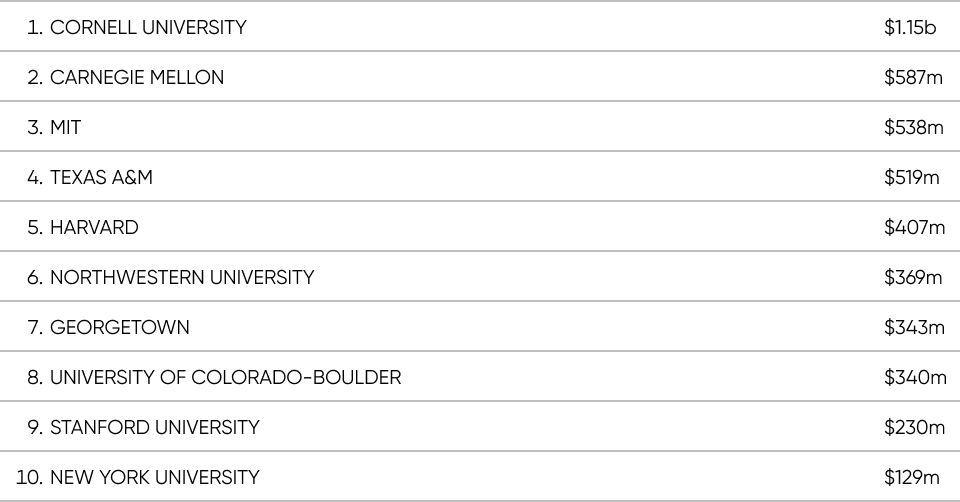
Dozens and dozens of other nations overseen by autocratic or dictatorial regimes produced more funding for American universities, such as Tanzania, Venezuela, Burma, Zimbabwe, Vietnam, Serbia, and many more.
Since the US Department of Education database details funding for only American universities, it is unclear if similar trends or totals exist in other democratic nations. However, it remains true that the US is the only democratic nation that requires American universities to disclose such information. As such, we have no idea what the scope of the issue may be for universities outside the US.
Given the scale of the numbers uncovered, however, it is fair to believe that American universities are the proverbial canary in the coal mine, and that dictatorial regimes around the world have engaged in similar practices in other, far less transparent democratic countries. With billions already expended in the US, and with access to effectively bottomless pots of wealth, kleptocratic regimes have proven that they can successfully finance the most prominent universities in America — and there’s no reason to think, absent significant changes, they won’t continue doing the same for years to come.
The phenomenon of foreign regimes targeting American universities is hardly new. While many universities can track their founding back to the 18th and 19th centuries, it was in the early 20th century that foreign regimes began realizing that these universities presented potential platforms to target American audiences, laundering the reputations of foreign dictators, gaining access to universities’ high-level research, and even cultivating potential allies in American academia — all without American officials, or the broader American public, having any idea.
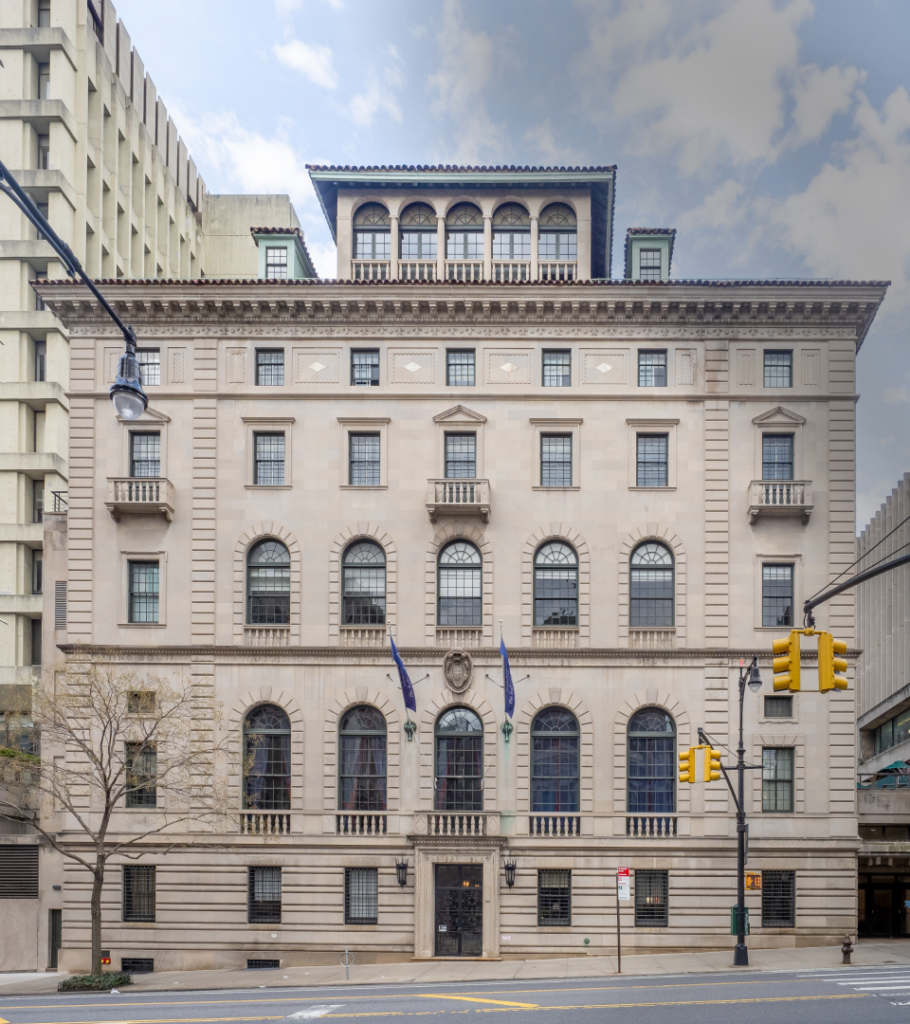
One of the earliest instances of such cultivation came in the 1920s, when New York’s Columbia University announced the opening of the “Casa Italiana,” a new research center dedicated to Italian studies1. However, it wasn’t funded simply by Columbia alone. As The New York Times reported in 1926, the building would be furnished by the government of Italy — a regime overseen by none other than fascist dictator Benito Mussolini. According to the Times, the new research center “will be completely furnished by Premier Mussolini.”2 The relationship between Columbia and Mussolini was cultivated by professor Peter Riccio, who met directly with Mussolini to gain the fascist leader’s support. Mussolini, the Times reported, was “enthusiastic over it” — not least for the fact that it would house the first Italian studies department in the US3.
The relationship between Columbia and Mussolini grew so close that Columbia President Nicholas Butler personally met with the fascist dictator on multiple occasions, and “cherished an autographed photograph of Mussolini he had received in 1924,” according to Butler’s biographer4. Butler even went so far as to support Italian — as well as Nazi German and Imperial Japanese — expansionism.
Unsurprisingly, the “Casa Italiana” became “one of the most important sources of Fascist propaganda in America,” according to one contemporary journalist — allowing Mussolini to whitewash his regime, and stave off democratic opposition in both Italy and America5.
Eventually, with the onset of the Second World War, Columbia was forced to distance itself from Mussolini’s fascist dictatorship. But the pattern that the university set — of opening its doors not only to financial relations with foreign dictatorships, but then turning into a center of that regime’s propaganda — was a pattern that would repeat itself over and over again, especially by the early 21st century.
To be fair to Columbia administrators, there were no laws or regulations in the 1920s that the university breached while building its relationship with Mussolini — if only because they did not exist at that time. By the 1980s, however, things had begun changing. Not only had the Soviet Union been exposed for years as a regime targeting American universities — as a source of both ideological fellow travelers, as well as information and research that could aid Soviet weapons and economics programs — but new nations had also begun building out formal financial arrangements with American universities. Some were democratic, such as Japan. Others, however, were far closer to fascist Italy in terms of their illiberalism, such as Islamist monarchies in the Persian Gulf, some of whom began sending “huge gifts” to fund Arab Studies departments at places like Georgetown University6.
All of this contributed to rising concerns in Washington about the role that universities played in terms of foreign influence and in helping erode America’s geopolitical leadership. As such, American legislators came up with a solution: transparency.
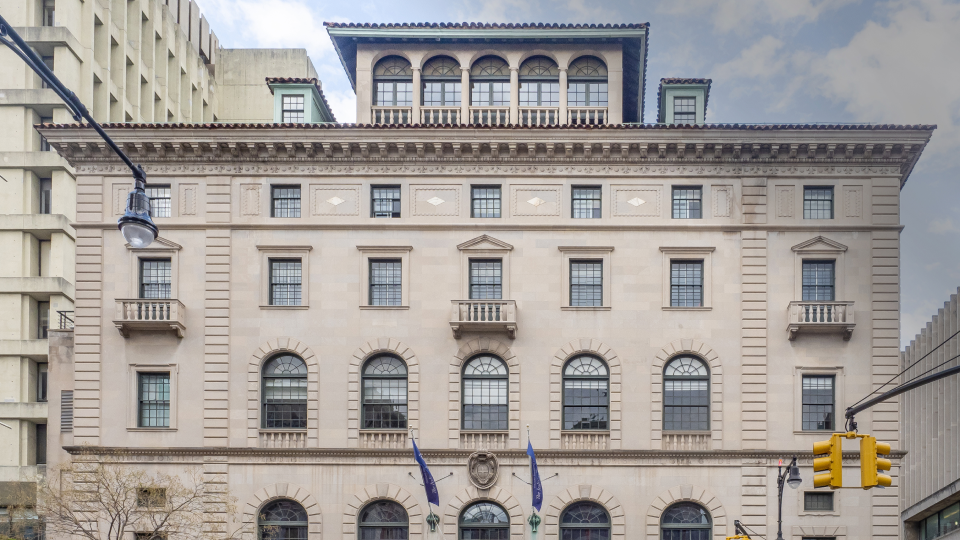
Columbia University’s Casa Italiana was
once a center of pro-Mussolini rhetoric and
propaganda.
Photo credit: Wikimedia Commons
Columbia University’s Casa Italiana was
once a center of pro-Mussolini rhetoric and
propaganda.
Photo credit: Wikimedia Commons
The Birth and Evolution of Section 117
Rather than ban financial arrangements between universities and dictatorships outright, US legislators announced that universities would simply need to disclose “substantial” gifts and contracts with foreign actors to the federal government. These regulations were eventually passed within Section 117 of the 1986 Higher Education Act7. As one article from the period notes, the new regulations “sought to protect academic integrity threatened by gifts or contracts with foreign entities.8” That protection centered on transparency: if American legislators, and Americans writ large, had an idea of which foreign countries were bankrolling which American universities, they could be better informed on policy decisions moving forward.
The new Section 117 regulations were hardly burdensome. They simply required all universities to report to the Department of Education when they had received or arranged “significant” financial agreements with foreign entities. If a university inked agreements or received gifts worth “at least $250,000 within a calendar year” from any foreign source — foreign governments, foreign nationals, foreign companies, or more — they had to report such financing to the federal government, as well as the dates of the financing involved. Indeed, the reporting requirements were surprisingly sparse, limited only to the amount, the dates, the type of financial arrangement, and the country of origin. Universities did not even need to specify which foreign entity they’d struck the financial agreement with; instead, they simply had to identify the country from which the financing originated, and whether the funding came from a foreign governmental source or not9.
There were two primary categories of the financing that universities had to report. The first was “gifts,” which comprised donations from foreign entities. The second was “contracts,” which comprised all investments and other financial arrangements with the foreign entities. Both of these categories had subtopics — “Restricted Gifts” and “Restricted Contracts,” for arrangements that came with specific restrictions from foreign funders — which universities could select when filing their disclosure reports. (These restrictions, as the Section 117 database would later make clear, were generally limited to covering academic costs for students from the foreign nation in question — though some occasionally had multiple clauses related to things like funding “necessary office and teaching equipment” or endowing professorships.)10
And that was it. The country of origin, basic information like dates and amounts, whether or not the financing came with any restrictions — the Section 117 requirements were, in many ways, as limited a set of required disclosures as universities could receive. Section 117 made similar transparency requirements elsewhere look remarkably comprehensive. For instance, America’s foreign lobbyists, including many who take millions from the same dictatorships bankrolling American universities, must disclose not only the countries they are representing and the amounts made, but also the formal contracts themselves. These foreign lobbyists must also disclose details of everything they have done on behalf of their foreign clients, from emails to sit-down meetings to campaign contributions11. Universities had to do none of that.
And yet, for decades, even that bare-bones approach appeared too much for universities. After the legislation was passed in 1986 it was, by all appearances, completely forgotten. There is no evidence of any further investigation, or even any further concern, about the topics of American universities striking financial deals with foreign dictatorships. There was no concern about enforcing the new regulations, either from legislators or the broader American public. Given the clear disinterest, it’s little surprise that universities began ignoring compliance requirements — and began failing to report billions of dollars in the process.
It’s ultimately unclear why universities and legislators alike appeared completely uninterested for decades in the topic. But it parallels similar disinterest in the foreign lobbying sector, which, despite the transparency requirements mentioned above, likewise escaped scrutiny for decades, until the late 2010s. American legislators were simply unconcerned with foreign regimes, especially foreign dictatorships, hiring American lobbyists, funding American think tanks, or even hiring former American officials as their mouthpieces and henchmen.12 It appears a similar phenomenon emerged regarding the dictatorship-university nexus. The topic was out of sight and out of mind — and so was allowed to fester, balloon, and, just like the looming scandals in the foreign lobbying space, later explode.
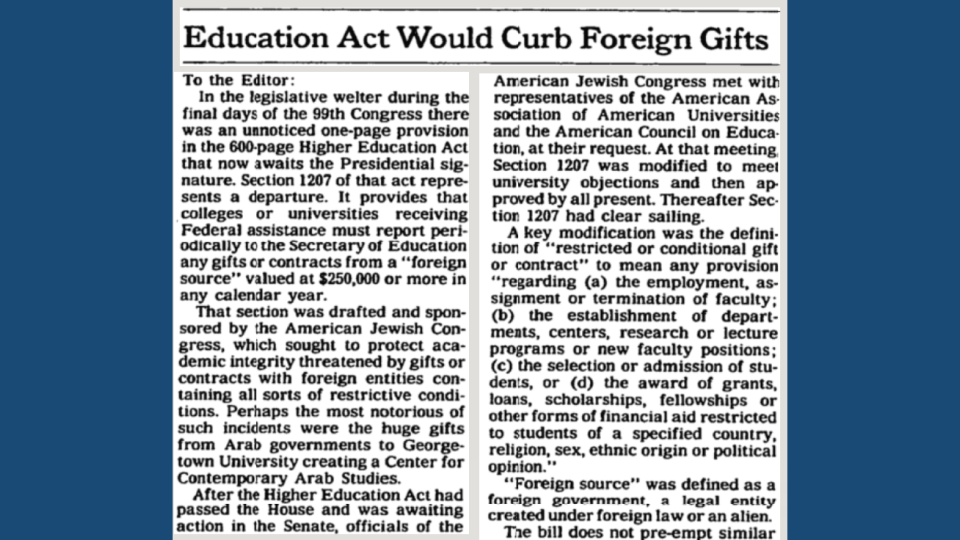
There was surprisingly little coverage of the initial transparency requirements for universities and dictatorships, though the New York Times did publish this letter in 1986.
Photo Credit: The New York Times
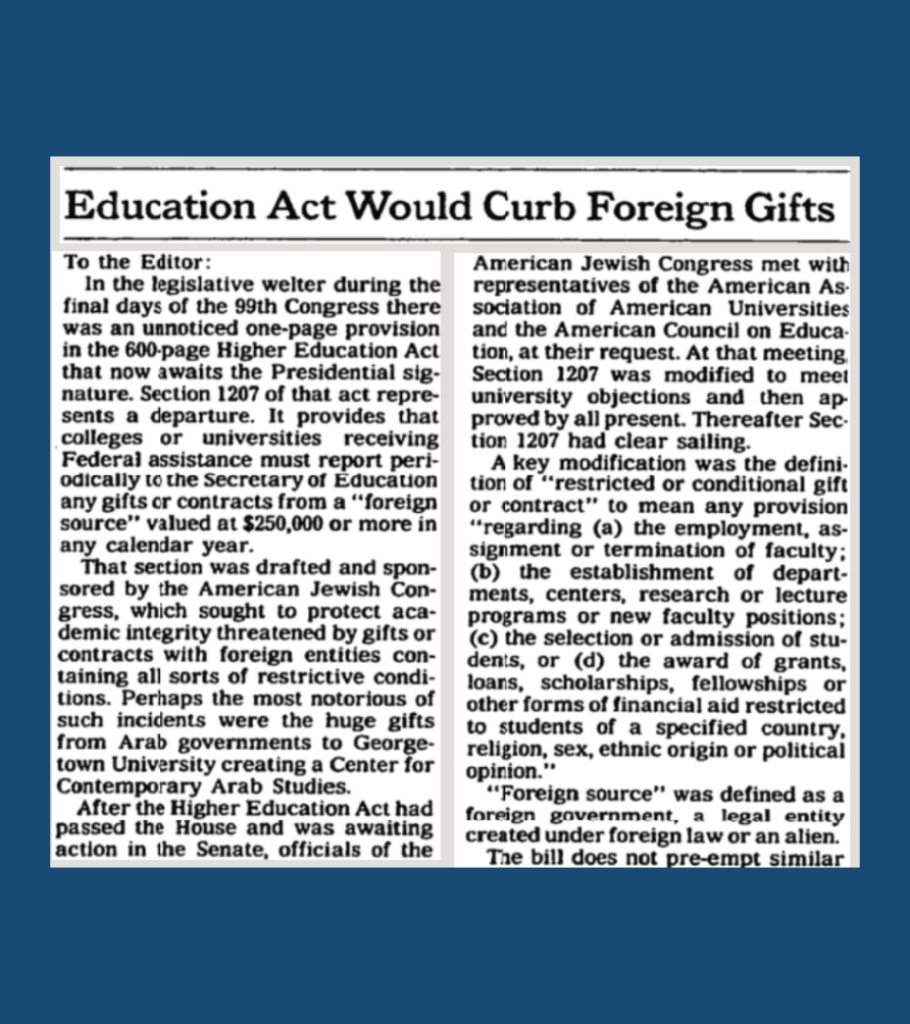
There was surprisingly little coverage of the initial transparency requirements for universities and dictatorships, though the New York Times did publish this letter in 1986.
Photo Credit: The New York Times
For years, the topic of foreign dictatorships bankrolling American universities had seen scattered coverage. Journalists broke occasional stories about how countries like China and Saudi Arabia had targeted American universities with massive donations and key contracts, gaining access to scholars and research while laundering the regimes’ images along the way.13 Much of the topic was, however, an afterthought.
But in the late 2010s, the topic of foreign dictatorships funding American universities gained new life. The newfound focus stemmed largely from scandals about China secretly bankrolling a number of organizations in the American educational system, most especially via so-called Confucius Institutes, which pushed pro-Beijing interests.14
As such, the US Department of Education launched its first formal investigation into how foreign regimes may be bankrolling American universities. In 2020, the department released its report, entitled “Institutional Compliance with Section 117 of the Higher Education Act of 1965,” which was the first to try to take a comprehensive examination of the topic.15
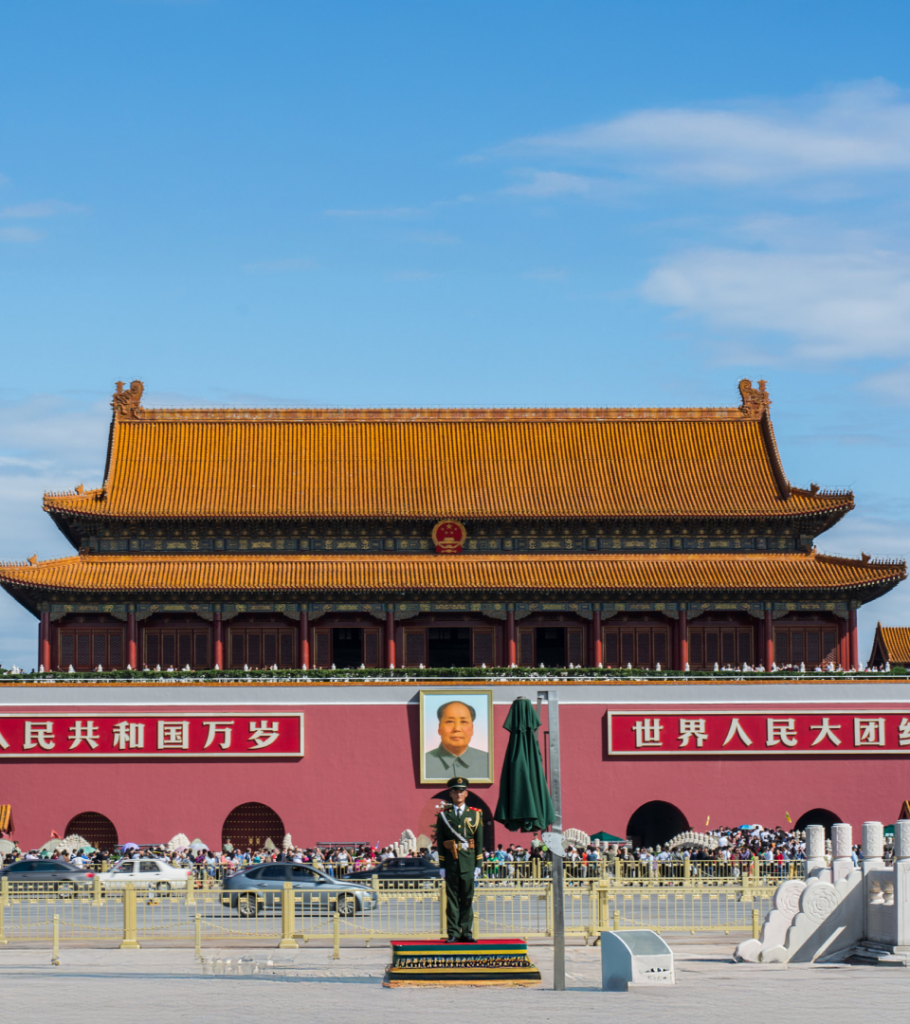
The results were shocking. As American officials discovered, foreign governments had inked arrangements worth billions of dollars with American universities in recent years. Moreover, they had targeted what are viewed as the most elite universities across the United States, including places like Yale, Harvard, and Stanford. As the report concluded, “the largest, wealthiest, and most sophisticated of America’s institutions of higher education have received nearly all foreign funds, receiving billions of dollars in assets using an assortment of related intermediaries, including functionally captive foundations, foreign operating units, and other structures.”16
Perhaps most remarkably, despite the decades-old legal requirements that all American universities disclose “substantial” financial arrangements with foreign entities — that is, gifts and contracts worth at least $250,000 — a wide range of universities across the country had failed to comply. As a result, in a survey of only a dozen universities, American officials uncovered some $6.5 billion that hadn’t been previously disclosed — funds that, because of the negligence of both university administrators and American officials, had never been reported to the federal government.
Certain universities, such as Cornell University, had somehow managed to avoid reporting hundreds of millions of dollars in foreign financial arrangements. (According to American officials, Cornell officials “chose the word ‘dumbfounded’ to explain this reporting error and provided no explanation.”) Others, like Yale or Case Western Reserve University, went multiple years without reporting any foreign gifts or contracts — “precisely when both were rapidly expanding their foreign operations and relationships,” US officials wrote.17
Nor were these financial arrangements with America’s democratic allies in places like Canada, Ireland, South Korea, or elsewhere. Instead, much of the funding uncovered came from explicitly dictatorial, even totalitarian, regimes, where all democratic opposition is smothered and where independent scholarship — a supposed keystone of the universities in question — is nonexistent. Places like Qatar, China, Saudi Arabia, Kuwait, and the United Arab Emirates led the way among nations bankrolling American universities, doing everything from arranging massive donations to opening satellite campuses to signing contracts for aiding — and aiding in the theft of — proprietary research.
As the investigators further discovered, over $1 billion total from places like China, Saudi Arabia, Qatar, and Russia was anonymized — making it effectively impossible to trace. Nor was this a phenomenon that had died out years ago. If anything, such funding was only picking up pace in recent years. “Beginning in 2009, the flow of foreign money, especially from instrumentalities of the governments of Qatar, Saudi Arabia, and China, rose massively,” the report continued.18
The report revealed that these universities opened their doors to foreign regimes without “any sense of … concern for our American national interests, security, or values,” often electing to partner with regimes, or proxies for regimes, engaged in massive human rights crimes. These crimes ranged from placing ethnic minorities in sprawling concentration camp systems to obliterating democratic opposition to silencing everyone from journalists to LGBTQ activists — all activities to which these American universities were at least nominally opposed. Nor was this funding ad hoc or haphazard; as the report concluded, universities “have solicited foreign sources … through official fundraising operations, quasi-entrepreneurial activities by professors and administrators, and through captive or affiliated foundations and alumni organizations.”19
The findings were disquieting, revealing not only that the most malign regimes around the world had targeted American universities, and that American universities had willingly opened their doors to such regimes, but that the universities in question then proceeded to flagrantly ignore disclosure requirements. As the report concluded, “There is very real reason for concern that foreign money buys influence or control over teaching and research.”20
A New Database
The 2020 report itself didn’t generate many headlines, published as it was in the middle of a raucous election campaign. However, it was not only a shot across the bow for universities who’d long avoided complying with the basic requirements of Section 117, but it led directly to the creation of arguably the single greatest tool the US, and the world, had ever seen when it came to dictatorships, universities, and transparency.
With the report’s release, US officials announced the creation of the new, publicly accessible Section 117 database. Known officially as the “College Foreign Gift Reporting” database, the online portal presented the first-ever publicly accessible database for anyone with internet access, anywhere in the world, to identify and sift through the related Section 117 data. No longer would the information be housed solely within the confines of the Department of Education; now, anyone could sort through the data and uncover the networks, links, gifts, and contracts connecting American universities with the most malign regimes around the world.21
The database (located at https://sites.ed.gov/foreigngifts/) was straightforward. Users could use drop-down menus to select from a handful of categories, including school name, state in which the university is located, transaction type, country origin of the funds in question, the gift or contract amount(s), and the gift or contract start date(s). For instance, users could select all of the gifts or contracts affiliated with, say, the University of Alabama, or all of the gifts or contracts during the calendar year 2019, or all of the gift amounts over $1 million, or all of the contracts impacting universities in the state of Kentucky. Users could, within the span of a few seconds, also access all of the gifts and/or contracts out of China, Russia, Iran, or elsewhere — as well as information on which universities were connected to such regimes. The permutations were bottomless.
To be sure, the database wasn’t perfect. Since Section 117 didn’t require universities to disclose formal contracts with foreign patrons, visitors to the database could only glean the basic information about these financial arrangements. All too often, the country of origin listed on any database entry was the only information listed on the source of the funds. That is, while it was clear that myriad gifts and contracts originated from countries overseen by dictatorships, it was unclear which governmental body oversaw specific gifts or contracts, or which regime proxies technically oversaw the financing. The bulk data, which HRF used to tabulate the totals for this report, also came via unwieldy Excel spreadsheets, which were often difficult to navigate (and even download).
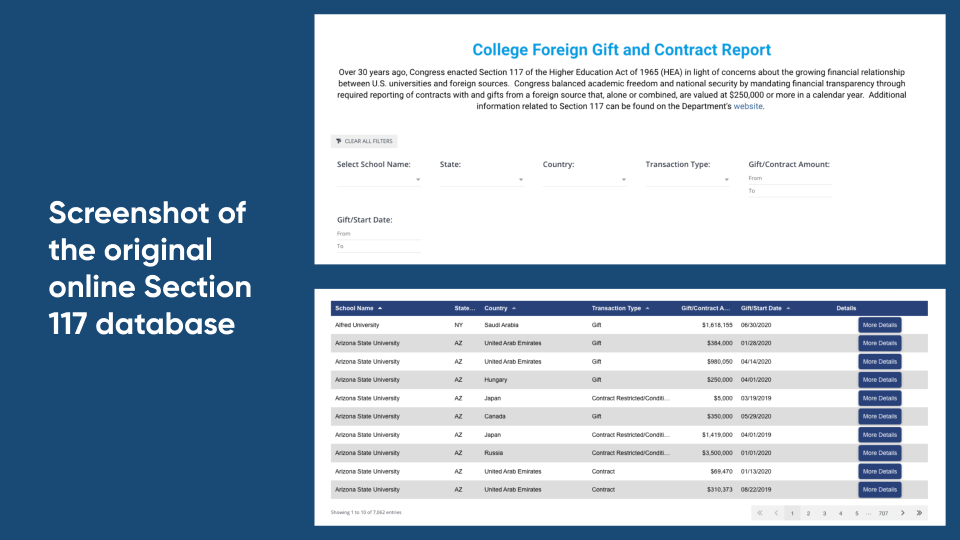
In late 2025, the Department of Education relaunched the database (with a new URL at https://www.foreignfundinghighered.gov/). The new portal is far more visually appealing, with key statistics and charts available. The portal also comes with key data, highlighting some of the key countries and universities in question.
As the portal now details, universities have disclosed some $62.4 billion in total funding, with approximately $37.4 billion in contracts and $13.7 billion in gifts disclosed. Among the largest countries are places like Qatar ($6.6 billion), Germany ($4.4 billion), and England ($4.3 billion). Others like China ($4.1 billion) and Saudi Arabia ($3.9 billion) are featured. The largest recipients are places like Harvard ($4 billion), Cornell ($3 billion), and Carnegie Mellon University ($2.9 billion).
At first blush, the new portal appears a significant step forward in terms of disclosure and access. However, those appearances are unfortunately deceiving. Unlike the previous portal, the new website does not allow users to access underlying data about specific contracts and gifts, nor does it allow users to access the chronology of these gifts and contracts. It does not break down whether data is sent from an official governmental source or not, or disclose any other particular data. Outside of a few top-10 lists, it also does not allow users to sort by country — making most of the data effectively worthless. Nor does it allow users to decipher when this data was actually disclosed; while the data in the new portal indicates that countries like Qatar or Saudi Arabia provided more funds than HRF tabulated, it’s unclear if that data was published before our data range for our tabulation, which began in 2014.
And while users can sort by university, it’s unclear just how clean or accurate the data actually is. For instance, when searching for “Rice University,” users receive multiple different answers, such as “Rice University,” “William Marsh Rice University,” and “William Marshall Rice University” (the latter of which does not exist). It’s likewise unclear if the satellite campuses of places like NYU or Cornell are included in the data.
All of which is to say: while the new portal looks far cleaner, it’s unclear just how worthwhile it actually is.
Transparency Forgotten
Still, the database was one of the greatest boons for transparency in the world of foreign influence seen in years. No other democratic country had anything comparable, and no other database provided anything as easily accessible, or as easy to navigate, as the Section 117 database.
But in terms of enforcement, the creation of the publicly accessible database would be the high-water mark.
The first signs that the Section 117 database would have significant issues came in 2022. For reasons that are still unexplained, the new Biden administration, which had taken office just a year before, revealed that it would no longer pursue any additional investigations into foreign donations to American universities. Instead, the Biden administration announced “plans to close the outstanding … investigations that remain open.”22
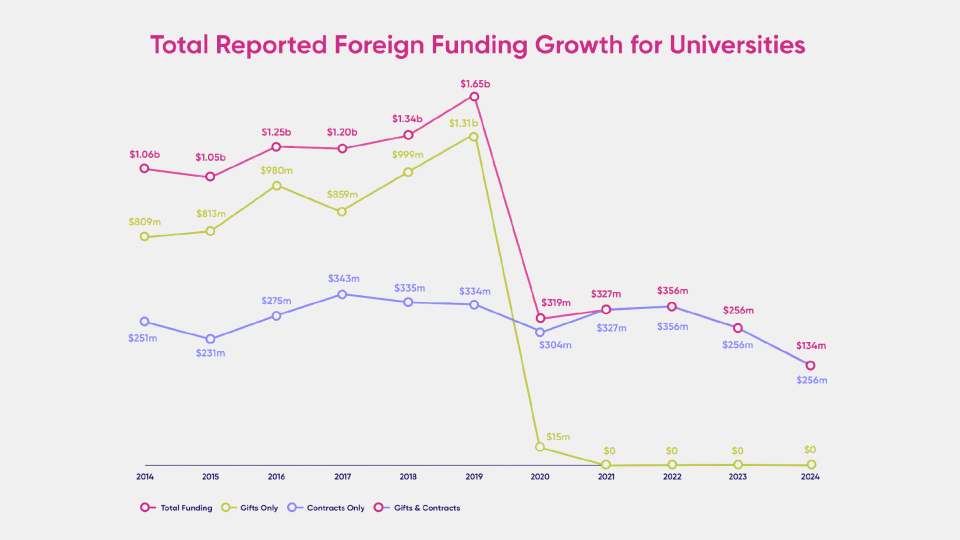
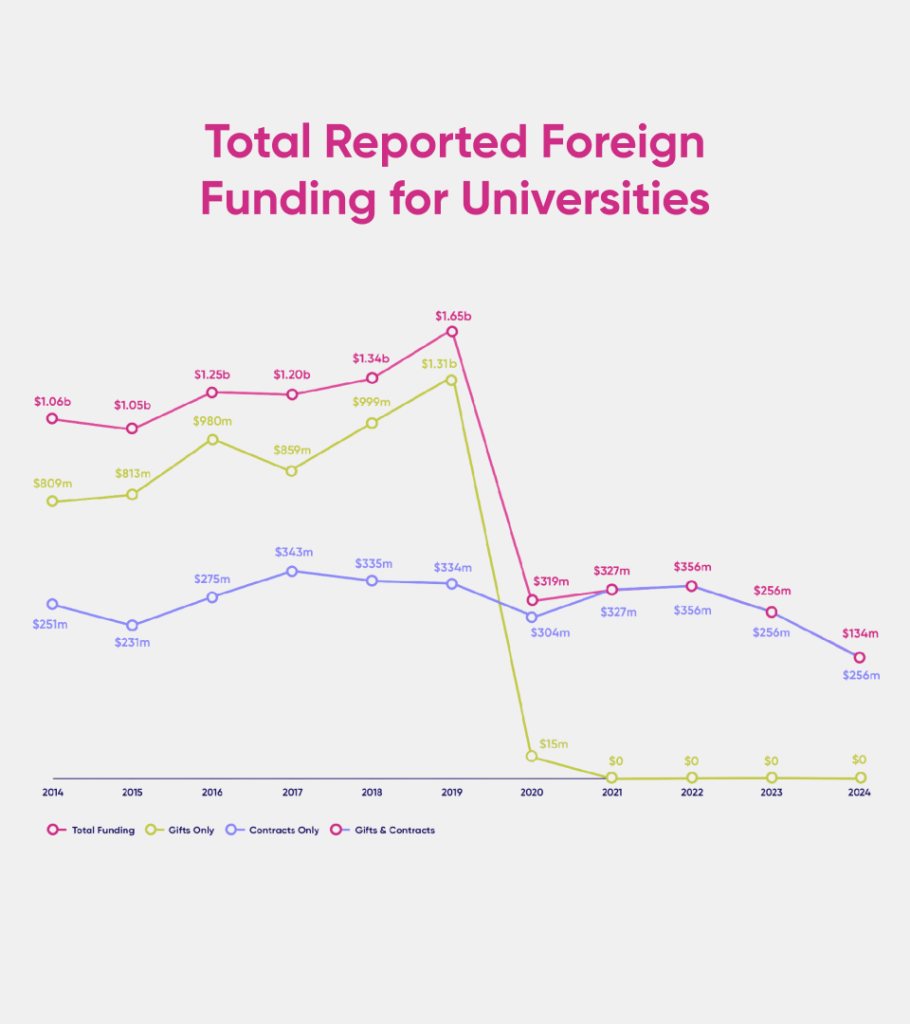
The administration never provided any rationale for closing such investigations — but as the data makes clear, the announcement paralleled a clear dropoff in universities’ disclosures of new fundings. This is, perhaps, unsurprising; with American officials announcing they would no longer investigate the topic, why would universities feel pressure to comply with transparency regulations? The disclosure dropoff was immediate and steep. As one analysis found, “Department of Education records showed that universities reported only a bit over $4 million in foreign gifts throughout part of 2021, compared with over $1.5 billion between July 2020 and January 2021.”23 Not only had the Biden administration announced that no new investigations would emerge, but the administration had concomitantly overseen an entire collapse in the information being reported.
Moreover, even when universities did disclose information, the Section 117 database still did not capture all of the foreign funding in question. One 2024 report from the National Association of Scholars found multiple instances of foreign funding, identified either via public records or records requests, that had never been uploaded to the Section 117 database. As the report discovered, under the Obama administration, over half of the “Section 117 reportable amounts” identified were not actually included in the Section 117 database. Perhaps that was understandable, given the broader lack of interest across the board in the topic at the time. However, even after the Department of Education’s 2020 report, the high-level investigations, and the creation of the publicly accessible database, American officials in the early 2020s still appeared unwilling to share all of the information required.
Shockingly, the National Association of Scholars discovered that by 2024 nearly 40 percent of all funds that were supposed to be reported still did not make it into the Section 117 database.24 The database, for as much transparency as it provided, still left much information out — information that independent researchers, but apparently not the government, could identify.
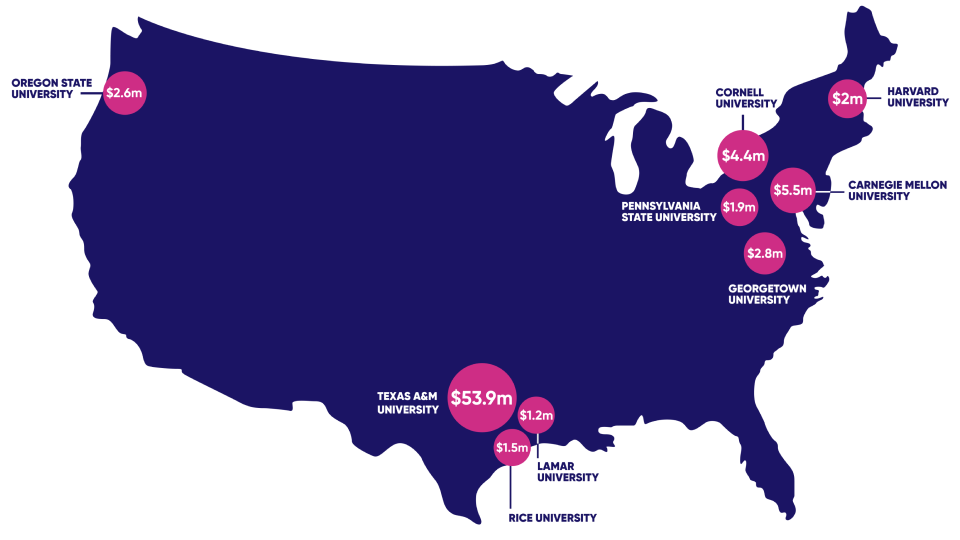
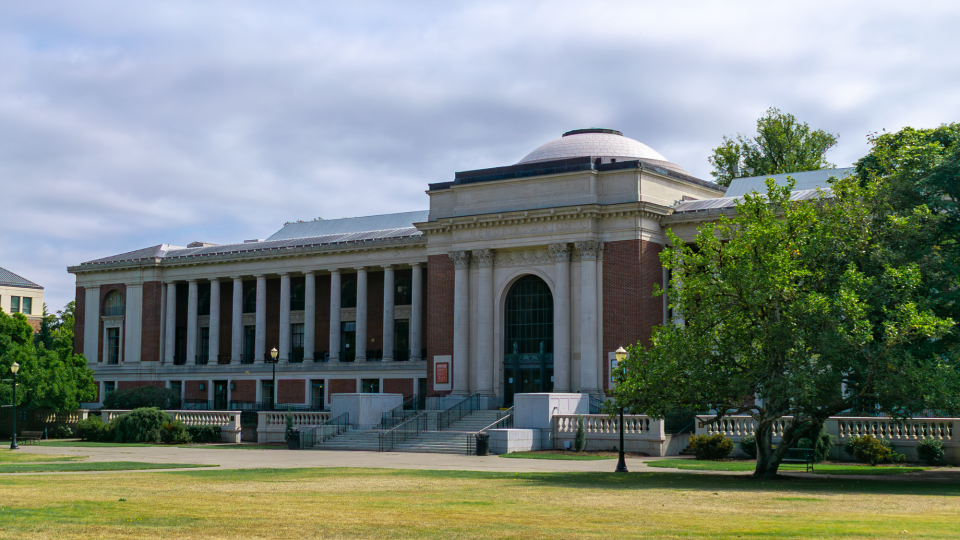
Again, this information was not limited to contracts with democratic allies, or gifts from other democracies. For instance, the National Association of Scholars found that nearly all contracts between Saudi Arabia and Oregon State University had been reported by 2020 — but then completely disappeared afterward, despite the fact that millions of dollars continued to flow. Much the same was found with Chinese contracts with places like Columbia University and Texas A&M University, with disclosures completely disappearing by 2022. The database may have still existed, but it was clearly atrophying, with universities understandably confident that they would never be investigated, let alone penalized.25
This, then is the state of the Section 117 disclosures in 2026. Instead of increasing requirements for further transparency, American officials have exhibited no interest in adding things like contract uploads or further details on donations. And instead of universities suddenly complying with the basic requirements to which they’ve been subject for decades, they are, by all appearances, once more masking their financial arrangements with despotic regimes, even to the point of ignoring federal requirements, and potentially breaking the law.
Before breaking down the data further, it’s worth highlighting that there are certain benefits to some of this financing. After all, money expended on scholarships or on new academic wings is certainly better than, say, Emirati funds expended on arms shipments destabilizing places like Sudan, or Chinese armaments that could be used on an assault on Taiwan. And given how universities in the US have seen funding slashed elsewhere, it’s perhaps unsurprising that they would turn to other sources of funding — including those out of dictatorships — that can provide further resources to their student bodies.
Then again, this is also the same kind of argument that parallels dictatorial financing of other non-profits, such as museums and cultural centers. As defenders of that funding often say, it is better to use dictatorial funds to provide for the opening of a new museum or to help bankroll a think tank engaged in policy analysis than it is to have those same dictatorships spend that money on invading a democratic neighbor or funding new prisons for dissidents. They are, in a very technical sense, correct. But as this report makes clear, any benefits are significantly outweighed by the negative consequences of universities opening their doors to dictators — not only for the universities themselves, but to the causes of academic freedom, and even of democracy, around the world.
What the Data Tells Us
The data on the Section 117 database is stark, and paints a damning picture both of how open American universities are to dictatorial financing and how eager foreign regimes are to bankroll American higher education.
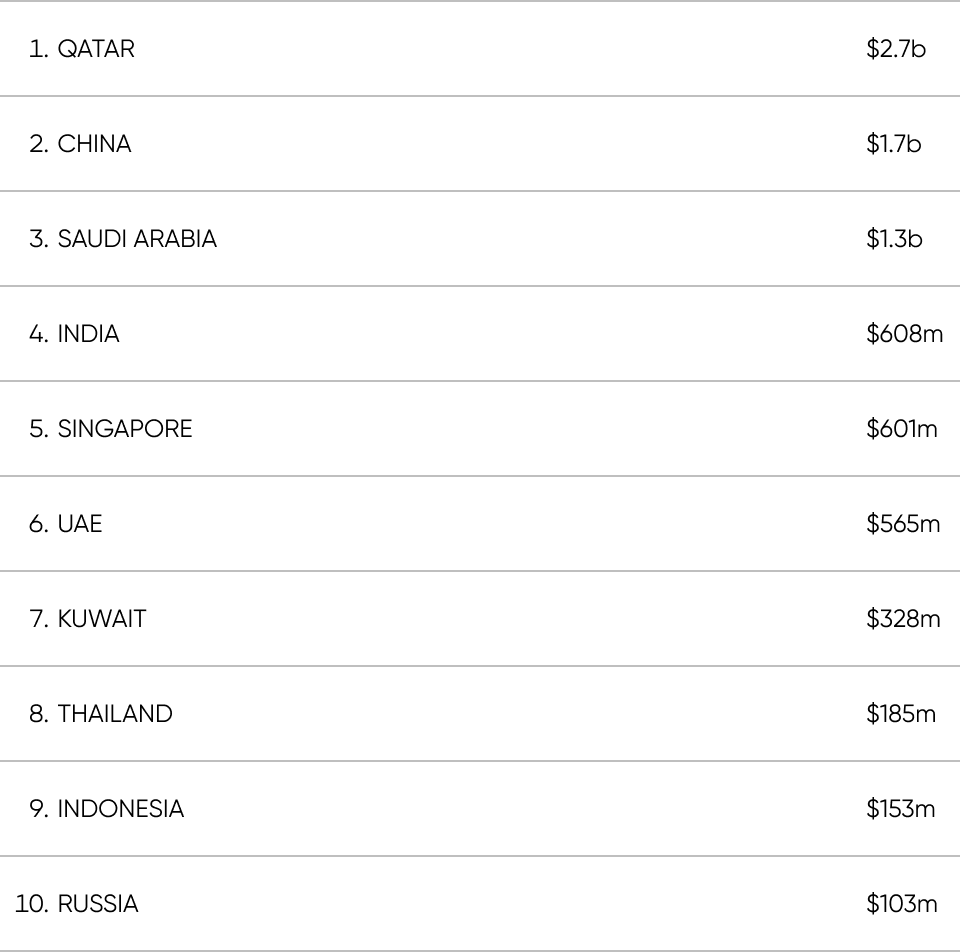
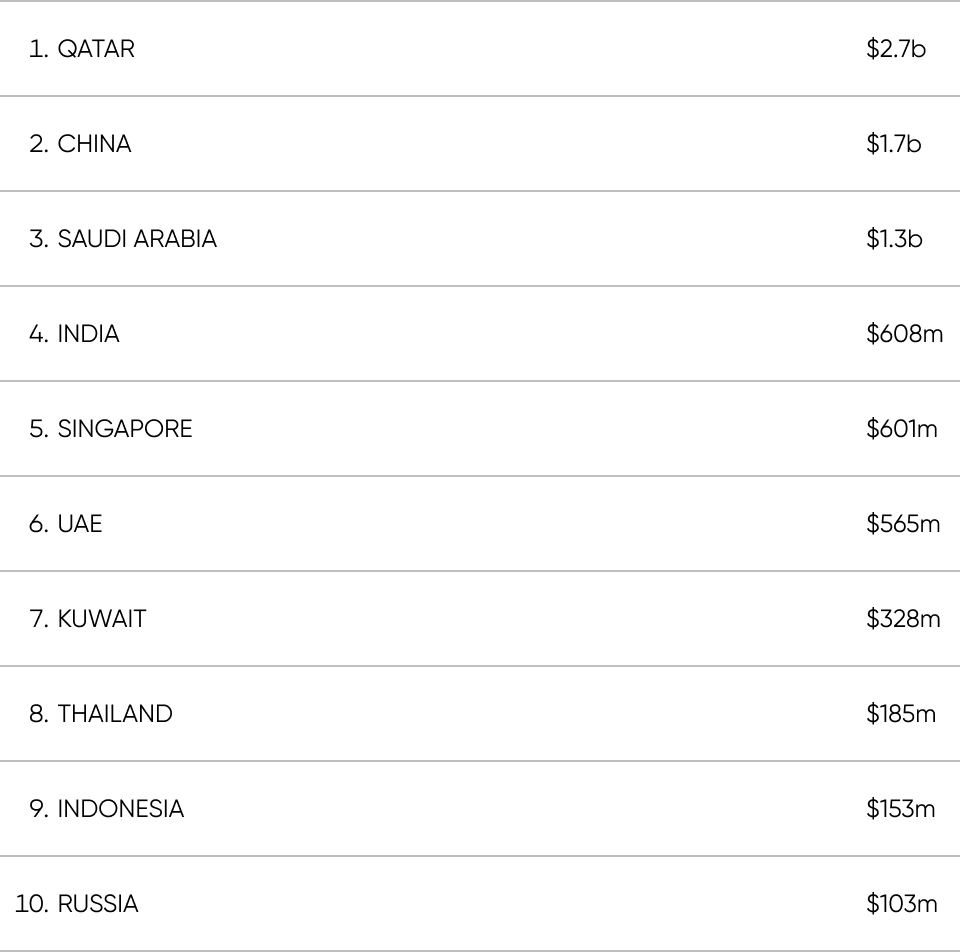
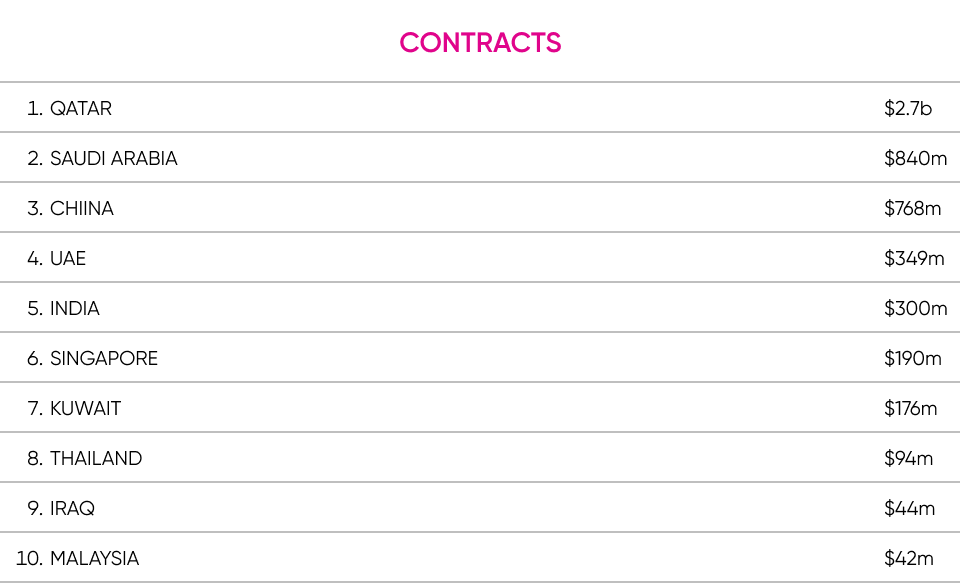
Since 2014, the total amounts that universities have accepted from nations overseen by authoritarian regimes is $8.94 billion. Approximately 70 nations overseen by anti-democratic regimes have engaged in this kind of financing, topped by these ten countries.
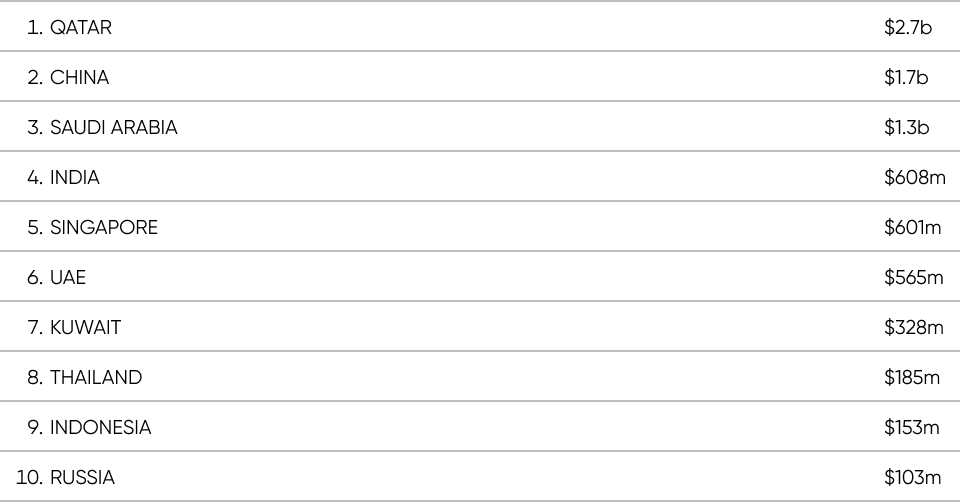
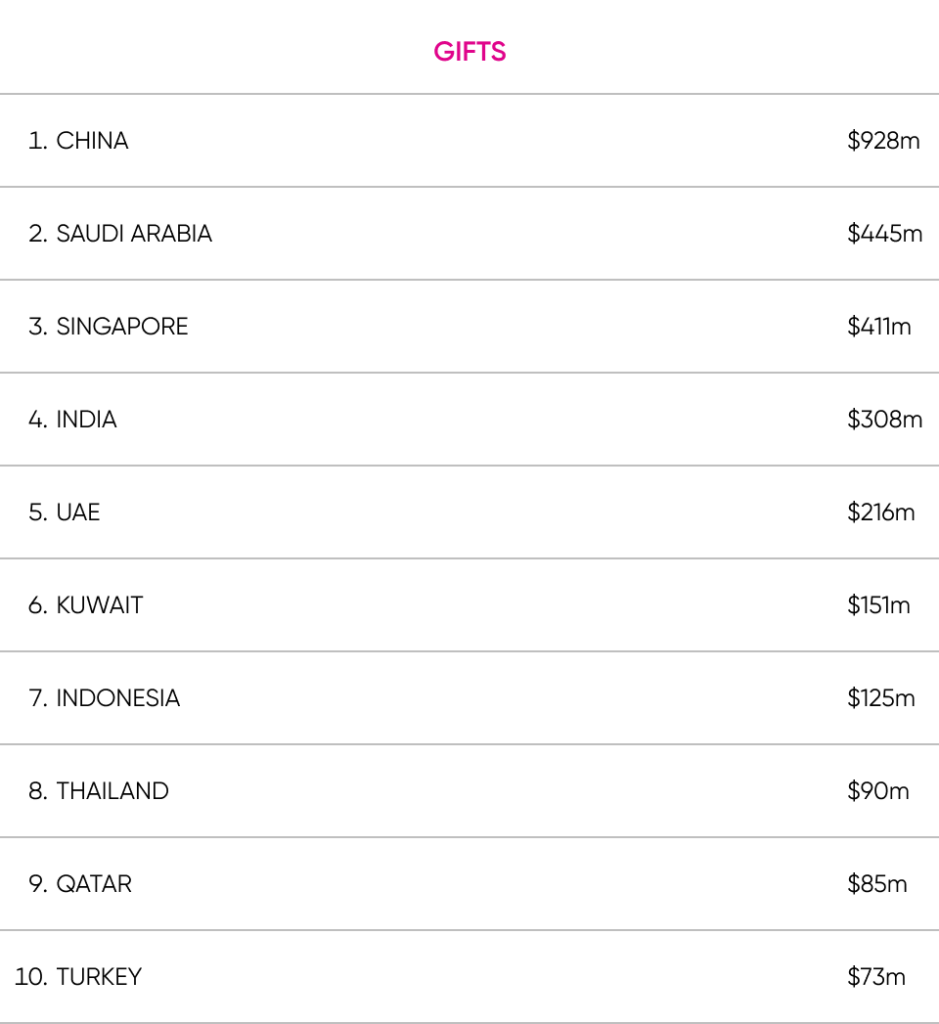
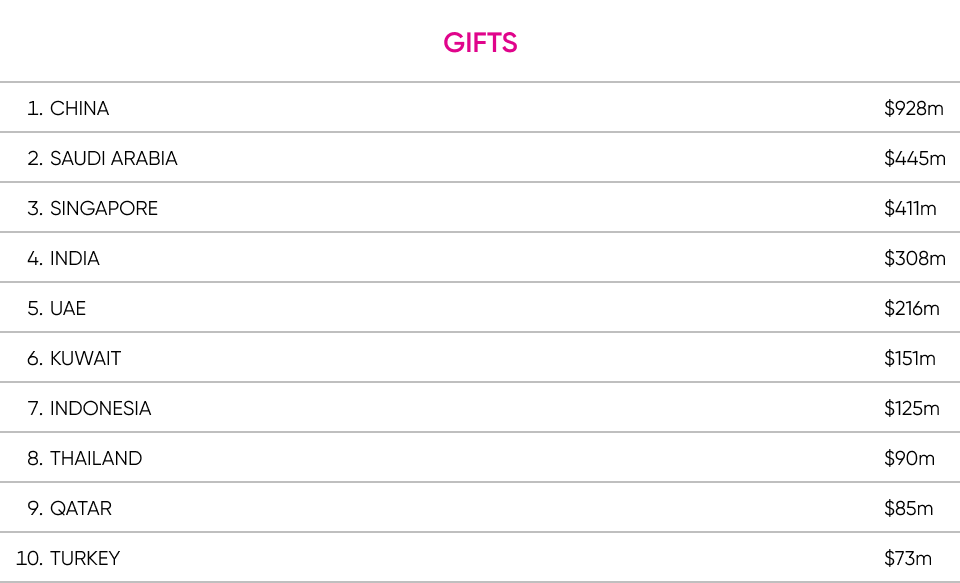
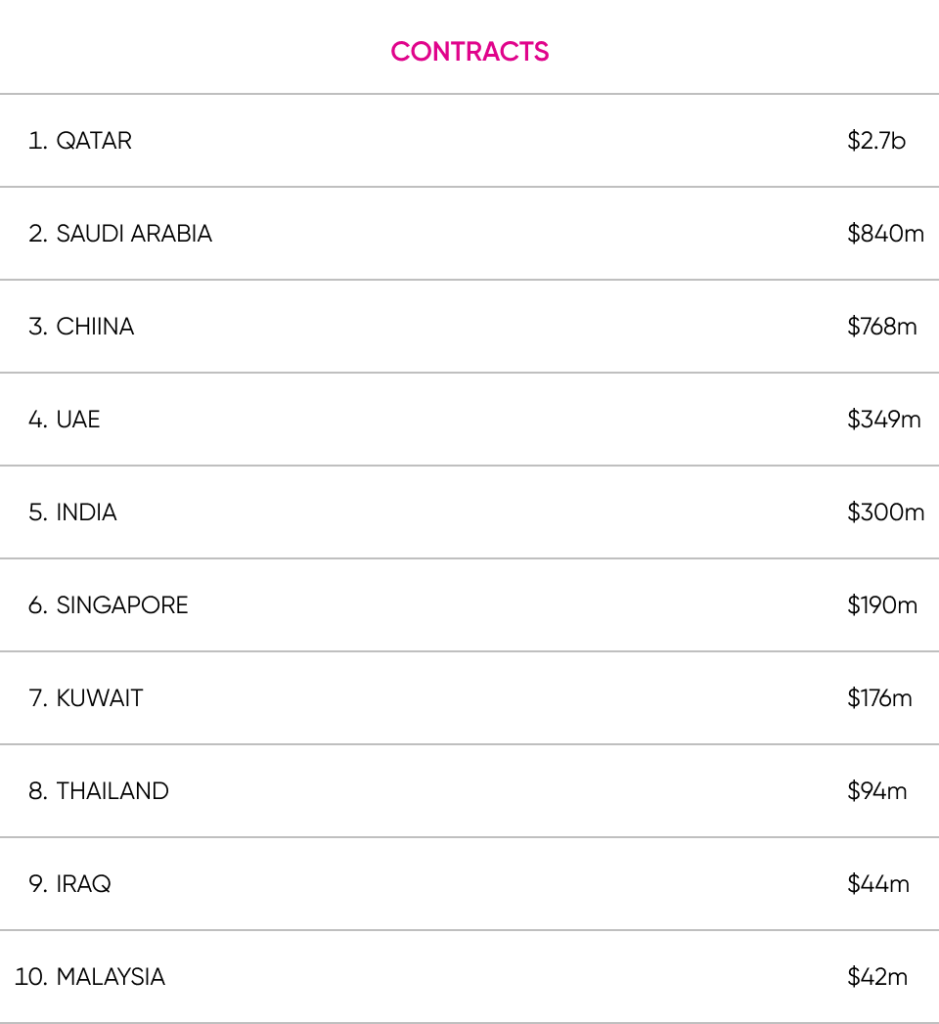
As mentioned above, the Section 117 database breaks the data down into receipt of gifts and signing of contracts. Those total amounts are broken down as follows:
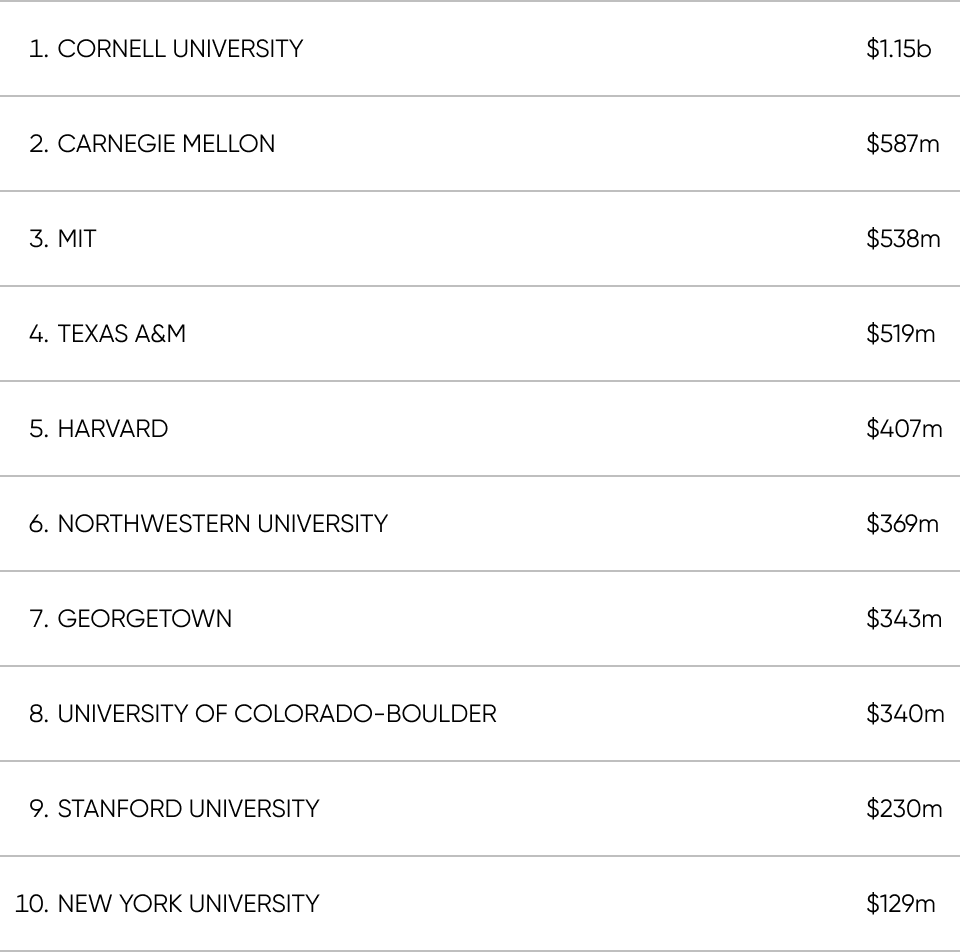
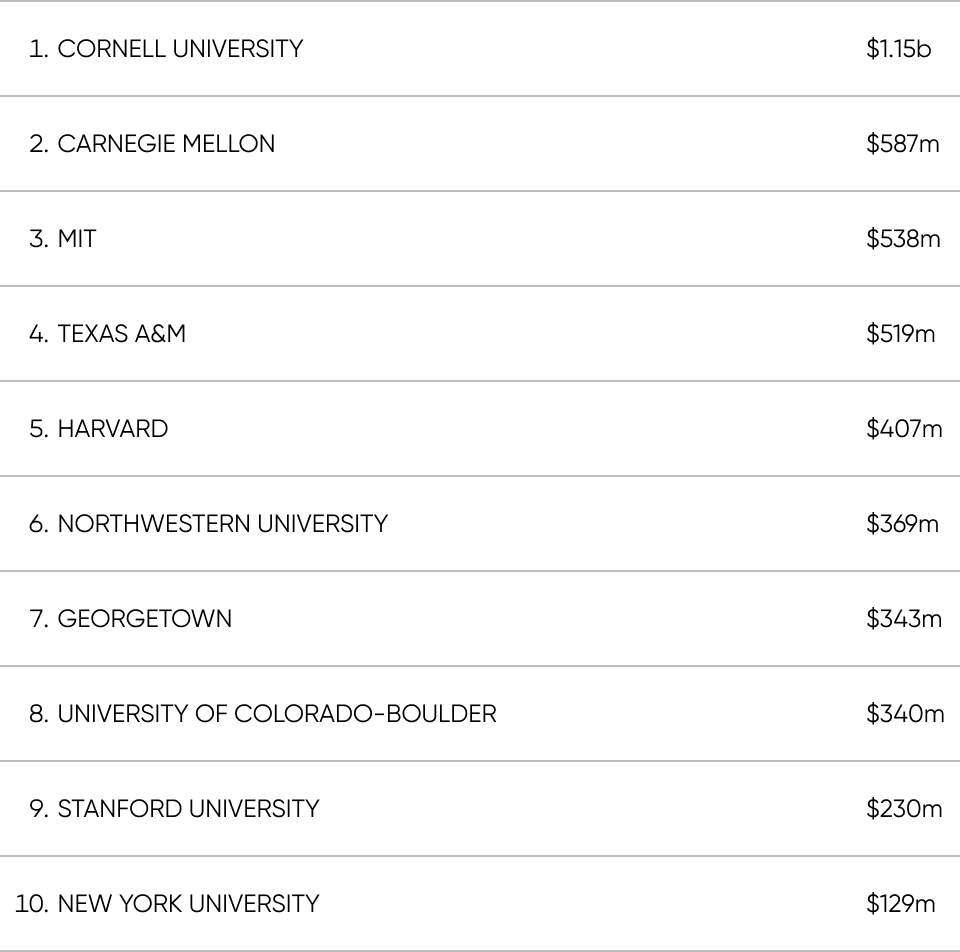
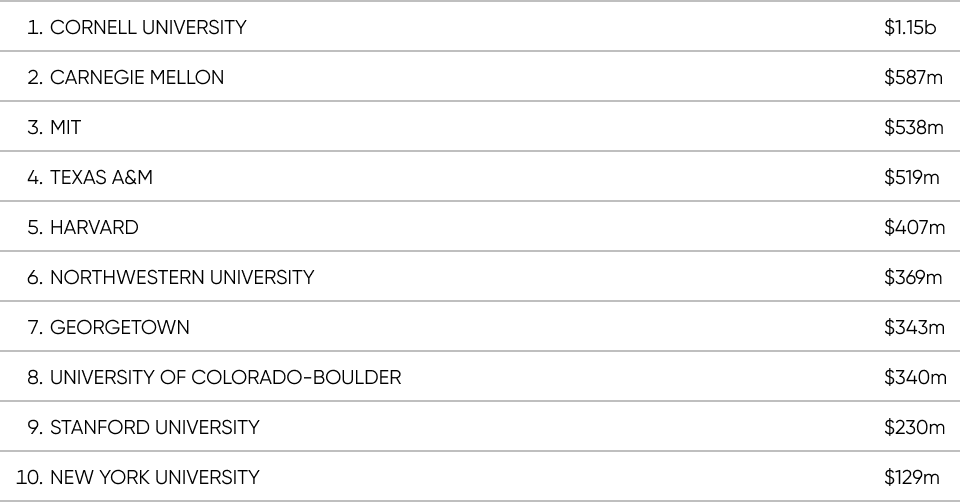
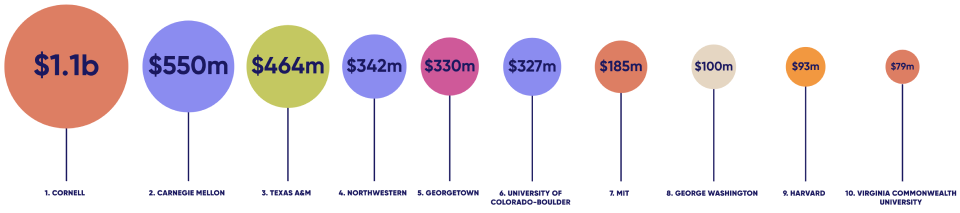
On the university side, the schools receiving the most funding out of nations overseen by authoritarian regimes are:
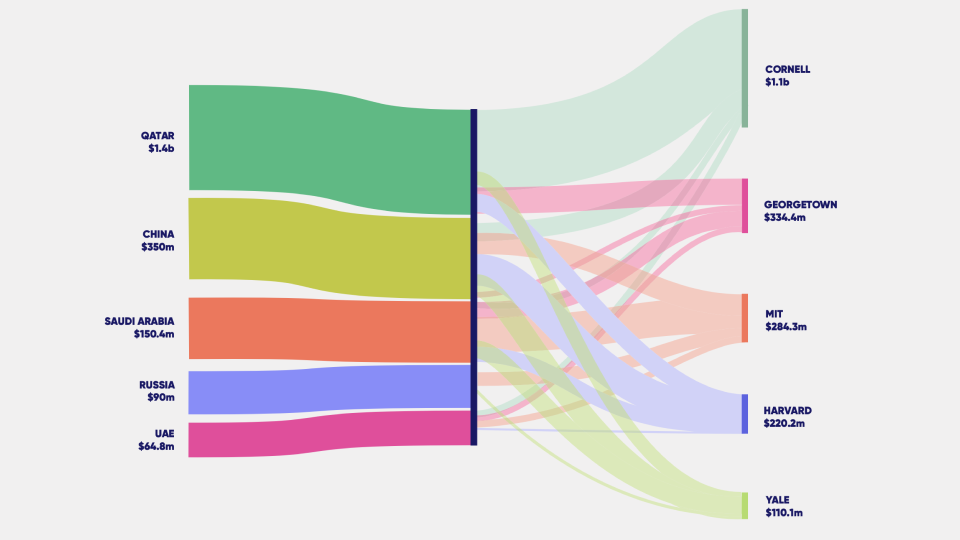
Major Links from Regimes to US Universities
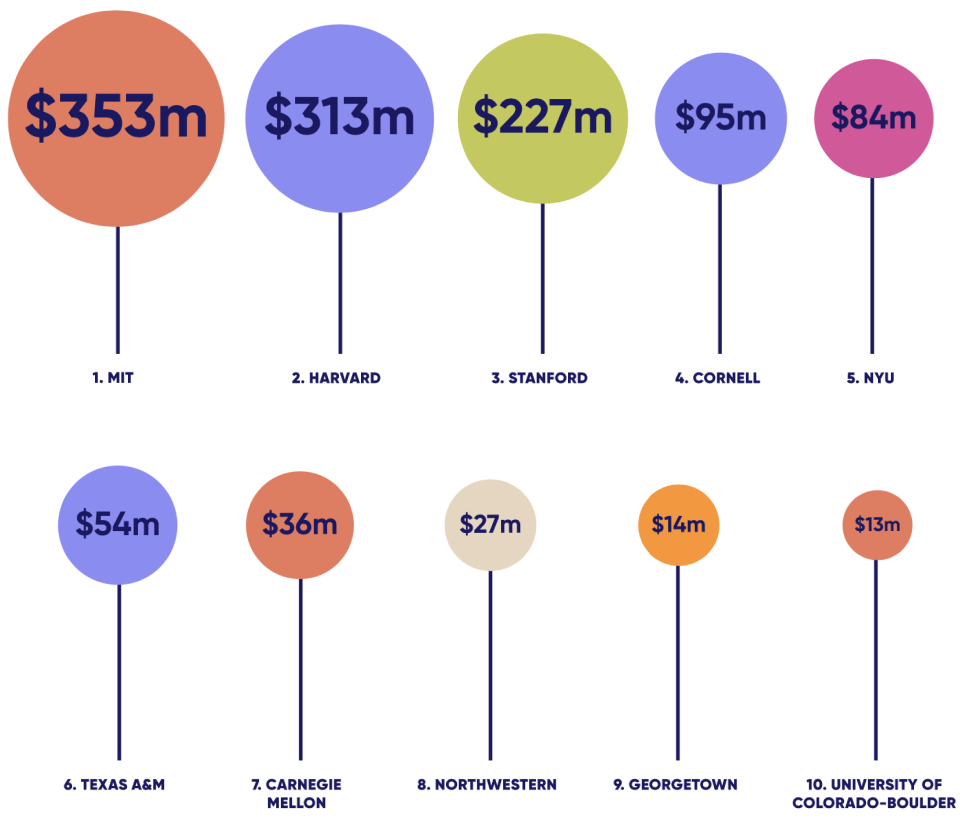
Universities accepting the most funding via gifts:
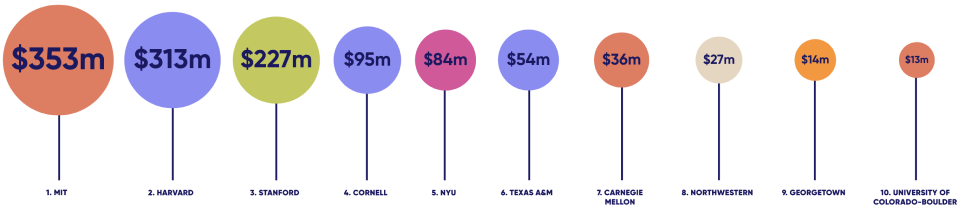
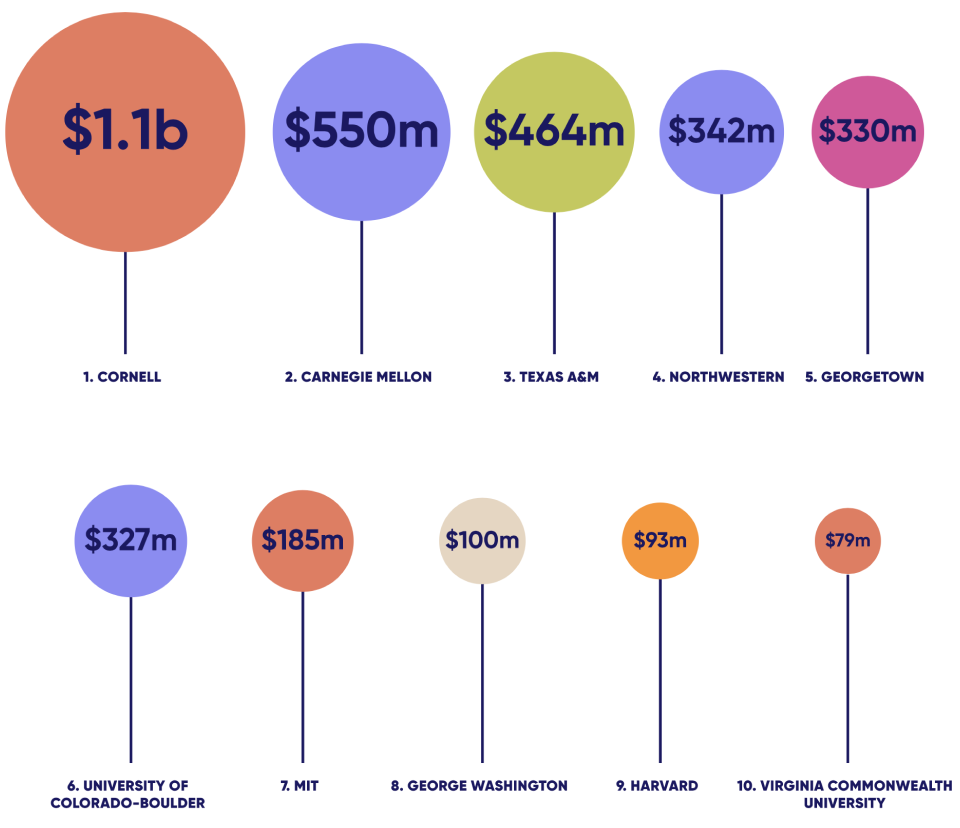
Universities accepting the most funding via contracts:
While dozens of universities and nations were involved in these transactions, all of these data points were consistently topped by a relatively small number of universities and nations, all of whom appeared to be taking far more advantage of loopholes and lax oversight than other universities and regimes.26
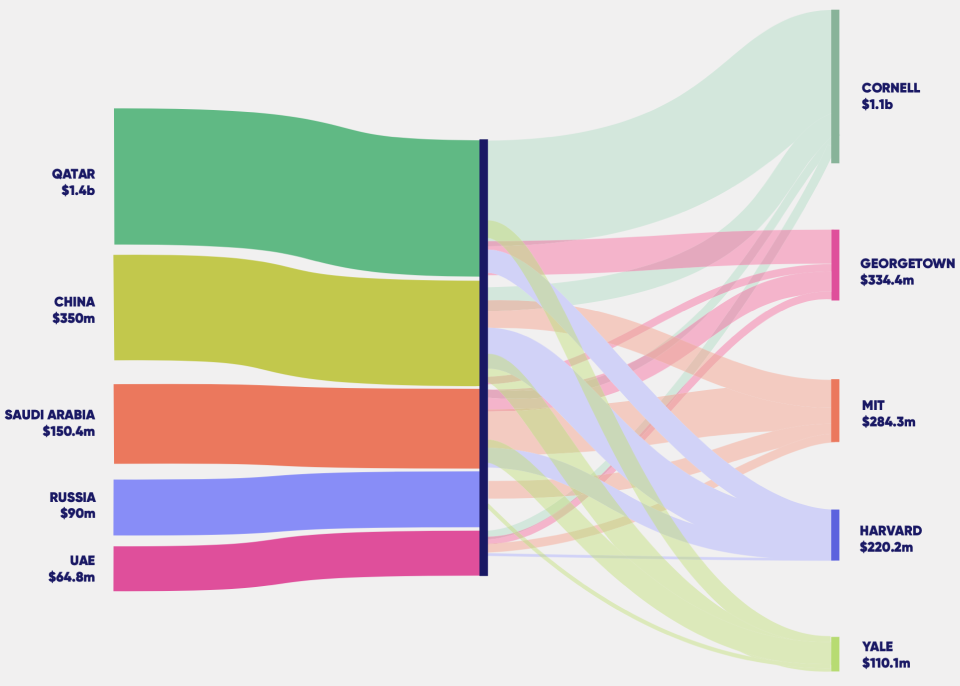
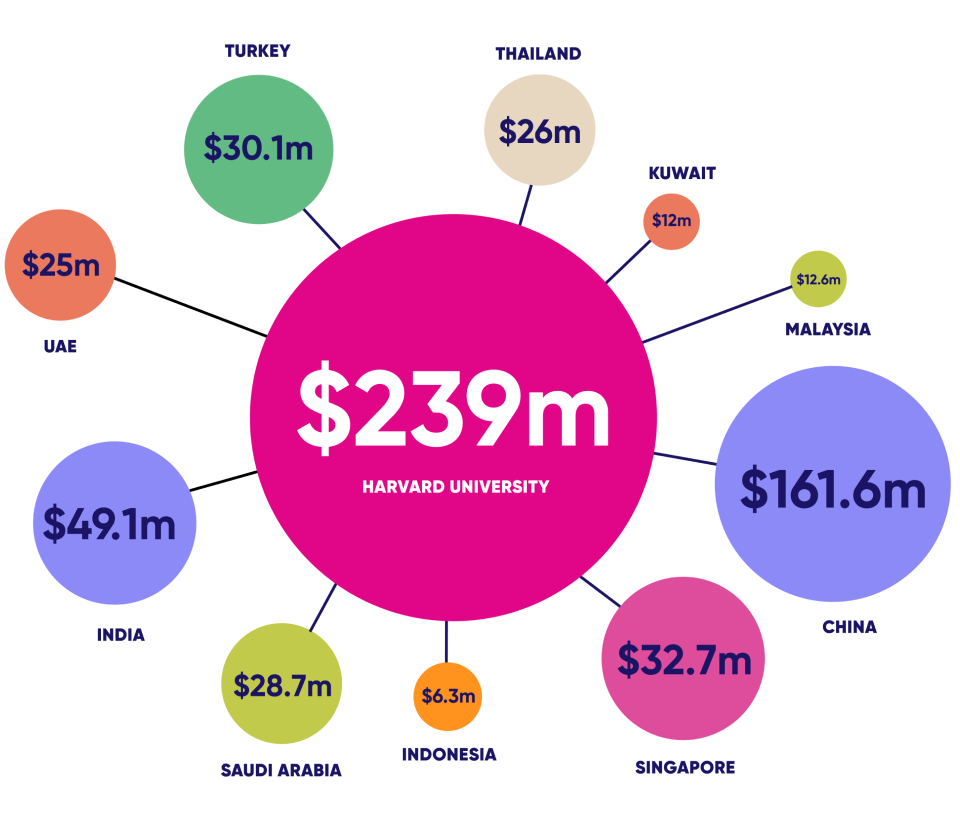
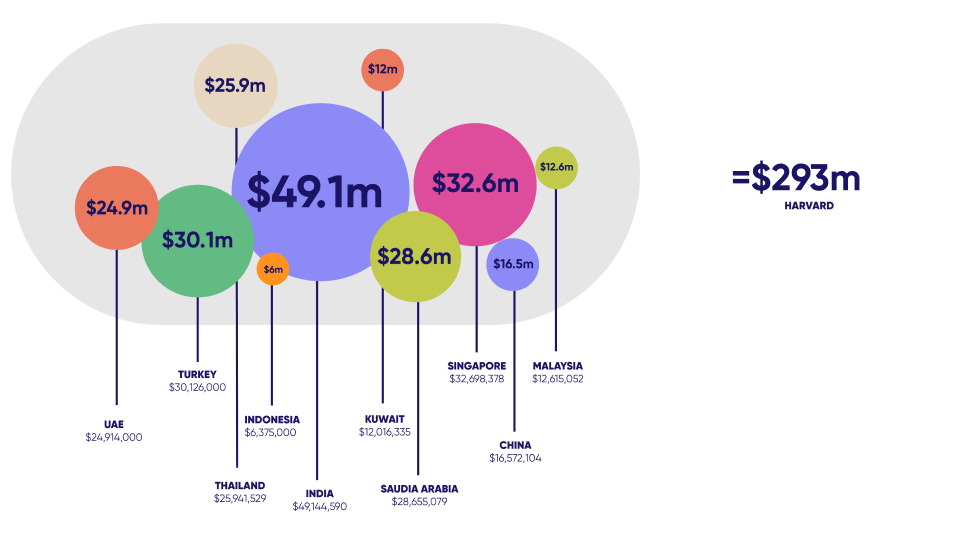
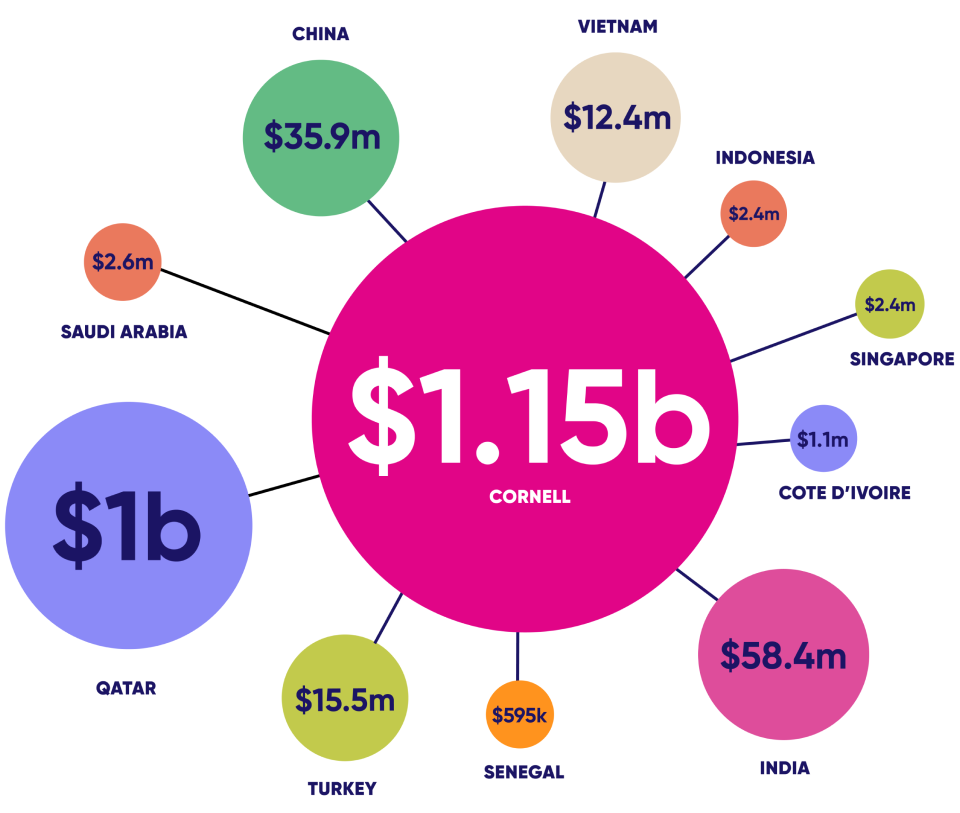
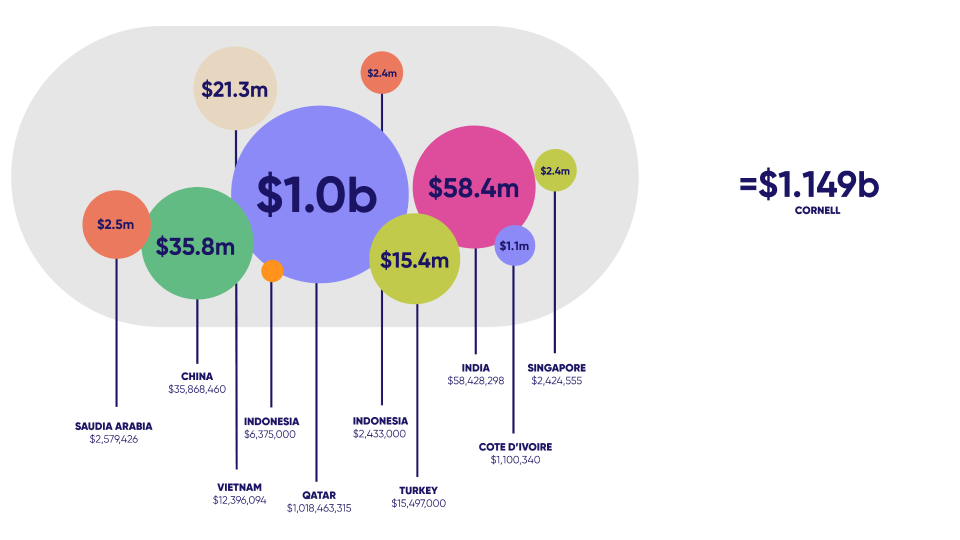
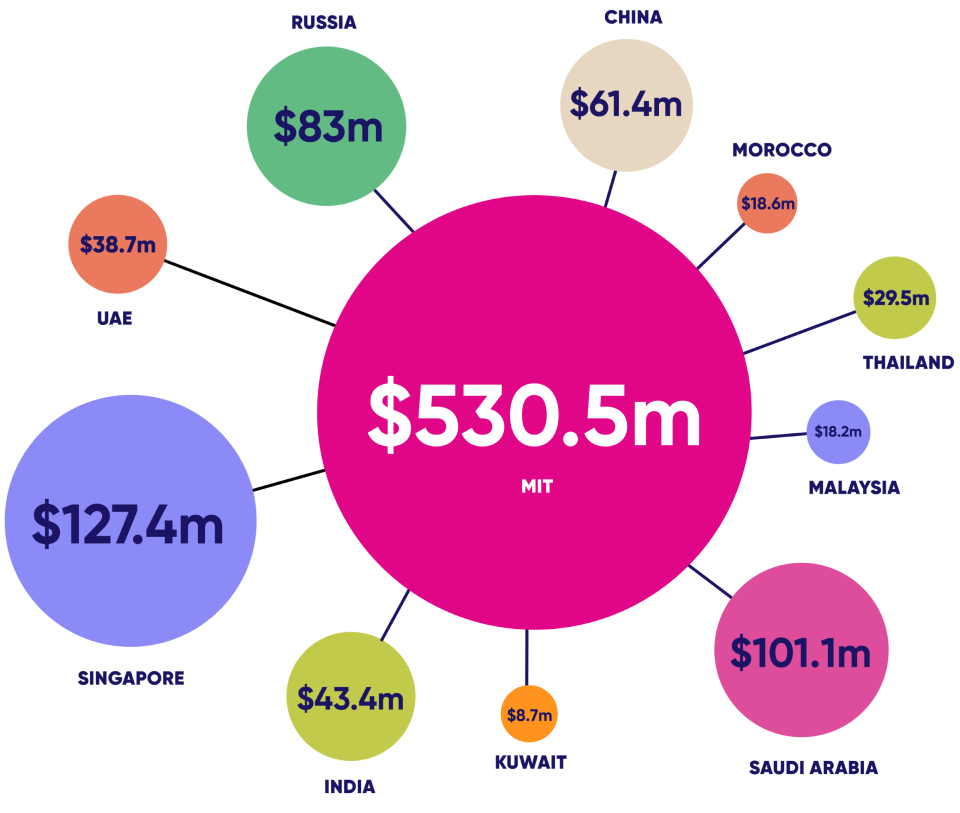
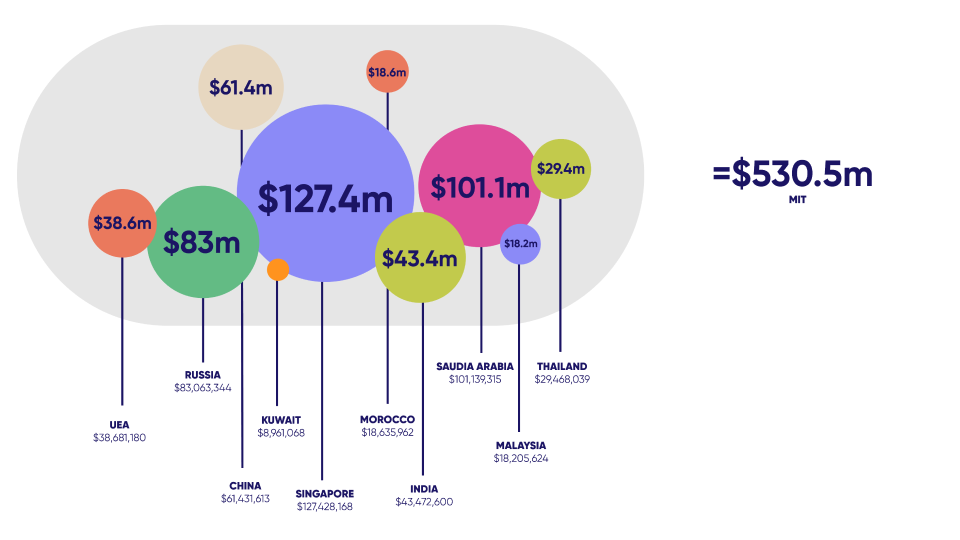
The Section 117 database has a phenomenal font of information about financial flows out of dictatorships to many of America’s leading universities. Indeed, there is so much data that trying to compile it all into one document would take thousands of pages. Instead of cataloguing every single transaction to every single university, we charted out some of the funders at key universities: Cornell, Harvard, and the Massachusetts Institute of Technology (MIT). As you’ll see in the following pages, these universities have all received significant funding out of dictatorial nations, but not always from the same sources. These graphics are snapshots of the wider phenomenon detailed in this report, and illustrate just how broad the sources for many of these universities are.27
Major Sources of Funding for Harvard
Major Sources of Funding for Cornell
Major Sources of Funding for MIT
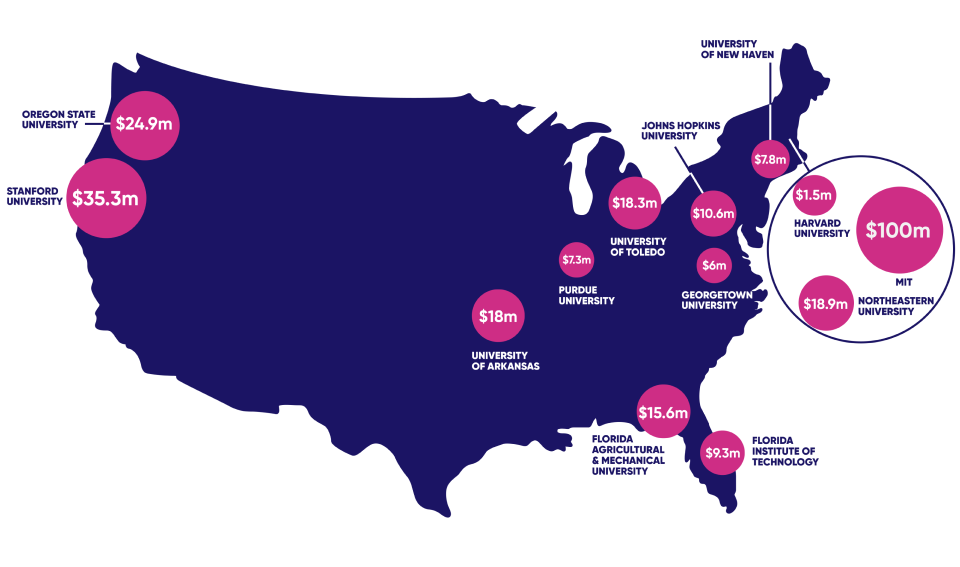
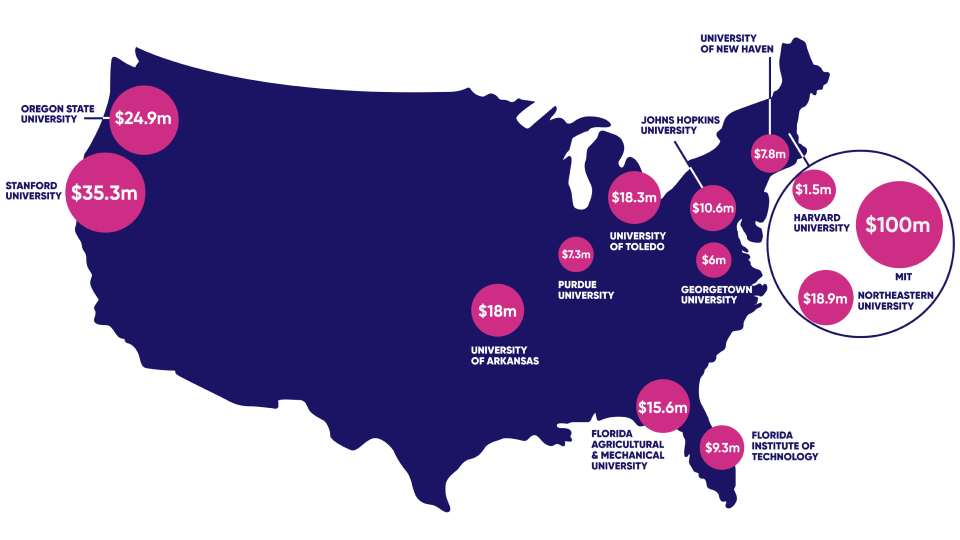
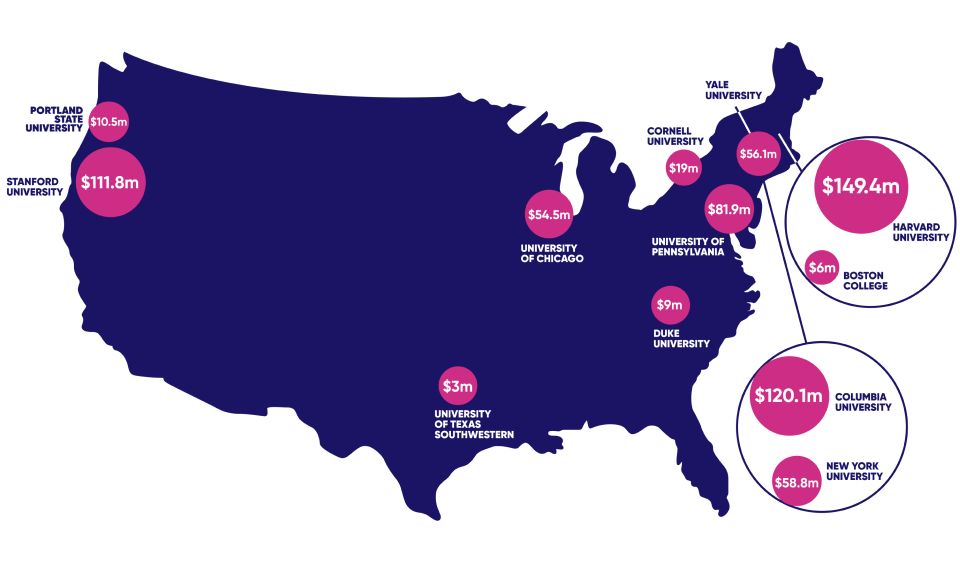
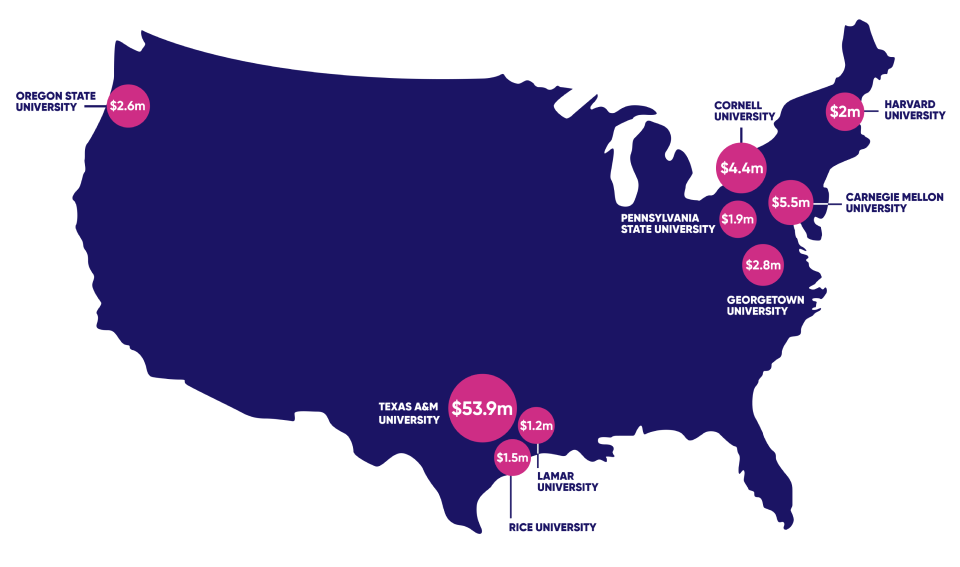
Just like the universities mentioned throughout this report received funding from different sources, many of the dictatorships and autocratic regimes throughout this report targeted a range of different universities. Rather than trying to map out every single gift or every single country, these three maps — from Saudi Arabia, China, and Qatar — help highlight both the diversity and geographic breadth of the universities targeted, from Ivy League institutes to state universities to smaller schools that are often overlooked, but that nonetheless participate in a phenomenon that is now worth billions of dollars.28
Gifts from Saudi Arabia to US Universities
Gifts from China to US Universities
Gifts from Qatar to US Universities
Why Dictatorships Turned to US Universities: A Few Case Studies
When examining the data that the Section 117 database divulges, there is one overarching question threading through all of the information: why do dictatorships, autocracies, and their proxies bother to organize such massive financing streams to American universities? Wouldn’t that money be put to better use elsewhere? Couldn’t it be invested in their own people, laundered, or perhaps invested, serving as a means to increase kleptocratic wealth? Why finance American universities?
As this chapter will detail, the answers fall into two primary buckets. The first has to do with laundering the reputations of the regimes in question: transforming them from rapacious regimes into governments dedicated to philanthropy, education, and students in the US. In the process, they also push regime-friendly messaging, downplaying crimes associated with these dictatorships while also pushing favorable geopolitical narratives.
Secondly, they access students and faculty in these universities themselves — including future policymakers as well as those who have just left office and still have significant sway in the US policymaking community. These donations and financial arrangements open significant doors on university campuses, allowing regimes to connect with whoever they need. Likewise, some universities even go so far as to open satellite campuses in the donor countries themselves — allowing them to push illiberal policies and criticism in the process. And dictatorships use these financial arrangements to access proprietary research from these universities. Given that American universities remain on the cutting edge of technological innovation, authoritarian regimes see them as sources of technological innovation and sources of resources to steal or copy outright.

The Rise of Confucius Institutes
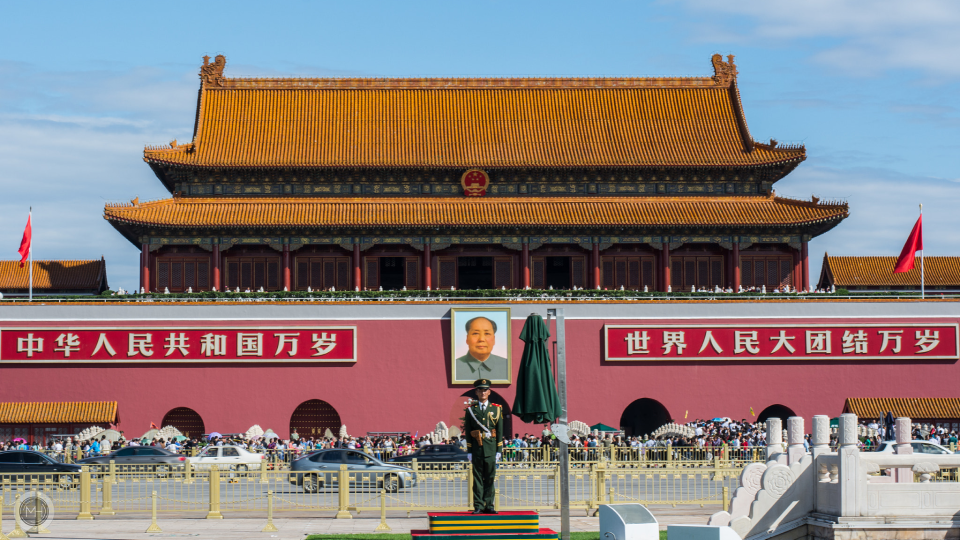
American legislators first grew concerned in the 2010s about dictators and American universities because of so-called “Confucius Institutes.” These institutes, chartered with the full backing of the Chinese regime, claimed to be dedicated solely to the study of Chinese languages, Chinese culture, and international comity. Topics like Tiananmen Square, the history of Taiwanese independence, or the ongoing, brutal colonization of Xinjiang and Tibet were verboten; instead, these Confucius Institutes provided platforms for topics and talking points approved by Beijing for the broader sake of improving the Chinese Communist Party’s image among American audiences.29
Initially, these Confucius Institutes proved wildly popular. With the first Confucius Institute founded in the US in 2004, more than 100 opened in the 15 years afterward. Nor were their activities limited to universities; as later reporting revealed, related “Confucius Classrooms” opened in hundreds of American grade schools — the expansion of which was “a top priority for China.”30
In the late 2010s, the US Senate Permanent Subcommittee on Investigation (PSI) authored a new investigation focused primarily on Confucius Institutes (rather than broader compliance with Section 117 regulations).31 The findings of the bipartisan PSI report were themselves shocking. Not only did the report conclude that Confucius Institutes, despite claims otherwise, were clear arms of the Chinese Communist Party — that they’re hardly neutral centers of Chinese studies, existing instead as “part of China’s broader, long-term strategy” — but it also determined they had little to do with education in the first place. Instead, as the report found:
More pertinently, the committee found that the total funding involved in Confucius Institutes was ultimately unclear. As American officials discovered, “over half of [China’s] annual payments … were under the $250,000 reporting requirement threshold,” meaning that, even when universities didn’t report such payments (as they often did not), they were under no legal requirement to do so.33
And as American officials discovered, even when the funding exceeded the $250,000 threshold, universities by and large never bothered to report the funding in the first place. As the legislators discovered, over two-thirds of US schools “failed to properly report information to the Department of Education as required.”34 As detailed above, Section 117 was effectively toothless and largely unenforced, and China had taken full advantage, with legislators estimating that Beijing had spent hundreds of millions of dollars on Confucius Institutes alone across the US, opening new avenues to launder Beijing’s image and play down concerns about the Chinese regime.
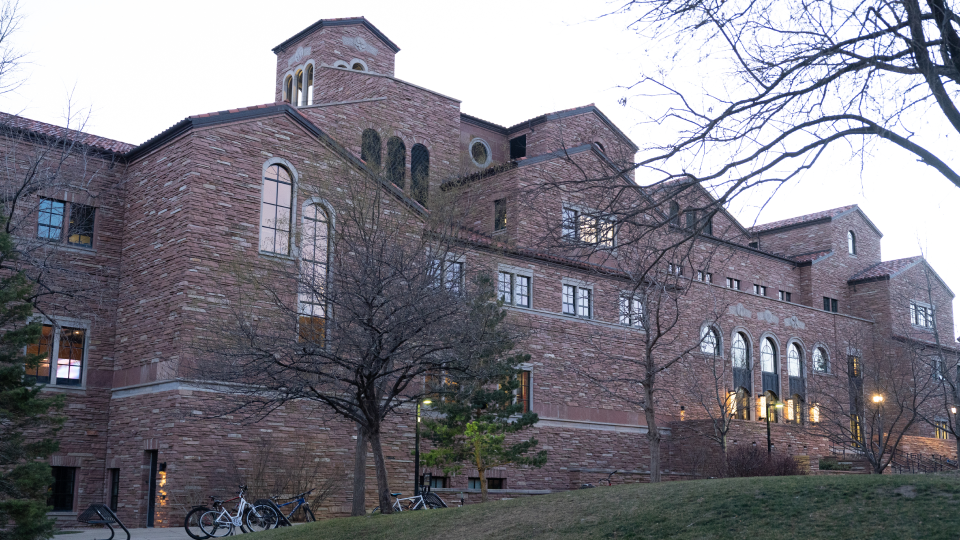
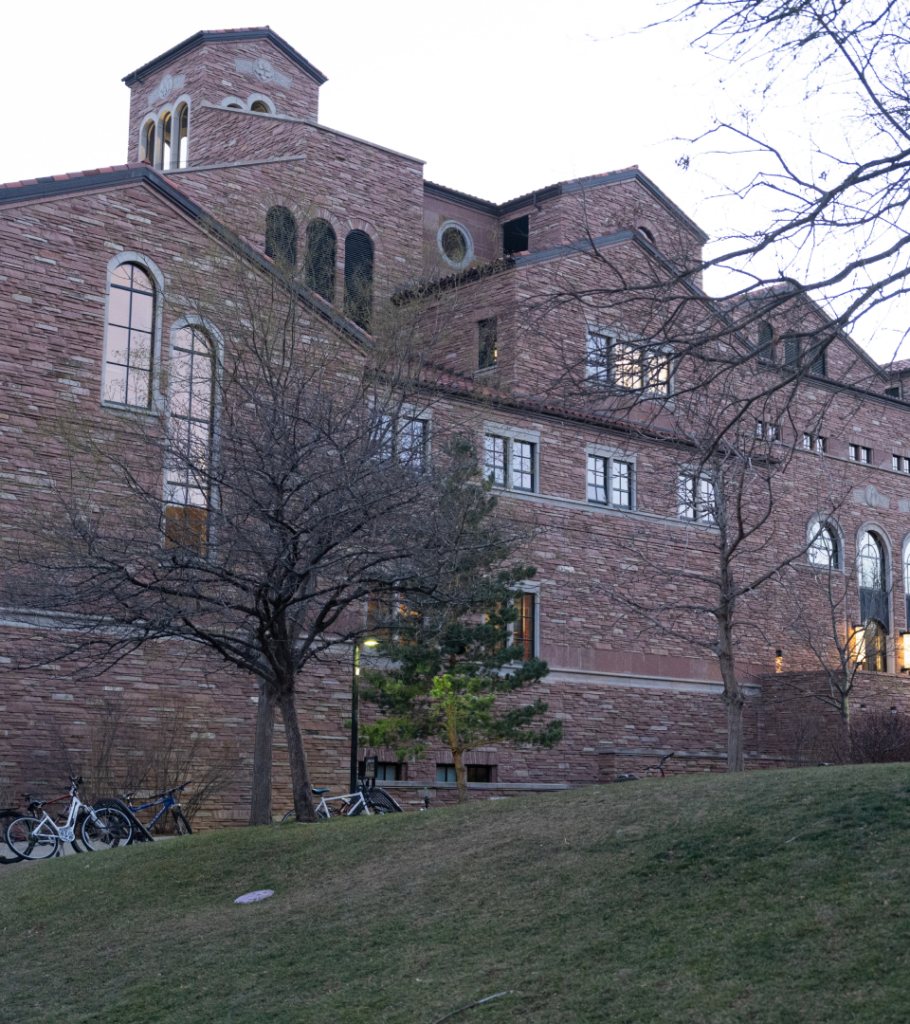
Dictatorship Patrons
The 2020 report from the US Department of Education shone further light on relationships between specific universities and related foreign funders. One of the relationships links Georgetown with Saudi Arabia, and in particular with Saudi Prince Alwaleed Bin Talal. As the report discovered, Bin Talal provided funding to establish Georgetown’s Prince Alwaleed Bin Talal Center for Muslim-Christian Understanding. As the report continued:
The Center … received criticism for deceptively labeling itself as pluralistic; according to critics, the “Christian” studies portion of the Center was a “misnomer” as there was no Christian representation. Additional worries spawned from Saudi Arabian infiltration of an institution commonly known to siphon graduates into government employment. Such concerns were salient because the Saudi Arabians had communicated that their money would “follow” the Center’s first Director. This strategy of funding a particular director is concerning, as it would allow a foreign government unduly to guide the Center’s content…
Prince Alwaleed has made considerable international donations and has conducted similar soft power operations by creating Islamic studies centers at the University of Cambridge and Edinburgh University located in the United Kingdom, for example. Prince Alwaleed’s controversial and political past, ranging from anti-Zionism to handsomely rewarding Saudi Arabians who participated in Yemen bombing raids, shadows him and his donations.
Prince Alwaleed’s agreement with Georgetown exemplifies how foreign money can advance a particular country’s worldview within US academic institutions.35
Another relationship alluded to involved a key figure out of Moscow building bridges with one of America’s most storied universities.36 For years, Russian oligarch Viktor Vekselberg served as one of the key figures in Russian President Vladimir Putin’s orbit. Though he did not have any official role in the administration, he and many of the other Russian oligarchs who owed their wealth to remaining in Putin’s good graces acted as effective proxies for the Kremlin.
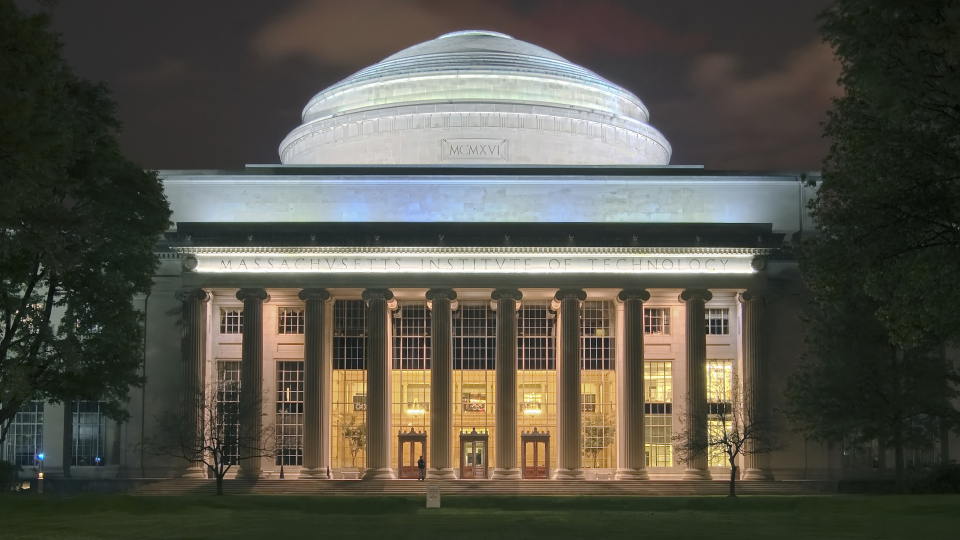
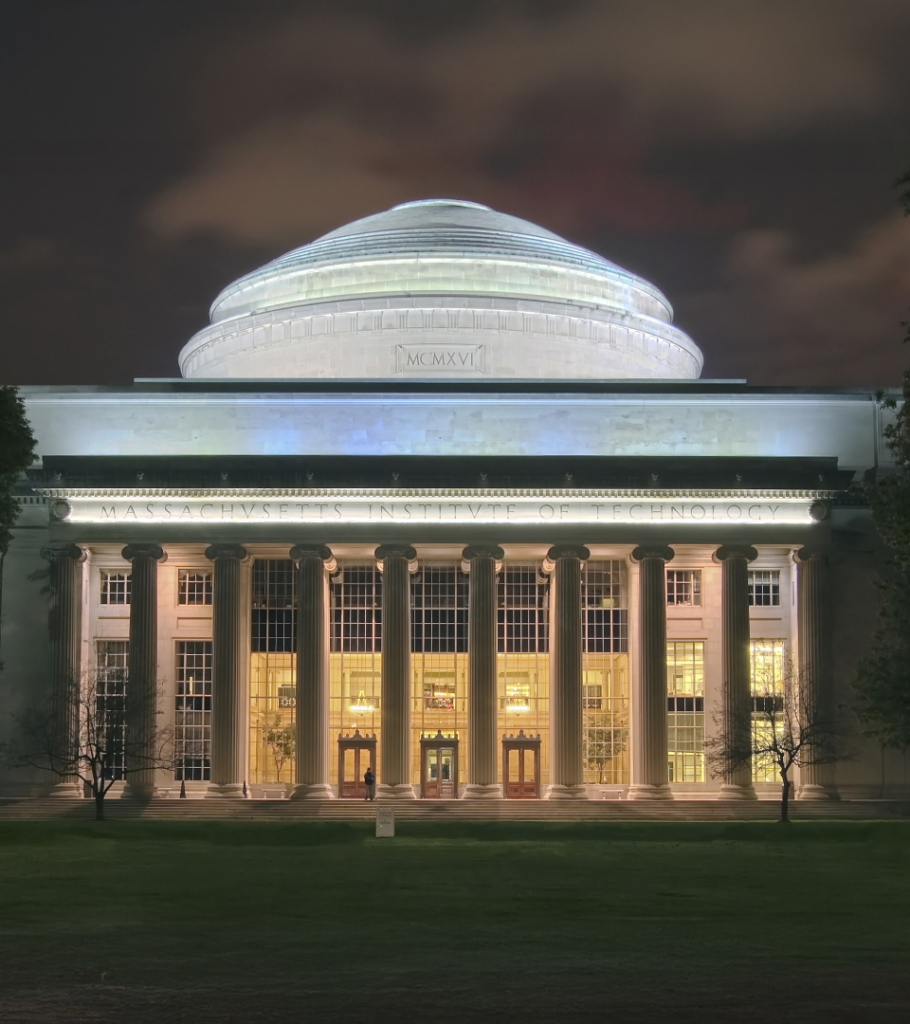
In that capacity, Vekselberg not only donated to things like the Clinton Foundation and used donations elsewhere to gain a foothold in places like California, but managed to land a seat on the board of trustees at one of the US’s most prestigious universities: MIT.
It’s unclear how Vekselberg managed to land a seat on the board, which dated to 2013. However, it paralleled the relationship between MIT and a Kremlin-backed initiative called “Skolkovo,” which was headed by Vekselberg. This initiative, which was supposed to “develop high technology, research, and entrepreneurship,” required a partnership with a leading American research institute. As one investigation in Radio Free Europe/Radio Liberty detailed, MIT “embraced the effort, and entered a $300 million collaboration to found the Skolkovo Institute of Science and Technology.”
All the while, Vekselberg continued to ascend the ranks at MIT. He ascended to MIT’s board, perhaps the most pronounced example of a foreign regime, via an oligarchic proxy, landing a prominent perch at an American university. He also donated significant sums to MIT itself, so much so that he became “a member of the school’s William Barton Rogers Society, a listing of elite donors who give larger amounts of money.”37
When it became clear that Vekselberg was little more than a cutout for the Kremlin, MIT “scrubbed Vekselberg from its board.” The US formally sanctioned Vekselberg in 2018, part of a broader crackdown on Russian oligarchs who engage “in a range of malign activity around the globe.”38
Accessing Research and Students
The Department of Education’s report further detailed links between multiple universities and China — and especially universities’ relationships with CCP cutouts like Huawei and Alibaba. Some of those stemmed from specific contracts that “could empower more Chinese government surveillance and oppression of vulnerable minorities,” while others pointed to how such “agreements and gifts strategically concerned sensitive topics like nuclear science or those related to competitive industries like robotics, semiconductors, and online cloud services.” In particular, investigators uncovered evidence that Beijing sought to acquire ultraviolet lithography capabilities, primarily for its semiconductor industry, and that such arrangements with American universities “may grant the Chinese Communist Party exceptional access to American research facilities.”39
Nor were concerns limited solely to American campuses. In the early 21st century, American universities pioneered a new practice, and new partnership, with foreign regimes: satellite campuses. All too often, however, these satellite campuses — connected, again, to some of the most nominally prestigious universities in the country — ended up partnered with malign, kleptocratic regimes, placing not only their own academic freedom at risk, but opening up new avenues for foreign regimes to manipulate democracies.
One of the clearest examples of this phenomenon came with Qatar. As the 2020 report continued, universities like Northwestern University partnered with the Qatari regime, specifically formalizing deals with the Qatar Foundation, a regime cutout that “has been known to silence viewpoints Qatar opposes.” As the report noted, in February 2020, the Qatar Foundation, Northwestern University Qatar’s partner organization, prevented a Lebanese band with an openly gay lead singer from speaking on Northwestern’s Qatar campus. The Qatar Foundation commented, “We also place the very highest value on academic freedom and the open exchange of knowledge, ideas and points of view in the context of Qatari laws as well as the country’s cultural and social customs. This particular event was canceled due to the fact that it patently did not correlate with this context.” The event had to be relocated to Northwestern’s U.S. campus, according to the article, which illustrates the power of foreign agents to censor or silence speech and quell academic freedom.40
Indeed, rather than spreading American educational freedoms, myriad examples exist of such satellite campuses simply providing foreign regimes with leverage over American universities. For instance, the United Arab Emirates was accused of not only censoring American professors, but actively harassing employees of New York University who were critical of the UAE’s brutal regime. When those employees tried to get university administrators to defend both academic freedoms and their ability to conduct research, the administration instead remained silent, preferring to maintain its relationship with the UAE rather than defend such basic academic principles.41
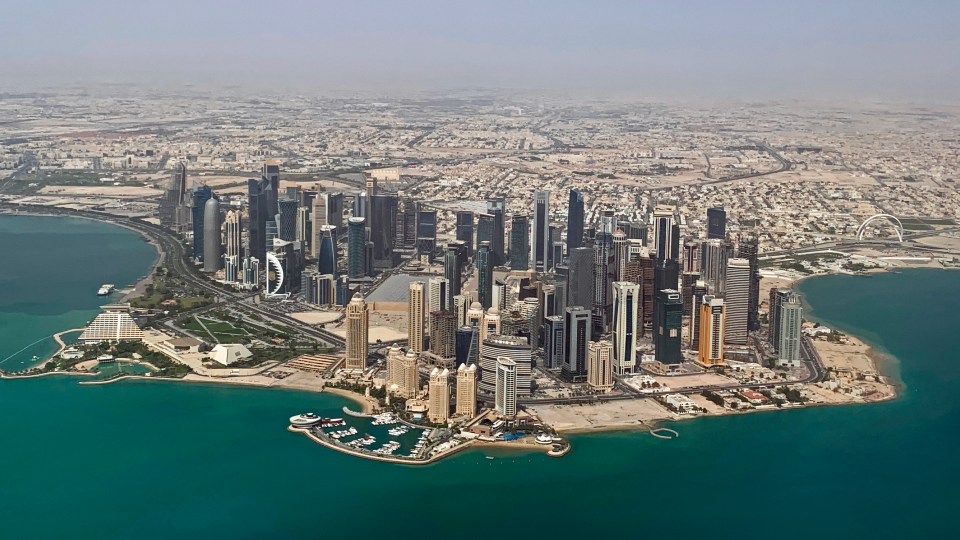
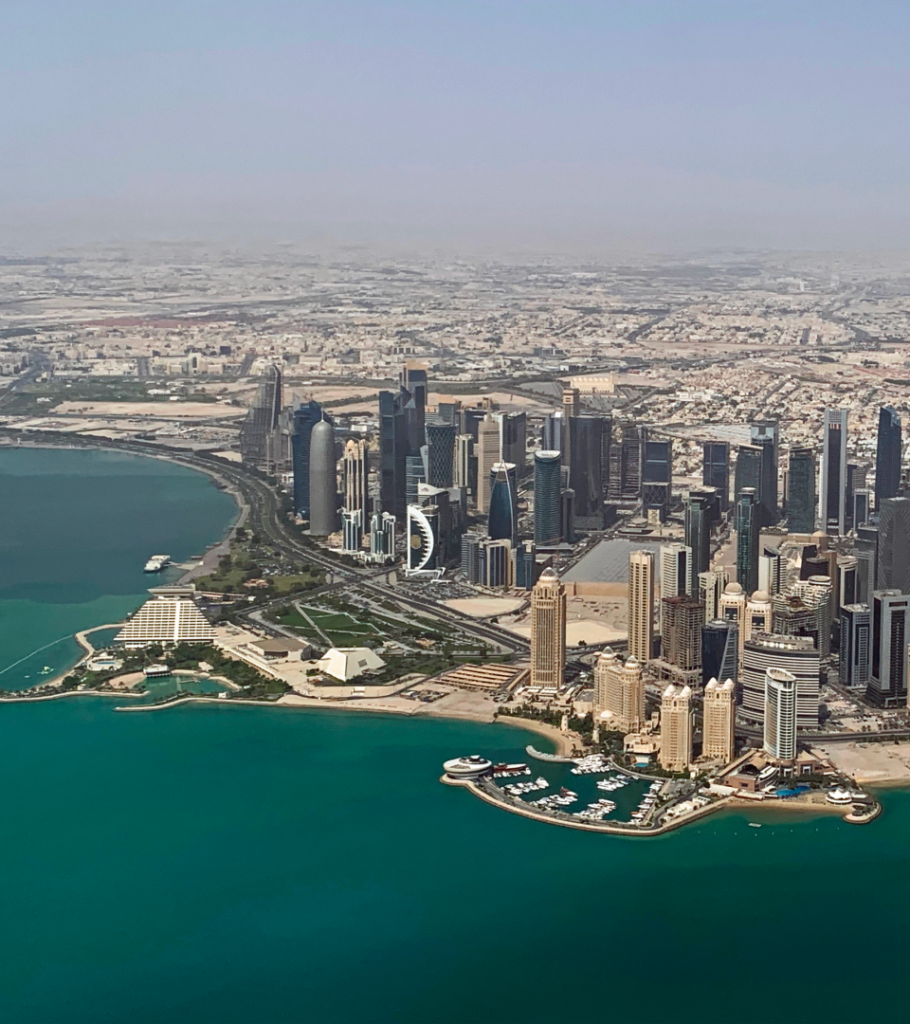
Once more, Cornell’s relationship with Qatar paved the way for this dynamic. Dating back to 2001, Cornell opened up a satellite campus for its medical school in Qatar, inking a $750 million arrangement with the Qatar Foundation. According to Cornell, the Qatar Foundation was a supposedly “private foundation” that “redefined the standards of quality for education in the Gulf region.”42 But it wasn’t long before Cornell began seeing criticism for its cozy relationship with the Qatari dictatorship. In 2014, groups like the Simon Wiesenthal Center began criticizing Cornell for its “outrageous” links with Qatar, given Qatar’s financial backing of groups like Hamas.43 Soon after, Cornell students began joining in that criticism, calling for the university to reveal whether or not Cornell had been complicit in the widespread labor abuses Qatari officials engaged in around the country, primarily targeted at migrant workers.44 Such criticism has only continued to the present day, with ongoing pressure on the university to abandon its authoritarian patron.45
Cornell has defended its relationship, claiming its Qatari presence “is the best way to promote understanding.”46 But even those still backing the relationship acknowledge that it has little to do with spreading American academic or democratic virtues. As the Financial Times reported in 2024, “Defenders of Qatar’s funding say it is no different from the lobbying efforts of other sovereign governments trying to burnish their reputation in the US.”47 That is, just as Saudi and Emirati officials hire fleets of lobbyists (and engage in similar academic funding) to whitewash the images of their regimes, so, too, has Qatar used its funding of Cornell.
Looking Ahead
Despite all of the setbacks, despite all of the issues, the Section 117 database still provides key insights into the ongoing financial flows between universities and authoritarian regimes. It may be ungainly and inconvenient, and is surely missing significant chunks of relevant disclosures. But as the Human Rights Foundation can share, the existing disclosures nonetheless reveal a staggering fact: American universities have agreed to billions of dollars’ worth of financial arrangements with the most malignant, most totalitarian regimes around the world.
Much of the information is scattered or incomplete. And there remain a wide range of questions about this financing. Since we don’t know the specific sources of this funding, we don’t know which governmental cutouts (like the Qatar Foundation) may have been behind certain funding, or which specific oligarchs and regime proxies (such as the Russian oligarch who sat on MIT’s board) may have helped arrange such financing. We also don’t know what specific stipulations or strings came with the gifts and contracts in question.
Still, even with all of the issues outlined above, one thing is inescapably clear: American universities have still not given up on agreeing to financing from foreign regimes. This is especially true of funding from countries overseen by authoritarian, autocratic, and dictatorial regimes who have no interest in things like liberal values or academic freedom — but have every interest in using American universities to launder their reputations, to target cutting-edge research, and to entrench their holds on power that much further. American universities, despite their professions otherwise, have proven themselves handmaidens to authoritarians — a relationship that shows no signs of slowing anytime soon.
Recommendations
To the Department of Education
01
02
03
04
05
To the Democratic Governments and Legislatures in Allied Countries
To Universities and University Leadership
To the U.S. Congress and Federal Policymakers
Acknowledgments
References
Caroline Wazer, “The Fascist Building in Upper Manhattan,” Atlas Obscura, May 2, 2016, https://www.atlasobscura.com/articles/the-fascist-building-in-upper-manhattan.
“Mussolini to Furnish Italian House Here,” The New York Times, January 20, 1926, https://timesmachine.nytimes.com/timesmachine/1926/01/20/119059848.html?pageNumber=5
Ibid.
“Nicholas Miraculous: The Amazing Career of the Redoutable Dr. Nicholas Murray,” Columbia University Press, 2006, https://books.google.com/books?id=HYIyBgAAQBAJ&dq=the+nation+fascism+at+columbia&source=gbs_navlinks_s.
Ibid.
Will Maslow, “Education Act Would Curb Foreign Gifts,” New York Times, October 16, 1986, https://www.nytimes.com/1986/10/16/opinion/l-education-act-would-curb-foreign-gifts-148386.html.
Adam K. Edgerton, “Section 117 of the Higher Education Act: Reporting of Foreign Gifts and Contracts,” Congressional Research Service, February 26, 2025, https://www.congress.gov/crs-product/IF12927?hl=IF12927&s=1&r=1.
Maslow, “Education Act Would Curb Foreign Gifts.”
Adam K. Edgerton, “Section 117 of the Higher Education Act: Reporting of Foreign Gifts and Contracts,” Congressional Research Service, February 26, 2025, https://www.congress.gov/crs-product/IF12927?hl=IF12927&s=1&r=1.
Ibid.
“Foreign Agents Registration Act,” Department of Justice FARA Unit, https://www.justice.gov/nsd-fara.
“‘Foreign Agents’ Explores the U.S. Citizens Lobbying for Foreign Governments,” NPR, August 14, 2024, https://www.npr.org/2024/08/14/g-s1-16968/foreign-agents-explores-the-u-s-citizens-lobbyingfor-foreign-governments.
Grif Peterson and Yarden Katz, “Elite Universities are Selling Themselves — and Look Who’s Buying,”The Guardian, March 30, 2018, https://www.theguardian.com/commentisfree/2018/mar/30/elite-universities-selling-themselves-mit-harvard-saudi-arabia-mohammed-bin-salman.
“China’s Impact on the U.S. Education System,”Senate Permanent Subcommittee on Investigations, U.S. Senate, 2019, https://www.hsgac.senate.gov/wp-content/uploads/imo/media/doc/PSI%20Report%20China’s%20Impact%20on%20the%20US%20Education%20System.pdf.
U.S. Department of Education Office of the General Counsel, “Institutional Compliance with Section 117 of the Higher Education Act of 1965,” October 2020, https://www.ed.gov/sites/ed/files/policy/highered/leg/institutional-compliance-section-117.pdf.
Ibid.
Ibid.
Ibid.
Ibid.
Ibid.
Adam K. Edgerton, “Section 117 of the Higher Education Act: Reporting of Foreign Gifts and Contracts,” Congressional Research Service, February 26, 2025, https://www.congress.gov/crs-product/IF12927.
Terry Hartle, “Letter to Melanie Muenzer, Lisa Brown, and Richard Cordray,” American Council on Education, August 16, 2022, https://www.cogr.edu/sites/default/files/081622%20FINAL%20August%202022%20ED%20letter%20on%20117%20follow%20up.pdf.
Jimmy Quinn, “Biden Admin Winds Down Probes into Universities’ Foreign Gifts,” National Review, October 18, 2022, https://www.nationalreview.com/corner/biden-admin-winds-down-probesinto-universities-foreign-gifts/.
Neetu Arnold, “Shadows of Influence: Uncovering Hidden Foreign Funds to American Universities, ”National Association of Scholars, September 29, 2024, https://www.nas.org/reports/shadows-of-influence/full-report.
Ibid.
Because of the scattered nature of the data available in the Section 117 database, including information missing on when contracts were either begun or completed, the data in this section includes totals for entries with receipt dates listed from 2014-2024.
Because of the scattered nature of the data available in the Section 117 database, including information missing on when contracts were either begun or completed, the data in this section includes totals for entries with receipt dates listed from 2014-2024.
Because of the scattered nature of the data available in the Section 117 database, including information missing on when contracts were either begun or completed, the data in this section includes totals for entries with receipt dates listed from 2014-2024.
“China’s Impact on the U.S. Education System, ”Permanent Subcommittee on Investigations, United States Senate, https://www.hsgac.senate.gov/wp-content/uploads/imo/media/doc/PSI%20Report%20China’s%20Impact%20on%20the%20US%20Education%20System.pdf.
Ibid.
Ibid.
Ibid.
Ibid.
Ibid.
“Treasury Designates Russian Oligarchs, Officials, and Entities in Response to Worldwide Malign Activity,” U.S. Treasury, April 6, 2018, https://home.treasury.gov/news/press-releases/sm0338.
Mike Eckel, ‘World-Renowned Scientific University Quietly Untangles Itself From Russian Billionaire, ”RFE/RL, January 14, 2019, https://www.rferl.org/a/mit-quietly-untangles-itself-from-russian-billionaire/29708417.html.
Ibid.
“Institutional Compliance with Section 117 of the Higher Education Act of 1965,” U.S. Department of Education Office of the General Counsel, October 2020, https://www.ed.gov/media/document/institutional-compliance-section-117-of-higher-education-act-of-1965-october-2020-57158.pdf.
“Institutional Compliance with Section 117 of the Higher Education Act of 1965,” U.S. Department of Education Office of the General Counsel, October 2020, https://www.ed.gov/media/document/institutional-compliance-section-117-of-higher-education-act-of-1965-october-2020-57158.pdf.
Ibid.
Ibid.
Henrik N. Dullea, “Cornell University to Establish Medical School in Qatar,” Cornell Chronicle, April 9, 2001, https://news.cornell.edu/stories/2001/04/cornell-university-establish-medical-school-qatar.
Stewart Ain, “Cornell’s Ties To Qatar Getting Fresh Scrutiny,” Jewish Telegraphic Agency, September 3, 2014, https://www.jta.org/2014/09/03/ny/cornells-ties-to-qatar-getting-fresh-scrutiny.
“S.A. Resolution #16: Addressing Labor Issues in Qatar,” Cornell University Student Assembly, October 16, 2015, https://assembly.cornell.edu/sites/default/files/r16addressing-labor-issues-in-qatar.pdf.
“Institutional Compliance with Section 117 of the Higher Education Act of 1965,” U.S. Department of Education Office of the General Counsel, October 2020, https://www.ed.gov/media/document/institutional-compliance-section-117-of-higher-education-act-of-1965-october-2020-57158.pdf.
Stewart Ain, “Cornell’s Ties To Qatar Getting Fresh Scrutiny,” Jewish Telegraphic Agency, September 3, 2014, https://www.jta.org/2014/09/03/ny/cornells-ties-to-qatar-getting-fresh-scrutiny.
“Qatar’s Ties to US Universities Scrutinised Amid Rise in Antisemitism,” Financial Times, March 16, 2024, https://www.ft.com/content/d0a16f75-8b05-4ff9-b5f1-d473d7f5a704.
To identify the dictatorships and autocracies in question, we recommend using the Human Rights Foundation’s new Tyranny Tracker (located at www.tyrannytracker.org), which identifies both “fully authoritarian regimes” and “hybrid authoritarian regimes.”