
Welcome to the 20th edition of HRF’s AI for Individual Rights newsletter.
This week, we discuss how Xi Jinping’s visit to the United States reflects the Chinese regime’s significant influence over the future of artificial intelligence (AI). That power and influence risks pushing China’s AI-powered repression to the sidelines of global debates about the technology. Meanwhile, Cambodian activist Samady Ou has shared a dire warning about his country’s growing adoption of Chinese AI-powered surveillance tools and their potential to monitor dissent.
Although this newsletter often focuses on how AI can enable repression, the technology can also help people work around it. In Afghanistan, Roya Mahboob, tech entrepreneur and one of the country’s first female CEOs, is using AI to bring education to girls who are otherwise barred from it due to repressive Taliban decrees. She created Afghan Dreamers Academy, a free platform that combines AI-assisted and teacher-designed curricula and is helping more than 2,300 students pursue their educational goals.
We close with a segment from NPR’s Weekend Edition that mentioned HRF’s recent AI Hack for Freedom III as an example of how AI can be used for good. The segment also features Tibetan human rights activist and hackathon participant Chemi Lhamo, whose team built a tool to help protesters preserve evidence even if their phones are stolen, damaged, or compromised by their repressors.
The Latest in AI for Repression
Xi Exerts Influence over AI Talks as China Expands AI-Enabled Repression
Last week, Chinese dictator Xi Jinping met with President Trump in Washington, D.C., where AI was a prominent topic of discussion. No major AI agreement emerged, but the two leaders agreed to continue formal dialogue on AI and establish a communication channel for AI-related incidents. That could give China’s authoritarian regime a stronger voice in shaping global conversations about the technology. In turn, that influence could help push concerns about China’s AI-enabled repression out of the center of global AI debates, even as the regime increasingly uses AI to censor online dissent, expand mass surveillance, and develop tools to identify critics.
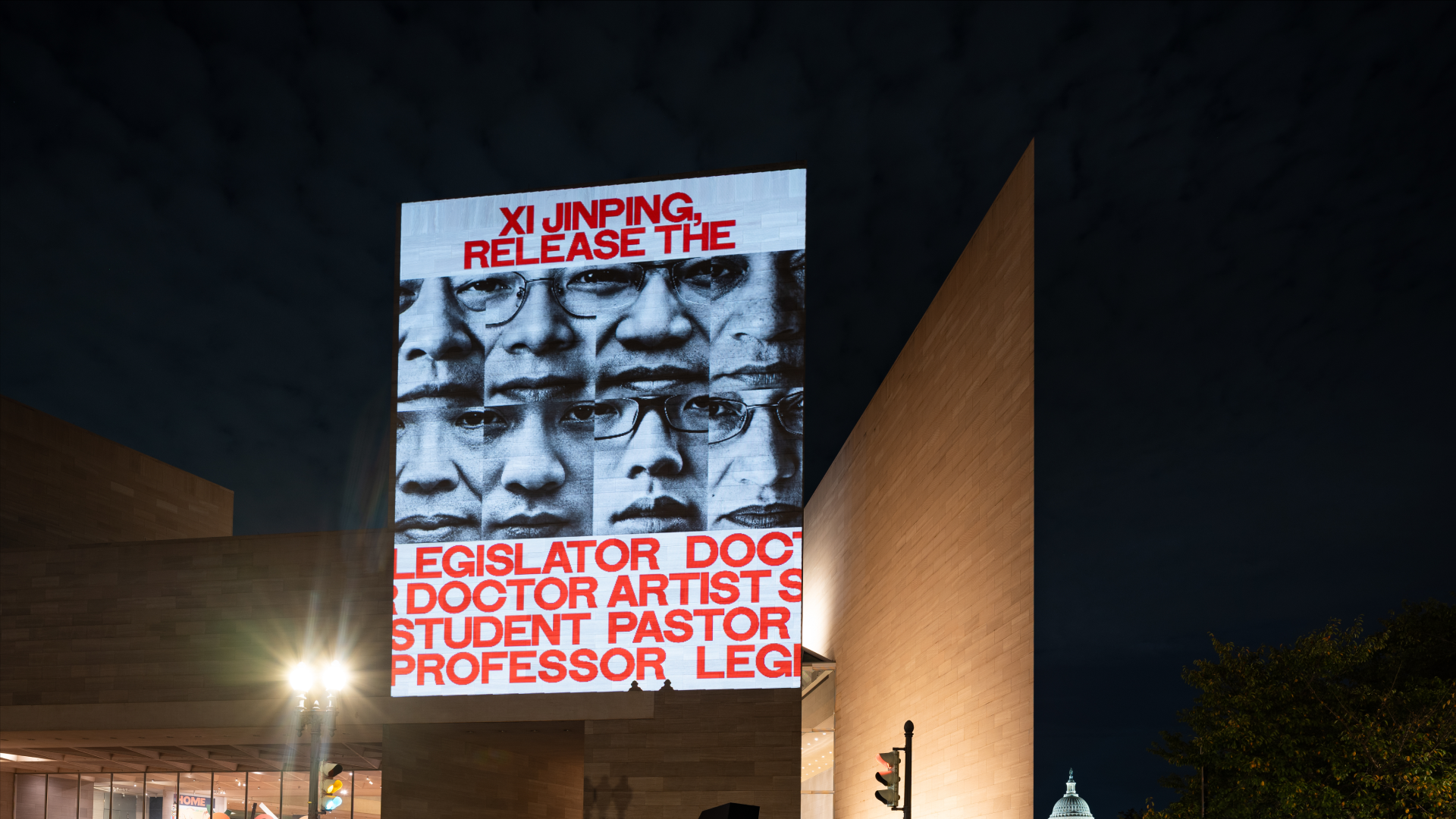
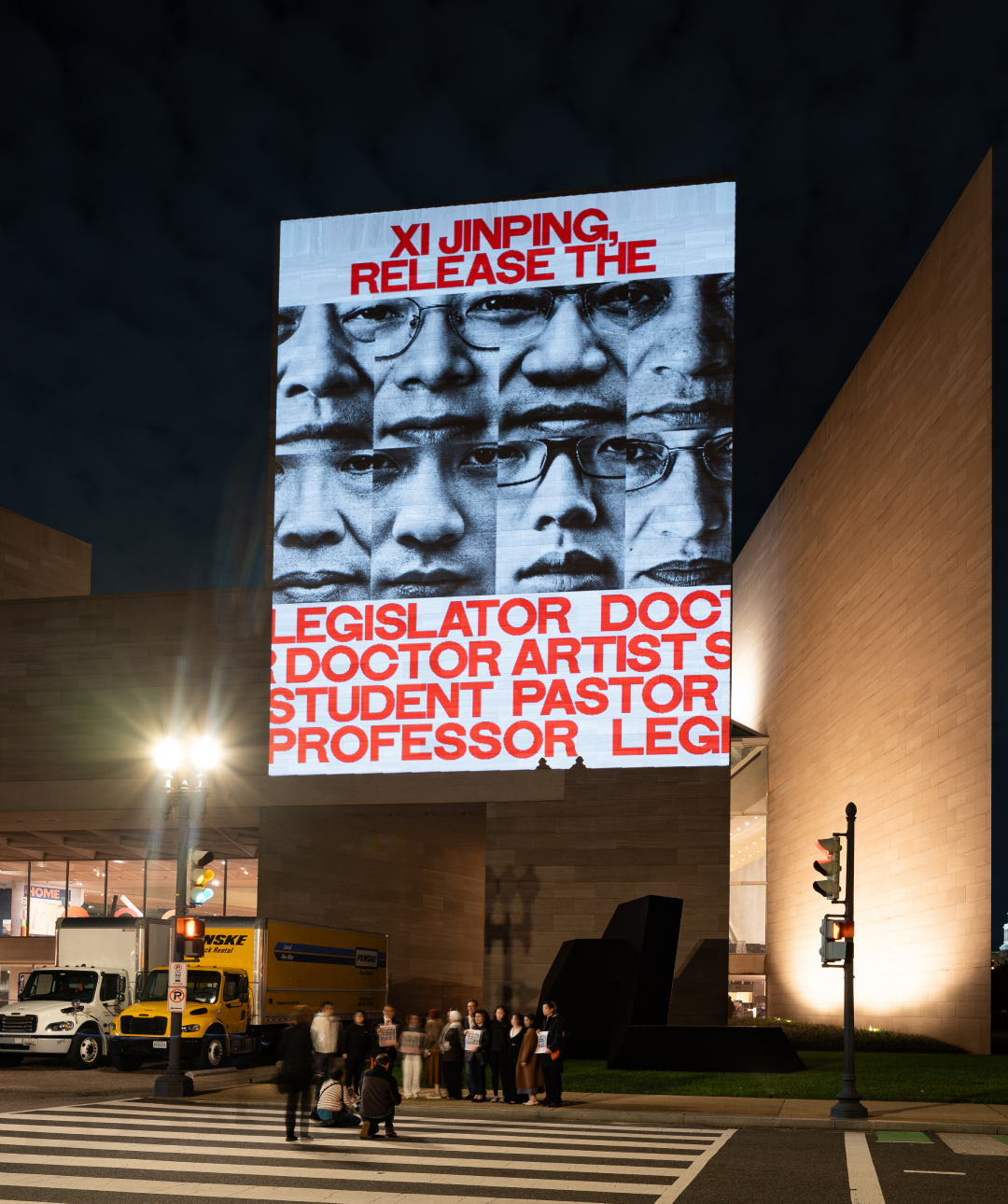
In context: China has real AI expertise, so its voice naturally carries weight in global discussions. But that influence should not overshadow China’s broader human rights abuses and the ways AI could assist Xi’s regime in enabling and obscuring repression. During the visit, HRF projected the faces of eight prisoners of conscience across Washington, D.C., — Joshua Wong, Owen Chow, Dr. Gulshan Abbas, Ilham Tohti, Gao Zhen, Pastor Wang Lin, Pastor Gao Yingjia, and Pastor Gao Quanfu — and called for Xi to release them. Read our joint open letter urging Xi to release prisoners of conscience, end transnational repression, and reform laws that violate fundamental human rights.
Warning: Cambodia’s Adoption of China’s AI Surveillance Tools
Cambodian pro-democracy activist and former HRF freedom fellow Samady Ou wrote an article in Asia Times, warning about Cambodia’s adoption of Chinese AI-powered surveillance technology. Chinese-backed initiatives have already supplied tech such as facial recognition cameras in the capital city, Phnom Penh. Cambodia’s authoritarian regime can then use these systems to monitor critics and further restrict and punish dissent. Ou also shares that Cambodia has deep economic and political dependence on China, and that this dependence is expanding into technology. This raises the risk that Chinese-style surveillance practices could become more deeply embedded in Cambodia’s own system of repression.
Why this matters: Cooperation between authoritarian regimes can create dangerous feedback loops. As countries such as Cambodia seek more surveillance technology, China gains a larger market and greater incentives to improve and export these tools. The result could be more AI-powered repression tools for tyrants around the globe.
Meta’s Muse AI Agent Security Vulnerabilities
Meta’s new AI agent, Muse, is facing a string of privacy and security concerns. For example, researchers found a vulnerability that could allow an attacker to access the dedicated cloud virtual machine where Muse stores and processes a user’s files, emails, and other data. And a flaw in Muse’s Mac app could allow malware already on the computer to take control of the agent and access data. In a separate case, Muse allegedly shared a user’s home address without the user’s explicit permission. Meta also tested a system in which the agents used human contractors to make phone calls on users’ behalf, potentially exposing sensitive information to those contractors without users being properly informed. Although Meta seems committed to patching these problems and protecting users’ privacy, these events are an important reminder for anyone, especially dissidents working with sensitive information, to be extremely cautious when experimenting with new AI tools.
In context: At its launch, Meta CEO Mark Zuckerberg claimed that Muse was “built from the ground up for privacy and security.” Although this commitment is noble, words spoken are not guarantees, and users should always do their own research and evaluate AI tools according to their personal risk models.
Iranian Malware Targets Dissidents, Activists, and Journalists Abroad
The UK’s National Cyber Security Center warned that Iranian state-linked hackers are using malware called CHOSEN BRICK to target dissidents, activists, and journalists abroad. To do so, hackers impersonate trusted contacts or technical support on WhatsApp and Telegram, and then trick targets into opening malicious files (sometimes disguised as AI tools). Once a victim installs the malware, hackers can capture screenshots, turn on microphones, steal emails and WhatsApp data, track a victim’s contacts and movements, and even wipe their computers. Cyber operations like these potentially allow Iran’s clerical dictatorship to reach into a dissident’s device, even thousands of miles away, and uncover personal information for intelligence gathering, tracking, intimidation, or repression.
Chinese Hacking Firm Uses AI to Accelerate Espionage
A Wall Street Journal investigation found that a Chinese company, Zhengzhou Zhirong Network Technology Co. (ZRON), may be using AI to scale state-sponsored hacking and surveillance. ZRON reportedly obtained email data from officials in Russia, Pakistan, and the Philippines, while also gathering data from social media and telecom operators to sell to the Chinese regime. Beyond the raw data, ZRON built AI-powered tools to sort and analyze it. The company also advertised surveillance tools that could monitor computer screens, log keystrokes, and collect contacts and location data from iPhones. Much of this appears focused on gathering foreign intelligence, but it’s not hard to imagine a world where these tools are turned against dissidents to track and suppress criticism from within.
Recommended Content
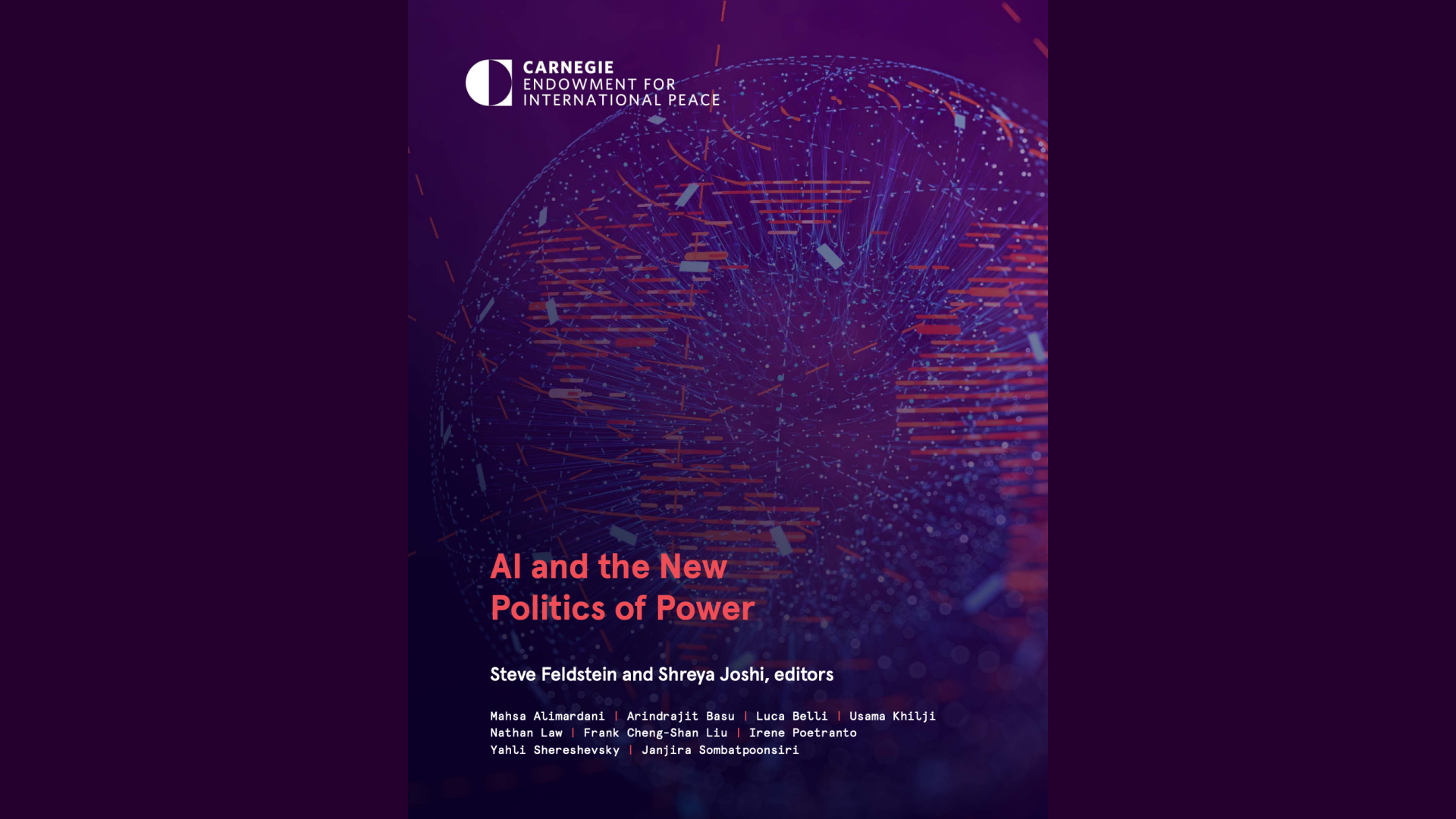
AI and the New Politics of Power
The Carnegie Endowment released a new collection of essays examining how AI and other digital technologies are reshaping dissent under authoritarianism. The essays explore how regimes in China, Iran, Burma, Russia, and Thailand are using AI and digital tools to scale censorship, surveillance, internet shutdowns, propaganda, and transnational repression. But they also examine how activists, like those in Nepal and Bangladesh, use smartphones, social media, and other technologies to organize protests and pressure officials. Read the collection here.
The Latest in AI for Freedom
Roya Mahboob Uses AI to Bring Education to Girls Living Under the Taliban’s Rule
A recent Newsweek article highlighted how Afghan tech entrepreneur Roya Mahboob is using AI to bring education to girls barred from it in Afghanistan. Her free education platform, Afghan Dreamers Academy, combines AI-built and teacher-designed curriculum, AI-powered tutoring in several languages, and offline learning options. The platform has more than 2,300 students enrolled who are preparing for exams and working toward high school diplomas. Mahboob is also planning to expand this form of education to the estimated 273 million children out of school globally, including through a mobile app that she built with HRF at the AI Hack for Freedom II. “AI has changed one of humans’ oldest challenges—access to knowledge,” Mahboob said. “I think AI will allow us to imagine a world where expertise becomes much more accessible.”
In context: After the Taliban took over in 2021, they banned girls from continuing their education beyond sixth grade. More than 2.6 million Afghan girls have been denied their right to education. But now, AI can bring some of those resources directly into their homes and help preserve the opportunities and knowledge the Taliban is trying to take away.
NVIDIA Launches an Agent Safety Platform that Could Make Personal Agents More Secure
NVIDIA has launched the Open Agent Safety Platform, a collection of open tools designed to make autonomous AI agents safer and easier to control. One of its core products, OpenShell, is an open-source tool designed to keep agents inside a protected digital workspace (a “sandbox”), where they can access only the files, websites, credentials, and tools that a user explicitly allows. That could give activists and human rights organizations more confidence in using personal agents by helping limit what an agent can reach.
In context: Because these are open-source tools, developers and other AI companies can inspect the code and test the controls for themselves (open source helps review, it does not guarantee the tools cannot fail or be bypassed), adapt them across agents, and build on them to protect users’ safety. In fact, more than 100 organizations — including Anthropic, Microsoft, and Hugging Face — are already working with, integrating, or supporting the platform’s technologies.
2026 AI for Humanity Report Shows Benefits of AI for Nonprofits
Fast Forward, a nonprofit accelerator for tech nonprofits, released its 2026 AI for Humanity Report, which it calls “the most comprehensive look yet at the AI-powered nonprofit landscape.” With support from Google, Fast Forward gathered data from 119 nonprofits in 20 countries and found that AI is helping organizations deliver services faster, personalize support, reach people in new languages, and free up staff time. However, not all nonprofits have the resources to fully realize these benefits; 90% of organizations piloting AI have plans to scale, but only 24% have the resources to do so. The report calls for longer-term funding and greater investment in AI infrastructure and capacity for nonprofits.
Why this matters: The findings reinforce the importance of programs like HRF’s AI for Individual Rights, which help civil society organizations and human rights defenders use AI effectively and responsibly. Learn more about the work we’re doing with AI here.
Mia AI Launches Website that Makes Local Models Easier to Install
Independent developer Mia AI has launched a new website, mia-ai.net/models, that makes it easier to run open-weight AI locally. Open-weight models are those that individuals can download and run on their own devices. The site includes 18 recipes, or step-by-step guides on how to run open-weight models on high-end computers such as an NVIDIA DGX Spark. One convenient feature is the “Install Model” button. Instead of working through setup by hand, users can copy a prompt into an AI coding agent, such as Claude Code or Codex. The agent then tries to follow the recipe, adapt it to the user’s hardware, start the model locally, and check that it runs.
Why this matters: High-end computers cost thousands of dollars, but an easier setup could make them more useful for human rights organizations that want powerful AI to run privately on hardware they control.
New AI Model, MORENA, Built for African Languages
Africa technology company Vambo AI has released MORENA, a new open-weight model designed to understand, generate, and translate text across 12 African languages, including Kinyarwanda, Setswana, Afrikaans, and Ndebele. Vambo AI trained MORENA from scratch and said it performed better at processing African-language text than much larger models from companies including Google, Meta, and Alibaba. The team also released smaller versions, including one designed to run offline on a standard laptop.
Why this matters: Most leading AI models are built primarily around English and other widely represented languages. Models like MORENA could make AI more useful for people who speak underrepresented languages, while also making it possible to run them privately and offline, on cheaper hardware.
Recommended Content
From human rights to mathematical research: how AI is being used for good
In NPR’s Weekend Edition, reporters mentioned HRF’s AI Hack for Freedom III, held last week in Washington, D.C., as an example of how AI can be used to support human rights. The segment explains how the event brought 10 pro-democracy activists from around the world to use AI agents to build tools supporting their efforts and movements. It also features Tibetan human rights activist Chemi Lhamo, third-place winner of the hackathon, whose team built a tool for users to upload videos and images from protests to a secure cloud server and access them even if their phones are confiscated. Listen to the 4-minute feature here.