
The regime is a family kleptocracy
Corruption finances repression
ALBANISA was the financial pivot
Gold is now the key revenue source
Migration was also a business
Public employees fund the FSLN
The children are operators, not just heirs
The legal system works in reverse
Territorial control is total
Dynastic succession is the ultimate objective
Download
If you would like to save this report, you can always download it here as a PDF.
Introduction
Nicaragua from 1990 to 2018: A Slow but Radical Transformation
To understand what Nicaragua is today, you need to know what it was thirty years ago. In 1990, the Sandinista National Liberation Front (FSLN) lost the elections. It was a historic defeat. Ortega had governed Nicaragua throughout the revolutionary decade of the 1980s, and a citizenry exhausted by the war against the Contras and the US economic embargo chose change. But Ortega and his inner circle did not leave empty-handed.
In the months before handing over the government, Sandinista leaders divided up state companies, properties, and assets among themselves in what became known as the Sandinista piñata. Three laws — Laws 85, 86, and 88 — gave them legal cover. With those resources, the FSLN maintained its organizational structure, funding, and territorial presence during the years it spent out of power. It was not a defeated party: it was a party that “governed from below.”
In the late 1990s, Ortega struck a political deal with Liberal president Arnoldo Alemán. The two divided control of key state institutions — the Supreme Court, the Electoral Council, oversight bodies — with a single objective: to protect each other and pave the way for a Sandinista return to power. The deal worked. In 2006, Ortega won the presidency with fewer votes than the law had previously required, thanks to the electoral reforms he had negotiated himself. He returned to power, but this time with a far clearer vision of what he intended to do with it.
Once in office in 2007, the transformation of the state began. Institutions lost their independence one by one. Judges, prosecutors, and electoral magistrates began answering to the needs of the party. The FSLN used social programs — productive bonuses, zero-interest loans, road-paving projects — as instruments of territorial loyalty: benefits went to those who backed the party and were withheld from those who did not. The line between government and party gradually dissolved.
In 2014, a constitutional reform eliminated limits on Ortega’s reelection and allowed his wife Rosario Murillo to run as vice president, breaking the constitutional prohibition on close family members of the president holding office. The reform was approved by a National Assembly controlled by the FSLN, in the middle of the night, with little public debate. Nicaragua was no longer a deteriorating democracy. It was a state captured in the service of a family.
Why Did Everything Change in 2018?
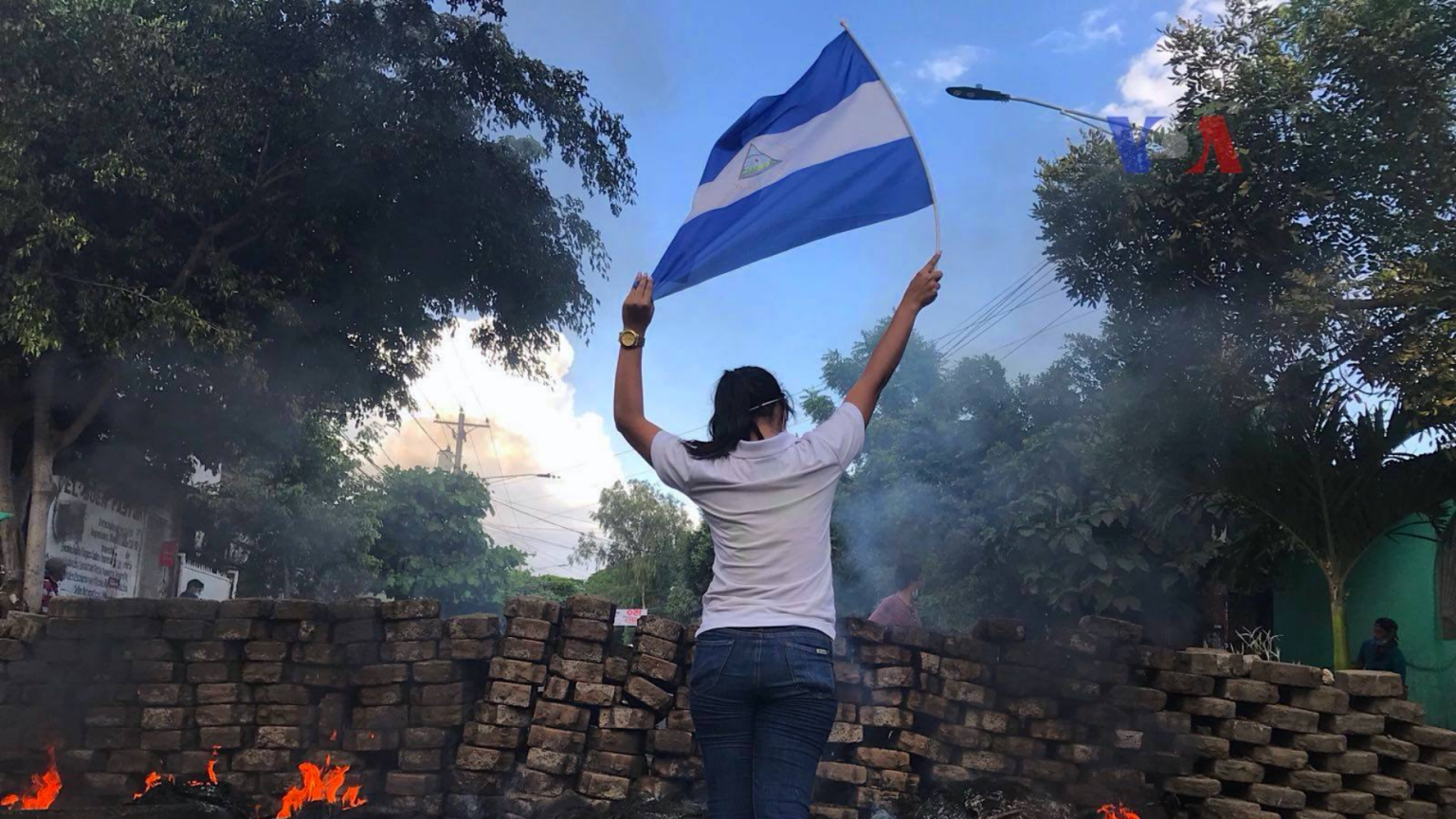
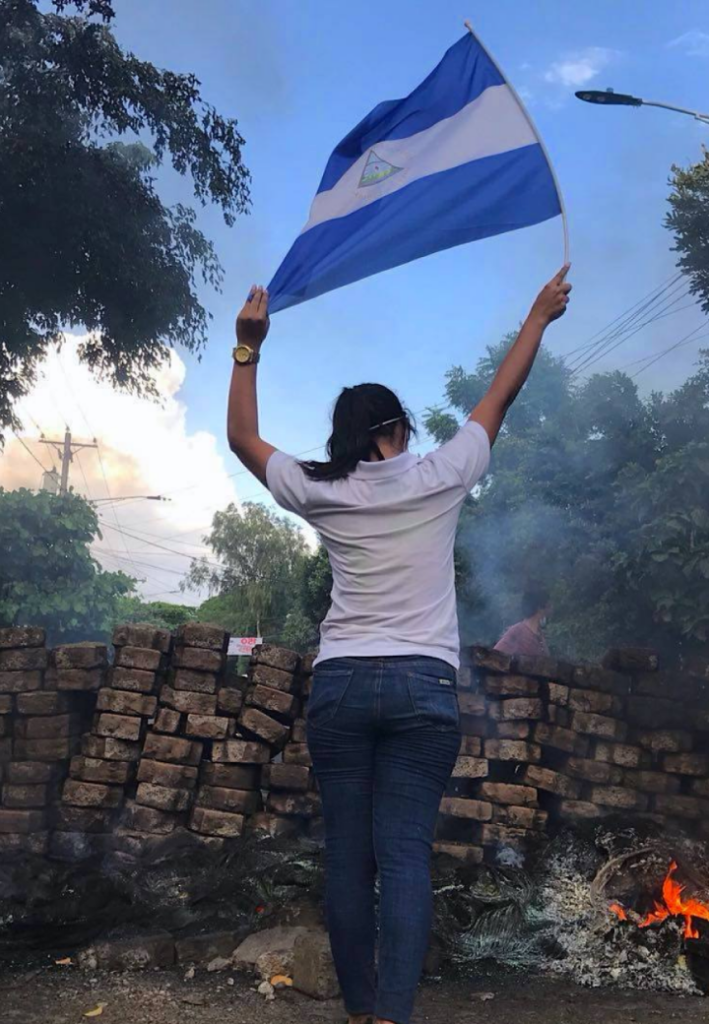
In April 2018, what began as a protest against proposed changes to the social security system (INSS) rapidly became the largest social uprising in Nicaragua’s recent history. Tens of thousands of people took to the streets across the country. Students, farmers, business owners, and religious leaders — an unusual and powerful coalition — initially demanded reform of the INSS, and then, in the face of official violence, called directly for Ortega’s resignation.
The government’s response was brutal and systematic. Police, paramilitary groups known as “turbas,” and FSLN structures acted jointly to suppress the protests. More than 300 people were killed. Hundreds were imprisoned on terrorism charges. Systematic torture was documented in detention centers. The regime deployed every available tool — judicial, police, media — in a coordinated and unapologetic manner. The world watched with disbelief as a Latin American government responded to peaceful protests with snipers and mass arrests.
The crisis was a point of no return. The regime understood it could no longer afford any gray areas. Before April of that year, some residual tolerance existed: a few critical media outlets, some non-governmental organizations, certain business leaders willing to voice opinions. After 2018, all of that was erased by decree. Universities were seized, media outlets were confiscated, civil organizations dissolved, opponents jailed or forced into exile, and religious leaders expelled from the country.
Since then, the model has been radicalized: less negotiation, more control. In 2026, the Human Rights Foundation classified Nicaragua as a “fully authoritarian” regime in its Tyranny Tracker classification, noting that “Ortega and Murillo have been designated as co-presidents who wield control over all three branches of government, thereby eliminating constitutional guarantees of separation of powers and institutionalizing authoritarian rule in Nicaragua.”1
And in order to sustain that total control over an increasingly impoverished and discontented population, the regime needed more money than ever. That financial need explains in large part the expansion of the extraction mechanisms described in this document.
How the Ortega-Murillo Family Maintains and Finances Its Control
The question most frequently asked by those who study Nicaragua is: where does the money come from? A poor country, sanctioned by the West, with no oil of its own and no significant industry. And yet the regime survives and the family accumulates wealth.
The answer lies in an extraction system that operates on several levels simultaneously: natural resources, diverted international cooperation funds, influence peddling over state institutions, and the use of migration as a revenue stream. All of it operates in the dark, through shell companies, front men, and foreign jurisdictions that make tracking nearly impossible.
A central element of this model is the fusion of public and private. In Nicaragua, the line separating state resources from the ruling family’s resources is, in practice, nonexistent. Public contracts go to family-owned companies. Mining and forestry concessions are granted by a state that answers to family interests. State-owned media outlets are operated by private companies tied to the presidential inner circle. In three television channels managed by the family, the state invested around $59 million in advertising spending in just two years. The government pays the family to advertise itself.
To shield this structure from external or internal scrutiny, the regime uses corporations specifically designed for opacity, with front men in executive positions and constantly rotating boards of directors to obstruct identification of the real beneficiaries. The network includes:
- Oil and Energy: The cornerstone was the privatization of Venezuelan cooperation through ALBANISA (Alba de Nicaragua S.A.), which functioned as a “parallel budget” of over $5 billion managed without legislative oversight. Also operating in this space are DNP Petronic2 (Nicaraguan Petroleum Distributor) and Inversiones Zanzibar.
- Telecommunications: Additional corporations connected to the regime include companies such as Telnicsa and the shared concession with Chinese firm Xinwei (Cootel), in which the family obtained a 30% stake.
- Media: Control is near total over Channels 4, 8, and 13, as well as CODISA (Corporación de Distribución S.A.), which operates radio stations including Radio Ya and Viva FM. Even state-owned Channel 6 is operated by the private company NEPISA (Negocios Publicitarios Internacionales S.A.). Over two years, three Ortega-Murillo-managed media outlets received approximately $59 million in state advertising spending.3
- Advertising and Real Estate: Key firms include Lumicentro, Difuso, and In & Out, along with real estate companies ICSA and URBISA (Urbanizadora Industrial S.A.), which has been linked to Grumixsa (Grupo Minero Xiloá S.A.), a company that operated a gold processing plant in Nicaragua.
When international sanctions began to apply pressure, the network expanded into offshore jurisdictions to protect capital. The money moves; the control stays in Managua.
- Cyprus and the British Virgin Islands: Companies such as Oromax Co. Limited4 and Samone International Corp. have been used as shareholders in telecommunications ventures.
- Honduras: Key operators like Francisco “Chico” López moved activities to the neighboring country, creating subsidiaries such as ALBANISA and Amerigas, exploiting weak regulatory frameworks to facilitate money laundering.5
What ties all of these mechanisms together is a simple logic: the state does not serve the citizens, it serves the family. Every institution, every contract, every concession ultimately exists to benefit the Ortega-Murillo inner circle or to secure the loyalty of those who sustain it.
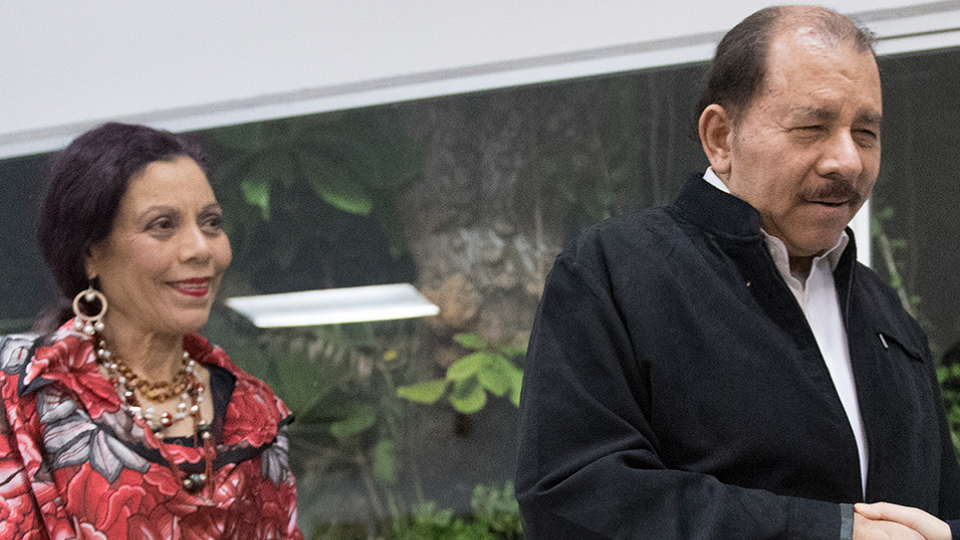
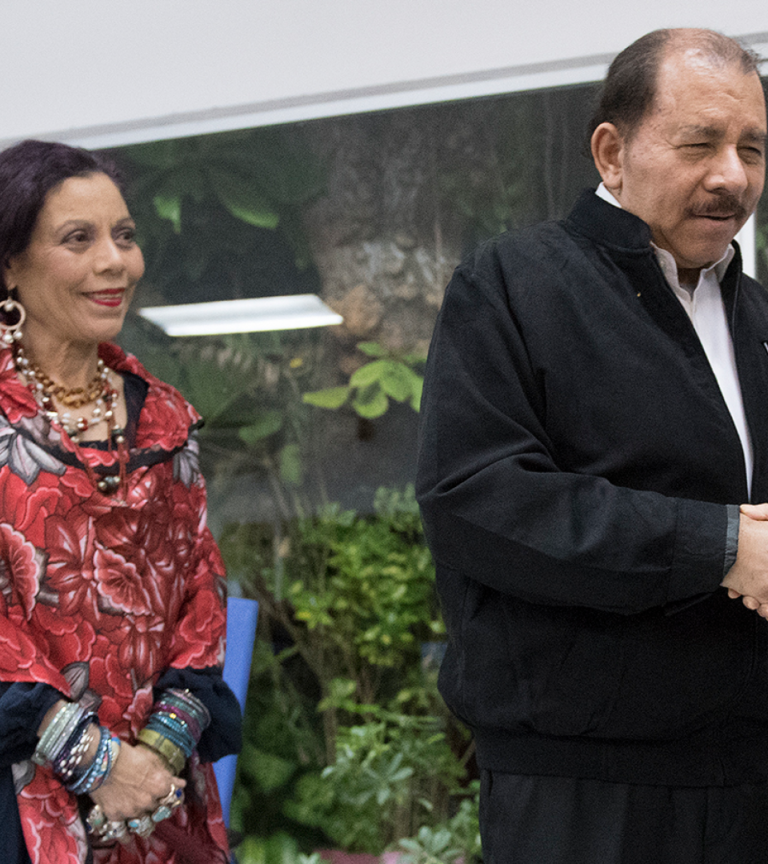
Daniel Ortega (right) and his wife Rosario Murillo (left) rule Nicaragua with an iron grip, turning the country from a fledgling democracy into an outright dictatorship.
Photo credit: Wikimedia Commons
Corporations and Corruption
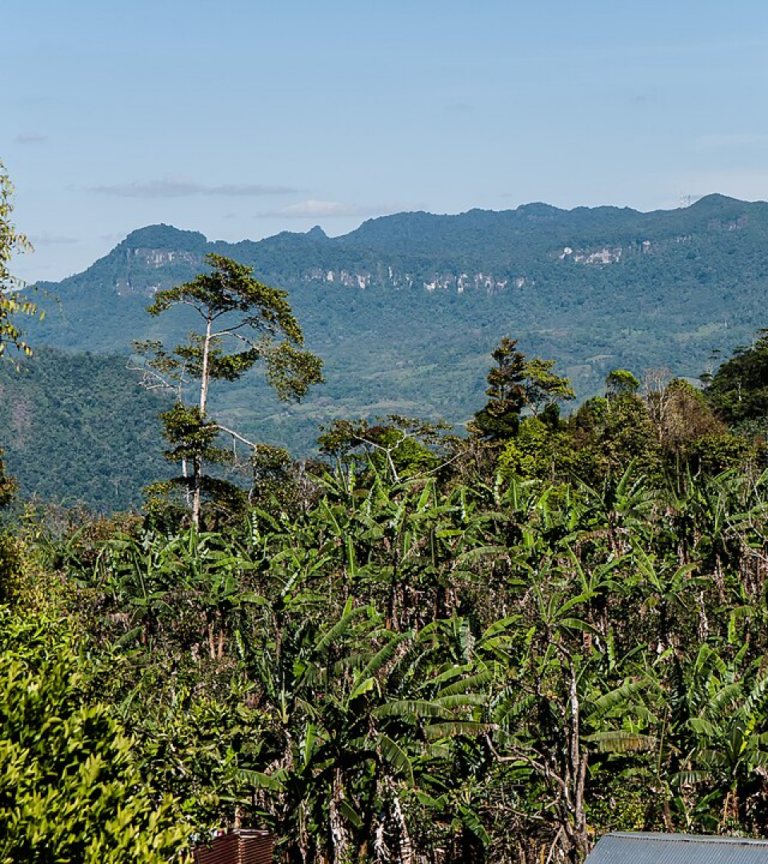
Photo credit: Wikimedia Commons
Corporations and Corruption
ALBA: The Alliance That Changed Everything
It all starts with Hugo Chávez. When the Venezuelan president came to power and began distributing oil as a foreign policy instrument, Ortega saw a unique opportunity. Nicaragua joined the ALBA-Petrocaribe scheme (Bolivarian Alliance for the Peoples of Our America). Venezuela sent oil at preferential prices, and Nicaragua sold it domestically at market prices.
The difference between those two prices — which could be enormous — was cash available immediately, without passing through the national budget and without any congressional oversight. In practice, Venezuela was depositing hundreds of millions of dollars a year into Ortega’s hands, with no accountability to anyone.
This scheme operated between 2007 and 2018, when the Venezuelan crisis gradually weakened it. During that period, oil revenues managed outside the national budget exceeded $5 billion.6 An estimated $3 billion was diverted into private trusts held by the family and its associates.
ALBANISA: The Parallel Budget
To manage that money, the regime created ALBANISA (Alba de Nicaragua S.A.). Officially, it was a joint venture between Venezuela and Nicaragua. In practice, it was Ortega’s personal slush fund: an entity that blended the functions of a corporation, a bank, an investment fund, and an electoral war chest, all under the control of the family’s inner circle and with no independent audits. Unlike other international cooperation funds that pass through the budget and are supervised by the National Assembly, ALBANISA’s money was managed directly by trusted members of the presidential circle.
This “parallel budget” channeled resources toward multiple strategic functions: financing political patronage and territorial loyalty networks, building Sandinista business networks in key sectors such as energy and agribusiness, sustaining the regime-aligned media apparatus, and providing liquidity for the electoral machine without touching the public treasury.
The complete absence of independent audits made ALBANISA one of the largest mechanisms of discretionary resource management in Nicaragua’s recent history.
ALBANISA did not merely manage money — it built a full business ecosystem that spanned electricity generation, fuel distribution, media, and agricultural credit. Operating within that ecosystem were companies such as DNP-Petronic, Caruna, BanCorp, Inversiones Zanzibar, and Difuso Comunicaciones, all tied to the presidential inner circle. Parts of those networks subsequently converged with the economic interests of Daniel Ortega and Rosario Murillo’s children,7 who began assuming operational roles in strategic sectors linked to propaganda, investment, mining, and international relations.
After the Venezuelan crisis reduced these financial flows, the regime adapted the model without abandoning it. Reports from the United Nations Group of Experts published in 2026 identified fictitious projects and the diversion of funds originally earmarked for social programs, redirected to finance repressive logistics,8 paramilitary structures, and political intelligence operations.
That adaptation explains the subsequent pivot toward new revenue sources, particularly gold mining, logging, and the instrumentalization of migration.
Rent Extraction
country.
Between 2006 and 2021, the FSLN accumulated approximately $60 million in official electoral reimbursements. The formal democratic process of elections became a direct revenue stream for the ruling party. Participating in elections that the regime always won generated tens of millions of dollars in public financing, which was then recycled into the FSLN’s electoral machine and territorial patronage networks.
The regime also pursued a deliberate strategy of co-opting the private sector. For years, the Superior Council of Private Enterprise (COSEP) accepted an implicit bargain: economic stability and market access in exchange for political silence.9 Large businesses could operate freely, as long as they did not question the government. That pragmatic alliance neutralized the business class as a potential counterweight for more than a decade. Only in 2018, when the government’s violence against protesters became impossible to ignore, did the private sector break its silence — and pay the price: many business owners were imprisoned, expropriated, or forced into exile.
The family’s private business network also benefits systematically from state contracts. At least 22 companies tied to the Ortega-Murillo circle receive government contracts,10 operated through front men and administered by constantly rotating boards of directors to obstruct tracing.
Other Mechanisms: The Public Payroll as a Funding Source
One of the most striking mechanisms in symbolic terms is the forced deduction of wages from public employees. Since 2008, deductions of between 2% and 10% were reported as an unofficial “party contribution”11 without documentation or consent.
In May 2026, the regime formalized the practice: a 6% deduction from the salaries of employees across approximately 15 ministries. Workers were notified verbally — without any written record — to avoid a paper trail. Doctors, teachers, and government bureaucrats, without fully understanding what is happening, finance the party that keeps them under its control.
Migration: The Transit Corridor Business
Between 2021 and 2024, the Ortega government eliminated visa requirements for dozens of nationalities: Cubans, Haitians,12 Indians, Moroccans, Kazakhs, Uzbeks, and many more. The objective was not to promote tourism. It was to turn Nicaragua into the primary transit platform for migrants seeking to reach the United States.
The scheme worked as follows: private airlines brought charter flights from distant countries directly to Managua. Between May 2022 and May 2023 alone, approximately 1,200 privately chartered flights arrived for this purpose.13 From Managua, migrants paid for transportation to the Honduran border and continued north, bypassing the dangerous Daríén Gap between Colombia and Panama. The regime did not merely allow the practice — it organized it and collected fees at every step.
For migrants entering overland from Costa Rica, the regime charged a $150 safe-conduct fee. The state also collected airport taxes, visa fees, and charges on transportation and lodging. Between January 2023 and the first quarter of 2024, the government reportedly collected at least $74 million through these channels alone,14 though actual revenues were likely much higher.
In total, more than 300,000 people used Nicaragua as an irregular entry point into the United States during that period, , according to estimates cited by Manuel Orozco of the Inter-American Dialogue. A humanitarian crisis became, for Ortega, both a financial asset and a geopolitical pressure tool against Washington.
Gold: The Regime’s New Financial Pillar
When Venezuelan revenues began to decline and Western sanctions multiplied, the regime found its new lifeline in gold mining. Gold has ideal properties for a sanctioned regime: it generates fast foreign currency, is difficult to trace internationally, and can be processed and sold with relative ease in alternative markets. There is no international financial intermediary that needs to approve the transaction; the metal simply crosses borders and becomes cash.
In the first four months of 2026, gold exports generated $1.16 billion,16 representing 32% of all of the country’s exports. The regime has reportedly granted mining concessions covering approximately 8.5% of the national territory, primarily to Chinese companies that displaced Western firms after sanctions took effect.
The terms of those concessions are systematically opaque: absent or non-competitive bidding processes, contracts withheld from public disclosure, confiscation of foreign companies’ assets for transfer to regime allies, and suspected underreporting of exports. Key companies such as ENIMINAS (Empresa Nicaragüense de Minas), Grumixsa (Grupo Minero Xiloá S.A.), and EMSA (Exportadora de Metales S.A.) connect mining operations to the family network.17 EMSA collects unrefined gold, processes it in Managua, and sells it abroad; according to the US Department of the Treasury, the proceeds financed the equipment and salaries of paramilitary groups serving the regime.
US Treasury sanctions imposed in April 2026 against Daniel Edmundo and Maurice Ortega Murillo, two of Ortega’s sons, confirmed what investigative reporting had already indicated: the gold business is a family circuit for foreign currency, money laundering, and illicit payments.
Timber: The Invisible Extraction
Less internationally visible than gold, but functionally equivalent to the regime, illegal logging constitutes a second extractive economy, concentrated primarily in the North Caribbean Coast Autonomous Region (RACCN), the Bosawas and Indio Maíz reserves, and Miskito and Mayangna Indigenous territories. These areas share a key characteristic: they are far from centers of power, receive little press coverage, and the communities that inhabit them have limited capacity to document what is happening or bring their complaints to international bodies.
The pattern mirrors that of gold: concessions granted without transparency, deliberate weakening of environmental oversight institutions, networks of falsified permits, and political protection for operators close to power. Armed settlers invade Indigenous lands, clear forests, and open extraction corridors that are later exploited by cattle ranchers and miners. Community leaders who resist face threats, forced displacement, and, in several documented cases, murder. The state does not investigate these crimes, but tolerates or conceals them.
Data from Global Forest Watch shows that Nicaragua remains among the countries with the highest proportional deforestation rates in Latin America.18 This is the result of deliberate policies that prioritize extraction over conservation, in areas where the state never arrives to protect Indigenous communities but always arrives to protect economically connected operators.
Like gold, timber has low international traceability, making it a useful vehicle for money laundering, illegal trafficking, and financial triangulation. The lack of transparency around logging permits, actual beneficiaries, and extraction volumes make the destinations of its profits difficult to trace. According to indigenous and environmental organizations,19 17 indigenous territories are currently under direct threat from mining and forestry concessions. The loss of these territories is not only an environmental problem—it is the elimination of the last remaining spaces of real autonomy that still fall outside the regime’s control.
Surveillance and Lawfare: Protecting Access to Corruption
Surveillance as a System
The regime does not only extract money. It also needs to ensure that no one can threaten the system. To that end, it has built a social control network that reaches down to the neighborhood and community level.
The Councils of Citizens’ Power (CPCs), originally created as spaces for popular participation, evolved after 2018 into the Electoral Victory Units (UVEs).20 These structures perform three functions: they mobilize FSLN supporters, distribute social benefits conditioned on loyalty, and report any signs of dissent to the security apparatus. Their operation explains something that many observers find puzzling: how the regime can identify and neutralize nascent opposition before it ever has a chance to organize.
Every neighborhood is simultaneously a preventive control space and a potential node of repression. The information generated by these networks flows to police and military intelligence, enabling the identification and neutralization of opposition before it can coalesce. At the local level, these same structures protect extractive businesses. Logging and mining operators work under the political umbrella of these networks.
FSLN political secretaries hold more real authority than elected mayors. The objective is to prevent the emergence of independent local leaders who could develop into an alternative power base. The elimination of municipal autonomy was a strategic goal of the system, not a side effect.
Law as a Weapon
The regime also perfected the use of the legal system as an offensive instrument. In what could be called “reverse lawfare,” the law does not serve justice, but lends a legal veneer to repression and complicates international sanctions.
In 2009, the Supreme Court — already packed with regime loyalists — removed the constitutional limits on Ortega’s reelection. The 2014 constitutional reform completed the process. In both cases, legal form was preserved while its normative content was hollowed out.
The so-called “Law for the Defense of the Rights of the People” (Law 1055)21 is the clearest example of the model. With deliberately vague criminal definitions built around open-ended concepts such as “treason” and “undermining sovereignty,” it allows the criminalization of any opponent, the generation of a judicial file with the appearance of legality, and the justification of arrests and asset seizures before the international community. Under this law, dozens of political leaders, journalists, business owners, and religious figures were prosecuted and convicted, including seven presidential candidates who had announced their intention to run against Ortega in the 2021 elections.
The mechanism serves a dual purpose: inward, it represses; outward, it defends. When international sanctions or condemnations arrive, the regime frames them as “interventionism” in Nicaragua’s sovereign affairs. In this way, sovereignty is converted into a shield for impunity. That same shield protects mining and forestry contracts: as long as the regime grounds them in domestic law, external pressure can be dismissed as interference.
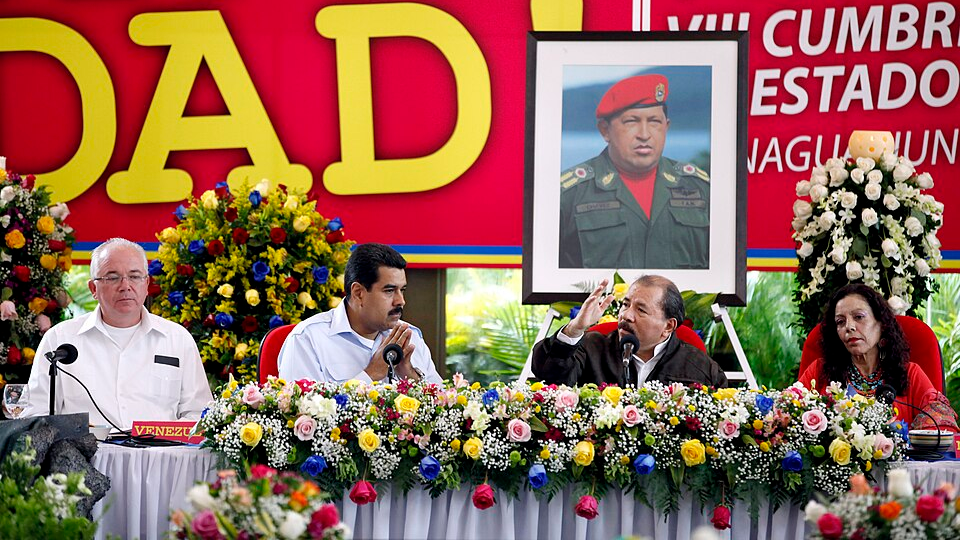
Photo credit: Wikimedia Commons
Photo credit: Wikimedia Commons
Dynastic Consolidation: Power as Inheritance
The final piece of the regime is perhaps the most important for understanding its future: the project is not to hold power indefinitely. It is to transfer it to the next generation.
For the Ortega-Murillo family, losing power does not mean moving into opposition. It means facing justice and losing a patrimony that, by its very nature, cannot be legitimized under the rule of law. The dynastic project is, at its core, a project of family survival. It explains many decisions that from the outside appear excessive or irrational: the elimination of all internal opposition, the integration of the children as active operators, and the subordination of the military through financial incentives. Each of those decisions makes sense when the time horizon is generational, not electoral. This is especially true since, as of July 2026, the regime announced it will no longer hold elections.
The Pillars of Succession
- Rosario Murillo as co-president: Murillo’s ascent from wife to vice president and then co-president formalized dual control.22 Her function is to ensure that institutional loyalty is owed to the family, not to Sandinista ideology.
- Purge of internal rivals (historical cadres): The regime has systematically eliminated any figure within the FSLN with independent standing.23 The cases of Herty Lewites, who was expelled and deceased under critical circumstances, and Víctor Hugo Tinoco, who was imprisoned, expelled, and stripped of his citizenship, demonstrate that no one within the party retains the real capacity to contest power.
- The Armed Forces as a financial partner: The army24 and police25 have been integrated into the family holding through the indefinite extension of their commanders’ terms and the granting of economic stakes in state business ventures. The military has a direct financial interest in the dynasty’s survival.
The Children: Heirs and Operators
US Treasury sanctions imposed in 2026 against two of the presidential couple’s children26 confirmed what investigative journalism had been documenting: the regime’s heirs are not decorative figures — they are active operators with specific roles within the power and business structure:
- Laureano Ortega Murillo is an economic liaison and promoter of foreign investment.
- Rafael Ortega Murillo owns businesses tied to fuel distribution and private security.
- Juan Carlos Ortega Murillo manages propaganda, advertising, and media outlets.
- Camila Ortega Murillo directs Nicaragua Diseña, a platform that receives state funding and backing.
- Daniel Edmundo Ortega Murillo is an official communications front for the regime.
- Maurice Ortega Murillo is linked to state sports management and the gold business.
The concentration of resources within the family core spans media, energy, advertising networks, mining, party structures, and direct control of state institutions.27 The United Nations and the governments that have imposed sanctions on the regime describe the model as an operational merger of party, ruling family, and state, in which the boundaries between public and private have effectively ceased to exist.
Conclusions
Nicaragua is not governed by an ideological dictatorship. It is administered by a family kleptocracy that uses ideology — Sandinismo — as a shield and a narrative, but whose real engine is the accumulation of power and wealth for the next Ortega-Murillo generation. Daniel Ortega did not return to power in 2007 as a revolutionary seeking to transform his country; he returned as a political operator who had learned during the years of opposition that control of the state was inseparable from control of the economy.
What makes this regime particularly resilient is neither its popularity nor its legitimacy. It is its financial architecture. Simultaneous control of energy, finance, justice, armed forces, and natural resources creates a structure that can withstand external pressures that would break conventional governments. As long as funding sources such as gold and timber continue flowing into the family’s accounts, the regime has the fuel to keep operating.
Block-by-block surveillance eliminates spaces for civic organization before they can grow. Lawfare criminalizes dissent under a veneer of legality, complicating the international response because the regime can display judicial files and formal legal proceedings. International sanctions have, to date, been selective and uncoordinated enough that they have not struck the material base of the system. Individuals are sanctioned, but the corporate networks and commercial partners that generate the revenue continue to function.
Also worth noting is what this analysis reveals about the role of external actors. China, whose companies now dominate Nicaragua’s mining sector, has found in Ortega a convenient partner: access to natural resources, a captive market, and a government that asks no questions about human rights or transparency. That relationship is a pillar of the regime’s survival model and a genuine complication for any Western pressure strategy.
The dynastic project is the horizon: the goal is not to keep Daniel Ortega in office, but to transfer that power and its accompanying impunity to his children. To accomplish that, the regime needs time, money, and the absence of a coordinated international mechanism capable of targeting its economic base. Every year that passes without that coordinated pressure is a year in which Ortega and Murillo’s children consolidate their position as economic operators and political successors.
The most important conclusion of this analysis is that any pressure strategy targeting the regime that is limited to the diplomatic or symbolic level has very limited chances of success. What sustains Ortega is not a narrative — it is a network of concrete economic interests. Dismantling it requires going directly after that network: the contracts, the concessions, the companies, the accounts, the commercial partners, and the markets that allow Nicaraguan gold to be converted into dollars available to the ruling family.
Until that material foundation is eliminated, Nicaragua’s dynastic kleptocracy has every incentive and every resource to continue exactly as it is. Time is on its side.
References
Nicaragua, Tyranny Tracker, Human Rights Foundation, https://tyrannytracker.org/?iso=NIC.
Open Sanctions.org. DNP PETRONIC – OpenSanctions. 2026-07-03. https://www.opensanctions.org/entities/NK-inPHN2tCWscVZyRS43KCU2/#rel.sanctions -Office of Foreign Assets Control. Sanctions List Search. 01/8/2026. https://sanctionssearch.ofac.treas.gov/Details.aspx?id=28010
Drazen Jorgic and Ismael Lopez. SPECIAL REPORT Ortega media enrich his family, entrench his hold on Nicaragua. November 23, 2020 https://www.reuters.com/world/special-report-ortega-media-enrich-his-family-entrench-his-hold-nicaragua-2020-11-23/
Confidencial. Inversiones y promesas rusas en Nicaragua empantanadas por sanciones. 18 de marzo de 2022 https://confidencial.digital/principal/inversiones-y-promesas-rusas-en-nicaragua-empantanadas-por-sanciones/
Expediente Público. Refinery in Colón: A Dream Cut Short for “Chico” López Who Arrived in Honduras with His Assets. Agosto 12, 2021. https://www.expedientepublico.org/refinery-in-colon-a-dream-cut-short-for-chico-lopez-who-arrived-in-honduras-with-his-assets/
Expediente Público. La fortuna secreta de Daniel Ortega ligada a sus años en el poder. Enero 1, 2025 https://www.expedientepublico.org/la-fortuna-secreta-de-daniel-ortega-ligada-a-sus-anos-en-el-poder/?fbclid=IwY2xjawSDGxRleHRuA2FlbQIxMABicmlkETE5NThpaEdOZndFNEtyc3RCc3J0YwZhcHBfaWQQMjIyMDM5MTc4ODIwMDg5MgABHoeZabQKR0PKyTuUnQjOhmVQ5hXtHl3065pMLncg6GzBXUQX51NoTTx6A9SZ_aem_lGSpeNMyx74wzTohNZs1DQ
Thania Urías. Infobae. Los hijos de Ortega y Murillo bajo el foco: sanciones de Estados Unidos, control mediático y la red familiar que sustenta el poder en Nicaragua. 17 Abr, 2026 https://www.infobae.com/nicaragua/2026/04/17/los-hijos-de-ortega-y-murillo-bajo-el-foco-sanciones-de-estados-unidos-control-mediatico-y-la-red-familiar-que-sustenta-el-poder-en-nicaragua/
Oficina del Alto Comisionado de Naciones Unidas. Nicaragua: Expertos de la ONU revelan financiamiento corrupto de la represión y red de espionaje contra exiliados, exigen justicia y libertad. 10 de Marzo, 2026. https://www.ohchr.org/es/press-releases/2026/03/nicaragua-un-experts-uncover-corrupt-financing-repression-and-spy-network
Cecilia Barría. BBC News Mundo. Cómo el “gran capital” en Nicaragua pasó de ser aliado a rival de Ortega (y qué puede pasar tras las elecciones) 5 de Noviembre, 2021. https://www.bbc.com/mundo/noticias-america-latina-59151990
Octavio Enriquez. La red de negocios privados de la familia de Daniel Ortega y Rosario Murillo: 22 empresas a costa del Estado. Ciper Chile. 22.02.2022. https://www.ciperchile.cl/2022/02/22/la-red-de-negocios-privados-de-la-familia-de-daniel-ortega-y-rosario-murillo-22-empresas-a-costa-del-estado/
Arítulo 66. Régimen de Nicaragua oficializa “robo” salarial para abultar cartera del FSLN: “Es una burla para los trabajadores”. Abril 30, 2026 https://www.articulo66.com/2026/04/30/regimen-nicaragua-oficializa-robo-salarial-abultar-cartera-fsln/
Megan Janetsky. AP News. Nicaragua is ‘weaponizing’ US-bound migrants as Haitians pour in on charter flights, observers say. October 24, 2023. https://apnews.com/article/cuba-nicaragua-migration-charter-flights-daniel-ortega-3abf2fc16e51e86eb8b25c913b8ec464
Atahualpa Amerise. BBC News Mundo. El millonario negocio de Nicaragua como puerta de entrada para los migrantes irregulares hacia EE.UU. 8 julio 2024 https://www.bbc.com/mundo/articles/cxrr2q3vnn5o
Redacción Confidencial. Dictadura continúa negocio millonario con migrantes, pese a sanciones de Estados Unidos. Junio 13, 2024. https://confidencial.digital/nacion/dictadura-continua-negocio-millonario-con-migrantes-pese-a-sanciones-de-estados-unidos/
La Prensa. En 2013 el paso de migrantes por Nicaragua le generó al régimen C$1,905 millones. Abri 12, 2024 https://www.laprensani.com/2024/04/12/economia/3304481-en-2023-el-paso-de-migrantes-por-nicaragua-le-genero-al-regimen-c1905-millones023-el-paso-de-migrantes-por-nicaragua-le-genero-al-regimen-c1905-millones
La Prensa. Oro y café sostienen el crecimiento récord de las exportaciones, mientras China solo compra el 2% Mayo 23, 2026. https://www.laprensani.com/2026/05/23/economia/3702775-oro-y-cafe-sostienen-el-crecimiento-record-de-las-exportaciones-mientras-china-solo-compra-el-2
U.S. Department of the Treasury. Treasury Sanctions Nicaraguan State Mining Company. June 17, 2022 https://home.treasury.gov/news/press-releases/jy0822
Global Forest Watch. Nicaragua Deforestation Rates & Statistics. 2025 https://www.globalforestwatch.org/dashboards/country/NIC/
Intertextual. Fundación del Río denuncia en la ONU el despojo territorial y la represión contra pueblos indígenas en Nicaragua. Septiembre 23, 2025.https://www.intertextualnic.com/post/fundacion-del-rio-denuncia-en-la-onu-el-despojo-territorial-y-la-represion-contra-pueblos-indigenas-en-nicaragua/
Carlos Fernando Chamorro. Confidencial. “Public employees’ real support for the regime is minimal”. Octubre 4, 2022. https://confidencial.digital/english/public-employees-real-support-for-the-regime-is-minimal/
Houston Castillo Vado. Voz de América. ¿Qué dice la ley por la cual están detenidos líderes opositores en Nicaragua? Agosto 11, 2021 https://www.vozdeamerica.com/a/nicaragua_ley-encarcelado-opositores-nicaragua/6075838.html
BBC News Mundo. Rosario Murillo, esposa de Daniel Ortega, y a quien una nueva reforma constitucional hará oficialmente copresidenta de Nicaragua. 21 noviembre 2024 https://www.bbc.com/mundo/articles/c20g2yjqqdvo
La Prensa. Congreso del FSLN ratifica expulsión de Lewites y Tinoco. Marzo 6, 2025. https://www.laprensani.com/2005/03/06/nacionales/958566-congreso-del-fsln-ratifica-expulsin-de-lewites-y-tinoco
Confidencial. Los militares de Daniel Ortega. Mayo 6, 2023. https://confidencial.digital/especiales/los-militares-millonarios-de-daniel-ortega/
Confidencial. Daniel Ortega “agiganta” a la Policía y paga lealtades regalando ascensos. Enero 9, 2022 https://confidencial.digital/especiales/daniel-ortega-agiganta-a-la-policia-y-paga-lealtades-regalando-ascensos/
Treasury Sanctions Government Officials, Nicaraguan Regime-Linked Gold Firms, and Individuals Involved in Seizing U.S.-Owned Property | U.S. Department of the Treasury. July 7, 2026. https://home.treasury.gov/news/press-releases/sb0451
Confidencial. Ortega Murillo S.A.: Negocios de los hijos de la pareja presidencial dejan USD 936,000 en contratos. Febrero 11, 2021. https://confidencial.digital/nacion/ortega-murillo-s-a-negocios-de-los-hijos-de-la-pareja-presidencial-dejan-usd-936000-en-contratos/
Other Sources
David Luhnow and José de Córdoba. Wall Street Journal: Nicaragua’s Shift Toward Dictatorship Is Part of a Backlash in Latin America. November 9, 2021. https://www.wsj.com/world/americas/nicaraguas-shift-towards-dictatorship-is-part-of-a-latin-american-backslide-11636476080
Inter-American Dialogue: Orozco: “In the specific case of Nicaragua, the main factor driving people to leave is political.” August 1, 2023. https://thedialogue.org/analysis/orozco-in-the-case-of-nicaragua-in-particular-the-main-determinant-that-drives-people-out-is-political
Inter-American Dialogue: State Capture in Nicaragua: The Case of International Pressure. April 3, 2024. https://thedialogue.org/analysis/captura-de-estado-en-nicaragua-el-caso-de-la-presion-internacional?lang=es
Inter-American Dialogue: STATE CAPTURE IN NICARAGUA: The Case of International Pressure. April 2024. https://thedialogue.org/wp-content/uploads/2024/04/STATEC1.pdf
Inter-American Dialogue: The Limited Prospects for Economic Growth in Nicaragua. February 13, 2023. https://thedialogue.org/analysis/las-limitadas-perspectivas-de-crecimiento-economico-en-nicaragua-2?lang=es
Octavio Enríquez. How the public company DNP passed into the hands of the private Ortega Murillo group. February 21, 2022 https://confidencial.digital/principal/como-paso-la-empresa-publica-dnp-a-manos-del-grupo-privado-ortega-murillo/
Associated Press: U.S. Sanctions Sons of Nicaragua’s Leaders and Officials in the Country’s Gold Industry. April 16, 2026. https://apnews.com/article/us-nicaragua-sanctions-ortega-sons-treasury-a9d9721bd331135462dbd810af8ed778
Confidencial. “Family Business”: Delving into the Secrets of the Ortega-Murillo Treasure Chest. January 4, 2023. https://confidencial.digital/principal/negocios-de-familia-hurgando-en-los-secretos-del-cofre-de-los-ortega-murillo/
Wilfredo Miranda Aburto. El País. NICARAGUA. The United States imposes sanctions on two of Ortega and Murillo’s sons over a shadowy gold deal with China. April 16, 2026. https://elpais.com/america/2026-04-16/estados-unidos-sanciona-a-dos-hijos-de-ortega-y-murillo-por-el-opaco-negocio-del-oro-con-china.html
La Prensa: Ortega-Murillo Government Hands Over 8.5% of Nicaragua’s Territory to Chinese Mining Companies. March 13, 2026. https://www.laprensani.com/2026/03/13/english/3651593-ortega-murillo-government-hands-8-5-of-nicaraguas-territory-to-chinese-mining-companies?utm_source=chatgpt.com
U.S. Department of State. Treasury Sanctions Against a Russian Institute Based in Nicaragua and Gold Mining Companies. May 15, 2024. https://2021-2025.state.gov/sanciones-del-tesoro-al-instituto-ruso-establecido-en-nicaragua-y-empresas-mineras-de-oro/
Migration Policy Institute: Crisis Triggers Record Emigration from Nicaragua, Exceeding Cold War Levels. April 19, 2023 https://www.migrationpolicy.org/article/crisis-provoca-emigracion-record-desde-nicaragua
Confidencial: Former Treasury Secretary Marks Six Months Under Arrest. October 5, 2024. https://confidencial.digital/economia/juan-jose-montoya-extesorero-de-hacienda-en-nicaragua/?shem=rimspwouoe
Confidencial: FSLN Slashes Salaries of Public Employees in Nicaragua. April 30, 2026 https://confidencial.digital/nacion/dictadura-quita-dinero-del-salario-a-los-empleados-publicos/
Article 66: 17 Indigenous Territories Under Threat Due to Mining Concessions Granted to Chinese Companies in Nicaragua. March 13, 2026. https://www.articulo66.com/2026/03/13/17-territorios-indigenas-bajo-amenaza-concesiones-mineria-china-nicaragua/
IACHR: NICARAGUA Violence against Indigenous Peoples and Afro-descendants on the Caribbean Coast. August 25, 2025 https://www.oas.org/es/cidh/informes/pdfs/2025/informe_afro_%20ind%C3%ADgenas_nicaragua.pdf
Office of the United Nations High Commissioner for Human Rights. Nicaragua: UN Panel of Experts Urges the International Community to Hold the Government Accountable for Human Rights Violations and to Protect Nicaraguans in Exile. October 30, 2025. https://www.ohchr.org/es/press-releases/2025/10/nicaragua-un-group-experts-urges-international-community-hold-government
Human Rights Watch Report. Nicaragua: Events of 2024. 2025 Report https://www.hrw.org/es/world-report/2025/country-chapters/nicaragua