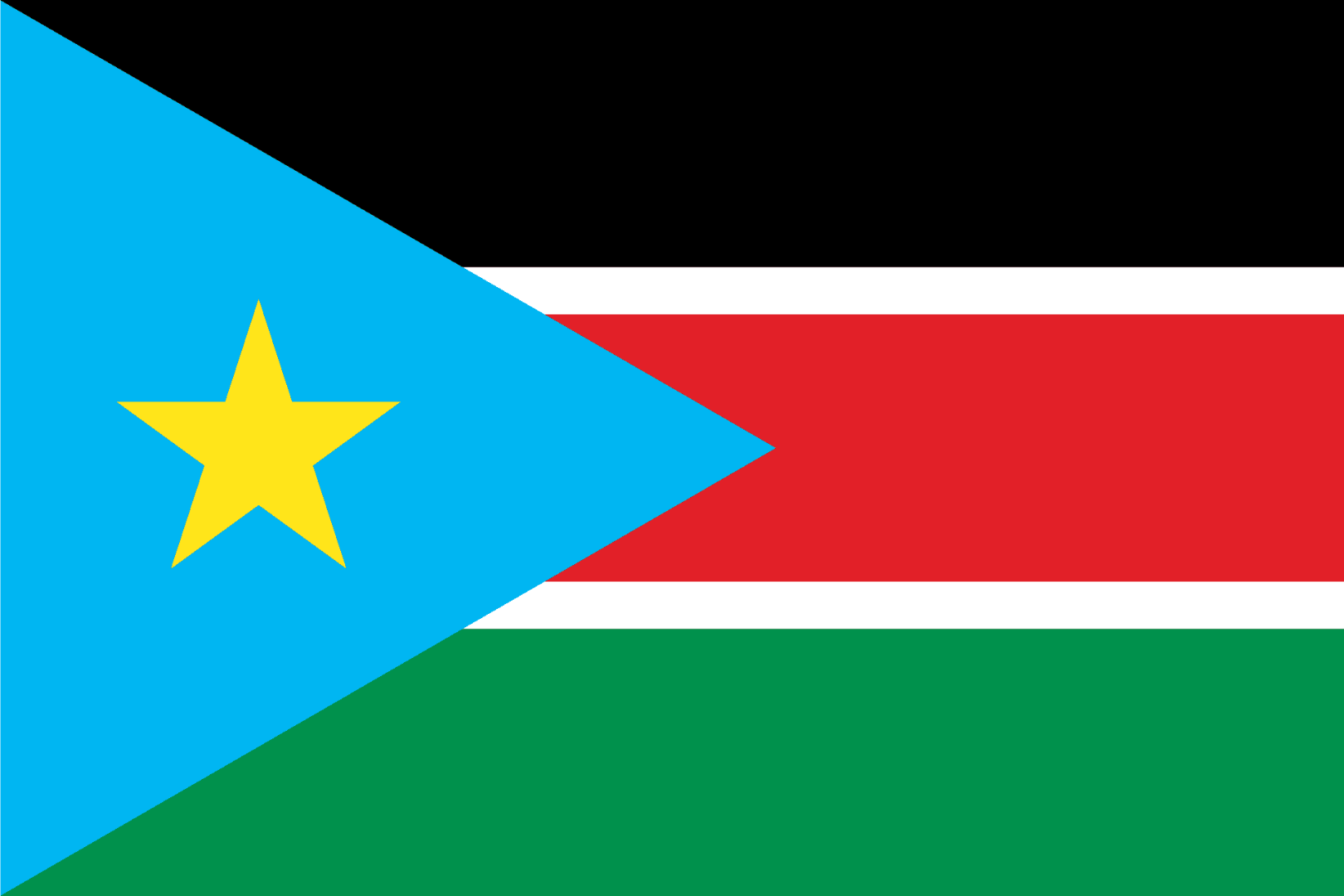
HRF classifies South Sudan as ruled by a fully authoritarian regime.
South Sudan is a de facto presidential republic, and the Head of State, Salva Kiir, assumed power as the leader of Sudan’s erstwhile semiautonomous region of Southern Sudan after the southern Sudanese overwhelmingly voted for separation in 2011, following two decades of civil war with the northern-dominated central government. Since independence, however, a violent power struggle between Kiir, the head of the Sudan People’s Liberation Movement-In Government (SPLM-IG), and his rival Riek Machar, the head of the the Sudan People’s Liberation Movement-In Opposition SPLM-IO, has splintered the main political movement, the Sudan People’s Liberation Movement, and plunged the country into a stasis of recurring factional armed conflict and political and ethnic violence. As a result, South Sudan suffers from one of the world’s worst man-made humanitarian crises, with more than two-thirds of the population, totaling over 9.3 million, requiring urgent humanitarian assistance, with more than four million of those either internally displaced or refugees in neighboring countries.
Key Highlights
National-level elections have been absent in South Sudan since the country’s independence in 2011, rendering moot any assessment of electoral competition. As a result, the unelected Revitalized Transitional Government of National Unity (R-TGoNU)—a power-sharing regime set up in 2020 between the previously warring factions of the SPLM-IG (In Government) of Kiir and SPLM-IO (In Opposition) of rival Machiar setup— represents the highest density of unelected constitutional post-holders in Africa. The R-TGoNU has repeatedly failed to hold elections and delayed them due to a lack of political will for the implementation of crucial pre-election benchmarks stipulated in a 2018 peace deal.
Independent media, political leaders, civil society leaders, organizations, and members of the general public face overt and systematic retaliation if they openly criticize or challenge the regime. The R-TGoNU maintains control through the unchecked powers of the National Security Service (NSS), which employs arbitrary arrests, prolonged detentions, and enforced disappearances against human rights defenders, journalists, and activists. Critical media outlets are censored, intimidated, or shut down, leading to widespread self-censorship and a decline in free expression. Political opponents and civil society leaders who criticize corruption or election delays encounter bureaucratic obstacles, harassment, and false charges, prompting many to flee the country and severely weakening the civic space essential for democracy.
Institutions in South Sudan largely fail to serve as independent checks on the regime. This is primarily due to political capture, a lack of resources, and the systematic non-implementation of mandated reforms. The transitional legislature, while reconstituted, often operates as a rubber stamp for the executive, delaying critical laws and lacking the political leverage to hold powerful R-TGoNU figures accountable. Vital oversight mechanisms required by the peace agreement—such as the National Elections Commission and anti-corruption bodies—have often been either inadequately funded or deliberately stalled, ensuring that these institutions remain powerless and unable to challenge the regime’s continuous consolidation of power.