



Delcy Rodríguez, the de facto dictator of Venezuela, is in The Hague this week, though not at the International Criminal Court (ICC) where a senior official of her regime belongs. Instead, she is being welcomed at another tribunal as a recognized head of state, despite her illegitimacy and her regime’s criminal record.
During her May 11 visit, Rodríguez did not stand trial for her regime’s crimes against humanity, but instead was given the chance to defend her country’s position on a territorial dispute over the Esequibo region, currently a part of neighboring Guyana, at the International Court of Justice (ICJ). Rodríguez’s welcome as a head of state at the ICJ — less than two miles from the ICC — adds salt to the wound already caused by the deafening silence from the world’s top criminal tribunal since it launched an investigation into Venezuela in 2021. The body tasked with ending impunity for the world’s worst human rights violators and perpetrators of crimes against humanity must do better.
Rodríguez is working overtime to sell a reformed image to Washington and the rest of the world, but she cannot be separated from the regime’s long track record of systematic human rights violations. She has held key positions in the regime in Venezuela since Maduro first took power in 2013. As foreign minister, she was a primary spokesperson who sought to legitimize the regime and whitewash its increasingly violent and repressive policies, including its brutal crackdown on nationwide protests in 2014. As president of the National Assembly, she oversaw the passing of anti-democratic legislation that consolidated Maduro’s grip on power.
When Rodríguez became the Minister of Economy, she oversaw a country crippled by a regime-made humanitarian crisis that pushed millions of Venezuelans into exile to escape both the regime’s persecution and the profound scarcity of essential goods. Finally, in 2018, she was hand-picked to become Maduro’s vice president: a role created by the late autocrat Hugo Chávez for top regime loyalists. It was this position that allowed her to take the country’s top office following Maduro’s capture by the United States in January 2026, and that has propelled her into the outlandish position of being accepted on the global stage despite lacking any legal or constitutional legitimacy.
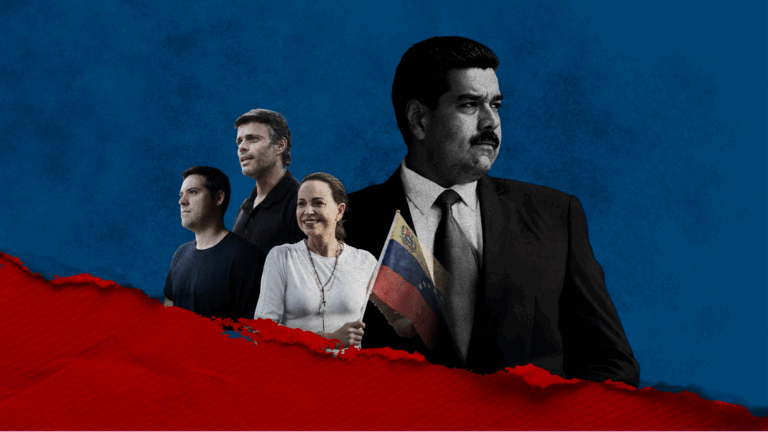
It is critical to remember how Maduro and Rodríguez came into their respective offices in the first place. When opposition candidates Edmundo González and María Corina Machado won the 2024 presidential election by a landslide, the regime presided over blatant electoral fraud. Maduro and Rodríguez followed this with a brutal crackdown on those who protested, carrying out thousands of arbitrary detentions, extrajudicial killings, and enforced disappearances that amounted to crimes against humanity.
Rodríguez doesn’t even pretend to abide by a façade of legality. According to the rules set by the regime’s own corrupt institutions, Rodríguez was only allowed to remain as interim president for 90 days. That period expired in early April.
In this context, Rodríguez’s visit to The Hague served as both a further embarrassment for the international system and a reminder of how it has failed Venezuelans time and time again. Not only has it failed to act promptly and decisively in the face of the regime’s brutal international crimes, but it has gone so far as to protect and legitimize the very people responsible for decades of suffering, exile and persecution in Venezuela.
The gross spectacle and the missed opportunity for justice at The Hague this week should serve as a wake up call not only to those who are concerned for the future of democracy and human rights in Venezuela, but also for anyone who cares about the credibility of institutions like the ICC and ICJ. It should raise the alarm when a notorious figure who should be on the ICC’s most wanted list can instead pose as a global leader right in its front yard.