
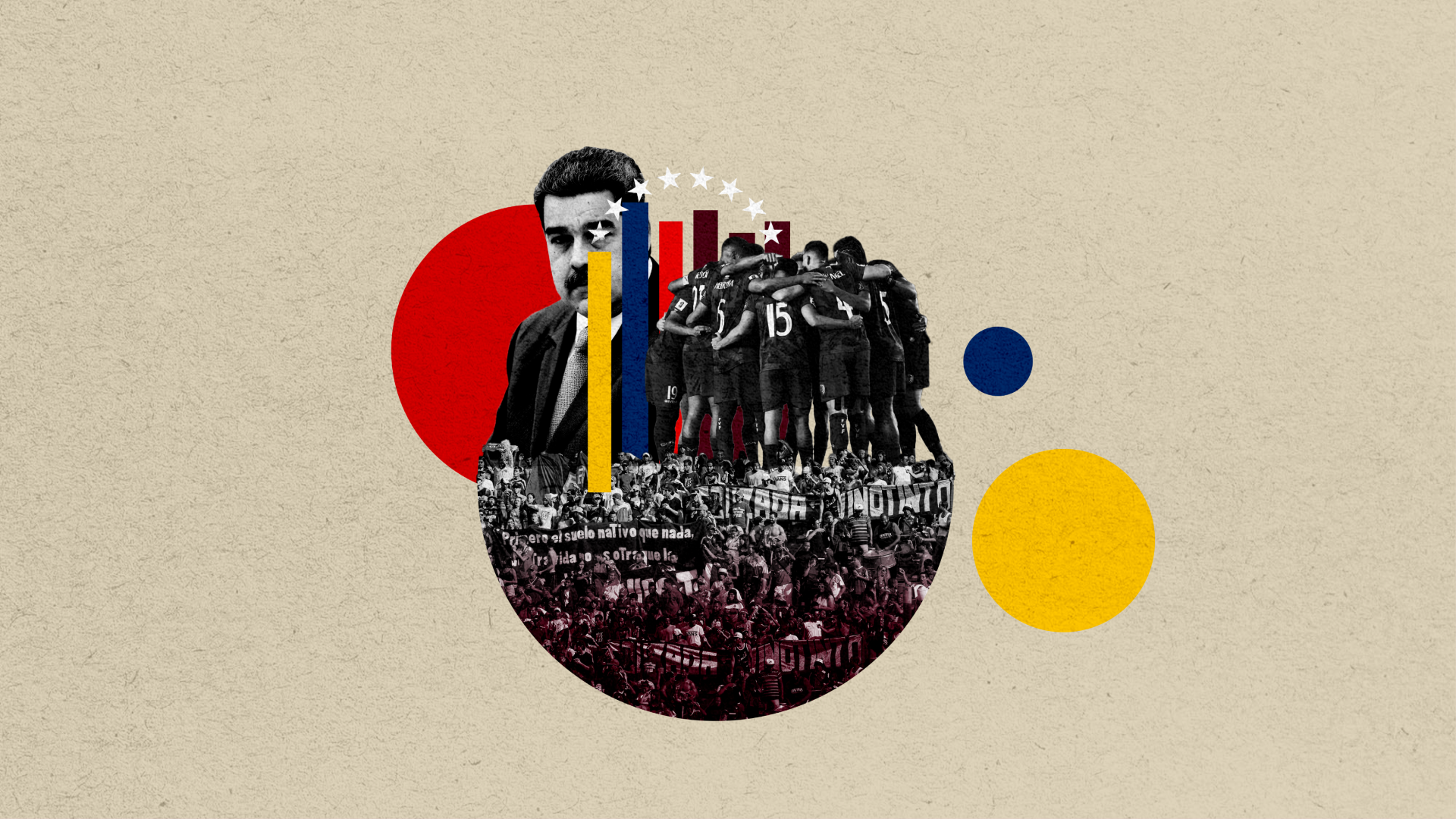

On a tense September night in Maturín, hope bloomed early as Venezuela surged to a 2–1 lead over Colombia, only to crumble following a cascade of goals that sealed their World Cup qualifying fate. The 6–3 defeat extinguished the slim playoff dreams of the Vinotinto (Venezuela’s national team), but it also underscored something far deeper: in a nation fractured by political turmoil, football had briefly become a fragile, unifying refuge.
Venezuela’s elimination from the 2026 World Cup qualifiers was an emotional rupture in a campaign that, for once, rallied an oppressed country around a collective dream. When it comes to international soccer, Venezuelans are long accustomed to disappointment. The country has never qualified for a World Cup, and the Venezuelan Football Federation (FVF) remains riddled with corruption. With baseball as the country’s most popular sport by far, football seemed relegated to inevitable obscurity.
Yet over the course of the qualifying tournament, the Vinotinto defied expectations, winning crucial matches and stirring national pride in arenas where despair once reigned. Their run held special resonance in a Venezuela scarred by economic collapse, mass emigration, and a stolen election; football offered a rare space for unity and shared optimism.
Yet that spark was extinguished in brutal fashion. Colombia’s Luis Javier Suárez torched the Venezuelan defense with four goals in just 25 minutes, turning what had begun as a hopeful finale into a blowout. The fallout was swift and political. Within hours, dictator Nicolás Maduro called for a “restructuring” of the national team, and coach Fernando Batista was sacked along with his entire staff.
For many Venezuelans, the loss exposed the fragile promise that football had come to symbolize: while the sport provided a momentary escape from hardship, it remained deeply enmeshed in the country’s volatile power structures.
Football in the Shadow of Political Turmoil
Football, though historically secondary to baseball in Venezuela, has grown in political and cultural significance in recent decades. The rise of the Vinotinto, has generated a surge of collective enthusiasm, which the regime has sought to harness.
This proved especially true over the past year, as recent successes placed the Vinotinto in a position to potentially qualify for the 2026 World Cup — which would have been their first time at the tournament.
The latest wave of success commenced in 2024, when the Vinotinto reached the quarterfinal stage of the Copa America tournament. Playing fearlessly, the team won the hearts of the baseball-mad nation, giving fans hope in a new crop of players looking to make football history.
However, three weeks after their quarterfinal exit, dictator Nicolás Maduro fraudulently claimed victory following the presidential elections on July 28. Maduro has held power since the demise of his predecessor, Hugo Chávez, in 2013, and has overseen a regime characterized by rampant corruption and serious human rights abuses.
Many international actors — including the U.S., parts of Latin America, the OAS, EU, UN experts, and election observer groups like the Carter Center — rejected the results from the regime-controlled electoral authority. The democratic opposition, led by María Corina Machado and president-elect Edmundo González, collected and published copies of more than 80 percent of the voting tally sheets, proving their victory at the polls by a wide margin. Nationwide protests erupted as a result. Reports indicated that security forces responded with widespread repression, resulting in at least 23 fatalities and hundreds of detained protesters.
Among those arrested was Carlos Chancellor, 64, father of Venezuelan national team defender Jhon Chancellor, and a local opposition leader who was previously imprisoned under Chávez for opposing the regime’s mining policies, according to reports in Venezuela.
Chancellor was released in July 2025 after serving 11 months of arbitrary detention.
Maduro maintains an alliance with the Venezuelan Football Federation (FVF). The organization’s senior vice-president, Pedro Infante, is a former Maduro-aligned congressman and the country’s ex-minister of sport.
Local and regional governments in Venezuela also commonly invest in first division teams to improve their public image. Perhaps the most scandalous example is Universidad Central de Venezuela Fútbol Club (UCV FC), a team based in Caracas and playing in the Venezuelan Primera División. UCV FC is chaired by Alexander Granko Arteaga, the chief of Venezuela’s Military Counterintelligence Unit (DCGIM).
Arteaga’s name is one of infamy in Venezuela. Known as a brutal operator of the Maduro regime, he is under US sanctions and has been investigated by the United Nations for orchestrating extrajudicial executions, enforced disappearances, arbitrary detention, torture, and sexual violence. Arteaga’s reputation has granted him enough influence to reshape UCV FC. Earlier this year, the club debuted its new emblem, a military helmet from Ancient Greece over black and gold stripes — the same design worn by agents of the DGCIM.
Such corruption extends to the national team. After beating Bolivia 2-0 in the 2026 World Cup qualifiers in June, the Maduro regime prevented the Bolivian team’s flight from departing Maturin airport, without offering clear explanations. The incident, which affected the team’s match schedule, caused outrage in Bolivia and signaled the Maduro regime’s overreach into football affairs.
Three months later, Venezuela was eliminated from the qualifiers. Maduro publicly weighed in almost immediately after the crushing 6–3 loss to Colombia, calling it a “painful defeat” and demanding a “restructuring” of the national team. Within 24 hours of his comments, the FVF sacked coach Fernando Batista and his entire staff. For Maduro, football mistakes are framed not just as technical failures but as tied to political doctrine.
Meanwhile, Nobel Peace Prize laureate María Corina Machado has repeatedly voiced her support for the Vinotinto, embracing the team’s successes as a genuine expression of national pride rather than a political prop. Known principally for her pro-democracy activism, she has not made football — or any sport — the centerpiece of her political brand. By avoiding attempts to politicize the team’s setback, she signals that the national squad should remain above partisan conflict. Her language of “pride” and “solidarity” reinforces that stance: even in defeat, she frames the Vinotinto as belonging to all Venezuelans, not just one faction.
Football as a Means of Democratic Renewal
In many ways, Venezuela’s football renaissance has become a double-edged sword. On one side, the Maduro regime has claimed Venezuela’s international soccer triumphs as a justification for its authoritarian rule. But the team has offered ordinary citizens a rare source of joy and solidarity, briefly dissolving the political and economic divides that define daily life.
In that tension lies the paradox of Venezuelan sport today: a game that can amplify the power of a repressive regime can also unite a fractured and oppressed nation. Under a democratic government, football could serve as a source of genuine national and democratic renewal.