
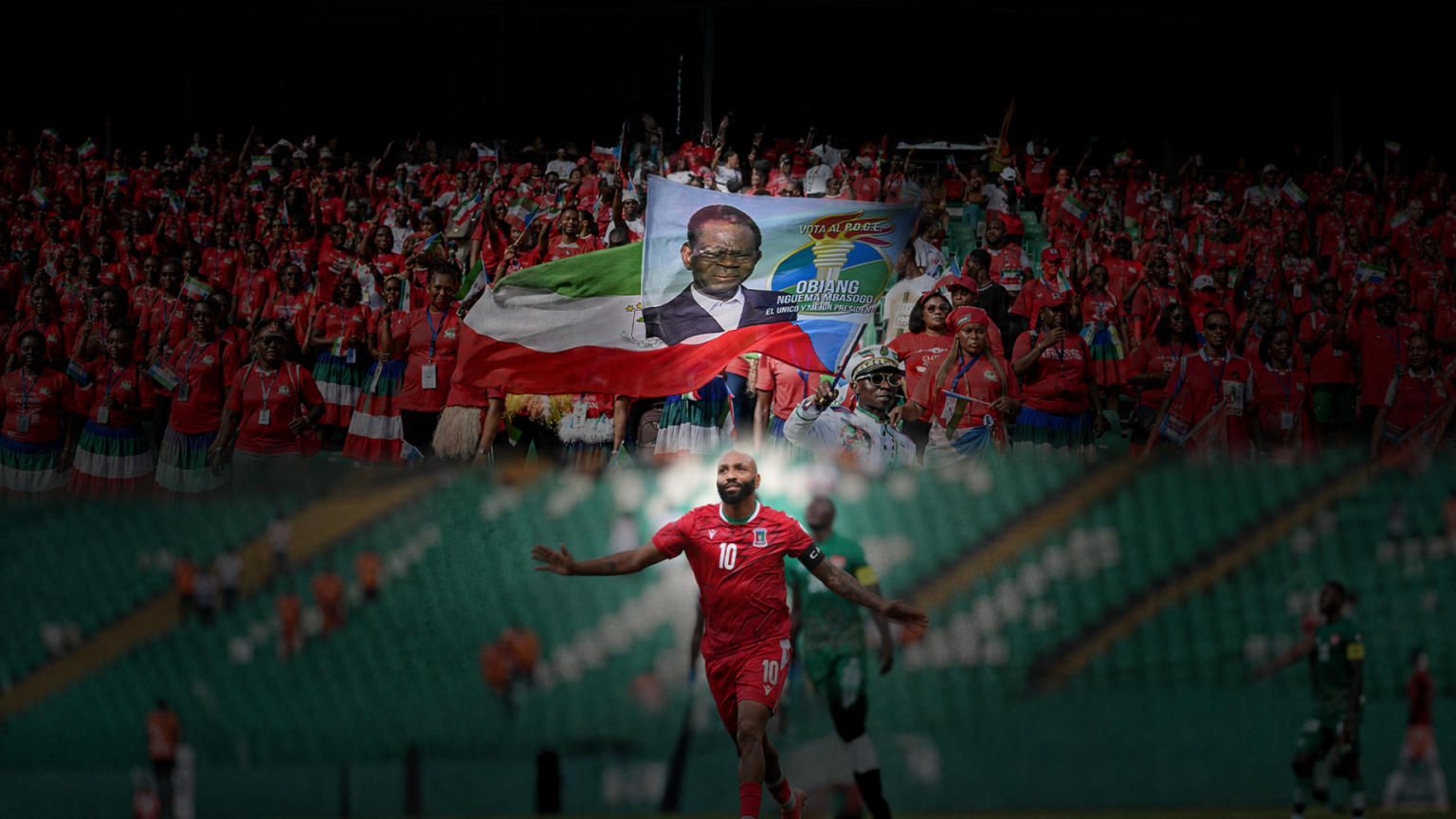
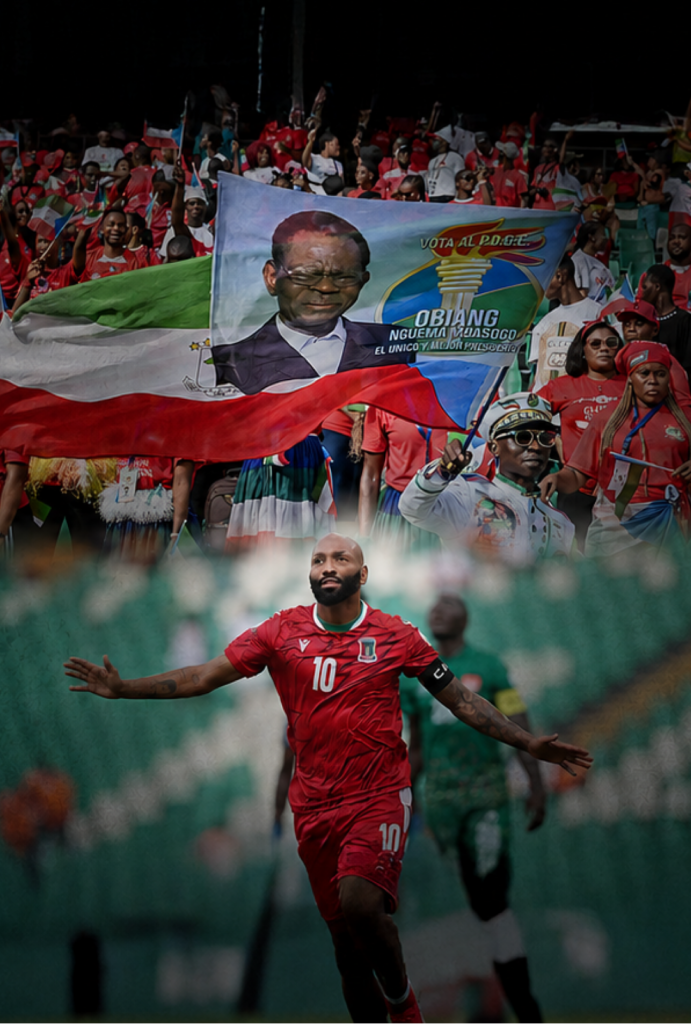
Equatorial Guinea at AFCON 2023: Glory on the Pitch, Corruption off the Field
How Football Became a Tool for Dictatorship
- A Francoist heritage in Equatorial Guinea
- Playing defense: The cost of Macías’s obsession with control on sports
- The “Freedom Coup” and Spain’s gift of a coach
- Distraction through entertainment under Obiang
- The politicization of football: From a neighborhood affair to cronyism
- Oil wealth and the rise of spectacle politics
Nzalang: The Crumbling Façade
- AFCON 2012: Reaching for the glow of international football
- AFCON 2015: From “The nation that saved AFCON from Ebola” to a “war zone”
- A national team with naturalized or foreign-born recruits
- The exploitation of diaspora recruits’ emotional ties
- Using passports to trap and control foreign-born recruits
State of Play of Domestic Football in Equatorial Guinea
Legitimization and Complicity in the Image Laundering of Equatorial Guinea’s Regime
Download
If you would like to save this report, you can always download it here as a PDF.
Background
Equatorial Guinea is a Central African country located in the Gulf of Guinea, bordered by Cameroon and Gabon. It is the only independent Spanish-speaking country in Africa. The nation consists of two main parts: the insular and the continental regions. The insular region consists of three provinces: two on the island of Bioko, home to Malabo, until recently the country’s capital1, and one on the island of Annobón. The continental region, formerly known as Río Muni, is home to the country’s largest city, Bata. It is divided into five provinces: four inland and one along the coast, which encompasses the islets of Corisco, Great Elobey, Little Elobey, Conga, Banie, and Cocoteros.
Since gaining independence from Spain, Equatorial Guinea has been ruled by two men from the same family and clan: Francisco Macías Nguema, the country’s first dictator, who was notorious for his totalitarian rule and extreme brutality2; and his nephew, Teodoro Obiang Nguema Mbasogo, who overthrew Macías in a 1979 military coup and today remains the world’s longest-serving republican head of state. Obiang and his party, the Democratic Party of Equatorial Guinea (PDGE), have maintained a continuous hold on power. Both rulers drew heavily from Francoist Spain, notably its 1947 Fundamental Law, embedding authoritarianism into the country’s governance.
Obiang’s power is absolute and only shared with his son, Teodoro Nguema, who is the country’s vice president. On paper, the country’s oil wealth and small population of 1.6 million have endowed it with one of the highest GDP per capita figures in sub-Saharan Africa3. In reality, even the most generous estimates place poverty rates at more than fifty percent4, while Obiang, his son, and the inner circle of the ruling family live in luxury. Dissent is brutally repressed, and the ruling family exercises absolute and arbitrary control over every branch of government and major institutions, including the national football federation, FEGUIFUT.
Though FEGUIFUT’s statutes stipulate the federation’s political neutrality and independence5, its governance reflects the tight grip of Obiang’s inner circle. Its president, Venancio Tomás Ndong, is a protégé of the first lady’s brother, while the former Minister of Youth and Sports, Patricio Bakale Mba Medja, now serves as a trusted presidential advisor. Despite the regime’s public pledges to invest in and develop professional football, the men’s national team, Nzalang Nacional, has remained in the lower tiers of international competition6. In many ways, football mirrors Equatorial Guinea’s society and offers a revealing window into the authoritarian regime’s inner workings.
Equatorial Guinea at AFCON 2023: Glory on the Pitch, Corruption off the Field
Emilio Nsue and Nzalang Nacional’s protest against corruption
On Feb. 11, 2024, Emilio Nsue, the captain of Nzalang Nacional — meaning “lightning” in Fang, the language of the country’s ethnic majority — received the Golden Boot award, crowning him as the 2023 Africa Cup of Nations (AFCON)’s top scorer. He stood on the podium of champions at the trophy ceremony shortly after Côte d’Ivoire defeated Nigeria to win its third African championship. Nsue reveled in the glory of his most significant moment on the global stage, a consecration of his breakout performance in the tournament. Nzalang Nacional’s incredible run in the tournament included a historic 4-0 upset victory against eventual champions Côte d’Ivoire.
But just two days later, as global attention had already shifted away from AFCON, Equatorial Guinea’s football federation FEGUIFUT suspended Nsue, who had become the nation’s golden boy, on vague accusations of indiscipline. The next day, Nsue and ten other Nzalang players issued an open letter rejecting the accusations. Instead, they claimed they had been “continuously humiliated, mistreated, swindled, threatened, and disrespected by FEGUIFUT president Venancio Tomás Ndong and Sports minister Patricio Bakale,” both cronies of Equatorial Guinea’s dynastic regime. The letter stated that the targeting of Nsue was meant to intimidate the other players into not speaking out against a number of abusive practices, including the embezzlement of more than $1 million in financial incentives promised to players and the International Federation of Football Associations (FIFA) funds earmarked for football development in the country.

– Nzalang Nacional’s open letter following the suspension of Emilio Nsue, Iban Salvador Edu, and a part of the technical staff from the national team, Feb. 14, 2024.
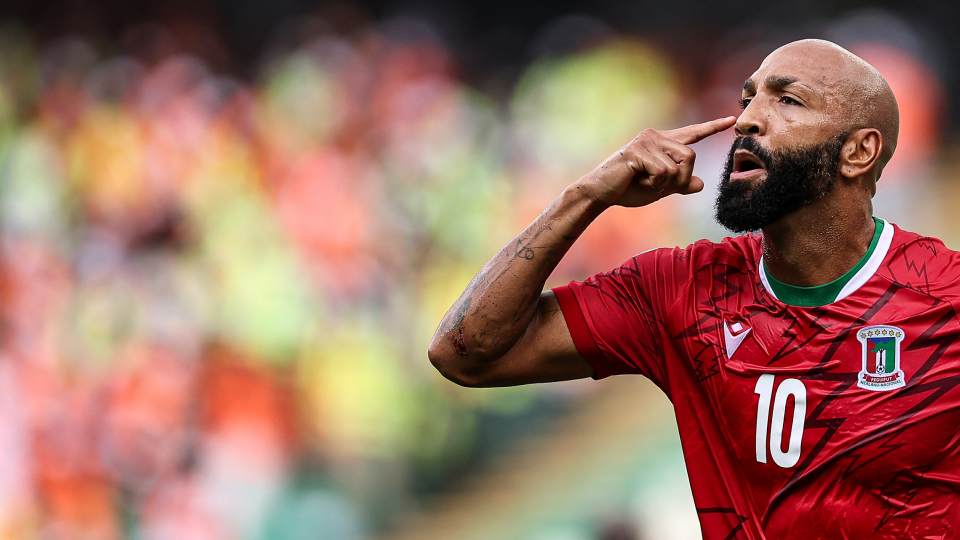
Emilio Nsue plays in a match between Equatorial Guinea and Guinea during the 2023
AFCON at Alassane Ouattara Stadium in Abidjan.
Photo Credit: Franck Fife / AFP
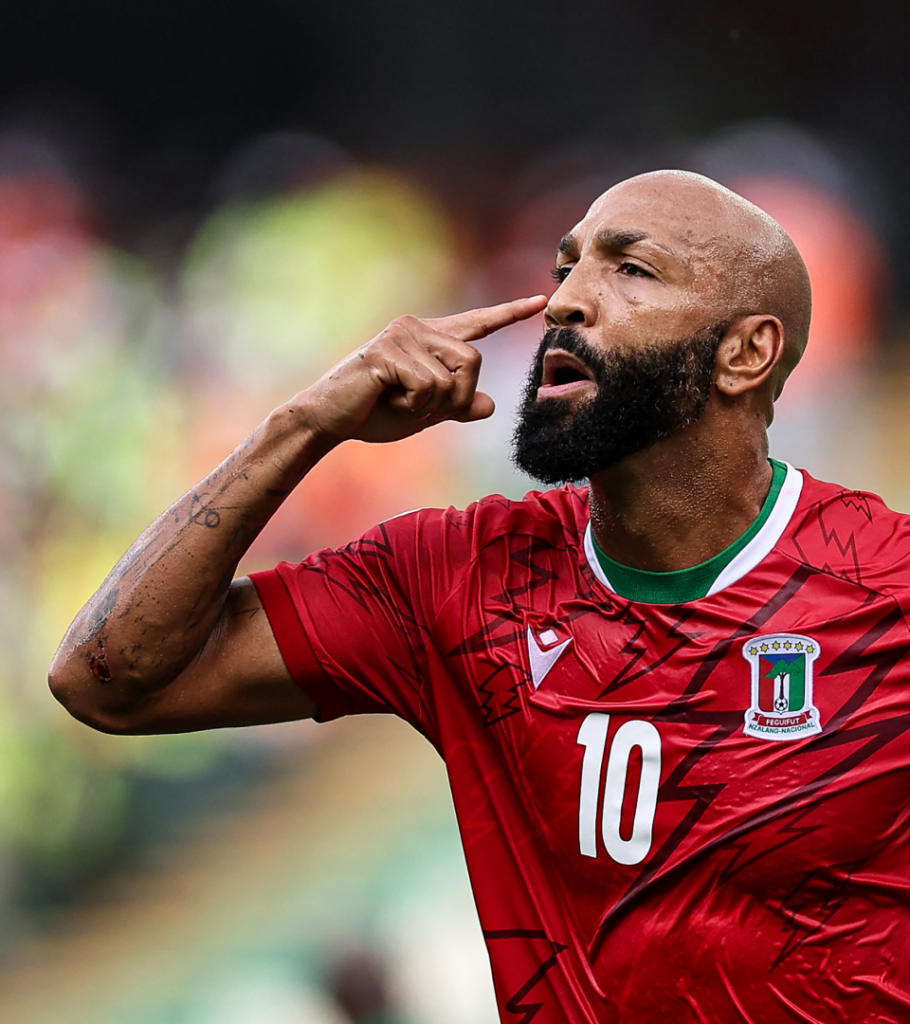
Emilio Nsue plays in a match between Equatorial Guinea and Guinea during the 2023
AFCON at Alassane Ouattara Stadium in Abidjan.
Photo Credit: Franck Fife / AFP
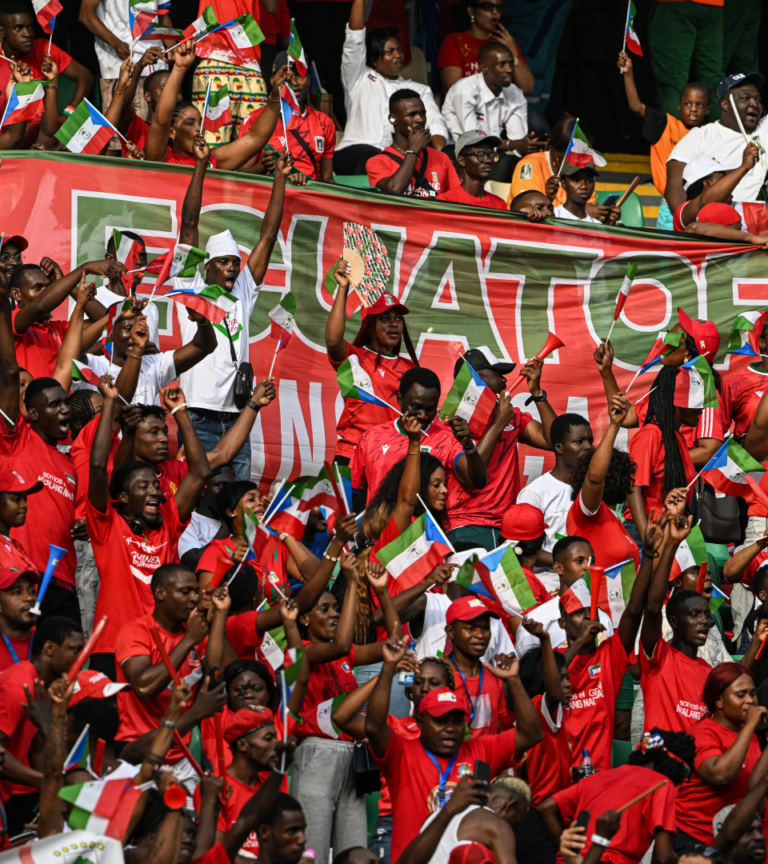
Equatorial Guinea’s supporters wave ahead of the AFCON 2024 round of 16 football match between Equatorial Guinea and Guinea at the Alassane Ouattara Stadium in Abidjan.
Photo credit: Issouf Sanogo / AFP
Nzalang’s AFCON fever and the semblance of a happy football nation
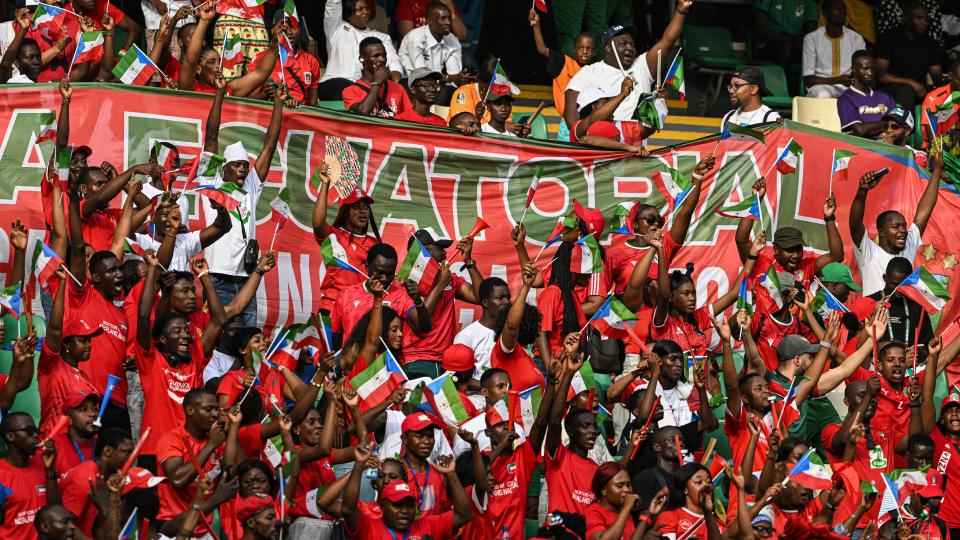
Equatorial Guinea’s supporters wave ahead of the AFCON 2024 round of 16 football match between Equatorial Guinea and Guinea at the Alassane Ouattara Stadium in Abidjan.
Photo credit: Issouf Sanogo / AFP
“Tiempo de ambiente:” Football as a distraction
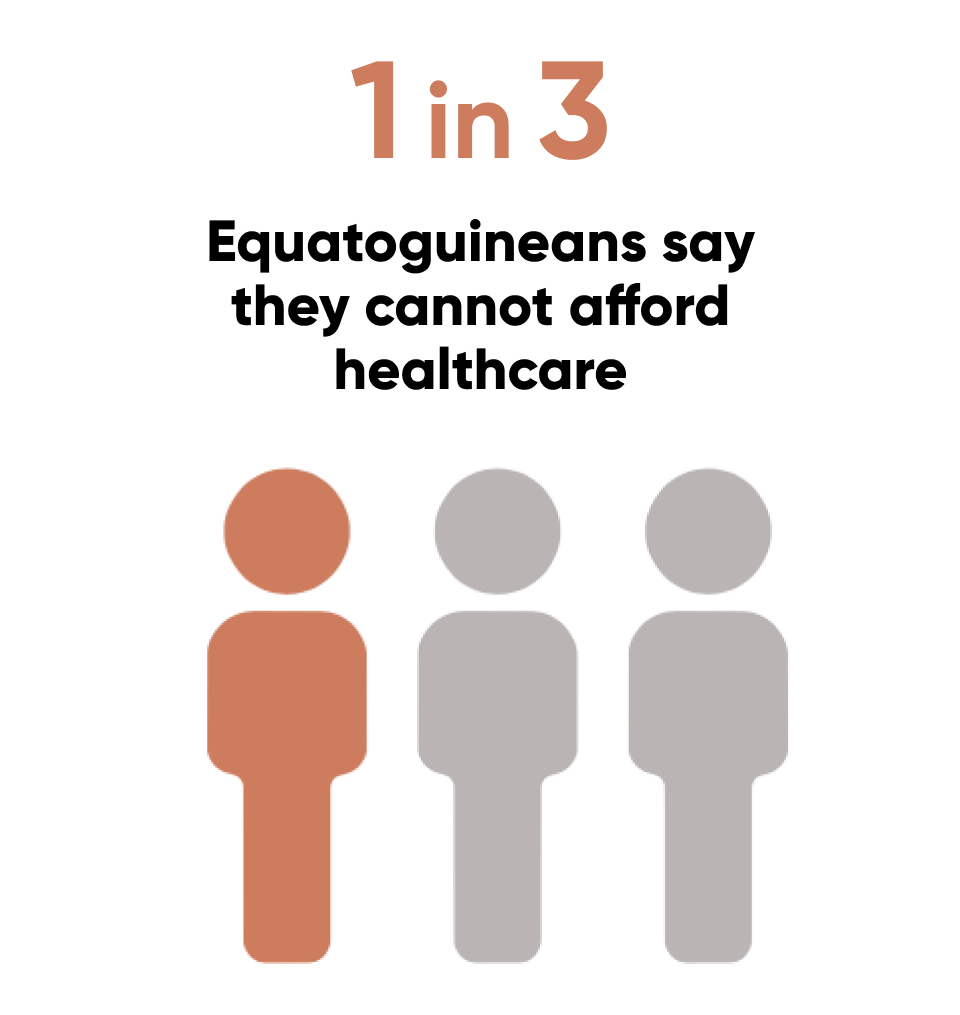
The celebrations surrounding AFCON exemplify what Equatoguineans commonly refer to as “tiempo de ambiente” — moments during festive periods or other occasions when citizens temporarily disconnect and forget their grim realities, which include arbitrary arrests, unemployment, limited opportunities, and restricted access to decent health and education.
For the regime, the euphoria surrounding Nzalang’s run in AFCON offered the kind of international prestige, nationalist fervor, and unity that it could not buy or coerce from ordinary citizens. “Who does this image of happiness on social networks favor? Clearly, Obiang,” Esono Eyoma, an exiled opposition activist and founder of YouTube channel Abaha TV, told HRF, pointing out that the effect of the appearance of normalcy is that “any person who does not know the country in-depth may wish to live in Equatorial Guinea.”
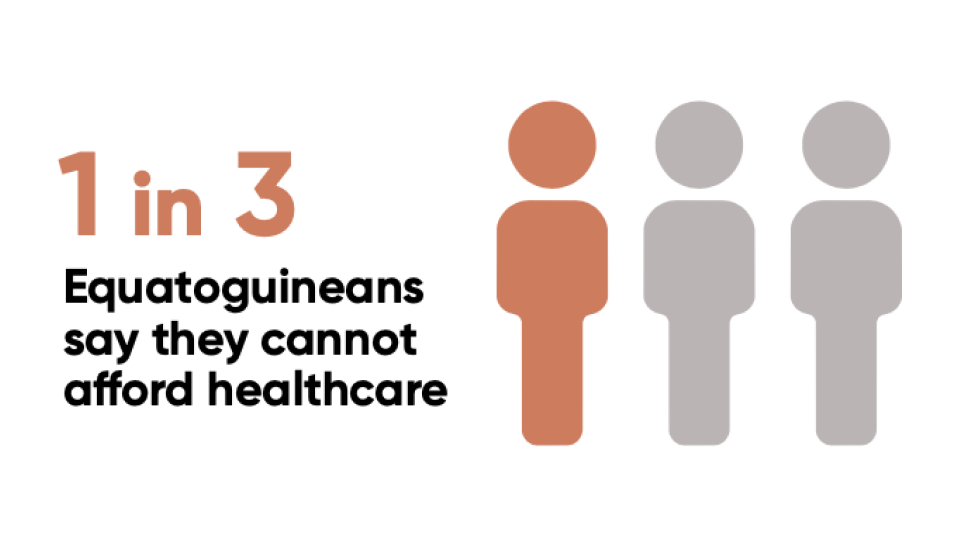
However, for ordinary citizens living in Equatorial Guinea, the harsh realities of daily existence dissipated the fleeting feverish euphoria. In a country where 57% of the population still lives in poverty,31 the regime’s ostentatious display of generosity towards Nzalang led some citizens to beg for the same outpouring of benevolence publicly. Some even took to the internet. “Please don’t forget us when you hand out money to national team players,” said one citizen in a video addressing the president.32 Journalist Mocache Massoko, founder and editor of the independent news website Diario Rombe, tweeted: “One million euros could solve many problems in Equatorial Guinea. [It] can buy many medicines for many public hospitals that have neither syringes nor sterilization of surgical material.”33
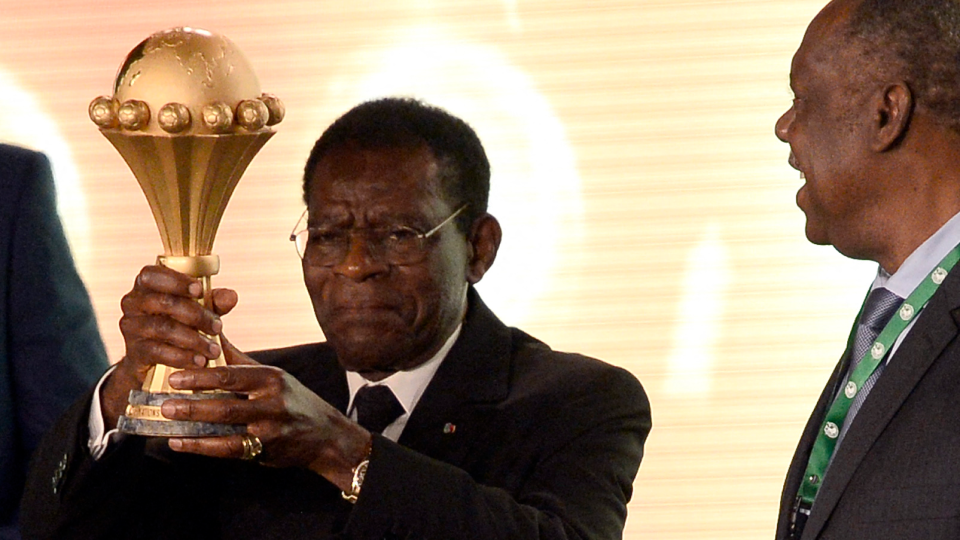
Equatorial Guinea President Teodoro Obiang Nguema holds the AFCON 2015 trophy.
Photo Credit: Stephane de Sakutin / AFP
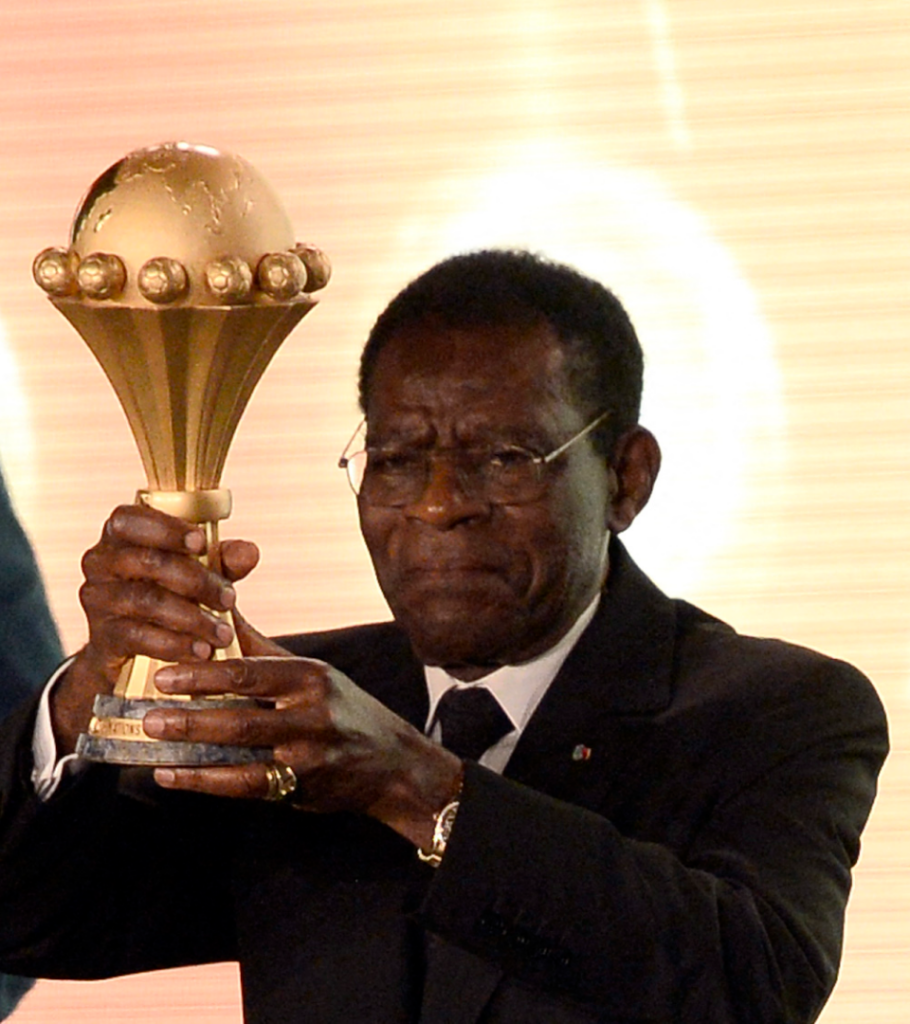
Equatorial Guinea President Teodoro Obiang Nguema holds the AFCON 2015 trophy.
Photo Credit: Stephane de Sakutin / AFP
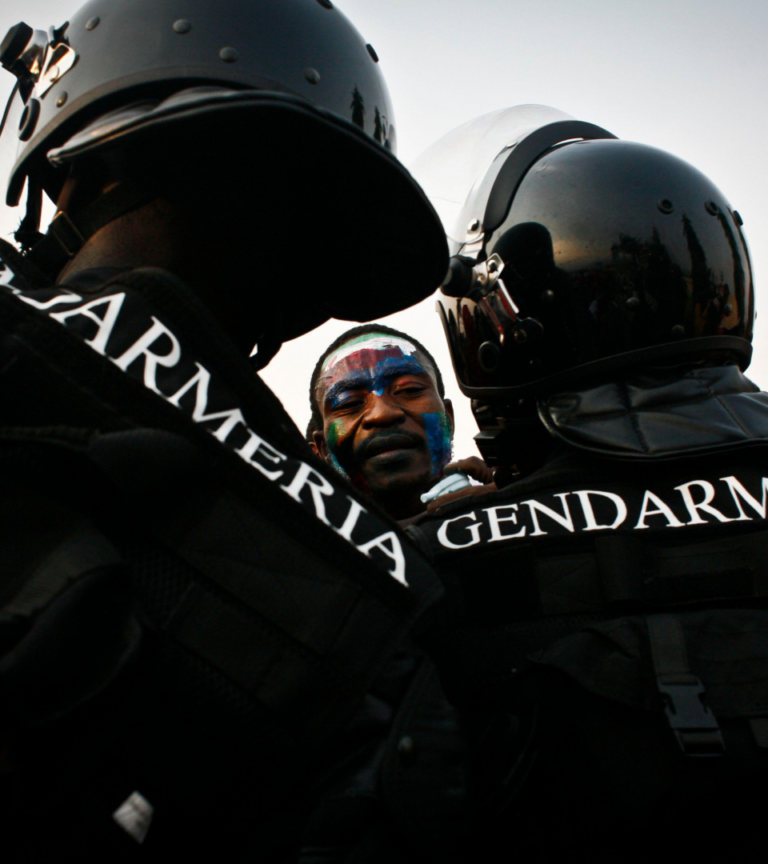
Police clash with fans outside Malabo Stadium on Jan. 29, 2012, as supporters without tickets try to enter ahead of an AFCON match.
Photo Credit: William Sands/ ZUMAPRESS.com / Alamy
Unabated repression during AFCON
FIFA President Gianni Infantino takes pride in affirming that football brings people together and fosters peace and understanding, with the subtext that it has the power to nudge closed societies towards opening and reform. In the case of Equatorial Guinea, the national fervor around Nzalang did not cause the regime to pause its repression or treat its citizens more favorably.
Just before AFCON, police detained a citizen for criticizing corruption in audio messages shared on WhatsApp,34 even as the country’s prisons were already bursting with prisoners of conscience and political dissidents.
Days after the Côte d’Ivoire match, police brutally arrested prominent human rights activist Anacleto Micha Ndong.35 Ndong had just been released from nine months of imprisonment in the country’s notorious Black Beach prison and had announced his intent to file a complaint against a prison guard for acts of torture. Instead, he was held for more than a month without charges, then charged with slander, and transferred to return to the same prison where he alleged he had been tortured.36 Then, in April 2024, Ndong disappeared in the Black Beach prison.37 To this day, his family and friends have been unable to locate him and fear that he was transferred to the remote Oveng Azem maximum-security prison,38 where dissident Julio Obama Mefuman died under suspicious circumstances in January 2023 amid allegations of torture.39
On Jan. 28, 2024, Guinea’s last-minute goal against Nzalang in the AFCON’s round of 16 abruptly ended the country’s fleeting tiempo de ambiente.”40 As critics like Esono Eyoma assert, “Nothing has changed, and everything will remain the same as long as Obiang continues to hold power hostage.”
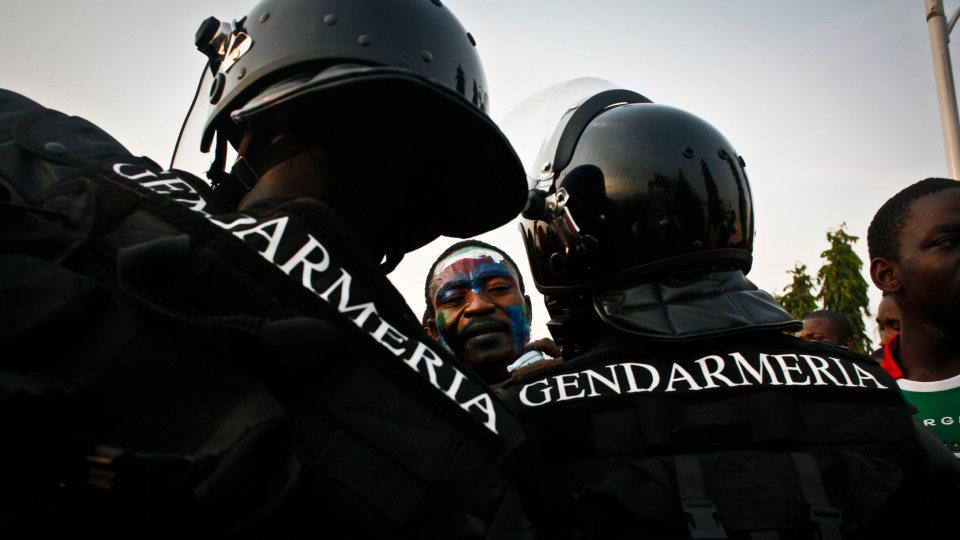
Police clash with fans outside Malabo Stadium on Jan. 29, 2012, as supporters without tickets try to enter ahead of an AFCON match.
Photo Credit: William Sands/ ZUMAPRESS.com / Alamy
How Football Became a Tool for Dictatorship
A Francoist heritage in Equatorial Guinea
When Spain solidified its control over what is now Equatorial Guinea, it used sports to promote colonial institutions and exert control over the local population. As in other African territories, colonial officials and missionaries sought to instill their ideals of discipline, self-control, and respect for rules through sports and physical education.41 Following the Spanish Civil War, General Franco consolidated control over sports in Spain through the National Sports Delegation.42 Football became a powerful instrument for foreign diplomacy and propaganda, as well as domestic nationalism and social control, a strategy that extended to Spain’s colonial territories. By 1945, Spanish Guinea’s colonial governor, Juan María Bonelli Rubio, formalized these efforts, establishing two sports delegations: one for the islands and another for the mainland. Three years later, the Football Federation of Spanish Guinea was founded.
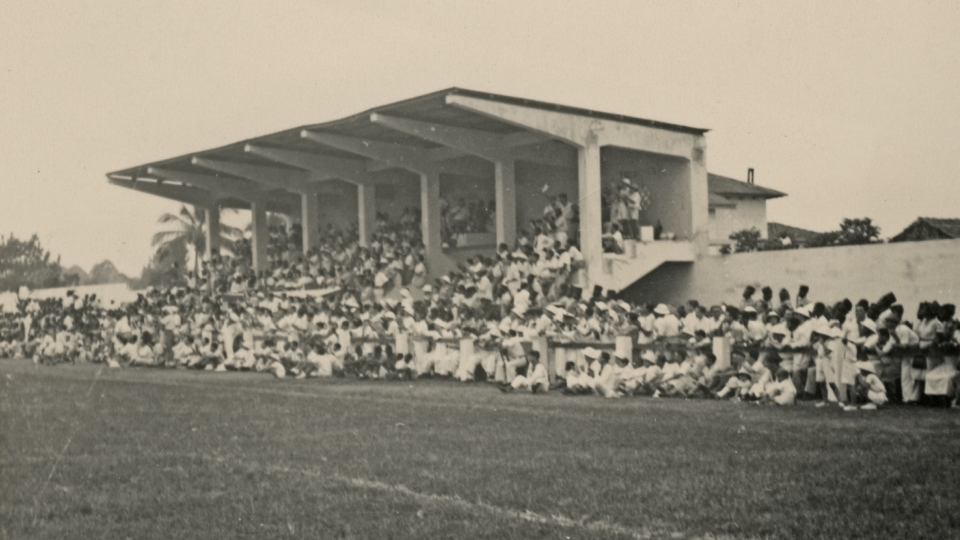
Santa Isabel Stadium in Fernando Poo, Spanish Guinea, 1950
Photo credit: El Museo Canario
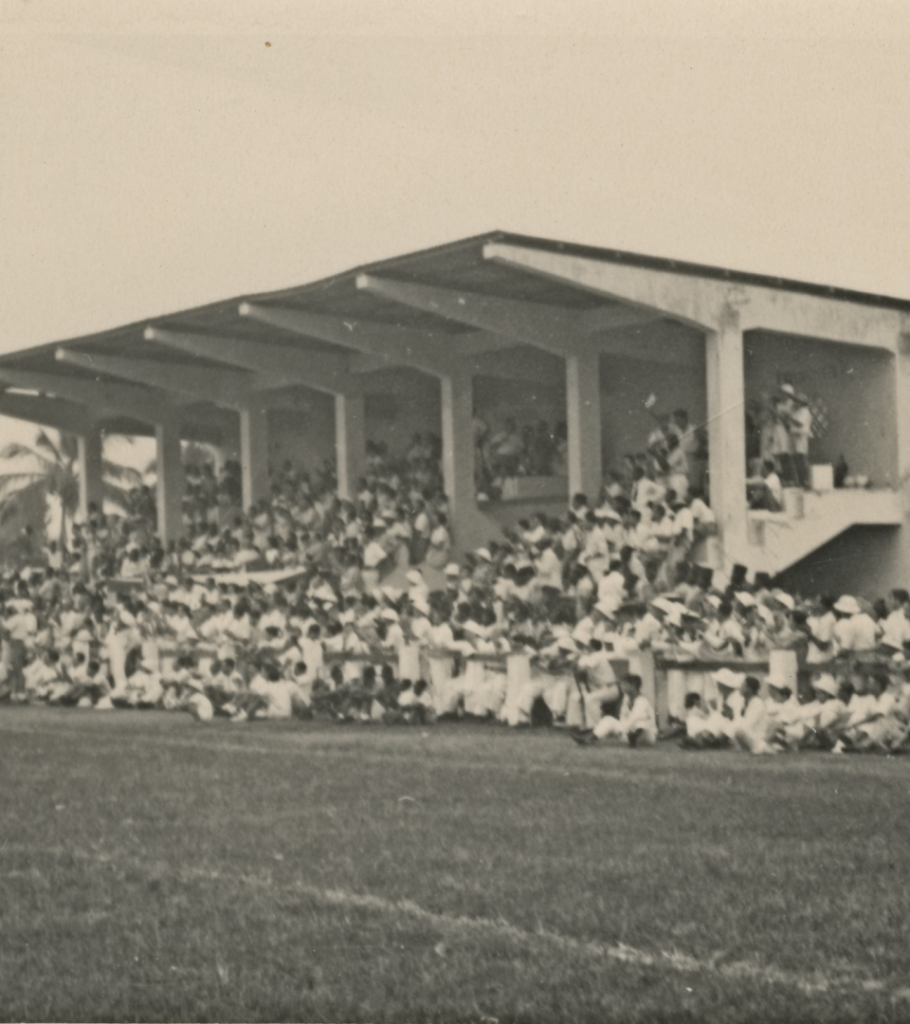
Santa Isabel Stadium in Fernando Poo, Spanish Guinea, 1950
Photo credit: El Museo Canario
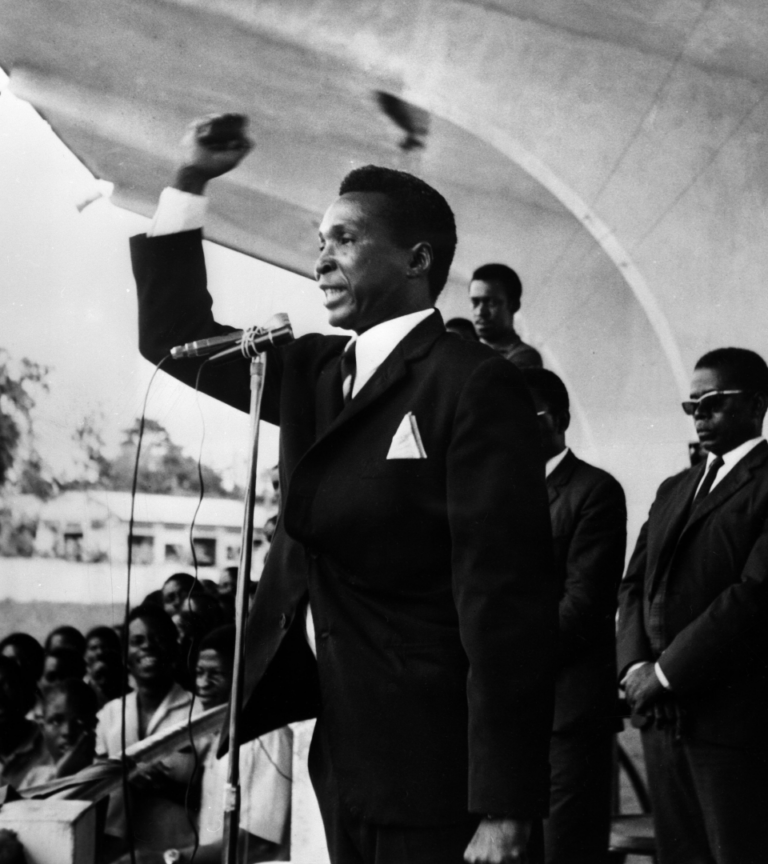
President Francisco Macías Nguema raises
his fist while addressing a crowd inside Bata’s football stadium on March 11, 1969, less than a week after a failed coup attempt, transforming a football ground into a platform for political consolidation.
Photo credit: Smith Archive / Alamy
Playing defense: The cost of Macías’s obsession with control on sports
Francisco Macías Nguema, a former colonial administration official turned fierce anti-colonialist and ultra-nationalist, became the first president of independent Equatorial Guinea. A swift consolidation of control marked his rise to power. Just four months after independence, Macías invoked a failed coup attempt to unleash a wave of terror and political purges across the country, characterized by torture, massacres, ethnic cleansing, and mass killings.43 In 1973, Macías formalized a one-party system and declared himself president for life.44 During his 11-year reign, Macías’ regime is estimated to have killed 80,000 Equatorial Guineans and forced nearly a third of the population into exile.45
Macías, an open admirer of Adolf Hitler and Spanish dictator Franco, exerted totalitarian control by banning anything associated with the West, including Christian names, churches,46 western medicine, and cinemas.47
Football was one of the very few forms of popular entertainment that Macías did not ban. At the same time, the dictator steered young people away from football and sports.
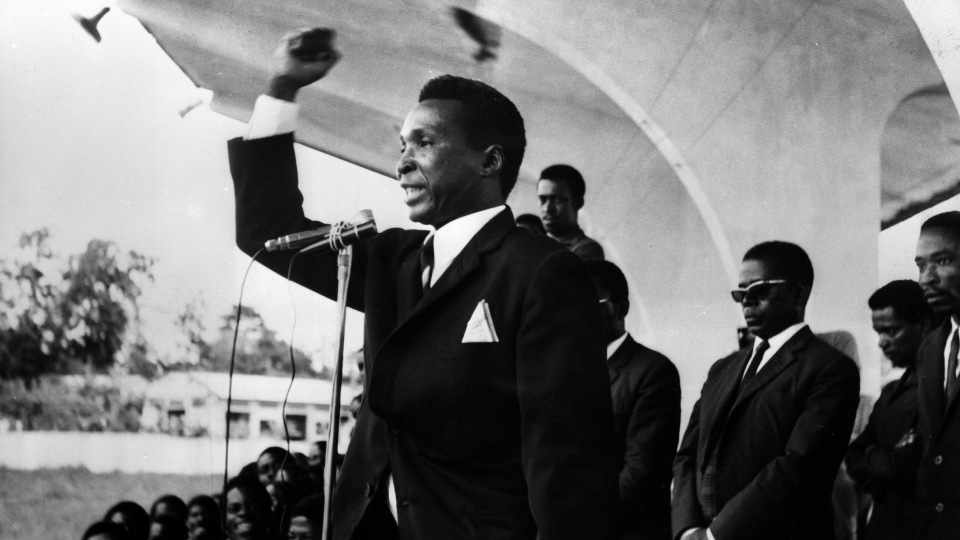
President Francisco Macías Nguema raises
his fist while addressing a crowd inside Bata’s football stadium on March 11, 1969, less than a week after a failed coup attempt, transforming a football ground into a platform for political consolidation.
Photo credit: Smith Archive / Alamy
The “Freedom Coup” and Spain’s gift of a coach
In August 1979, Macías’ nephew and head of the presidential guard, Lieutenant Colonel Teodoro Obiang, fearing his inclusion in an impending bloody purge, deposed his uncle Macías in a coup. Obiang called the takeover “Golpe de Libertad” (Freedom Coup). While his Supreme Military Council (CMS) junta claimed to have liberated the country from the terror of Macías’ rule, in reality it was just a palace coup. “It’s the same dog, just with a different collar,” wrote Cruz Melchor Eya Nchama in a commentary in the Swiss newspaper Journal de Genève.48
However, Obiang, who previously served as the director of the infamous Black Beach prison under Macías, adopted a different approach to exercising power and football.
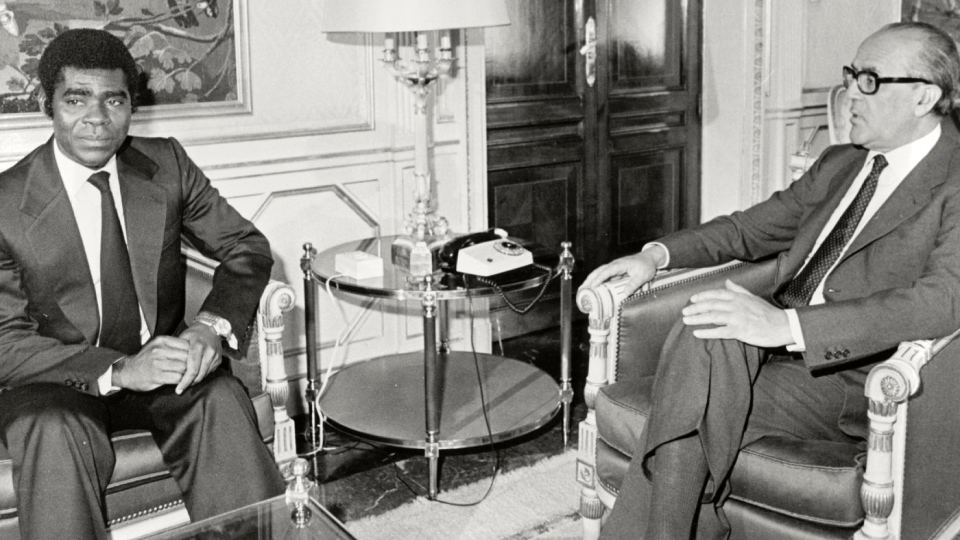
Equatorial Guinea’s president, Teodoro Obiang Nguema Mbasogo, meets Spanish prime minister Leopoldo Calvo Sotelo at the Palace
of Moncloa, Spain in May 1982.
Photo credit: J.M. Pastor and A. Millan / EFEE
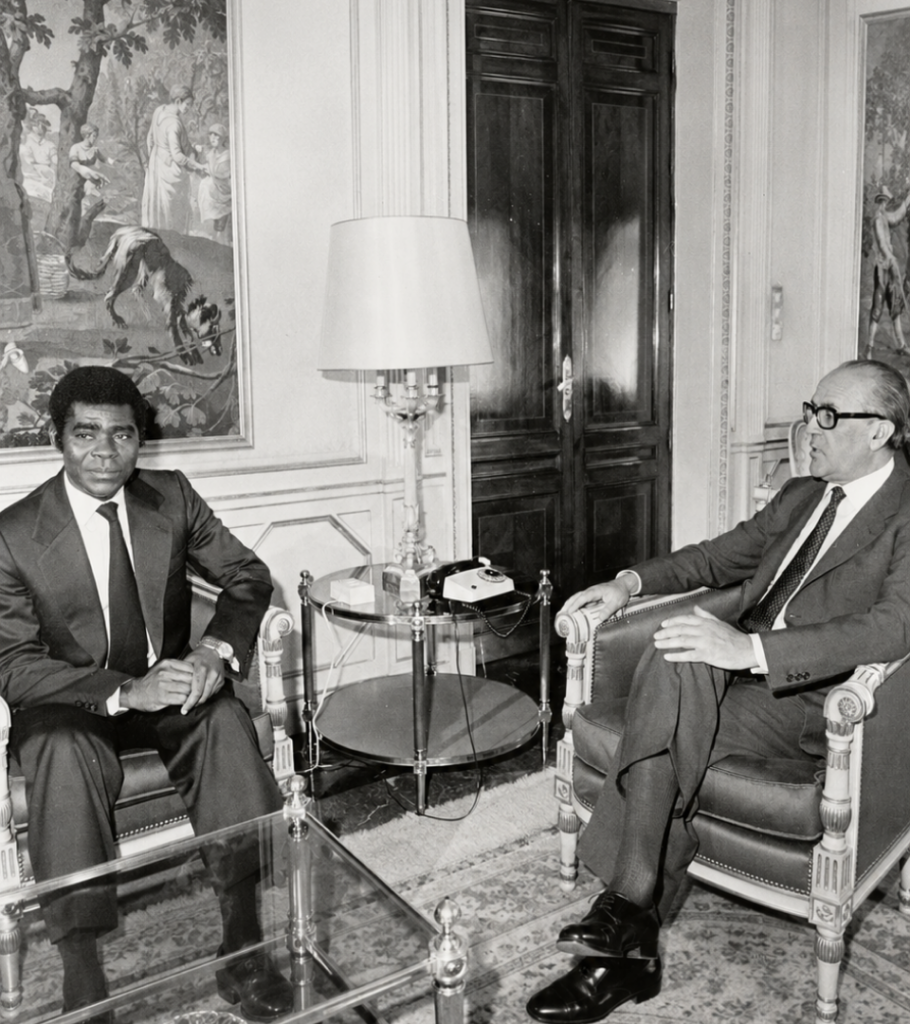
Equatorial Guinea’s president, Teodoro Obiang Nguema Mbasogo, meets Spanish prime minister Leopoldo Calvo Sotelo at the Palace
of Moncloa, Spain in May 1982.
Photo credit: J.M. Pastor and A. Millan / EFEE
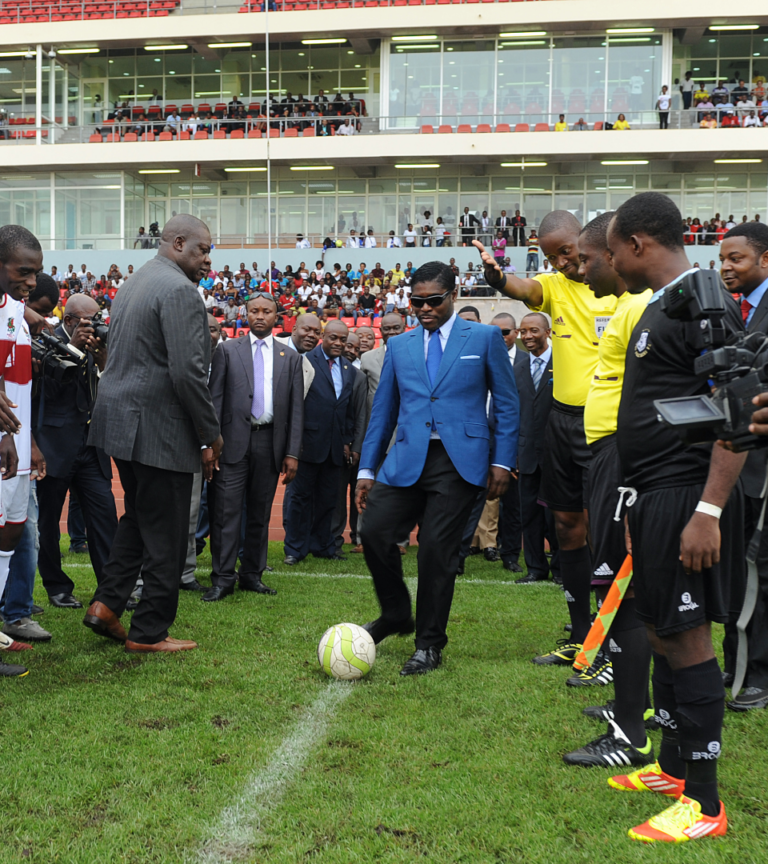
Vice President Teodorín Nguema Obiang, son of dictator Teodoro Obiang Nguema Mbasogo, kicks a ball at Malabo Stadium before a football match between two local teams, as part of the celebrations for his 41st birthday.
Photo Credit: Jerome Leroy /AFP
Distraction through entertainment under Obiang
In the same year he seized power, Obiang revived domestic professional football, which had been abandoned under Macías’s rule, by formalizing independent Equatorial Guinea’s first national league.49 Throughout the 1980s and 1990s, the regime promoted regional championships.50 “There were teams of 1st, 2nd and 3rd division; we participated in Central African competitions; also soccer teams from Russia, China, and Korea came to play friendly matches against the national teams,” shared a member of the exiled opposition, who requested anonymity.
The regime strategically staged big matches on symbolic dates, such as independence celebrations or the anniversary of Obiang’s coup. Obiang used these events to grandstand his image. The father of human rights activist Tutu Alicante, founder of the NGO EG Justice, was then the president of the Duma Duma football team from the remote island of Annobón. Alicante told HRF that football was “a tool for Obiang to control people.”
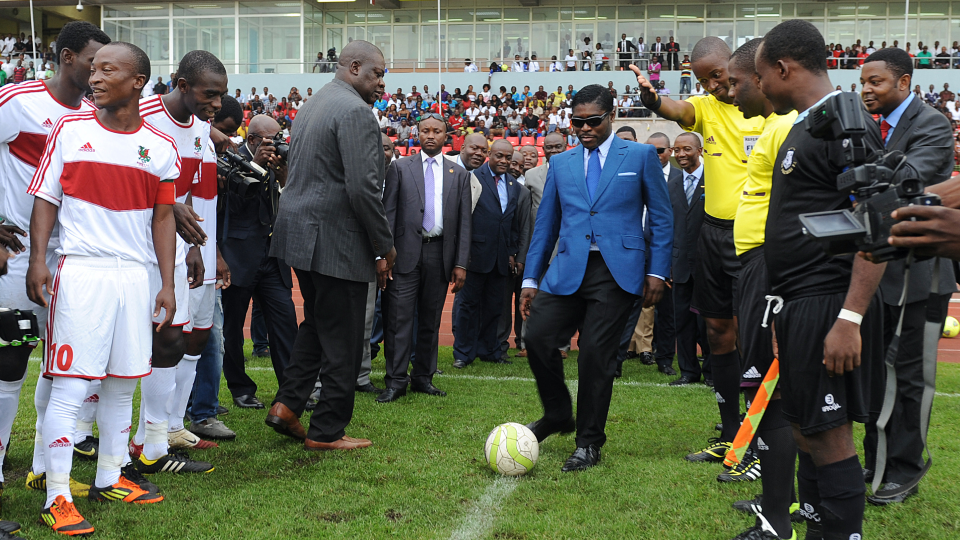
Vice President Teodorín Nguema Obiang, son of dictator Teodoro Obiang Nguema Mbasogo, kicks a ball at Malabo Stadium before a football match between two local teams, as part of the
celebrations for his 41st birthday.
Photo Credit: Jerome Leroy /AFP
The politicization of football: From a neighborhood affair to cronyism
Despite its lack of interest in developing professional sports, the Obiang regime turned football into a powerful tool of political control. For example, the regime occasionally staged a friendly football match between a military team and a team featuring senior regime officials. During such matches, it was common practice for military players to deliberately let government officials win, according to an opposition activist in exile who witnessed this and requested anonymity.
The ruling PDGE party tolerated no dissenters in the football arena. For example, in 1998, the regime arrested Ildefonso Montero, coach of Jau — a club linked to the Bubi ethnic minority — along with CPDS opposition party members in retaliation for alleged political activities.51
Instead of appointing competent people, Obiang surrounded himself with his own, solely intent on stealing public funds
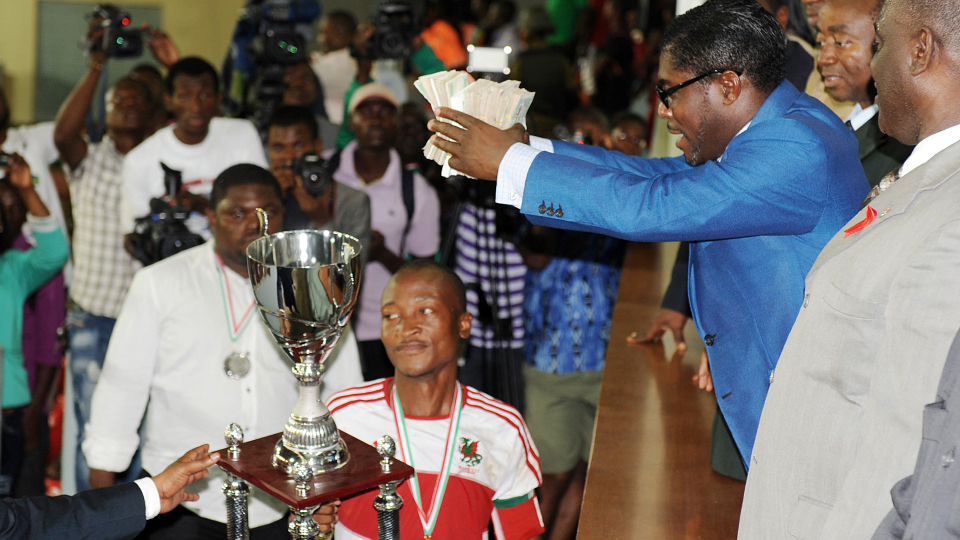
Teodorín Nguema Obiang hands money to athletes in Malabo in 2013, during celebrations for his 41st birthday.
Photo Credit: Jerome Leroy / AFP
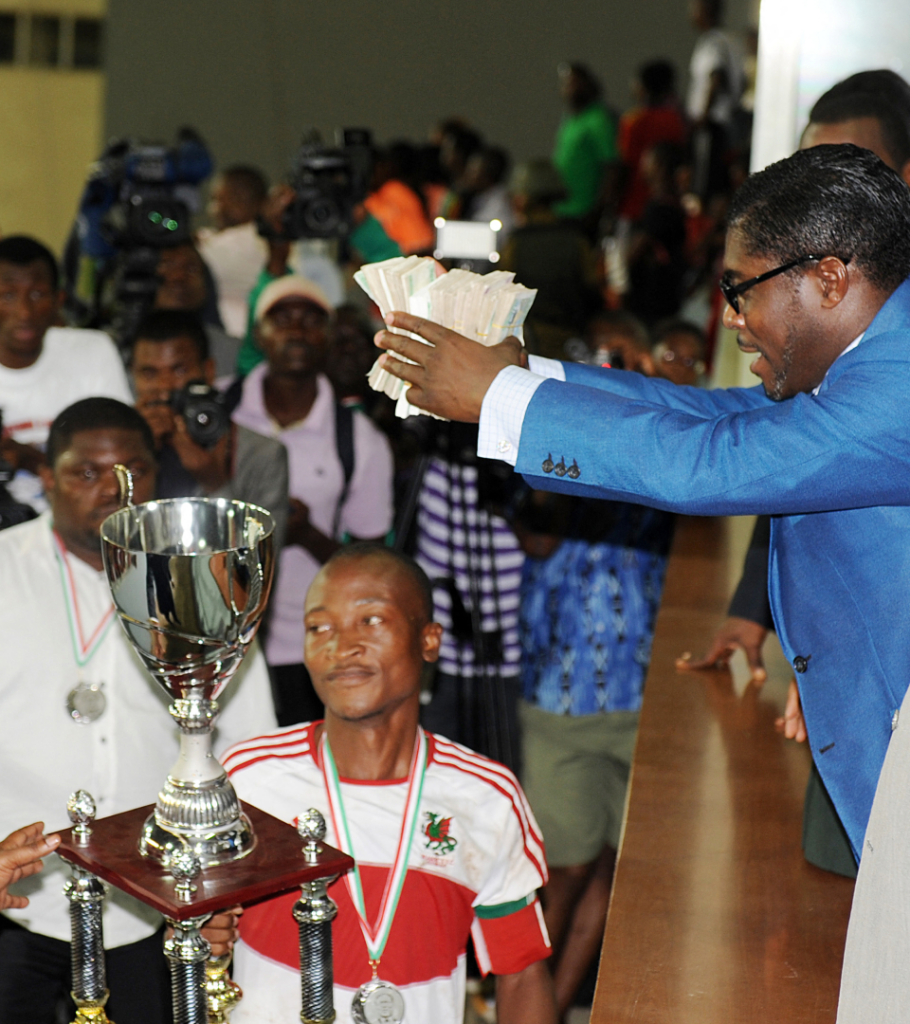
Teodorín Nguema Obiang hands money to athletes in Malabo in 2013, during celebrations for his 41st birthday.
Photo Credit: Jerome Leroy / AFP
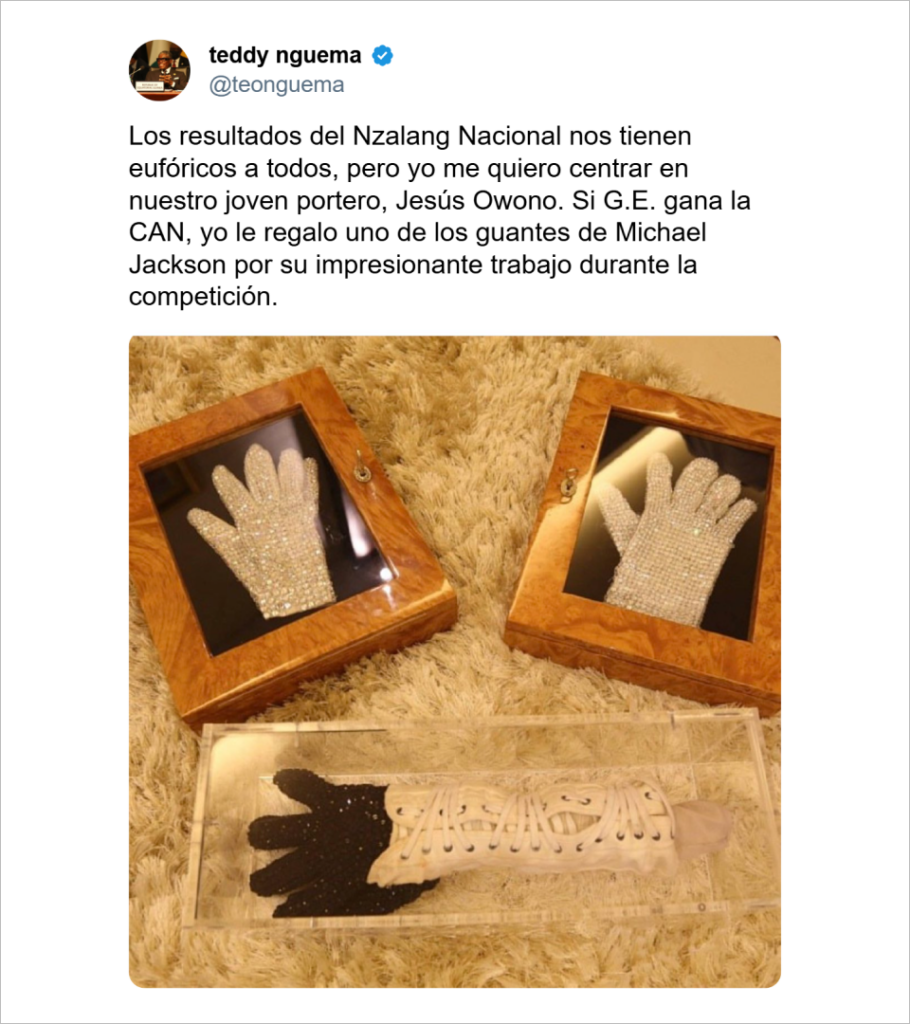
Translated tweet: “The results of the Nzalang Nacional have us all euphoric, but I want to focus on our young goal-keeper, Jesús Owono. If E.G.wins [AFCON], I’ll give him one of Michael
Jackson’s gloves for his impressive work during the competition.”
Sourced from X, @teonguema, Jan. 2, 2022
Oil wealth and the rise of spectacle politics
In the early 2000s, Equatorial Guinea was producing over 300,000 barrels of crude oil per day, a figure that has since plummeted to around 80,000 barrels.52 The oil boom of that era marked a turning point for the regime, as it increasingly spent top dollar on world-class entertainment to make a splash in global pop culture.
Teodorín Obiang, the dictator’s son and the country’s vice president, epitomized this extravagance, as evidenced by his acquisition of the world’s largest collection of Michael Jackson memorabilia.53 Teodorín’s flamboyant excesses drew multiple international corruption investigations into his assets in the United States, Spain, and France.
In this context, the regime launched a quest to polish its global image, distract from accusations of human rights abuses and corruption, and project a façade of a modern, emerging nation. The strategy included luring internationally acclaimed celebrities to perform in the country. For example, the regime succeeded in luring American rapper Fat Joe, Nigerian-American singer Davido, and global music icon and former footballer Julio Iglesias to Malabo for performances.54
At the same time, the regime began investing in hosting prestigious international football matches and events.55 “Obiang thinks that by distracting the people, he can last much longer in power and guarantee continuity,” Alicante told HRF.
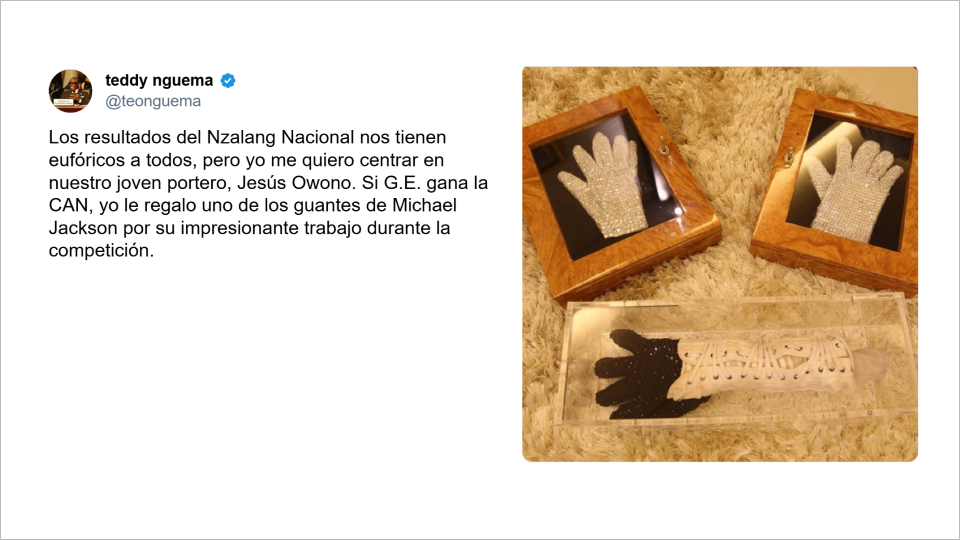
Translated tweet: “The results of the Nzalang Nacional have us all euphoric, but I want to focus on our young goal-keeper, Jesús Owono. If E.G.wins [AFCON], I’ll give him one of Michael
Jackson’s gloves for his impressive work during the competition.”
Sourced from X, @teonguema, Jan. 2, 2022
Nzalang:
The Crumbling Façade
AFCON 2012: Reaching for the glow of international football
In 2012, Equatorial Guinea and its neighboring country, Gabon, became the smallest nations to secure co-hosting rights for AFCON, the continent’s biggest sporting event.56 While such an honor was typically reserved for Africa’s great footballing nations, Equatorial Guinea’s participation was not merely about football. It was a calculated move by its ruler, Teodoro Obiang, to grandstand on the international stage and polish his regime’s tarnished reputation. At the time, Obiang’s regime was mired in an explosive international scandal over ill-gotten wealth in France and the United States. In 2011, US authorities filed complaints against the Minister of Forests and Agriculture, then Obiang’s son Teodorín, for laundering $70.8 million in assets,57 including a Malibu mansion and a collection of Michael Jackson memorabilia, acquired through misappropriation of public funds, embezzlement of natural resources, corruption, extortion, bribes, and kickbacks.58 In France, he faced separate charges of embezzling and laundering $174 million of public money into luxury goods, sports cars, and a Paris mansion.59 Against this backdrop, hosting AFCON provided an opportunity to divert attention and reframe his nation’s image.
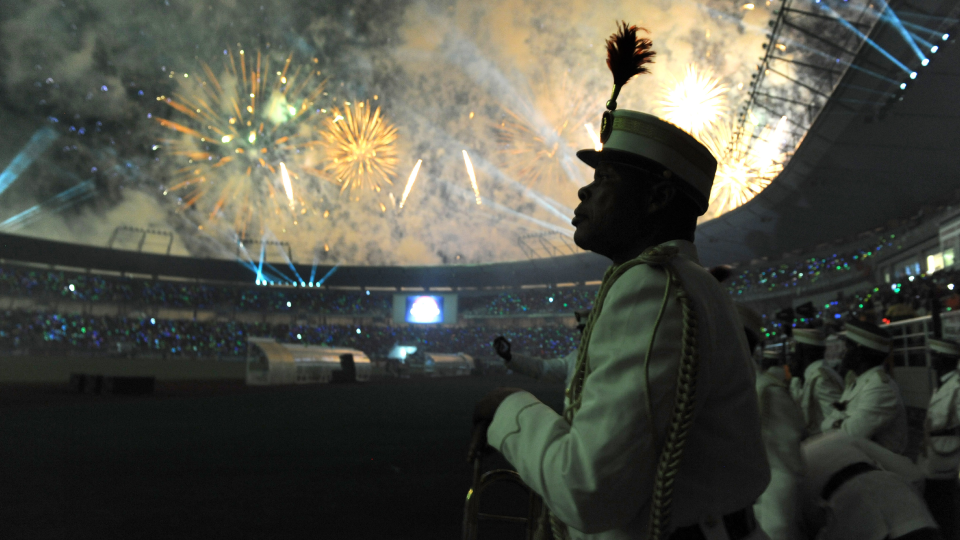
Fireworks are seen during the opening ceremony of the 2012 AFCON at the stadium in Bata, Equatorial Guinea.
Photo credit: Abdelhak Senna / AFP
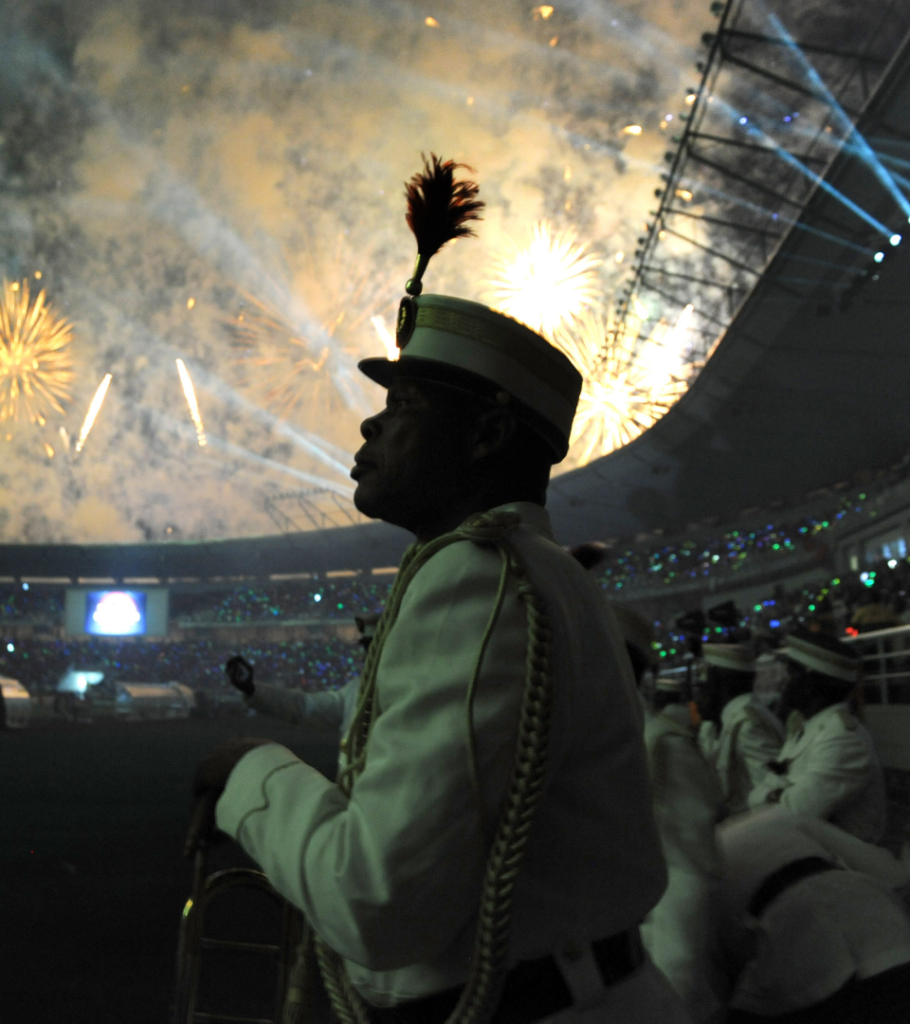
Fireworks are seen during the opening ceremony of the 2012 AFCON at the stadium in Bata, Equatorial Guinea.
Photo credit: Abdelhak Senna / AFP
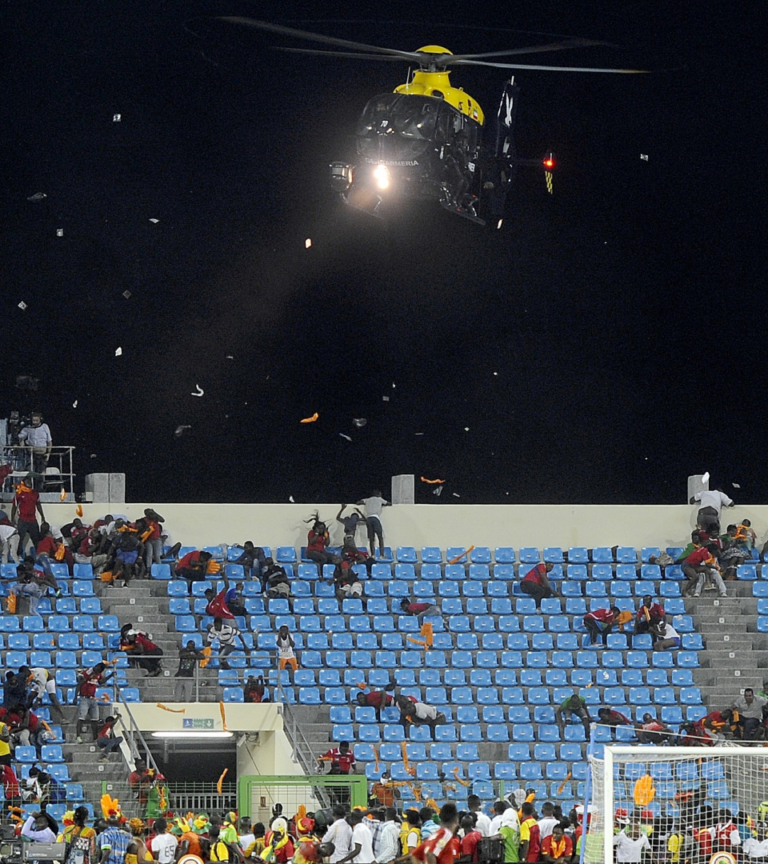
A police helicopter hovers above the stadium during a match interruption in the 2015 AFCON semifinal between Ghana and Equatorial Guinea at Malabo Stadium
Photo credit: Mohamed Hossam and Anadolu Agency / AFP
AFCON 2015: From “The nation that saved AFCON from Ebola” to a “war zone”
In 2015, the Ebola outbreak in West Africa triggered widespread fear across the continent, leading the original host of that year’s AFCON, Morocco, to withdraw and propose a postponement, citing public health concerns. The crisis threatened the tournament, as no other nation seemed willing to step in. In response, Obiang seized this moment, offering Equatorial Guinea as a last-minute replacement and proclaiming his decision as one made “for African youth.”60 While Obiang’s move succeeded in positioning Equatorial Guinea as what a Saudi newspaper article dubbed “The nation that saved the AFCON,”61 it imposed on a population already challenged with inadequate access to essential services such as running water, and a crumbling healthcare system,62 health risks that other nations had deemed unacceptable. When dissenting voices raised concerns, the regime silenced them. Security forces arrested members of the opposition party Popular Union (UP) for distributing flyers that called for a peaceful boycott of the tournament.63
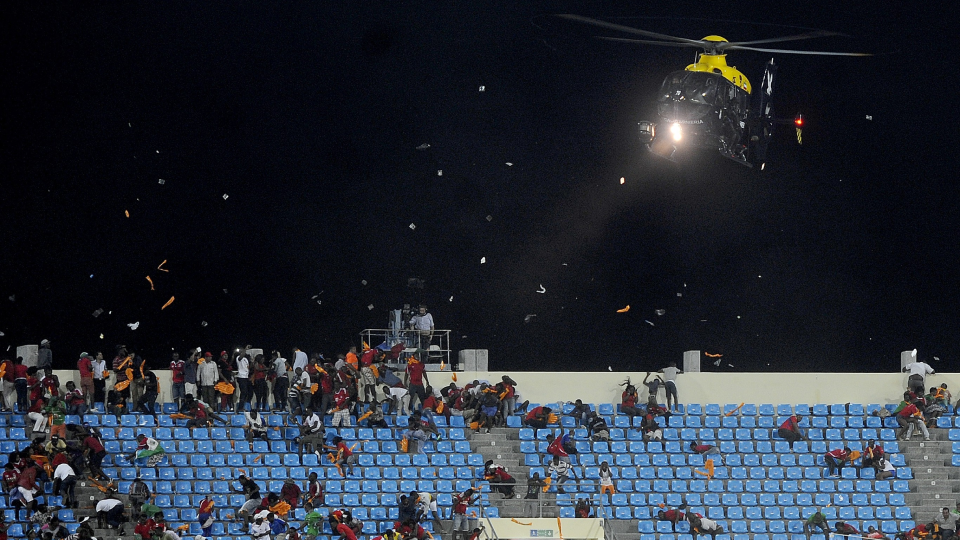
A police helicopter hovers above the stadium during a match interruption in the 2015 AFCON semifinal between Ghana and Equatorial Guinea at Malabo Stadium
Photo credit: Mohamed Hossam and Anadolu Agency / AFP
A national team with naturalized or foreign-born recruits
With its oil wealth, Equatorial Guinea’s regime pursued an ambitious strategy to strengthen its national football team, not by developing local talent but by recruiting foreign-born talent worldwide.
Starting in late 2005, Ruslan Obiang assigned Brazilian coach Antonio Dumas the mission to recruit players from his homeland into the Nzalang team. The regime put a large budget at Dumas’s disposal to offer financial incentives to Brazilian players. For example, Brazilian striker André Neles was offered $200,000 to naturalize, plus $10,000 for each match played, according to the Citizen Rights in Africa Initiative. By the 2012 AFCON, Nzalang had over ten foreign-born players. By 2013, 21 Brazilians, 14 Cameroonians, 4 Senegalese, 3 Colombians, 2 Ghanaians, 2 Ivorians, 2 Nigerians, 1 Liberian, and 2 Spaniards were reportedly naturalized to play for the team. The excessive naturalization of players led French coach Claude Le Roy to mockingly dub Nzalang the “United Nations of Football,” but resistance to the procedure also came from within Equatorial Guinea. Nzalang coach Henri Michel voiced opposition to the practice and eventually resigned after complaining of constant interference by officials.
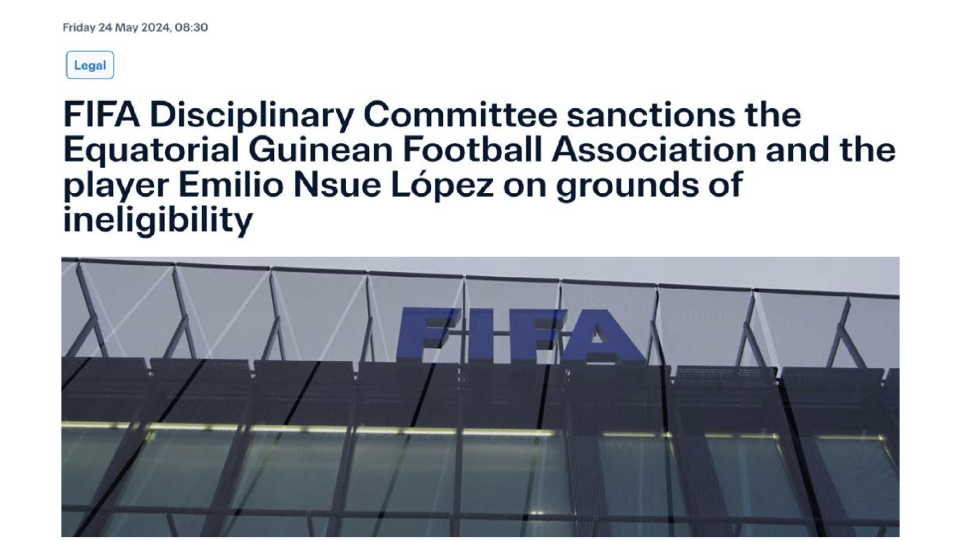
FIFA fined the Equatorial Guinean Football Federation €151,000 and banned Emilio Nsue for six months for fielding an ineligible player.
Sourced from Inside.fifa.com, May 24, 2024
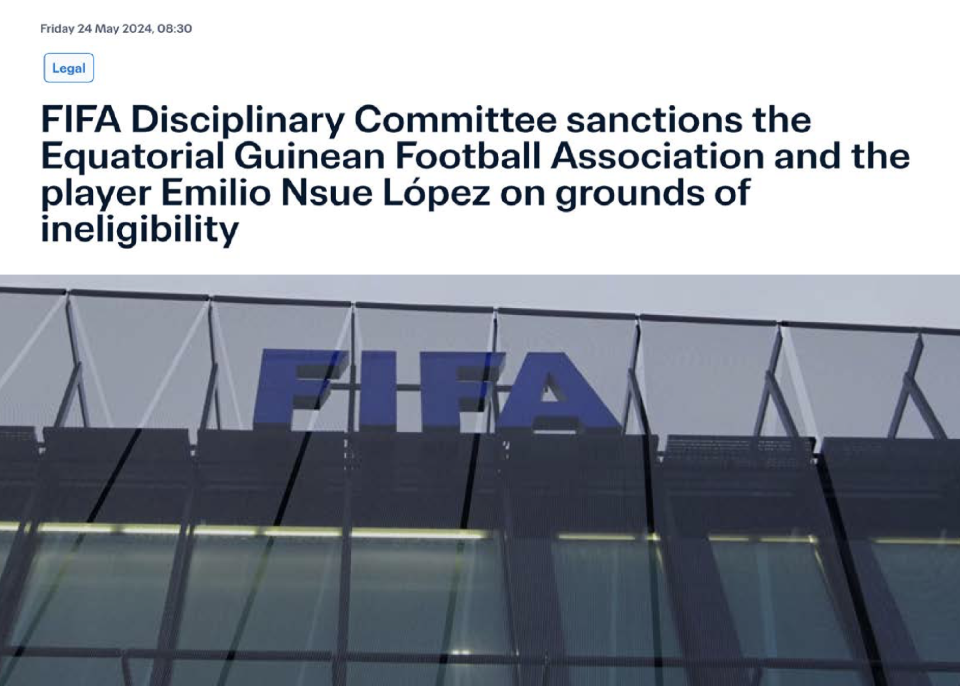
FIFA fined the Equatorial Guinean Football Federation €151,000 and banned Emilio Nsue for six months for fielding an ineligible player.
Sourced from Inside.fifa.com, May 24, 2024
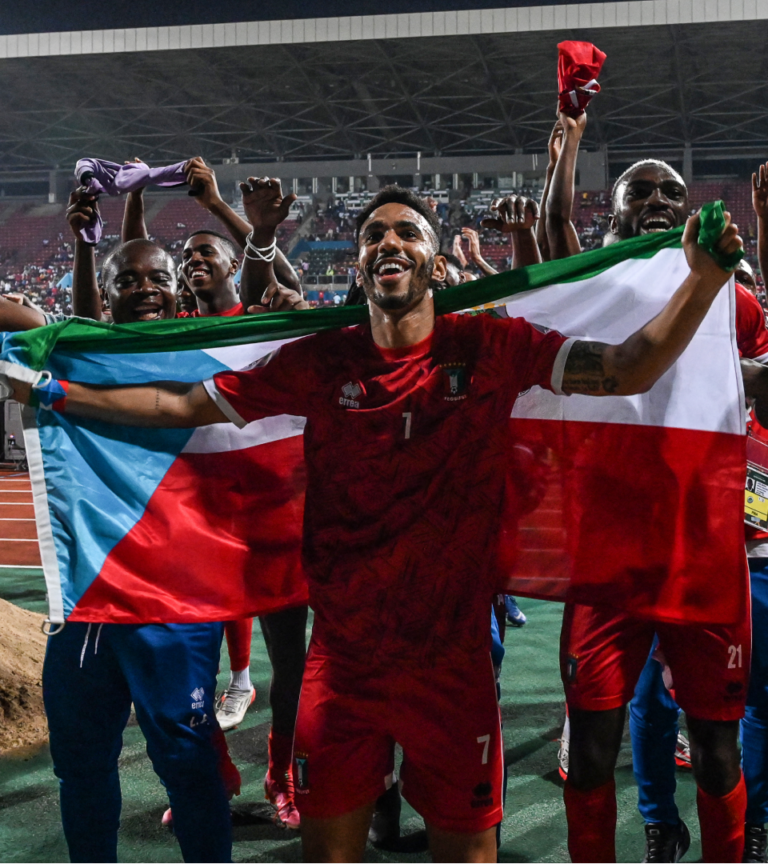
Left winger Rubén Belima, of Equatoguinean and Spanish descent, celebrates Nzalang’s victory over Sierra Leone at the 2021 AFCON in Cameroon, surrounded by teammates.
Photo credit: Issouf Sanogo / AFP
The exploitation of diaspora recruits’ emotional ties
For players of Equatoguinean origin hailing from the country’s diaspora, the emotional pull to the nation masks the harsh realities of playing in an exploitative football ecosystem. This was the experience of now-retired players Jacinto Elá and Alberto Edjogo-Owono, who each have ties to both Spain and Equatorial Guinea.
Jacinto Elá, a former winger who excelled in Spain’s youth ranks, was crowned Best Young Player in the World at the Nike Premier Cup in 1996. Born in Equatorial Guinea but raised in Spain, Elá became the first Spanish player under 22 to debut in the English Premier League. Elá’s initial motivation to join the Nzalang Nacional was deeply personal. “When the opportunity [to join the Equatoguinean national team] arose, I saw it as an enormous chance to contribute to Guinea. It wasn’t about personal ambition anymore but about giving back to my homeland,” he told HRF.
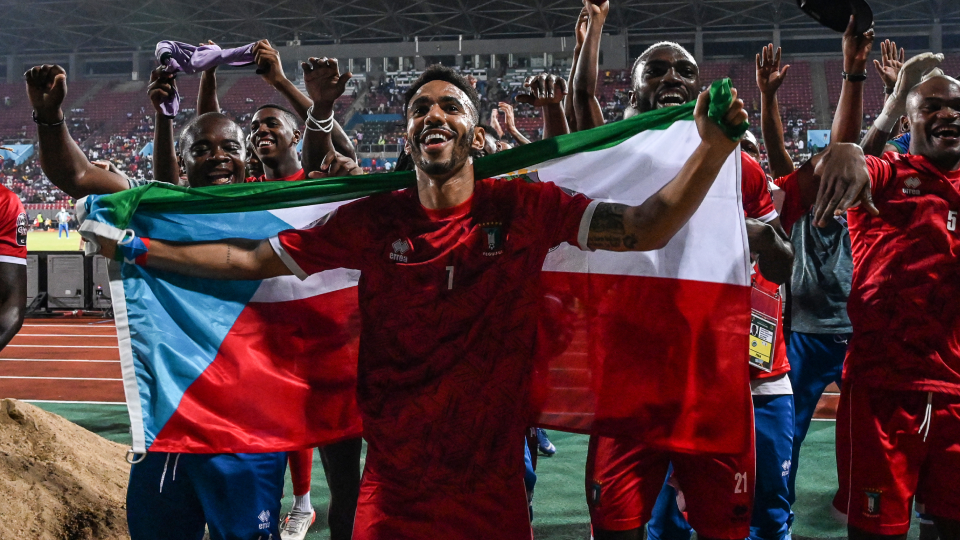
Left winger Rubén Belima, of Equatoguinean and Spanish descent, celebrates Nzalang’s victory over Sierra Leone at the 2021 AFCON in Cameroon, surrounded by teammates.
Photo credit: Issouf Sanogo / AFP
Using passports to trap and control foreign-born recruits
The gilded cage, reserved for those supposed to be the nation’s pride, kept the foreign players bound, even as they witnessed the crumbling façade of the structure they had hoped to strengthen. The dysfunction ran deeper than mere mismanagement: the regime weaponized passports as instruments of control. Like many foreign-based players, Elá never formally applied for an Equatoguinean passport. Instead, the Federation issued him one on the spot, a practice common at the time. Yet the passport was not truly his. It remained in the officials’ hands, stripping him of autonomy. Though it was presented at every game, Elá himself never once saw or held it. At just 22 years old, Elá felt utterly powerless. “You weren’t free to speak out because they had your passport. It was such a strange situation,” he recalls.
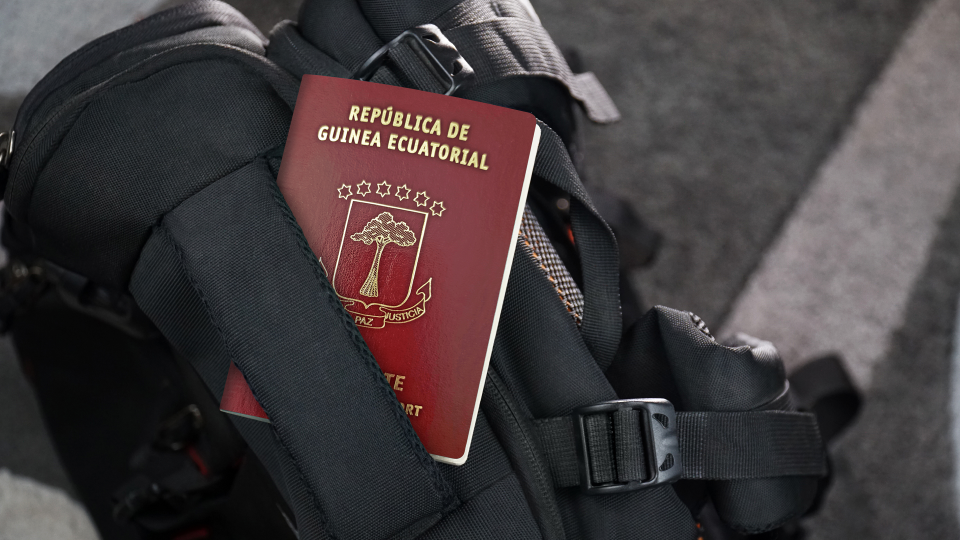
Photo credit: Alii Sher / Shutterstock
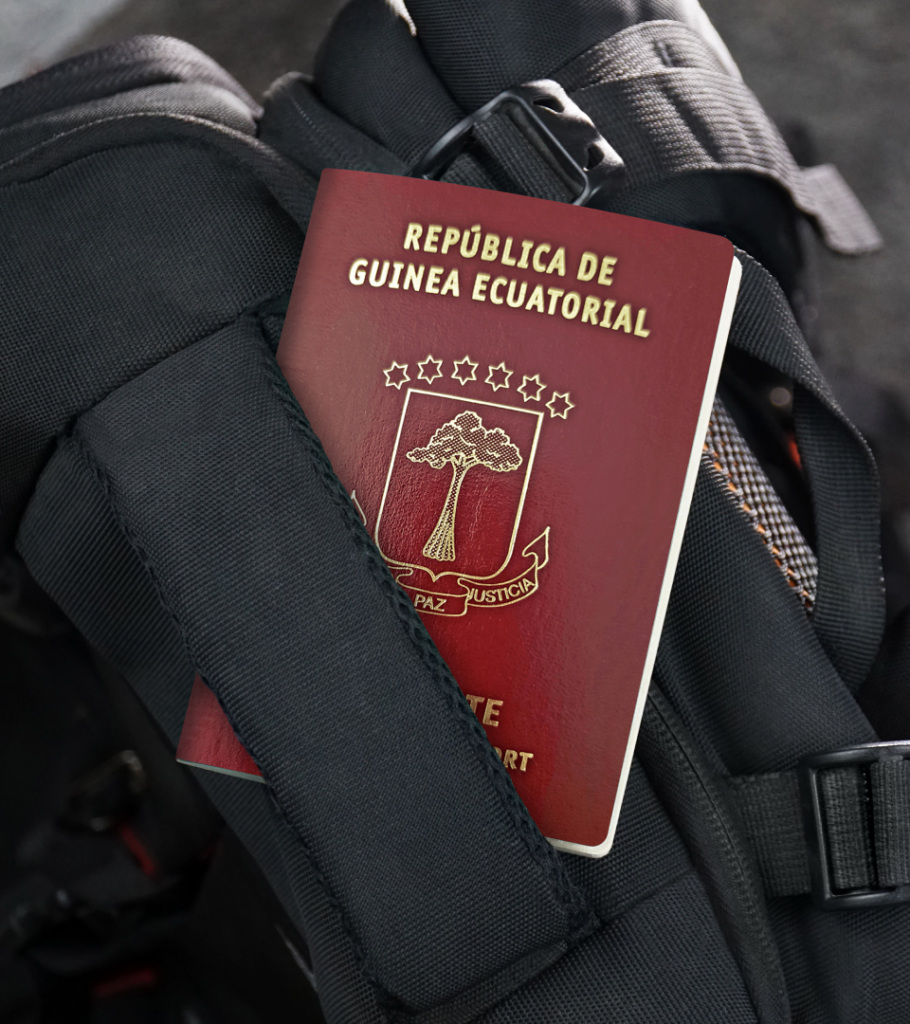
Photo credit: Alii Sher / Shutterstock
State of Play of Domestic Football in Equatorial Guinea
Behind the crumbling façade: The reality of local football
The contrast between the image presented during international sporting competitions and the reality of local professional football in the country is stark and troubling, and it is felt even within the national team itself. Former Nzalang players Elá and Edjogo-Owono explain that this gap manifests in the unequal treatment of locally born and based players compared to foreign-based ones. Elá revealed that during his time with the team, Spanish-based players earned twice as much in a week as local players struggled to earn in a month. This divide also translates to this day in players’ differing ability to speak out: foreign-based players face fewer risks of reprisals, often acting as a buffer and public voice for the team’s demands and denunciations of abuse. “What hurt me the most was knowing that when we left, their conditions would drop drastically,” Elá said.
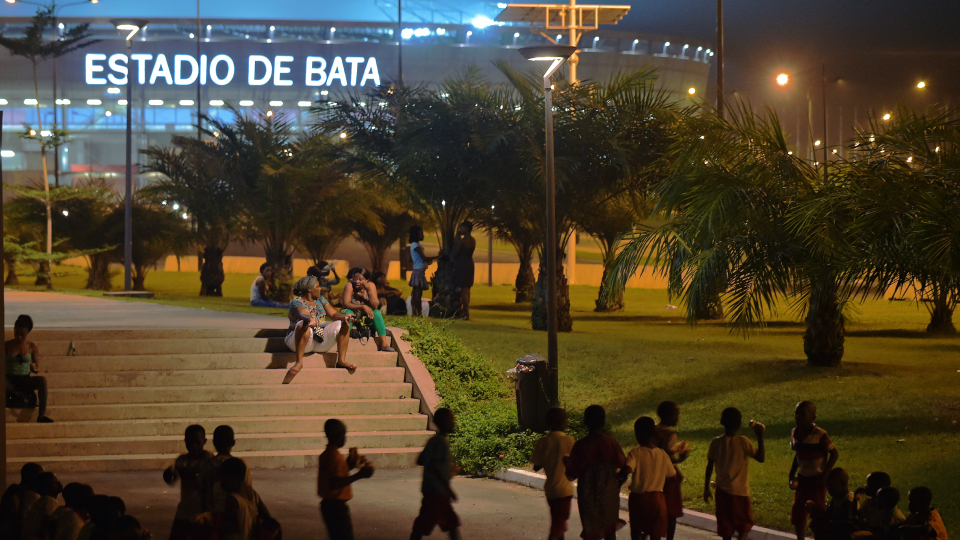
Children sit outside near the illuminated Bata Stadium during the 2015 AFCON.
Photo credit: Carl de Souza / AFP
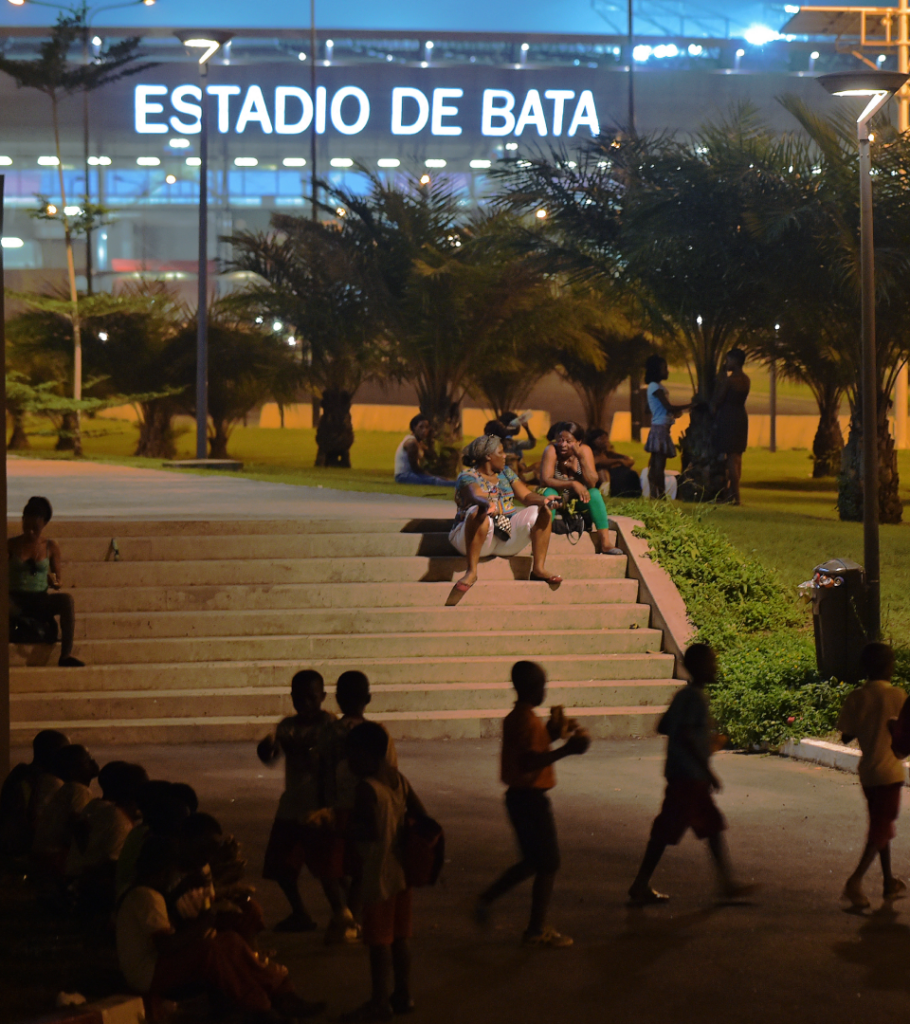
Children sit outside near the illuminated Bata Stadium during the 2015 AFCON.
Photo credit: Carl de Souza / AFP
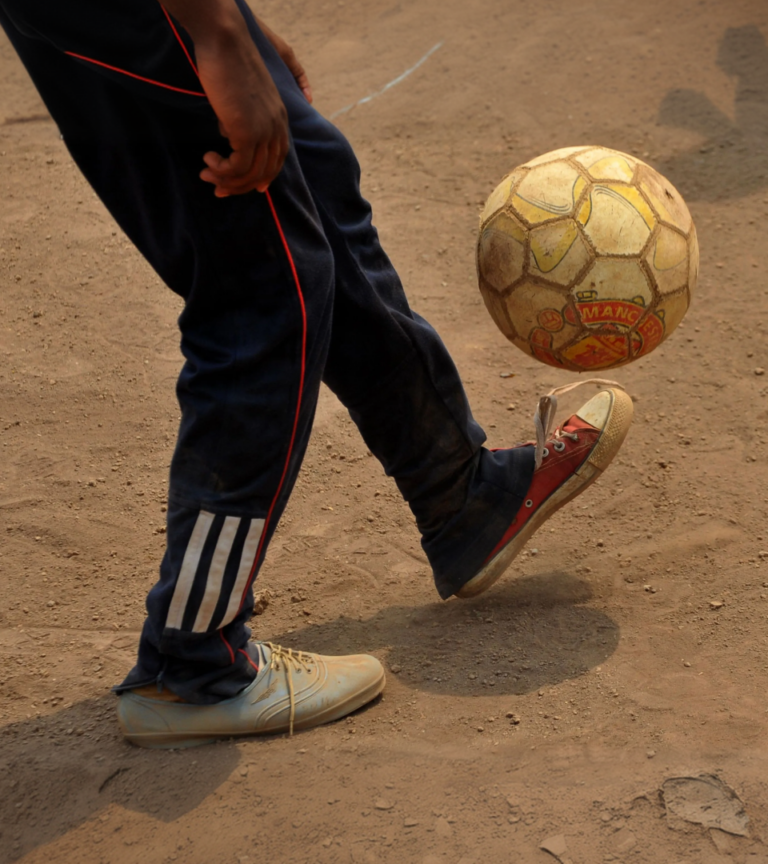
A youth plays football in a suburb of Malabo, hours before the opening match of AFCON 2012 in Bata.
Photo credit: Alexander Joe / AFP
The regime’s neglect of local talent
The regime allocates resources to the School Football Federation (FEGUIDE), and the League, while additional funding comes from CAF and FIFA. Yet these financial inflows have not translated into sustainable professionalization or meaningful investment in domestic talent. In 2010, under pressure from FIFA and CAF ahead of the country’s hosting of AFCON 2012, the regime pledged 124 million CFA francs (approximately $214,500) to professionalize clubs and the league.68 After AFCON 2012, Obiang pledged a further $1.56 million to revive local leagues, but the promise went unfulfilled.69 This pattern reflects a broader lack of political will to develop homegrown players beyond moments of international scrutiny.
Obiang’s interest in football appears to dissipate once international visibility fades. Players have repeatedly called in vain on the regime to reinvest the funds generated from past AFCON tournaments into the development of the sport at home. Where does the money go? Tutu Alicante offers a blunt answer:
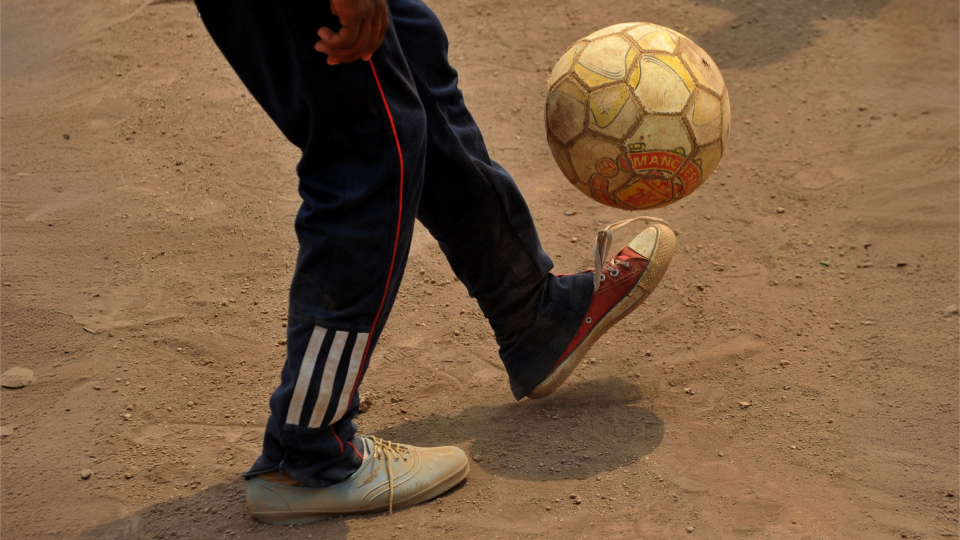
A youth plays football in a suburb of Malabo, hours before the opening match of AFCON 2012 in Bata.
Photo credit: Alexander Joe / AFP
Regime control stifles football development
Football development in Equatorial Guinea is reduced to fragmented, under-resourced initiatives trapped in a highly centralized system lacking strategy, clear goals, and institutional capacity. Regime control and weak organization leave clubs and academies without the autonomy or support required to develop local talent.
State investment has prioritized visibility over sustainability. The regime owns and manages four FIFA-approved stadiums in Bata, Malabo, Mongomo — the hometown of the ruling clan — and Ebebiyin, maintaining them for international tournaments while neglecting everyday use. Clubs and academies, most of which lack private training grounds, depend on these facilities and report poor conditions once major events end. The E16 Academy, a free initiative founded by former Nzalang players, struggled to get permission for training space; when access was granted, fields were severely degraded
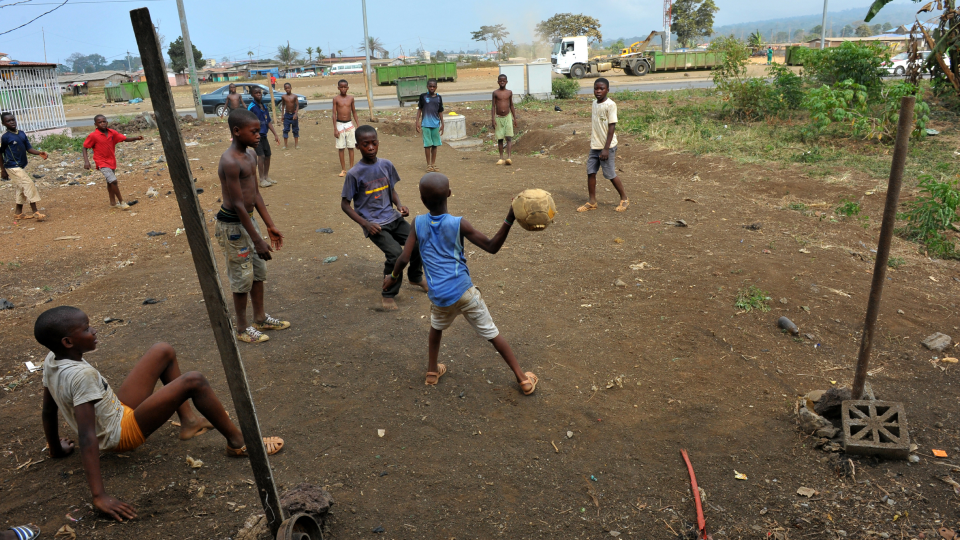
Children play a football game in a dry field in Malabo during AFCON 2012.
Photo credit: Alexander Joe / AFP
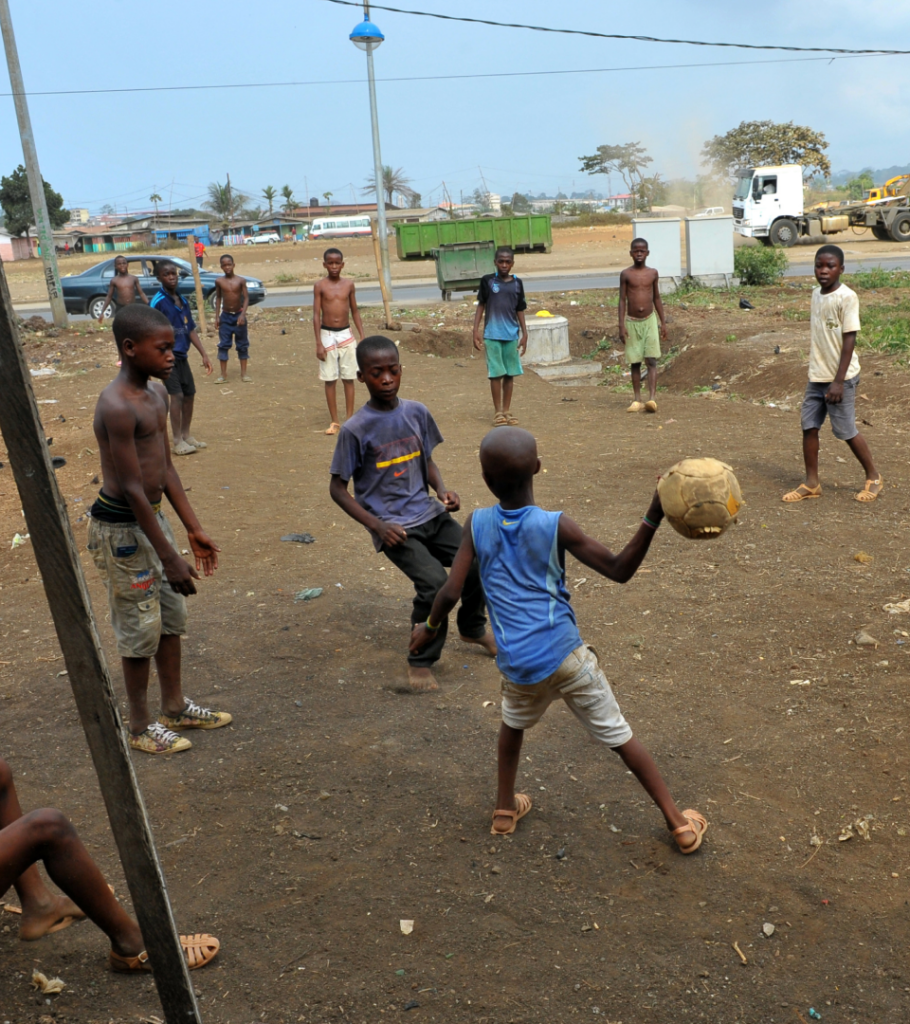
Children play a football game in a dry field in Malabo during AFCON 2012.
Photo credit: Alexander Joe / AFP
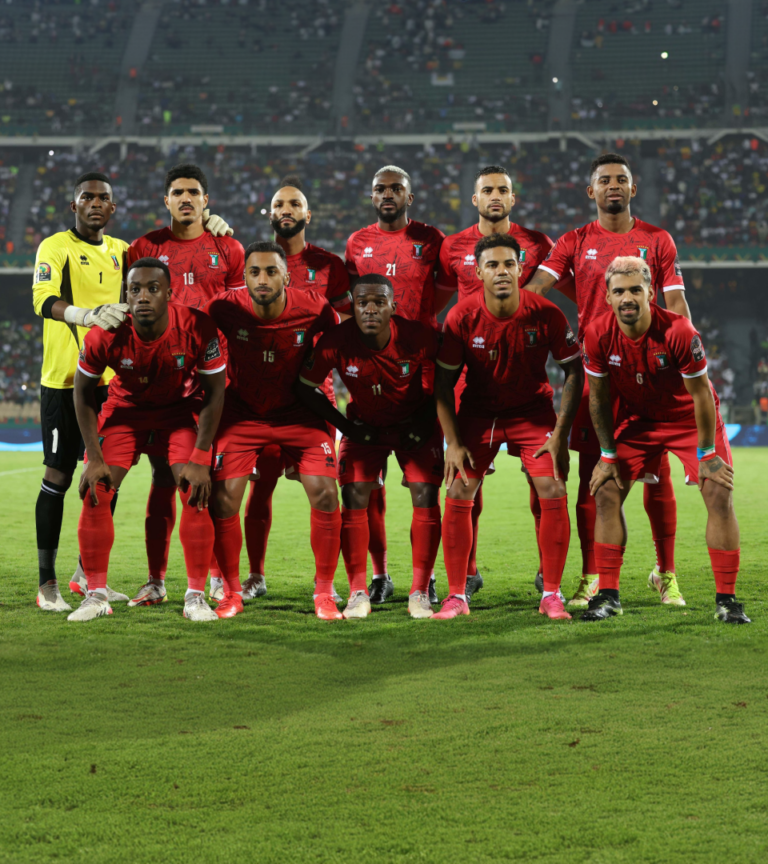
National team of Equatorial Guinea at the quarter-final match against Senegal in Yaoundé on January 30, 2022. Basilio Ndong, trained at Cano Sport Academy, is in the front row, third from the right.
Photo credit: Sebastian Frej / Alamy
The promising case of Cano Sport Academy
Cano Sport Academy stands out as a rare case of structured player development. Founded in 2014 by the younger brother of the First Lady, Cándido Nsue Okomo, it offered a clear model: identify local talent, provide education and stability, and facilitate international transfers. Unlike other clubs, Cano Sport Academy had its own field. It also provided housing, schooling, and modest stipends for players (around $18 per month). The results were tangible, with multiple players transferring abroad and several featuring in national team call-ups. In the most recent national team call-up alone, four players were products of Cano Sport: José Nabil (France’s FC Nantes), Gael Joel Akogo (Spain’s Recreativo Granada), Basilio Ndong (Albania’s KF Tirana), and Luis Enrique Nsue (Malaysia’s Negeri Sembilan).
Yet Cano Sport Academy declined.
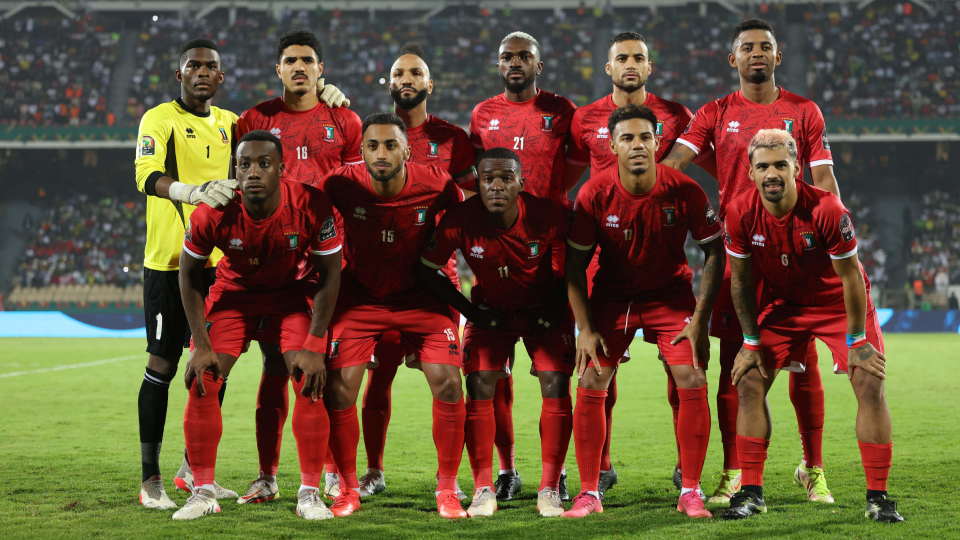
National team of Equatorial Guinea at the quarter-final match against Senegal in Yaoundé on January 30, 2022. Basilio Ndong, trained at Cano Sport Academy, is in the front row, third from the right.
Photo credit: Sebastian Frej / Alamy
Bad governance and corruption in football administration
Equatorial Guinea’s entrenched lack of transparency extends to the sports sector, where corruption and mismanagement have long undermined football development. In 2024, the country ranked 173rd out of 180 on Transparency International’s Corruption Perceptions Index.70 That same year, the government’s provisional budget allocated 3 billion CFA francs (approximately $ 5.3 million) to sports federations,71 yet detailed breakdowns of spending across federations such as athletics, tennis, or football are not publicly available.
At the national level, football likely receives a larger share of funding, partly due to FEGUIFUT’s participation in international competitions such as AFCON, according to Nzamio Nsa. On this basis, at the regional level, Equatorial Guinea’s football budget could reportedly exceed that of Angola72 and be comparable to Gabon’s 2025 football federation budget.73 The problem, therefore, is not a lack of investment. The regime, FIFA, and CAF all provide funding, but these resources are absorbed by a governance system incapable of translating financial inputs into a coherent, professional football model.
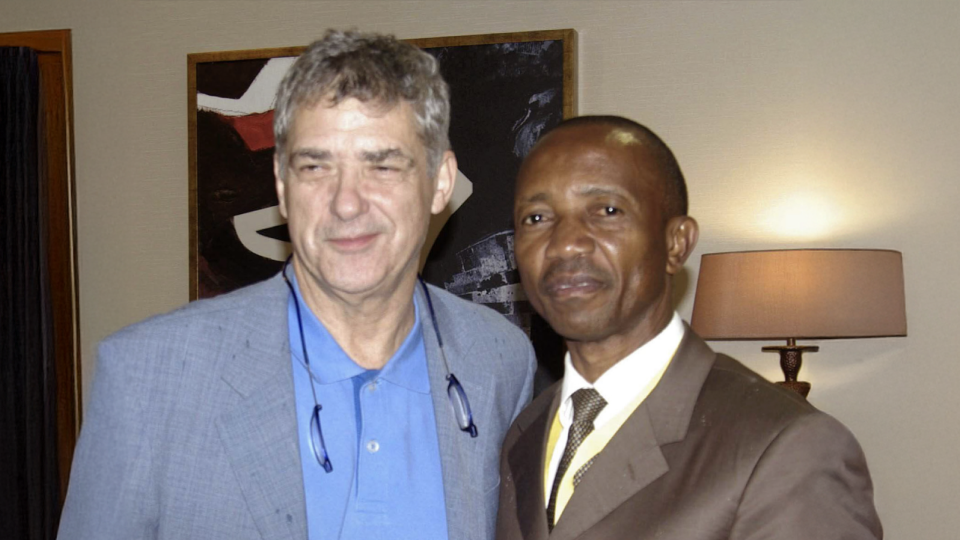
Ángel María Villar, former president of Spain’s football federation, poses with Domingo Mituy Edjang, the president of Equatorial Guinea’s football federation before a 2013 friendly match between their national teams.
Photo credit: Mansueto Loeri / EFE
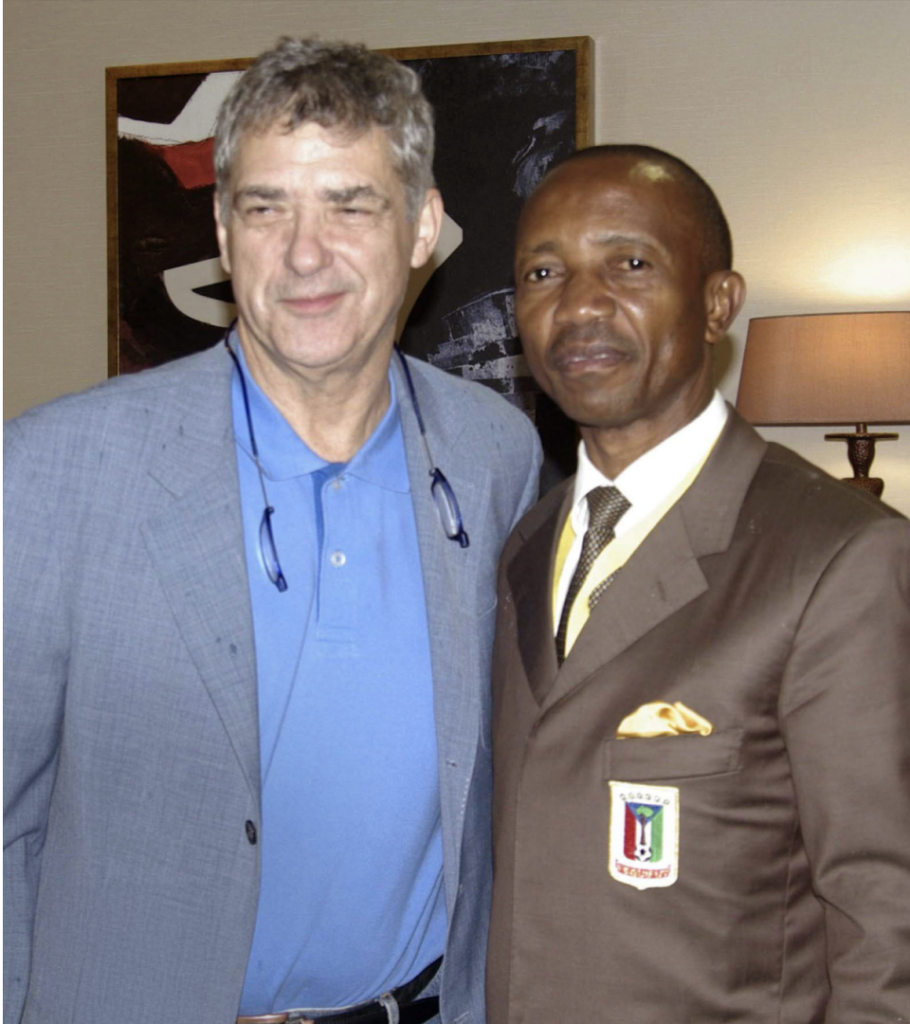
Ángel María Villar, former president of Spain’s football federation, poses with Domingo Mituy Edjang, the president of Equatorial Guinea’s football federation before a 2013 friendly match between their national teams.
Photo credit: Mansueto Loeri / EFE
Legitimization and Complicity in the Image Laundering of Equatorial Guinea’s Regime
Football diplomacy
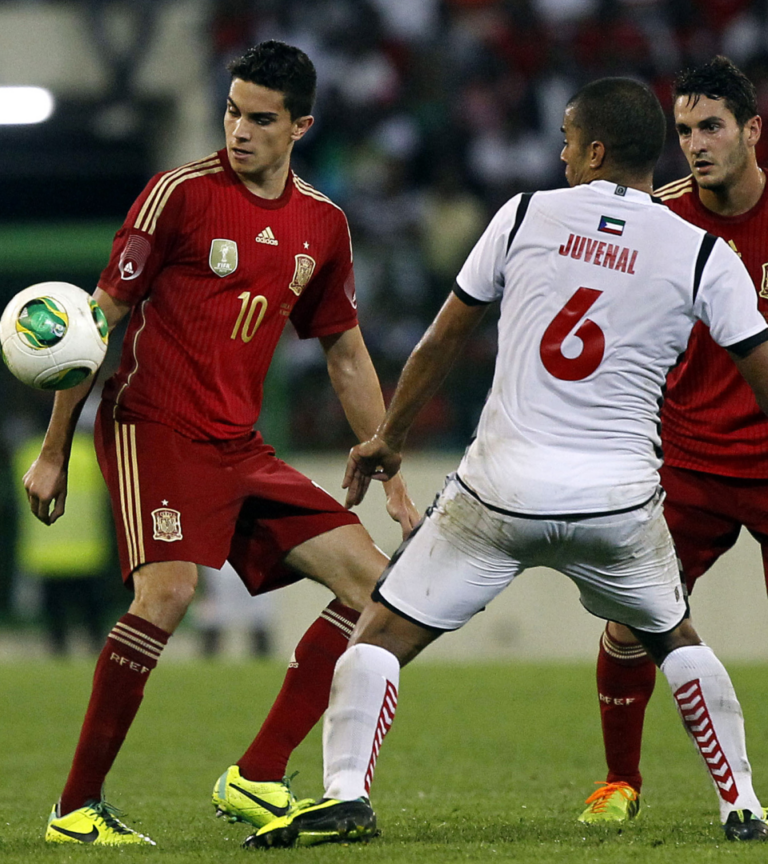
Juvenal Edjogo-Owono of Equatorial Guinea (centre) challenges Marc Bartra and Koke of Spain during a 2013 friendly match in Malabo.
Photo credit: Valentina Lizard / AFP
World champions in a dictatorship: Spain’s 2013 friendly scandal
On Nov. 8, 2013, the Obiang regime announced that the reigning FIFA World Champions, Spain’s La Roja, which was touring Africa at the time, chose Equatorial Guinea over Gabon and Angola to play a friendly match against Nzalang.79 Billing the game as “the great sporting event in Equatorial Guinea,” the regime, through Minister of Youth and Sports Francisco Pascual Obama Asue, boasted that La Roja agreed to play without any financial compensation at the New Malabo Stadium.80 On Nov. 10, Teodoro Nguema announced a reward of five million euros to Nzalang if it won the match and 50,000 euros for every goal scored.81
News about the event stirred a firestorm of controversy.82 Equatoguinean human rights defenders, including the late Dr. Wenceslao Mansogo, warned that the match and the spectacle of a passionate fan base would serve to obscure the country’s rampant repression and human rights abuses.83
The Royal Spanish Football Federation (RFEF)’s decision to play in Equatorial Guinea raised questions and suspicions about the motives behind the agreement. While RFEF justified the decision by citing strong cultural ties between the nations, Euronews reported at the time that the Spanish team had allegedly received 15 million euros for the match.84 However, both the regime and RFEF later denied this claim, asserting that the game was played free of charge.85
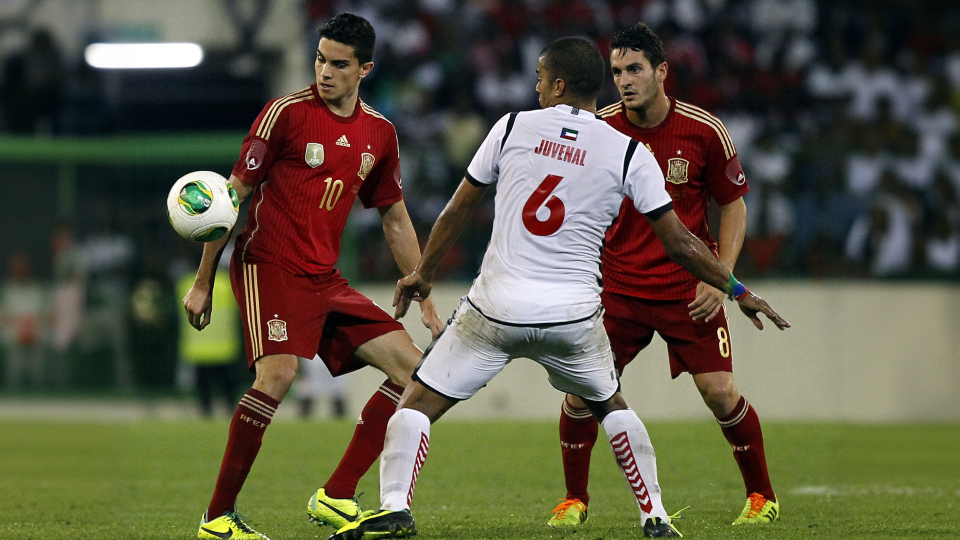
Juvenal Edjogo-Owono of Equatorial Guinea (centre) challenges Marc Bartra and Koke of Spain during a 2013 friendly match in Malabo.
Photo credit: Valentina Lizard / AFP
Spanish football leaders’ association with Equatorial Guinea’s regime
On May 17, 2016, Spanish businessman, film producer, and Atlético de Madrid president Enrique Cerezo visited Teodoro Obiang just weeks after he claimed 93.7% of the vote in an election that was neither free nor fair. Cerezo congratulated Obiang and presented him with an Atlético de Madrid jersey bearing his name, along with “other gifts.” Cerezo was, in fact, thanking Obiang for the regime’s cooperation in allowing his production company to film the multi-million-dollar Sony movie 1898: Our Last Men in the Philippines in Equatorial Guinea. Cerezo has traced his love of Equatorial Guinea to a friendship he developed with Guillermina Mekuy Mba Obono, a former minister delegate for culture and tourism.
On Nov. 29, 2022, FC Barcelona President Joan Laporta welcomed Miguel Edjang, Equatorial Guinea’s ambassador to Spain, with a handshake at the club’s sports complex. Framed as an effort to expand Barcelona’s global presence, Laporta accepted a formal gift from the Guinean diplomatic delegation.
Equatorial Guinea’s regime has long sought legitimacy through high-profile international ties, and football offers a convenient avenue. As the country attempts to raise its profile in the sport, its engagement with Spanish clubs is unsurprising. However, given the dynastic nature of its authoritarian power, these relationships are far from trivial.
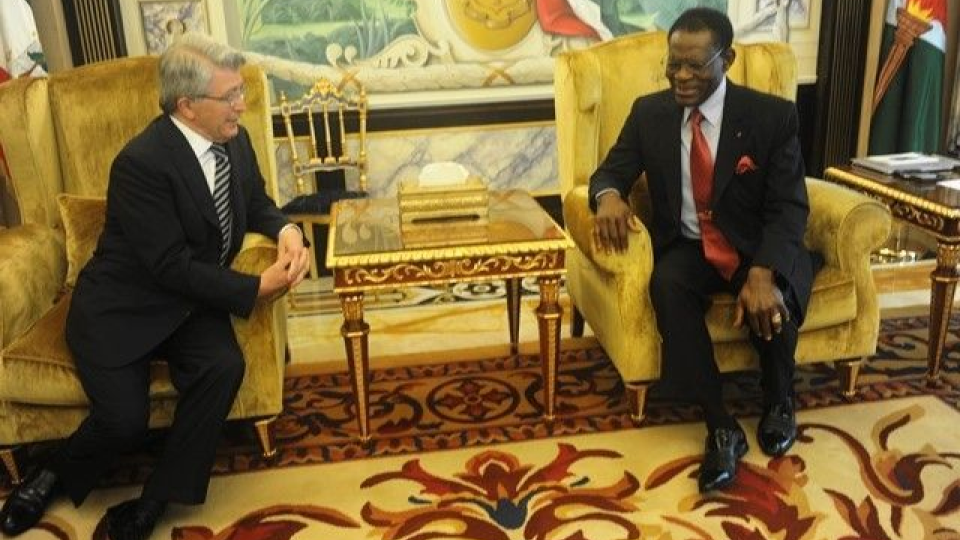
Atlético Madrid President Enrique Cerezo meets with Teodoro Obiang Nguema Mbasogo in the Malabo Government Building in May 2016.
Photo credit: Manuel Mangue, sourced from PDGE Press Office
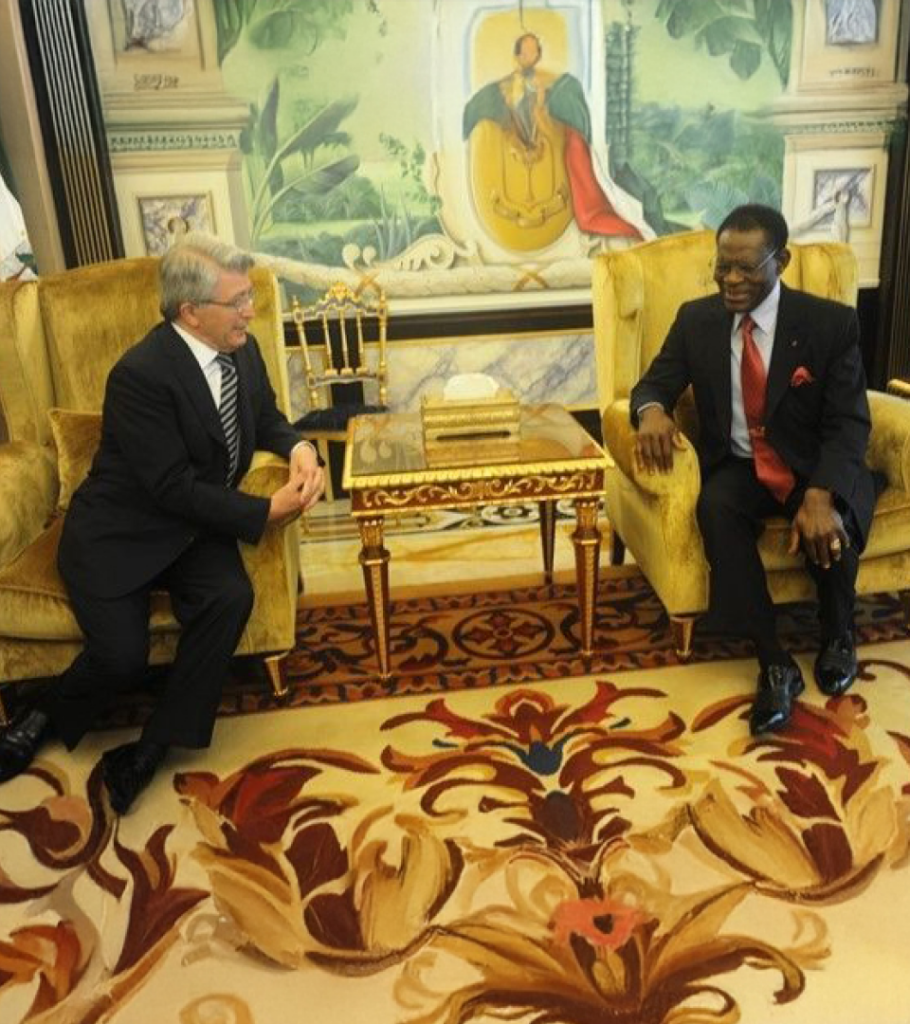
Atlético Madrid President Enrique Cerezo meets with Teodoro Obiang Nguema Mbasogo in the Malabo Government Building in May 2016.
Photo credit: Manuel Mangue, sourced from PDGE Press Office
Equatorial Guinea’s “forbidden documentary” finds no screen time in Spain
Juan Tomás Ávila Laurel is well aware of the deep connections between politics and football in his country. In 2013, he joined other activists in protesting the friendly match between Spain and Equatorial Guinea, urging Spanish football stars like Sergio Ramos and Andrés Iniesta on X (then Twitter) to publicly oppose the game. But the regime’s ties with influential foreign football figures do more than lend legitimacy to Teodoro Obiang — they serve as a means of extending his repressive rule beyond Equatorial Guinea’s borders and into other sectors, including the Spanish film industry. This became evident when a Spanish documentary critical of the regime featuring Ávila Laurel faced significant distribution hurdles in Spain.
Feeding and failing: Business in kleptocratic Equatorial Guinea
In the kleptocratic regime of Equatorial Guinea, doing business often requires complicity with the ruling powers. This is evident in the case of Martínez Hermanos, a company that has operated in the country since 1927 and now leads the nation’s retail sector.90 To maintain its status, the company actively sponsors events such as beauty contests91 and Nzalang for AFCON 2023, consistently supporting the regime. Public expressions of loyalty are commonplace, most notably the state-mandated celebrations of the birthdays of President Obiang and his vice president.92
Ties with the regime are a double-edged sword. They may grant privileged economic advantages, but at the cost of living under the yoke of an arbitrary power that demands total complicity: submitting to its whims, being forced to don the mantle it assigns, and bowing to its staged performances of public image.
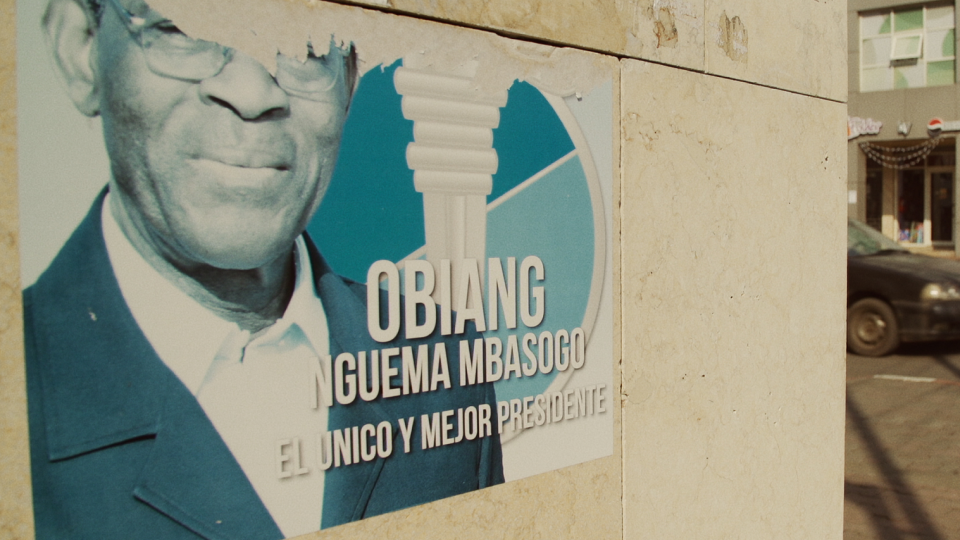
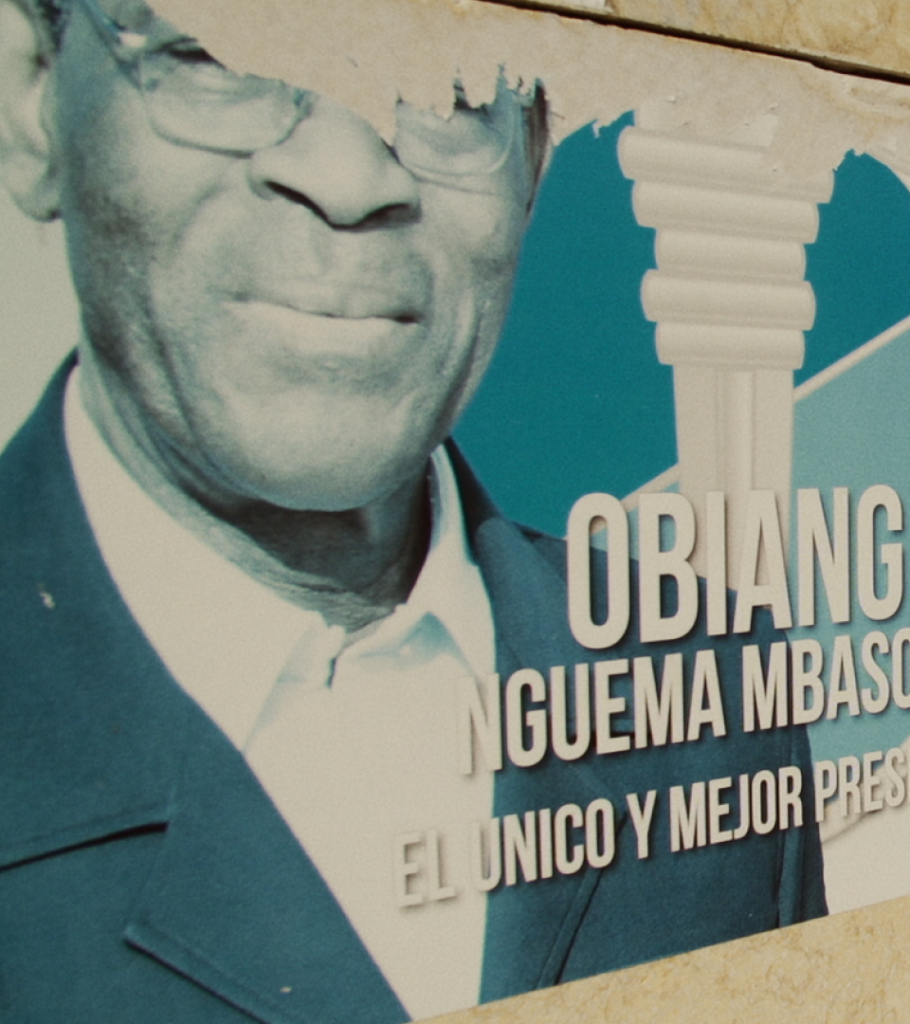
Recommendations
To decision-makers and the international community
01
02
03
To FIFA
01
02
To LaLiga
01
02
To professional football players
01
To the Equatoguinean regime
01
02
03
Acknowledgments
References
On Jan. 3, 2026, a presidential decree changed Equatorial Guinea’s capital city from Malabo to Ciudad de La Paz located on the mainland.
“Equatorial Guinea: 40 years of repression and rule of fear highlights human rights crisis,” Amnesty International (Aug. 8, 2022), http://www.amnesty.org/en/latest/press-release/2019/08/equatorial-guinea-years-of-repression-and-rule-of-fear.
“PIB per cápita (US$ a precios actuales) – Sub-Saharan Africa,” World Bank Open Data, http://datos.bancomundial.org/indicador/NY.GDP.PCAP.CD?locations=ZG&most_recent_value_desc=true.
“Actualización económica de Guinea Ecuatorial 2025: Gestión de la riqueza de Guinea Ecuatorial para un crecimiento y desarrollo sostenibles,” Grupo Banco Mundial (July 21, 2025), https://www.bancomundial.org/es/country/equatorialguinea/publication/equatorial-guinea-economic-update-2025-managing-equatorial-guinea-wealth-for-sustainable-growth-and-development.
“Estatutos Generales FEGUIFUT,” Federación Ecuatoguineana De Fútbol, http://www.feguifut.org/estatutos-generales.
FIFA, “FIFA/Coca-Cola Men’s World Ranking – Equatorial Guinea”, https://inside.fifa.com/fifa-world-ranking/EQG?gender=men.
“Emilio Nsue Wins PUMA Golden Boot Award,” CAFonline (Feb. 11, 2024), http://www.cafonline.com/caf-africa-cup-of-nations/news/emilio-nsue-wins-puma-golden-boot-award.
Juan Antonio Nguema Meñe Abeso, “Comunicado de Prensa,” Federación Ecuatoguineana De Fútbol (Feb. 13, 2024), https://www.feguifut.org/imgdb/NOTA%20PRENSA%20JUNTA%20EJECUTIVA%2009%2002%202024.pdf.
Asonga Radio y Television, “Noticias Asonga 14-2-2024 La FEGUIFUT suspende al capitán Emilio Nsue y Iban Edú del Nzalang,” YouTube (Feb. 14, 2024), https://www.youtube.com/watch?v=bDimwzSzBi4.
“Carta abierta de los jugadores de Nzalang”(Feb. 14, 2024), https://estaticos-cdn.prensaiberica.es/epi/public/content/file/original/2024/0215/20/carta-abierta-nzalang23-pdf.pdf.
FIFA, “Equatorial Guinean FA President Venancio Tomás Ndong,” YouTube (Sept. 7, 2022), http://www.youtube.com/watch?v=LS4IXh0AwPE.
Ornella Diana Molongua Djombe, “Nguema Obiang Mangue es un pilar en la FEGUIFUT”, ha dicho Venancio Tomás,” La Vicepress (June 23, 2023), https://www.lavicepress.org/post/nguema-obiang-mangue-es-un-pilar-en-la-feguifut-ha-dicho-venancio-tom%C3%A1s.
Adrian Bishop, “Emilio Nsue Alleges the Equatoguinean FA ‘Embezzled More Than £850,000 of Bonuses’ During AFCON…,” DailyMail (Feb. 17, 2024), https://www.dailymail.co.uk/sport/football/article-13093055/Emilio-Nsue-alleges-Equatoguinean-FA-embezzled-850-000-bonuses-Africa-Cup-Nations-tournaments-scorer-suspended-indefinitely-gross-misconduct.html.
@eg_only_one, “La selección Nacional de Guinea Ecuatorial ya tiene a disposición los fondos para su estancia en la CAN Costa de Marfil 2024,” Instagram (Dec. 30, 2023), https://www.instagram.com/p/C1ex7WQo2uw/.
Ley de Presupuestos Generales del Estado 2024, Presidencia del Gobierno de la República de Guinea Ecuatorial (Dec. 6, 2023) 56, https://www.lavicepress.org/post/presupuestos-generales-del-estado-para-el-ejercicio-econ%C3%B3mico-2024.
In 2022, 7 out of 28 hospitals in Equatorial Guinea were not functional. See: Guinea Ecuatorial en Cifras, Instituto Nacional de Estadística de Guinea Ecuatorial (2023) 34, https://inege.org/wp-content/uploads/2024/01/Guinea-Ecuatorial-en-Cifras-2023.pdf.
Encuesta Nacional de Hogares de Guinea Ecuatorial, Instituto Nacional de Estadística de Guinea Ecuatorial (Nov. 2024) 100, https://inege.org/wp-content/uploads/2024/12/Informe-Definitivo-de-la-ENH2.pdf.
@eg_only_one, “Si llegáis a la final de la CAN, me veréis allí en Costa de Marfil animandoles,” Instagram (Jan. 10, 2024), https://www.instagram.com/p/C17T8pJIEDZ/.
@la_vice_press, “Continúan las investigaciones de los presuntos casos de corrupción,” Instagram (May, 19, 2021) https://www.instagram.com/p/CPC8VNGs-wA/?img_index=1.
@eg_only_one, “Como apoyo al Nzalang Nacional, ofrezco 200 billetes para quienes quieran ir al primer partido de nuestra selección nacional en Costa de Marfil,” Instagram (Jan. 9, 2024), https://www.instagram.com/p/C15P-gMolXI/.
@eg_only_one, “El grupo de fans del Nzalang Nacional encabezado por su presidenta @wendy_la_pija acompañada de varios influencers Ecuatoguineanos ya están volando para Costa de Marfil a animar al combinado del @_nzalang.nacional @nzalangnacional,” Instagram (Jan. 18, 2024), https://www.instagram.com/p/C2PFLn0IWIS/.
@cathy.afrorizada, “Todos con Nzalang Nacional,” Instagram (Jan. 13, 2024), https://www.instagram.com/p/C2CxjoCofbQ/.
@sandrasiosa, “Nosotros somos Guinea Ecuatorial,” Instagram (Jan. 19, 2024), https://www.instagram.com/p/C2SYOToIPRs/.
@k.eyamaofficial, “Yo por mi patria, hasta mi último respirar”, Instagram (Jan. 29, 2024), https://www.instagram.com/p/C2sNebwo02l/.
@la_vice_press, “El Vicepresidente felicita a los Nzalang Boys por el resultado frente a Nigeria,” Instagram (Jan. 15, 2024), https://www.instagram.com/p/C2GPc26I1eI/?img_index=1.
@teonguema, “¡Bravo a Nzalang Nacional!”, X (Jan. 22, 2024), https://twitter.com/teonguema/status/1749528022477148524.
@T_Obiang, “A parte de la prima de participación, por el buen partido realizado esta tarde ante Costa de Marfil yo les prometo al Nzalang Nacional una prima de “un millón de Euros”,” X (Jan. 22, 2024), https://twitter.com/T_Obiang/status/1749518038250987712.
Efe,“Locura por La Roja en Ginea Ecuatorial,” Diario AS (Jan. 23, 2024), https://as.com/futbol/internacional/locura-por-la-roja-en-guinea-ecuatorial-n/.
María Jesús Nsang, “El Jefe de Estado entrega a la Selección Nacional el millón de euros prometido,” PDGE, https://www.pdge-guineaecuatorial.com/el-jefe-de-estado-entrega-a-la-seleccion-nacional-el-millon-de-euros-prometido/.
@ParaCpds “Graciaaaaaaaassssssss, Zalang!!!!!”, X (Jan. 22, 2024), https://x.com/ParaCpds/status/1749527887940555070?s=20.
Grupo Banco Mundial, supra note 4
ABAHA TV, “Un ciudadano guineo ecuatoriano pide ayuda desesperadamente el hijo del tirano del País.” YouTube (Jan. 24, 2024), https://www.youtube.com/watch?v=3wtDCHK_dLQ.
@MocacheMassoko, “Un millón de euros resuelve muchos problemas en Guinea Ecuatorial,” X (Jan. 22, 2024), https://x.com/MocacheMassoko/status/1749545195366912339?s=20.
@HRF, “1/ On Jan.12, police in Equatorial Guinea arrested Liberato Biachó Bilelo because of an audio message on WhatsApp in which he complained about public corruption, nepotism, and other abuses in the country,” X (Jan. 22, 2024), https://x.com/HRF/status/1749475540564603385.
Kgalalello Gaebee, “Equatorial Guinea: Free Actvist Anacleto Micha Ndong Nlang and End Brutality Against Rights Defenders,” CIVICUS (Feb. 22, 2024), https://www.civicus.org/index.php/media-resources/news/6867-equatorial-guinea-free-activist-anacleto-micha-ndong-nlang-and-end-brutality-against-rights-defenders.
“Equatorial Guinea: Jailed Human Rights Defender at Risk of Torture: Anacleto Micha Ndong,” Amnesty International (March 13, 2024), https://www.amnesty.org/fr/documents/afr24/7794/2024/en/.
@HRF, “1/ It has been two weeks since human rights activist Anacleto Micha Ndong disappeared in the custody of prison officials in Equatorial Guinea,” X (May 7, 2024), https://x.com/HRF/status/1787930496837550490.
“Equatorial Guinea: Human Rights Defender’s Whereabouts Unknwon,” https://www.amnesty.org.uk/urgent-actions/human-rights-defenders-whereabouts-unknown.
“Equatorial Guinea dissident dies in prison,” France 24 (Jan. 16, 2023), https://www.france24.com/en/live-news/20230116-equatorial-guinea-dissident-dies-in-prison.
“Last minute goal sees Guinea into AFCON quarterfinals,” ESPN (Jan. 28, 2024), https://www.espn.com/soccer/report/_/gameId/697523.
Susann Baller et al., The politics of football in Africa: Mobilizations and Trajectories, 2010/2 No. 118, Politique africaine, 5-21, CAIRN.INFO, https://shs.cairn.info/meta-selection/article/39a4fc5d-e592-5d78-8017-a9ab390123fc?lang=fr.
“A History of Sorts & Dictators, Part 3: Post-WWII Soft Power,” Human Rights Foundation (Dec. 12, 2024), https://hrf.org/latest/a-history-of-sports-dictators-part-3-post-wwii-soft-power/.
Simon Baynham, Equatorial Guinea: The Terror and the Coup, 36, No. 2, The World Today, 65–71, JSTOR, http://www.jstor.org/stable/40395170 (accessed 27 Jan. 2025).
Constitución de 1973 (B.O.E. 1973) (Equatorial Guinea), Art. 50, § 5, https://drive.google.com/file/d/1m6606laWM-g2Qh4k1V8LisbZ6Xg-6bXm/view?usp=drive_link.
“Biografia de Francisco Macías Nguema,” cmeyanchama.com, http://www.cmeyanchama.com/Documents/Guinee/Francisco_Macias_Nguema.pdf
Ibid.
“Francisco Macías, El Hitler Africano,” El Cuaderno (Oct. 17, 2018), https://elcuadernodigital.com/2018/10/15/francisco-macias-el-hitler-africano/
Joaquín Mbomío Bacheng,“Contrapunto a la barbaridad de Moratinos: Un guineano es alcalde de un cantón ginebrino…” (Nov. 2, 2006), https://www.guinea-ecuatorial.net/inicio.asp?cd=ni4972.
“Discriminación Étnica y Colonialismo. El Fútbol Ecuatoguineano Bajo el Franquismo (II),” Blog de Carles Viñas (April 24, 2012), https://carlesvinyas.wordpress.com/2012/04/24/discriminacion-etnica-y-colonialismo-el-futbol-ecuatoguineano-bajo-el-franquismo-ii/.
“Equatorial Guinea – List of Champions,” RSSSF, https://www.rsssf.org/tablese/eqguineachamp.html.
“Discriminación Étnica y Colonialismo. El Fútbol Ecuatoguineano Bajo el Franquismo (II),” Blog de Carles Viñas (April 24, 2012), https://carlesvinyas.wordpress.com/2012/04/24/discriminacion-etnica-y-colonialismo-el-futbol-ecuatoguineano-bajo-el-franquismo-ii/.
David Lewis, Filipp Lebedev and Giulia Paravicini, “Russian power creeps across West Africa with Equatorial Guinea mission,” Reuters (Nov. 12, 2024), https://www.reuters.com/world/russian-power-creeps-across-west-africa-with-equatorial-guinea-mission-2024-11-12/.
Casey Michel, “Michael Jackson Memorabilia Bought With Dirty Money of Dictator’s Son.” Rolling Stone (Oct. 8, 2021), https://www.rollingstone.com/culture/culture-features/teodoro-obiang-michael-jackson-memorabilia-collection-1237437/.
“Gran éxito de Julio Iglesias en Malabo,” Guinea Ecuatorial Press (Oct. 10, 2012), https://www.guineaecuatorialpress.com/noticias/gran_exito_de_julio_iglesias_en_malabo.
Before the oil boom, the state’s investment in sports infrastructure was negligible. As Alicante recalls, “Estadio La Paz used to be laughable.” Today, the country boasts state-of-the-art stadiums in Malabo, Bata, and Mongomo, symbols of a transformation driven more by optics than genuine development.
Chris Murphy, “African ambition: Tiny nations host football feast,” CNN Sports (Jan. 20, 2012), https://edition.cnn.com/2012/01/20/sport/football/football-africa-cup-nations/index.html.
“Department of Justice Seeks to Recover More Than $70.8 Million in Proceeds of Corruption from Government Minister of Equatorial Guinea,” Office of Public Affairs (Oct. 25, 2011), https://www.justice.gov/archives/opa/pr/department-justice-seeks-recover-more-708-million-proceeds-corruption-government-minister.
“Second Vice President of Equatorial Guinea Agrees to Relinquish More Than $30 Million of Assets Purchased with Corruption Proceeds,” Office of Public Affairs (Oct. 10, 2014), https://www.justice.gov/archives/opa/pr/second-vice-president-equatorial-guinea-agrees-relinquish-more-30-million-assets-purchased.
“Obiang Verdicts: Transparency International Welcomes the Corruption Conviction and Seizure of Assets, Transparency International (Oct. 27, 2017), https://www.transparency.org/en/press/obiang-verdict-transparency-international-welcomes-the-corruption-convictio.
“Guinée Équatoriale : Le pays qui sauva la CAN…,” Franceinfo (Feb. 3, 2015), https://www.francetvinfo.fr/monde/afrique/guinee-equatoriale/guinee-equatoriale-le-pays-qui-sauva-la-can_3066161.html.
“How Equatorial Guinea stepped up and saved African Cup of Nations,” Alarabiya news (Jan. 27, 2015), https://english.alarabiya.net/sports/2015/01/28/How-Equatorial-Guinea-stepped-up-and-saved-African-Cup-of-Nations.
Zoe Spriet-Mezoued, “Equatorial Guinea and EITI Candidacy, Slow but Steady Progress?,” Publish What You Pay (Oct. 19, 2023), https://pwyp.org/equatorial-guinea-and-eiti-candidacy-slow-but-steady-progress/.
Jonathan Wilson, “Letter From Equatorial Guinea: Forget Human Rights – Here Comes the Football.” New Statesman (Feb. 12, 2015), https://www.newstatesman.com/culture/sport/2015/02/letter-equatorial-guinea-forget-human-rights-here-comes-football.
“Equatorial Guinea: Naturalisation at a New Level,” Citizen Rights in Africa Initiative (March 8, 2013), https://citizenshiprightsafrica.org/equatorial-guinea-naturalisation-at-a-new-level/.
“La Guinée équatoriale et sa légion étrangère,” BBC News Afrique (Feb. 2, 2012), https://www.bbc.com/afrique/institutionelles/2012/02/120202_cguinee.
ESPN, “Equatorial Guinea: Naturalisation at a New Level,” Citizen Rights in Africa Initiative (March 8, 2013), https://citizenshiprightsafrica.org/equatorial-guinea-naturalisation-at-a-new-level/.
Jon Fadugba, “Equatorial Guinea: How Africa’s 41st Best Footballing Nation Came to Host the ACON,” Fourfourtwo (Jan. 20, 2012), https://www.fourfourtwo.com/features/equatorial-guinea-how-africas-41st-best-footballing-nation-came-host-acon.
“Guinea Ecuatorial dispondrá de una Liga de Fútbol Profesional,” Guinea Ecuatorial Press (Oct. 29, 2010), https://www.guineaecuatorialpress.com/noticias/guinea_ecuatorial_dispondra_de_una_liga_de_futbol_profesional.
“Equatorial Guinea: Naturalisation at a New Level,” Citizen Rights in Africa Initiative (March 8, 2013), https://citizenshiprightsafrica.org/equatorial-guinea-naturalisation-at-a-new-level/.
“Equatorial Guinea, 2024” Transparency International, https://www.transparency.org/en/countries/equatorial-guinea.
Ley de Presupuestos Generales del Estado, República de Guinea Ecuatorial 27, https://mpde.gq/wp-content/uploads/2024/05/LEY-PGE-2024.pdf.
Raimundo Ngunza, “Federação Angolana de Futebol no “topo” da verba do OGE/2025,” Novo Jornal, (Jan. 18, 2025), https://www.novojornal.co.ao/desporto/detalhe/federacao-angolana-de-futebol-no-topo-da-verba-do-oge2025-63703.html.
Daniel Dematsatsa, “63e congrès Fegafoot : un budget de 3,3 milliards pour relancer le football gabonais” FootGabon (July 1, 025), https://footgabon.com/63e-congres-fegafoot-un-budget-de-3-3-milliards-pour-relancer-le.html.
“Rajoy se reúne con Obiang y pide en Guinea Ecuatorial respeto a los derechos humanos,” El Mundo (June 26, 2014), https://www.elmundo.es/espana/2014/06/26/53abe0d8e2704eeb4b8b4570.html.
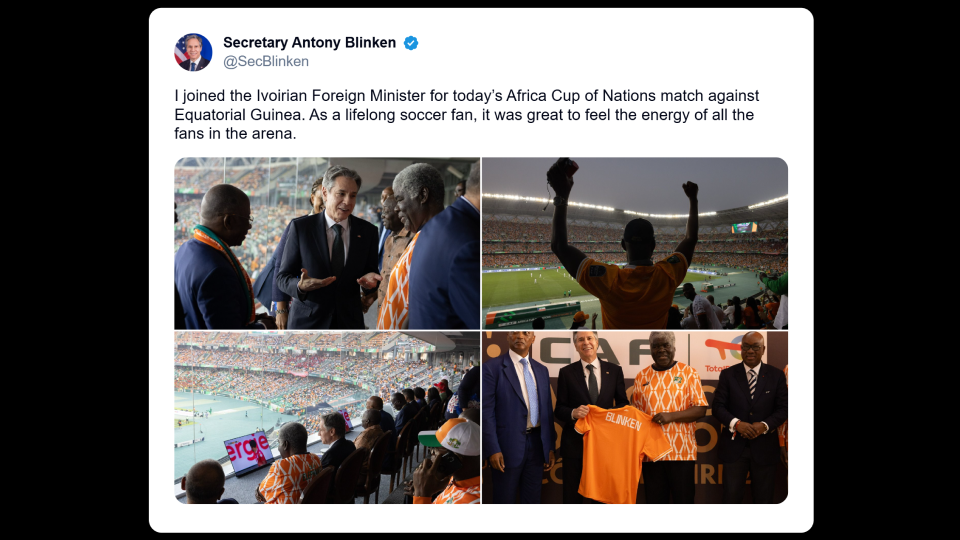
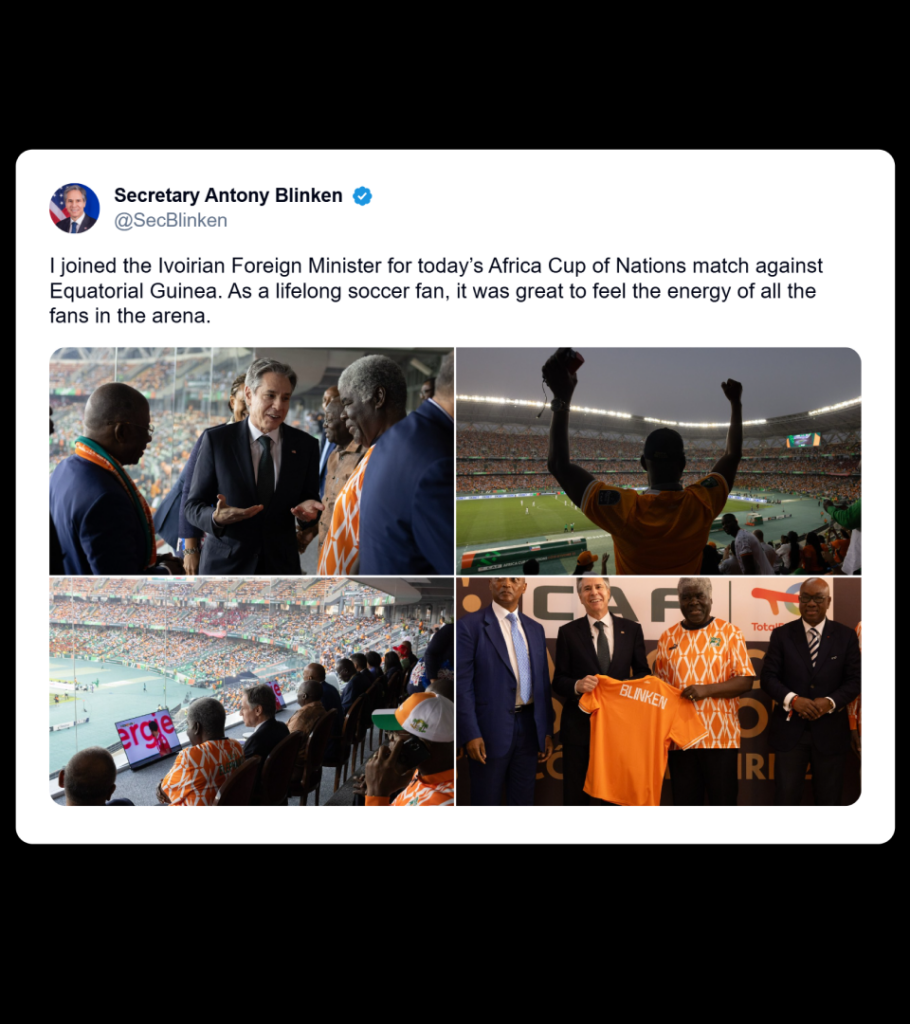
@SecBlinken, “I joined the Ivoirian Foreign Minister for today’s Africa Cup of Nations match against Equatorial Guinea,” X (Jan. 23, 2024), https://x.com/SecBlinken/status/1749597455111639489.
Karim Zidan, “What Is Blinken Doing at an African Football Event?,” Sports Politika (Jan. 24, 2024), https://www.sportspolitika.news/p/blinken-afcon-football-politics-us-china.
AFP, “Blinken Sees Bright Future For Ivory Coast Football Despite Loss,” Barron’s (Jan. 23, 2024), https://www.barrons.com/news/blinken-sees-bright-future-for-ivory-coast-football-despite-loss-6b269ba1.
Nick Turse, “Squeezed By African Coups, Biden Cozies up to the World’s Worst Dictator,” The Intercept (March 25, 2024), https://theintercept.com/2024/03/25/biden-equatorial-guinea-teodoro-obiang-aid/.
“Toda la información del Nzalang – España,” Guinea Ecuatorial Press (Nov. 8, 2013), https://www.guineaecuatorialpress.com/index.php/noticias/toda_la_informacion_del_nzalang_-_espa%C3%B1a.
Ibid.
“Nguema Obiang Mangue promete cinco millones de euros si Nzalang vence a España,” Guinea Ecuatorial Press (Nov. 10, 2013), https://www.guineaecuatorialpress.com/index.php/noticias/nguema_obiang_mangue_promete_cinco_millones_de_euros_si_nzalang_vence_a_espa%C3%B1a.
“La selección española, en la corte de Obiang,” RTVE (Nov. 14, 2013), https://www.rtve.es/deportes/20131114/guinea-espana/789381.shtml.
“Las amistades peligrosas de La Roja,” El País “Nov. 8, 2013), https://elpais.com/sociedad/2013/11/08/actualidad/1383944597_990106.html.
Euronews, “Spanish Football ‘Paid 15 million Euros’ for Controversial Friendly Against Equatorial Guinea,” YouTube, Nov. 16, 2013, https://www.youtube.com/watch?v=pDXhA4eb46U.
“La Roja se desmarca de Obiang,” El País (Nov. 13, 2013), https://elpais.com/deportes/2013/11/13/actualidad/1384375120_020420.html.
“El Jefe de Estado recibe al Presidente del Atlético de Madrid,” Guinea Ecuatorial Press (May 18, 2016), https://www.guineaecuatorialpress.com/noticias/_el_jefe_de_estado_recibe_al_presidente_del_atletico_de_madrid.
“Enrique Cerezo regala a Obiang una camiseta del Atlético Madrid” El Mundo (May 18, 2016), https://www.elmundo.es/deportes/2016/05/18/573c392b46163f7d668b4608.html.
“Miguel Edjang Angue mantiene conversaciones con Joan Laporta, Presidente del F.C. Barcelona,” Embajada de Guinea Ecuatorial en España” (Nov. 30, 2022), https://xn--embajadadeguineaecuatorialenespaa-yfd.com/miguel-edjang-angue-mantiene-conversaciones-con-joan-laporta-presidente-del-f-c-barcelona/.
Ibid.
“Conócenos – Grupo Martínez Hermanos.” Grupo Martínez Hermanos (Nov. 29, 2021), https://martinezhermanos.com/conocenos/#historia.
Martínez Hermanos, “Nos sentimos honrados de haber sido, una vez más, patrocinadores de este increíble certamen que cada año impulsa el talento, la elegancia y la dedicación de la juventud ecuatoguineana,” Facebook (Sept. 11, 2024), https://www.facebook.com/MartinezHermanos1927/posts/pfbid0zquADvoyeWR2PDskXqGjgyZMPFwbjny8Cyy7ouxRG4Rofzpii2SZ8cxUbbZZXyzml.
Martínez Hermanos, “¡Feliz Cumpleaños a S.E. Teodoro Nguema Obiang Mangue!”, Facebook (June 25, 2024), https://www.facebook.com/MartinezHermanos1927/posts/pfbid0EUUPpGEfYpUCuQZLUbjcNbreXShD79pXcJ2FpKdoRGWAF5QMwdZpuEck4AvKwoKMl.