



Welcome to the 27th edition of HRF’s AI for Individual Rights newsletter.
Russia’s media regulator, Roskomnadzor, deployed an artificial intelligence (AI) system that filters the country’s internet traffic. This could increase the Kremlin’s ability to censor websites, restrict access to information, and detect Russians’ efforts to use virtual private networks (VPNs). In Zimbabwe, officials announced plans to expand the automated traffic surveillance network, raising concerns about the use of AI to monitor citizens.
In AI for freedom news, American technology company Block shipped Buzz 1.0, an update of its open-source workspace that brings humans, AI agents, and customizable tools together to help teams collaborate. Meanwhile, Numes launched an open marketplace where anyone can buy or sell access to computing power, potentially making open-weight AI more affordable and accessible.
We end with a talk from local AI researcher 0xSero, who explains how AI agents running on personal hardware can help people accomplish tasks without relying on corporate providers. This is especially relevant for human rights defenders navigating the frontier of AI.
The Latest in AI for Repression
Russia Deploys AI-Powered Internet Censorship System
Russia’s media regulator, Roskomnadzor, has reportedly spent 2.27 billion rubles (approximately $28 million) to deploy an AI-powered system that filters internet traffic. While officials have not disclosed exactly how it will work, this system could monitor the flow of information across the local internet, block websites or apps, or detect VPN use in Russia. The system allegedly uses a Russian-developed AI model running on Russian-controlled infrastructure. This new AI filter, which runs on infrastructure no one can audit or stop, could make Russia’s already extensive online censorship even more difficult for civil society and dissidents to circumvent.
In context: The Kremlin has spent years tightening its control over the internet, blocking independent news outlets and cracking down on VPNs that Russians use to bypass censorship. Just in October, Russia’s Digital Development Ministry proposed using AI to detect and block VPNs. The Kremlin plans to double funding for its internet censorship in 2027, compared to 2026.
Zimbabwe to Install More Traffic Cameras with Automated Fines
Zimbabwe’s Ministry of Home Affairs and Cultural Heritage has outlined plans to expand its traffic surveillance network. Officials plan to add cameras capable of automatically detecting and fining motorists for violations (such as running red lights or using mobile phones while driving) to 92 more locations. This move is only part of Zimbabwe’s broader efforts to cover its major highways and public spaces with cameras. While this innovation is ostensibly pitched as a road safety measure, it could also help the regime build out a nationwide surveillance grid, one intersection at a time.
In context: Zimbabwe’s authoritarian regime has abducted, tortured, and killed political opponents, as well as violently dispersed protests and arrested its organizers. Expanding AI-powered surveillance could give officials new tools to identify and track anyone critical of the regime. Zimbabwe has even reportedly deployed facial recognition cameras near parliament and a public square where protests frequently take place, raising more concerns about the misuse of the technology.
Saudi Arabia Commits $667 Million to Expand AI Infrastructure
Saudi Arabia’s National Infrastructure Fund has signed financing agreements worth up to $667 million with HUMAIN, a Saudi AI company backed by the regime’s sovereign wealth fund. Approximately $293 million will support the purchase and deployment of powerful AI chips, while another $373 million will fund electricity infrastructure to power AI data centers. The investments “will help accelerate the deployment of advanced computing capacity and the power infrastructure required to support it,” HUMAIN CEO Tareq Amin said. They also reflect the ambition of Saudi Arabia, ruled by an authoritarian regime, to become a major global AI hub.
In context: Saudi Arabia has a history of using digital surveillance, from deploying AI-powered cameras in public spaces to spyware targeting the relatives of murdered journalist Jamal Khashoggi. As the authoritarian regime invests millions in AI infrastructure, some warn that these technologies could further strengthen its monitoring of civil society and suppress dissent.
China-Africa Think Tanks Forum Raises Concerns Over AI Cooperation
China hosted the 15th China-Africa Think Tanks Forum, which gathered roughly 300 officials, researchers, and representatives from China and 46 African countries. They discussed cooperation on development, governance, and technology, including AI, and called for stronger joint research and institutional partnerships. The forum reflects China’s broader ambitions to shape global AI partnerships. Earlier this year, China established the World Artificial Intelligence Cooperation Organization, which includes 29 founding member states (many of them governed by authoritarian regimes). As China expands these partnerships, its authoritarian regime could gain greater influence over how AI is developed and governed worldwide.
In context: China has already exported surveillance technologies to authoritarian regimes in Africa that are capable of monitoring their populations and any dissent within them. Deeper AI collaboration could bring opportunities for regimes to adopt Chinese surveillance and censorship technologies.
Indian Telecom Leader Calls for Complete Control Over Satellite Internet
Sunil Bharti Mittal, founder and chairman of Indian telecommunications giant Bharti Airtel, has urged India to retain control over the “kill switch” for satellite internet services operating in the country. This would allow the hybrid authoritarian regime to quickly shut down or restrict satellite connectivity for entire regions or networks. Mittal argues that India must maintain this control for national security and technological independence. But this so-called kill switch gives the regime an easy way to cut communication for protesters and limit their ability to organize, spread their messages, and push for change.
In context: India has a long history of imposing internet shutdowns. In July, officials disrupted mobile connectivity around student demonstrations in New Delhi. In 2024, they cut mobile connectivity during peaceful protests where farmers were demanding higher guaranteed prices for their crops. State control over satellite internet could make it harder for protesters to coordinate and stay connected when traditional networks are shut down. This is why many protesters in India have recently turned to Bitchat, an encrypted messaging platform that works offline, to communicate amid shutdowns.
Recommended Content
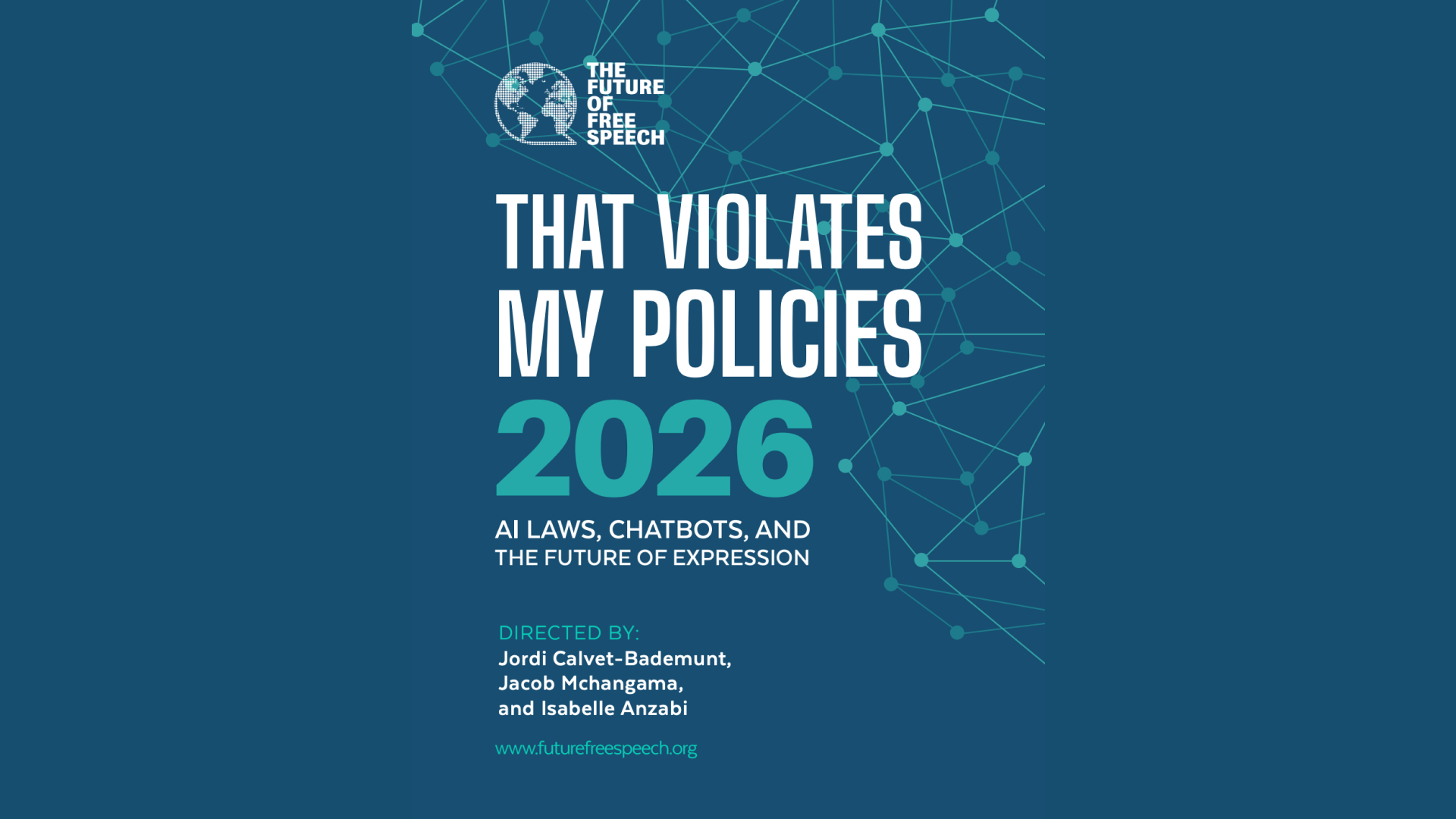
“That Violates My Policies”: AI Laws, Chatbots, and the Future of Expression
In a recent report, the independent think tank The Future of Free Speech examines how governance of generative AI in the European Union, Nigeria, Peru, Sweden, Turkey, the United Kingdom, the United States, and Vietnam affects free expression and access to information. The report finds that governments often apply existing laws, such as those involving national security or propaganda, to AI-generated content. This can be particularly concerning in authoritarian regimes. For example, two exiled Vietnamese dissidents were sentenced in absentia to 17 years in prison for spreading anti-state material, partly involving AI-generated videos, and Turkish courts have ordered AI chatbot responses blocked under existing internet censorship laws. Read the report here — or a summary from one of the authors in The Conversation.
The Latest in AI for Freedom
Block Launches Buzz 1.0 for Agent and Human Collaboration
Block, the financial technology company behind Square and Cash App, has launched Buzz 1.0, a major update to its free, open-source workspace. Buzz is a Slack-like application that lets teams communicate and work side by side with their agents (like Claude, Codex, Goose, or agents powered by local models). One of the biggest additions is a new plugin system that lets teams customize the platform and build their own tools and workflows. For example, users could build dashboards that track AI agents’ work or create interactive maps and project management tools. Buzz can also be self-hosted and is built on Nostr (a censorship-resistant communication protocol), giving organizations greater control over their data and communications infrastructure. The application is available on desktop and mobile devices.
Why this matters: Agents are extremely useful for human rights work, but integrating them into an organization’s daily operations can be complicated. Buzz can now bring people, agents, and customizable tools into a single, self-hosted workspace, making it easier for human rights organizations to put AI to work across their teams.
Numes Offers an Open Marketplace for Open-Weight AI Compute
Numes, a new open marketplace for AI compute, has launched publicly. The platform allows individuals with spare computing power or unused AI capacity to sell access to it. Providers can earn money by selling excess computing power or tap into that extra capacity at competitive prices, or even for free. Numes also offers access to end-to-end encrypted models to protect privacy. Users can pay in traditional currency or bitcoin, which creates new possibilities for permissionless, censorship-resistant access to AI. The platform has already seen impressive demand. In just 11 days, users made 1.4 million AI requests and processed 157 billion tokens (the small units of text that AI models read and generate).
Why this matters: Numes reduces dependence on major AI companies by bringing independent providers together in a single marketplace. This could give human rights defenders more choice over who hosts their AI models and potentially lower costs. It could also help activists and organizations offset the expense of running AI locally by enabling them to earn money from their unused computing power.
Developers Make Powerful, American Open-Weight AI More Accessible
If you missed it in last week’s newsletter, American startup Thinking Machines Lab has released Inkling 2 Small, what some call the best open-weight model developed outside China. Running the full model locally requires extremely expensive hardware, but developers are already working to make it more accessible without sacrificing much privacy. For example, Tinfoil and Maple, both privacy-focused AI companies, allow users to access Inkling 2 Small running in Trusted Execution Environments, secure hardware that keeps users’ AI interactions hidden from the providers. Human rights defenders can now chat with the model in a privacy-protecting manner at competitive prices.
Meanwhile, HRF grantee and AI researcher 0xSero has compressed and optimized Inkling 2 Small to run across four high-end GPUs, making it more feasible for a well-resourced nonprofit or human rights organization to run the model privately without relying on AI providers. There is still plenty more opportunity for further optimization, with the long-term possibility of bringing powerful, non-Chinese AI models to everyday devices and putting private intelligence in people’s pockets around the world.
First Person Labs Raises $10 Million to Build Personalized AI Models
AI research company First Person Labs has launched publicly and secured $10 million to develop Second, an infrastructure that builds personalized, portable AI models. Second will continuously learn about users’ work, style, preferences, and priorities and create evolving models they can interact with directly or use to power other AI tools. Importantly, First Person Labs says that “privacy and sovereignty are paramount.” Second can remain local or run on Tinfoil’s secure hardware that protects user privacy. Users can also connect Second to external tools such as Claude, Muse, Grok Bot, or iMessage (although information shared with those services might not have the same privacy protections). Second could give human rights defenders personal agents that deeply understand their goals and preferences, while allowing them to retain control over their personal information and avoid becoming dependent on a single AI provider.
In context: Behind First Person Labs are Ken Liu and Erik Chi, former HRF grantees who developed the Open Anonymity Project, an initiative building tools that let people use powerful AI models without linking their requests to their identities. Their continued focus on privacy and user control could help make personalized AI safer for people at risk of surveillance.
llama.cpp Launches a New Version for Local AI
The team behind llama.cpp, one of the most widely used open-source tools for running AI models locally, has released version 1.0. This open-source application allows users to run open-weight AI models directly on their own hardware, without sending sensitive information to AI companies. It supports more than 150 AI models and a wide range of hardware, including Macs, Windows, and Linux computers and smartphones. After more than three years of development, this release introduces more predictable software updates and will make it more practical for human rights defenders to access advanced intelligence privately, without depending on corporate AI providers.
Recommended Content
Omarchy SF Event: Local AI is here now
At the Omarchy SF tech meetup, local AI researcher 0xSero gave a talk on the rapidly expanding capabilities of AI agents running on privately owned hardware. He demonstrated how he uses local models to automate complex tasks, including managing a citizenship application, filing taxes, or helping start a nonprofit. Watch the talk here to learn how to run powerful AI models locally and which hardware offers the best performance for the price.