
On the Ground: Acts of Creative Defiance
This chapter explores a series of protests in which young activists in the region used the power of pop culture, symbols, and creativity to strengthen their movements.
Digital Resistance: The Online Battle against Censorship
This chapter studies how young people use digital tools to reach a wider audience, facilitate communications, and avoid censorship from authoritarian regimes.
Facing the Storm: The Challenges of Youth Activism
This chapter details how the authoritarian regimes responded to online and offline resistance, examining the oppressive legislation and digital surveillance employed by the regimes.
Diasporic Dissent: Youth Activism Away from the Homeland
This chapter highlights conditions that facilitated the mobilization of diaspora movements of Hong Kong, Tibet, and Uyghur youth living abroad.
Conclusion & Recommendations
Download

Major Takeaways
Leaderless Mobilization
Online Dissent
Repressive Laws
Cyberattacks
Diasporic Movements
02
On the Ground:
Acts of Creative Defiance
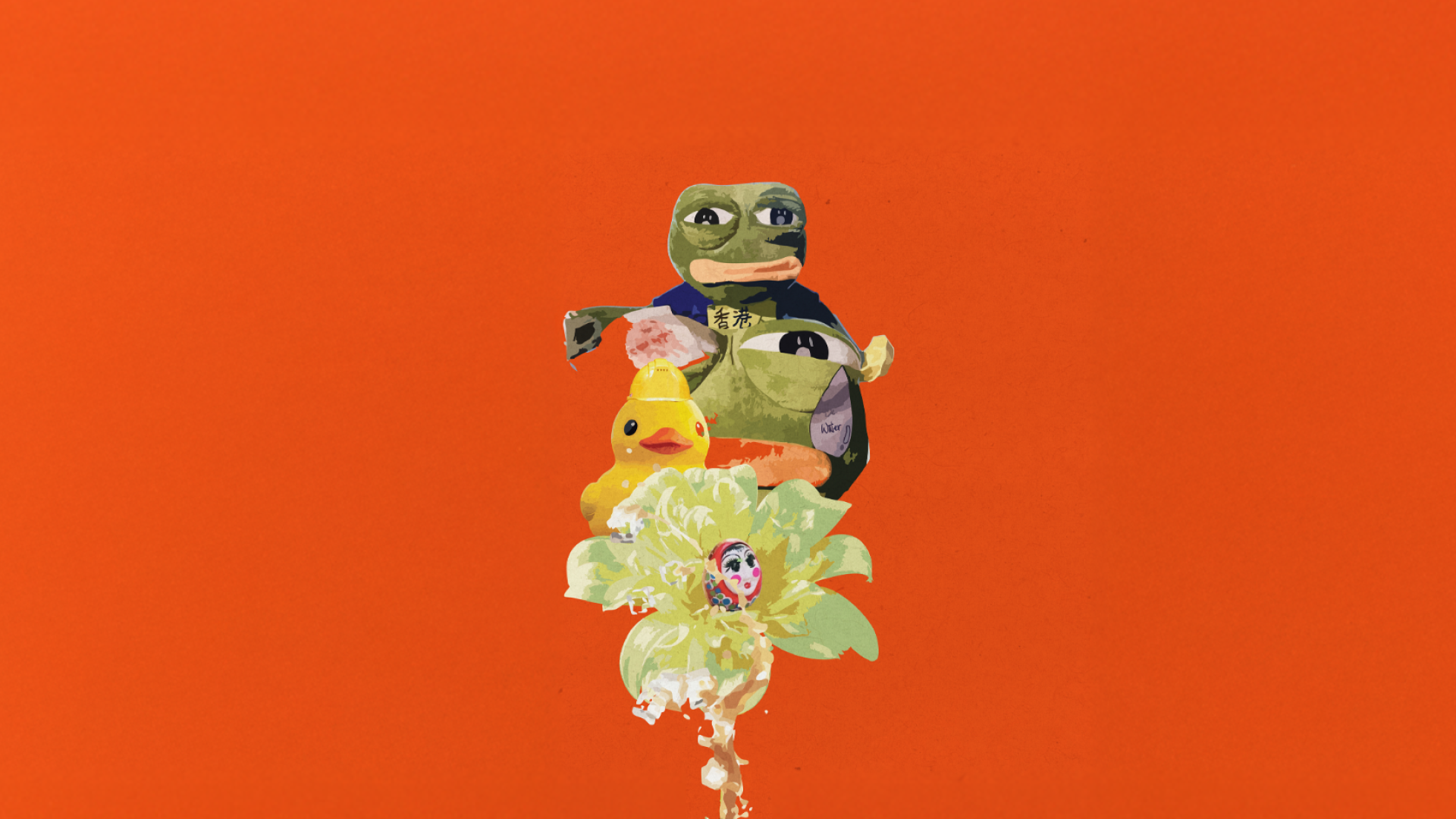
Youth across East and Southeast Asia have sparked a wave of movements characterized by leaderless organization and innovative creativity. Young activists in the region have harnessed the power of pop culture and creativity to advance their causes. Whether it be Pepe the Frog in Hong Kong, Harry Potter in Thailand, the three-finger salute in Burma, or the A4 protests in China, these movements have become powerful symbols of resistance and unity. Throughout this dynamic period, young activists have not only drawn inspiration from each other but have also exchanged ideas to strengthen their movements.
Be Water: Hong Kong’s Leaderless Protests
As Beijing gradually tightened its grip over Hong Kong in the 21st century, starting with education reform that erased the Chinese Communist Party’s (CCP) historic crimes from textbooks to increasing control over Hong Kong elections, Hong Kongers have remained resilient in the face of CCP aggression2. One such The most recent wave of repression came in 2019 when the pro-Beijing government of Carrie Lam proposed a law that would allow extraditions to mainland China, where political dissidents would be subject to China’s opaque judicial process3. The movement grew into a citywide campaign of resistance against Hong Kong’s deteriorating freedoms and Beijing’s increasing authoritarian influence that would become the blueprint for youth-led movements.

We successfully pushed them to care about Hong Kong and fight for democracy and freedom, to voice their opposition against the Chinese Communist Party, even though the power is unmatched, even though Beijing has really overrun our power and authority. Then, we still resist.
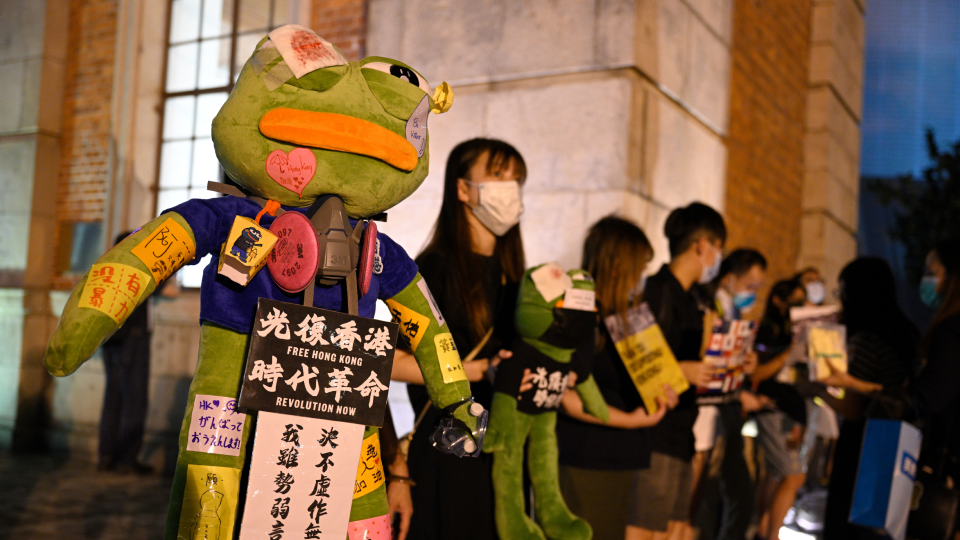
A demonstrator wears a costume of a Pepe the Frog with a bandage over his eye and carrying posters with protest slogans to sympathize with maltreated protesters.
Photo credit: HUIYT via Shutterstock
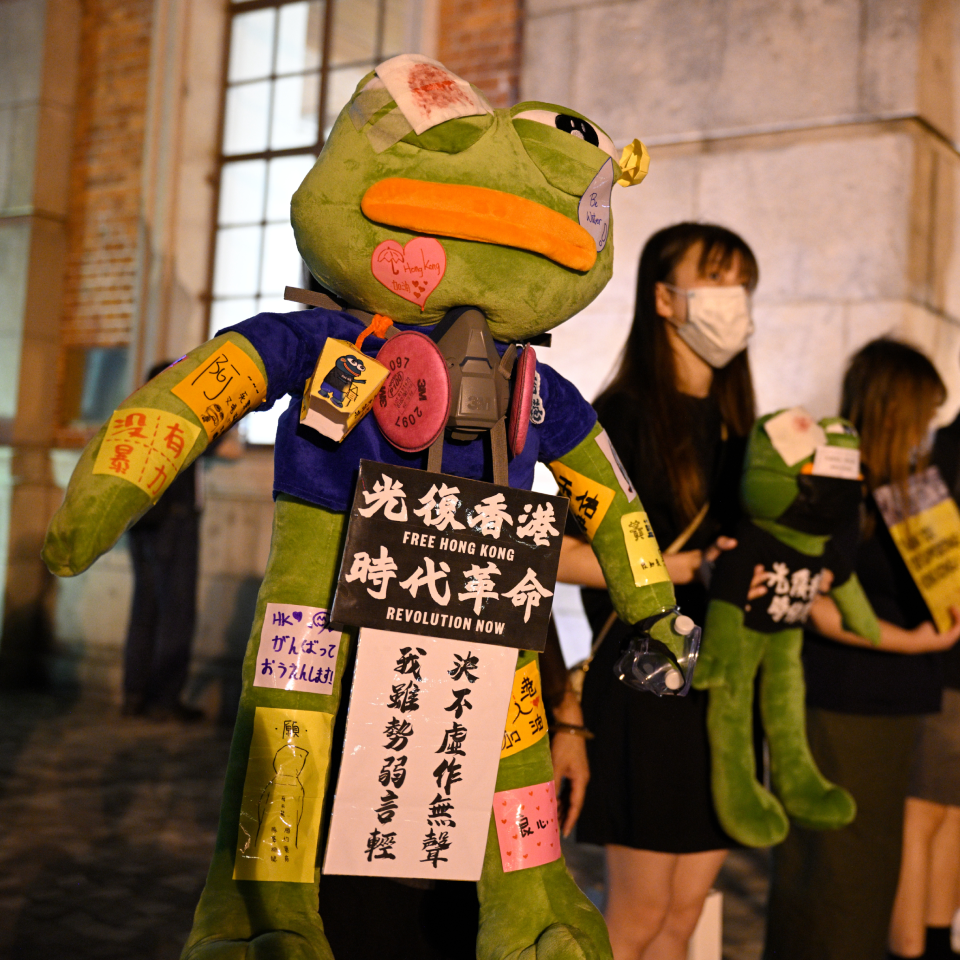
A demonstrator wears a costume of a Pepe the Frog with a bandage over his eye and carrying posters with protest slogans to sympathize with maltreated protesters.
Photo credit: HUIYT via Shutterstock
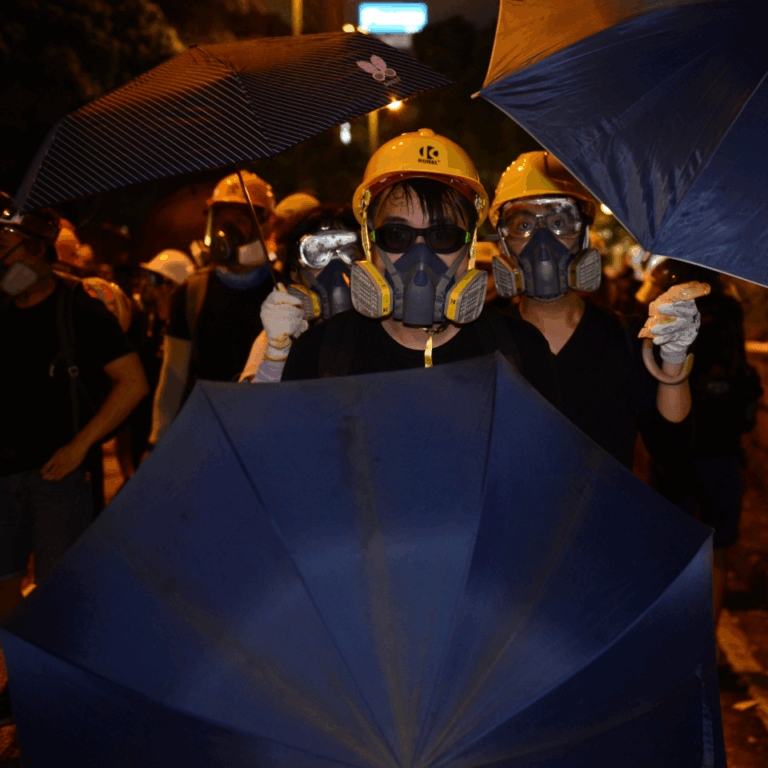
Protesters wear gas masks, yellow helmets, sunglasses, and other protective gear on their way to a demonstration.
Photo credit: Rumbo a lo desconocido via Shutterstock
Other art inspired optimism. Artists placed Hong Kongers in the midst of iconic scenes of liberation to envision what a possible victory might look like. For example, one user shared a reproduction of Eugène Delacroix’s Liberty Leading the People that replaced protesters of the French Revolution with Hong Kongers11. The reproduction suggests that liberty can prevail in Hong Kong’s struggle for freedom and democracy. Other aspirational renditions employed more modern and popular references from Japanese anime series, such as One Piece or Neon Genesis Evangelion. Drawings likened Hong Kong protesters to the series’ protagonists, who also had to struggle to resist or defeat staggering villains12. These animes’ central themes of integrity, unity, and resistance strongly resonated with protesters who also felt the imperative to remain united and resilient against assaults from police forces, the Hong Kong government, or the CCP13.
Many users also created original content14. This includes the unofficial anthem of the protests, “Glory to Hong Kong, ” whose instrumental and lyrics were crowd-sourced on the LIHKG forum15. The anonymous composer then compiled recordings of people singing the song via Google Drive into a choir rendition16. The success of crowdsourcing was also exemplified by the construction of the four-meter tall pro-democracy statue, “Lady Liberty Hong Kong.” The design team held a vote on LIHKG to ask users which design they preferred and then launched a crowdfunding campaign, which raised HK$203,933 (~US$26,100) within six hours17.
The abundance of protest art was the product of a movement that was inclusive, anonymous, and collaborative. Facilitated by safe but anonymous technologies,young people felt particularly empowered to express themselves in creative formats and through popular references.
Technology also allowed protesters to share practical information widely, organize safely incognito, provide real-time updates, and generally create a community of care. Much of the city’s protests were organized on the LIHKG forum or via Telegram where people would post dates, times, and locations of protests18. Organizers also cleverly took advantage of the Airdrop feature on iPhones to quickly share protest art or schedules with other iPhone users at rallies, subway stations, and other public locations19. To help keep each other safe, protesters would often make maps identifying the location of police, “thugs,” or instigators of chaos, protesters, and icons to indicate the location of first aid and refueling stations20. As protesters endured the brutality of tear gas, police batons, and rubber bullets, protesters voluntarily set up supply points stocked with water, sanitary pads, googles, and plastic wrap to protect against pepper spray, with locations shared on social media21.
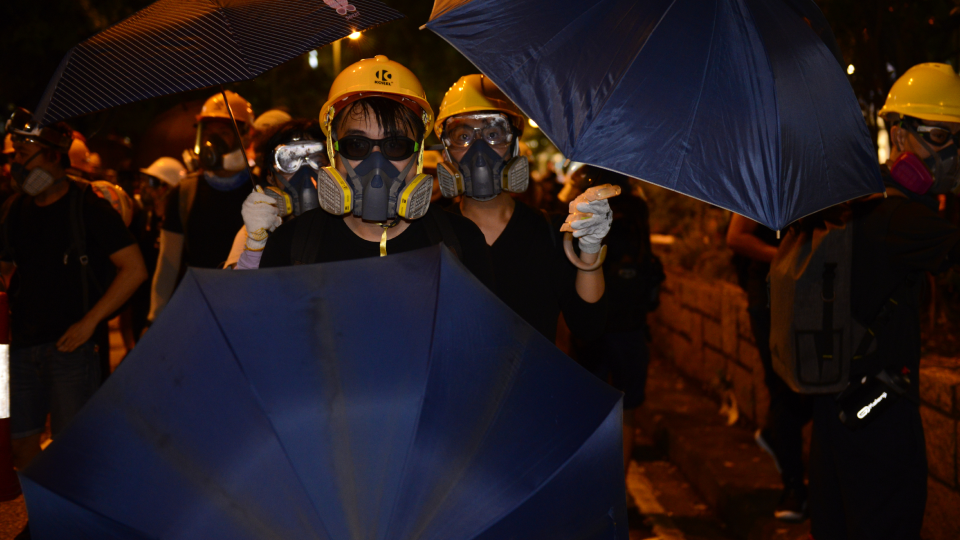
Protesters wear gas masks, yellow helmets, sunglasses, and other protective gear on their way to a demonstration.
Photo credit: Rumbo a lo desconocido via Shutterstock
Witnesses at protests would fact-check updates of protests circulating online and send photos as verification22. As police began to use live streaming and surveillance cameras to track individuals, protesters encouraged each other to wear masks, yellow helmets to hide their faces and protect themselves23. They would also largely wear all-black clothes to better conceal themselves among the crowd24. Anna Kwok, exiled Hong Kong activist, describes how she helped others stay safe:
Other citizens found less involved ways to contribute to protests. Civil servants, for instance, uploaded their work IDs covered in a sticky note with messages condemning the regime25. Many citizens would tack on post-its denouncing the regime and containing words of encouragement on walls across the city, much like the famous Lennon wall in Prague26. An anonymous 21-year old revealed she would protect the pieces of paper by protecting them with large sheets of plastic wrap27. And when the walls were forcibly taken down as the city cracked down on visible signs of dissent, restaurants and shops would put up blank post-it notes in solidarity28.
Protesters also developed a unique lexicon of protest slogans and chants that encapsulated Hong Kongers’ indomitable spirit and collaborative attitude. Many were straightforward calls for liberty and freedom such as “Liberate Hong Kong, Revolution of Our Times (光復香港 時代革命)29.” In addition to being graffitied all over the cityscape, the phrase was chanted at protests; and when police started cracking down on these protests, people would shout the slogan together from their own apartment in the evenings in a show of unity30.
Perhaps the most notable and ubiquitous slogan in Hong Kong was “Be Water”31. Derived from martial arts star Bruce Lee, the phrase reminded youth to “be flexible,” adaptable, and mobile with every challenge that arose32. The phrase encouraged people to be creative in their resistance as police escalated their crackdown on protesters. In one instance where an individual was arrested and charged with possessing an “offensive weapon” for wielding a laser at the protests, hundreds of protesters proceeded to wield lasers and direct the rays at the same planetarium33. The solidarity conveyed as hundreds of strangers coalesced to protest an individual’s wrongful arrest exemplifies the cohesion of young protesters. In another instance, protesters formed a 30-mile-long human chain while waving lights from their mobile phones to express their yearning for freedom34. The move was a callback to anti-Soviet protesters of the 1980s who also linked arms to demand liberty across former Soviet states35.
The unity and tenacity of protesters rippled throughout the city and around the globe, inspiring other youth to join in the calls for freedom and democracy in Hong Kong and their own homes. Hong Kong’s leaderless movement, characterized by inventive strategies of resilience, created a blueprint for youth-led movements across the region to follow.
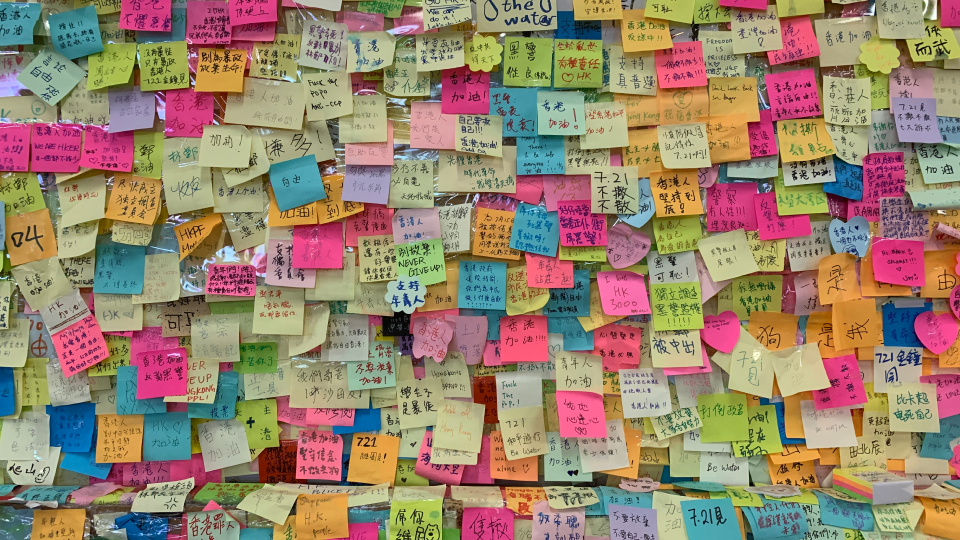
Hong Kongers write anonymous messages of encouragement on post-it notes to stick on athe wall of Tsuen Wan.
Photo credit: Calvin Au via Shutterstock
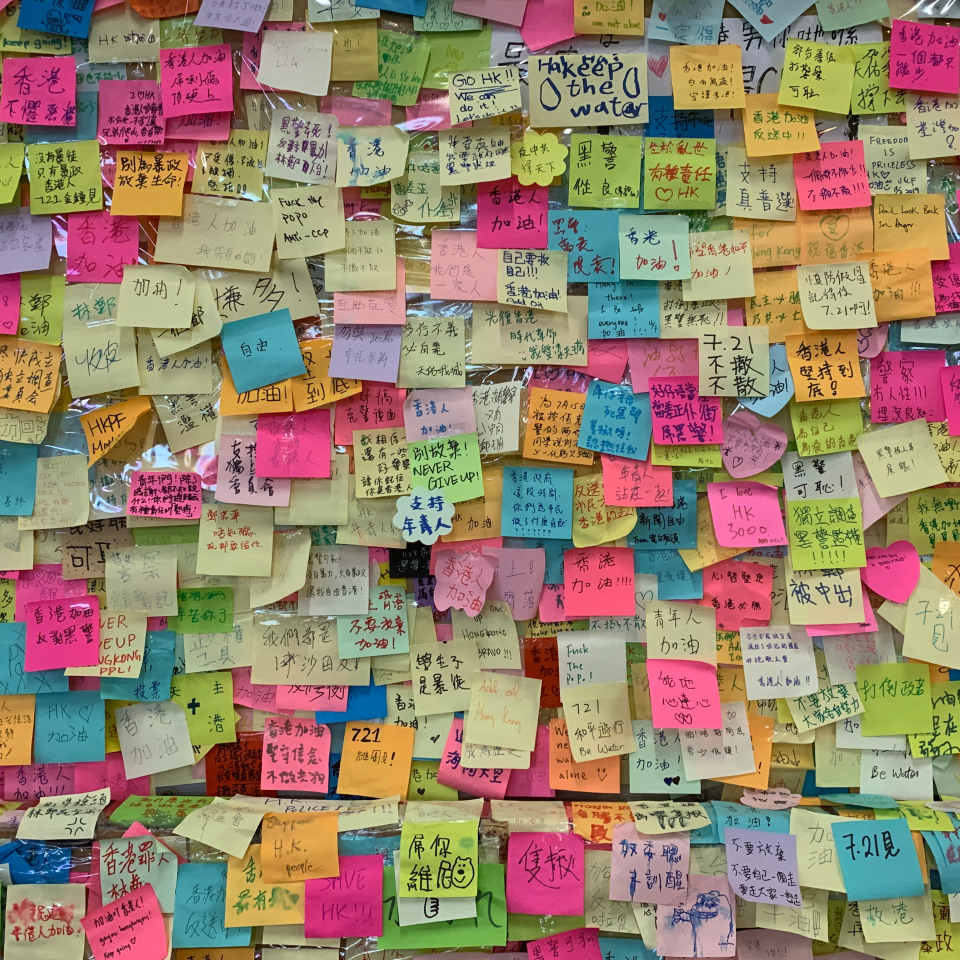
Hong Kongers write anonymous messages of encouragement on post-it notes to stick on athe wall of Tsuen Wan.
Photo credit: Calvin Au via Shutterstock
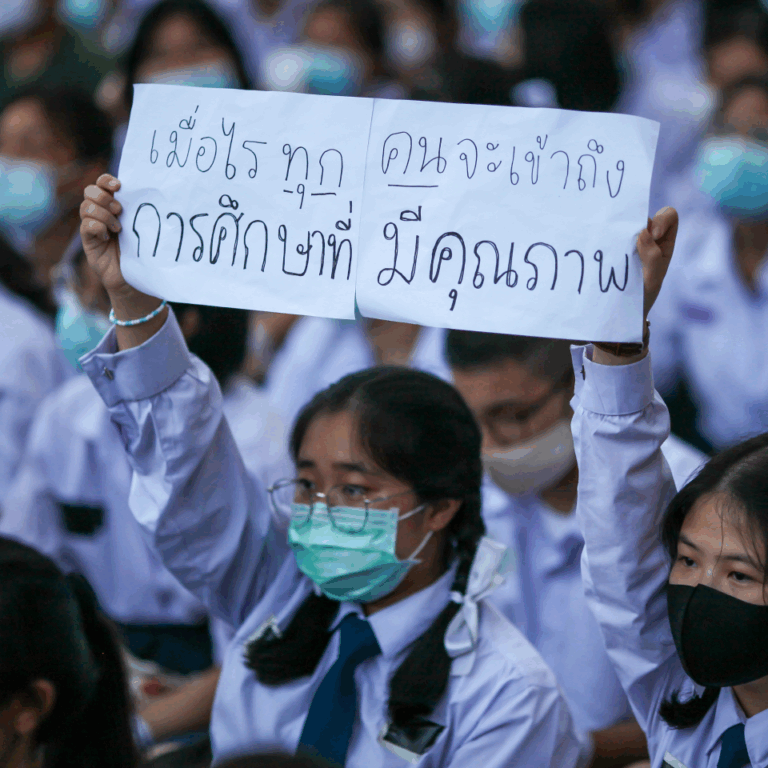
Thai students protested in front of the Ministry of Education in September 2020, calling for quality education and criticizing the authoritarian government.
Photo credit: Kan Sangtong via Shutterstock
“Free Youth” and Thai Student Resistance
Young people took to the street to protest the unjustified disbandment of the party. They not only demanded the reinstatement of the FFP but also called for broader political reforms, including a new constitution, the reduction of military influence in politics, and, unprecedentedly, the reform of the monarchy40. Angelo Sathayu Sathorn, a Thai activist and member of the United Front of Thammasat and Demonstration (UFTD), notes how people’s conception of the monarchy drastically changed:
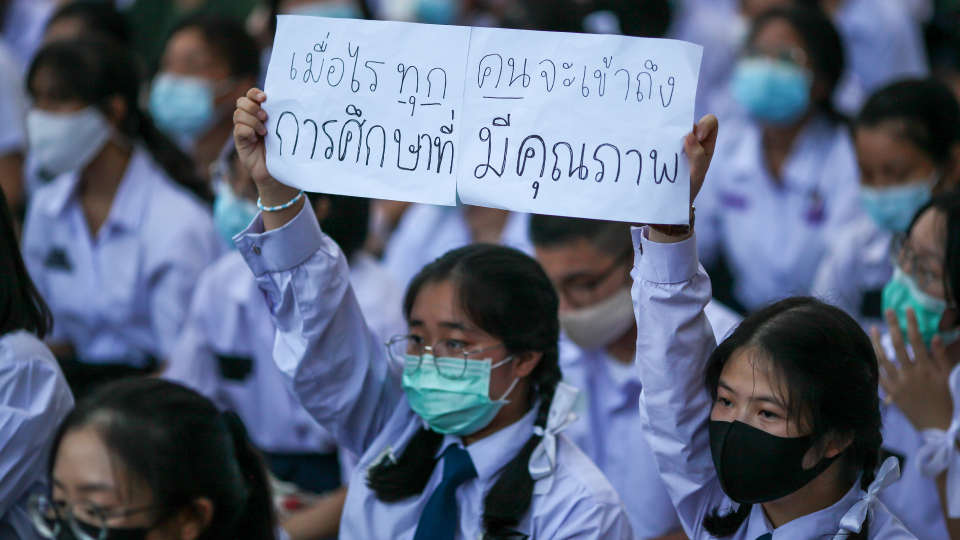
Thai students protested in front of the Ministry of Education in September 2020, calling for quality education and criticizing the authoritarian government.
Photo credit: Kan Sangtong via Shutterstock
Unlike previous protests in Thailand, young people infused creativity into their activism41. They set up smaller protest stages within rallies and utilized a range of innovative campaigns, including art exhibitions, public opinion polls, drag queen performances, and street fashion shows42. Political activist Sombat Boonngamanong shares how these creative protests rallied the youth:
Thai youth took inspiration from Hong Kong protesters by adopting a leaderless strategy and leveraging digital tools to advance their calls43. The leaderless strategy facilitated decentralized decision-making that helped protesters to efficiently organize and mobilize large gatherings across the country44.As the protest progressed, young people utilized Telegram, an end-to-end encrypted messaging application, to circumvent official monitoring on platforms like X (formerly known as Twitter) and Facebook45. Telegram’s features provided secure communication, including cloud-based messages and self-destruct timers46.
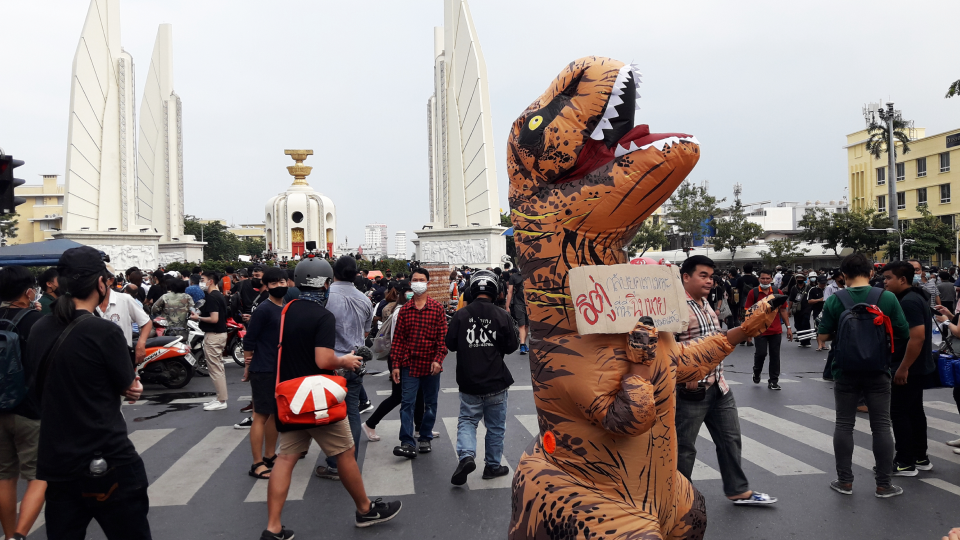
Thai students wear inflatable dinosaur costumes at a ‘Bad Student’ rally in Bangkok in November 2020.
Photo credit: Narong Sangnak/ EPA-EFE via Shutterstock
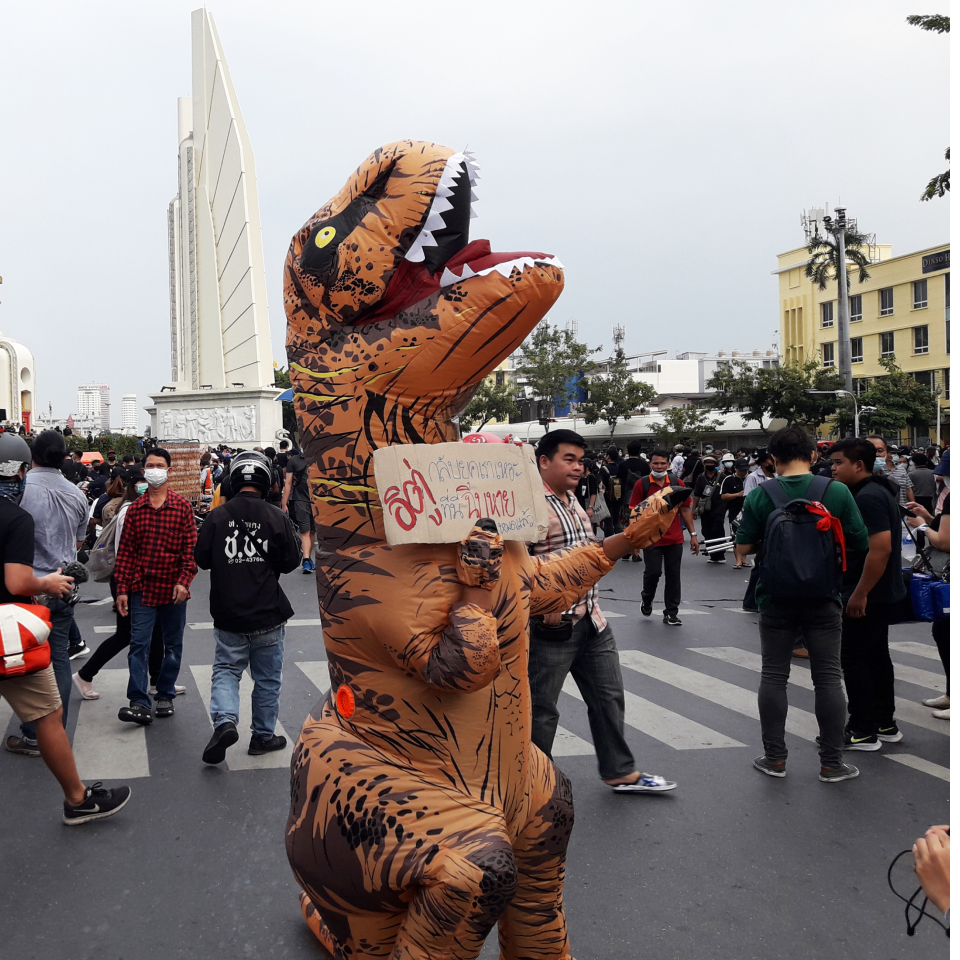
Thai students wear inflatable dinosaur costumes at a ‘Bad Student’ rally in Bangkok in November 2020.
Photo credit: Narong Sangnak/ EPA-EFE via Shutterstock
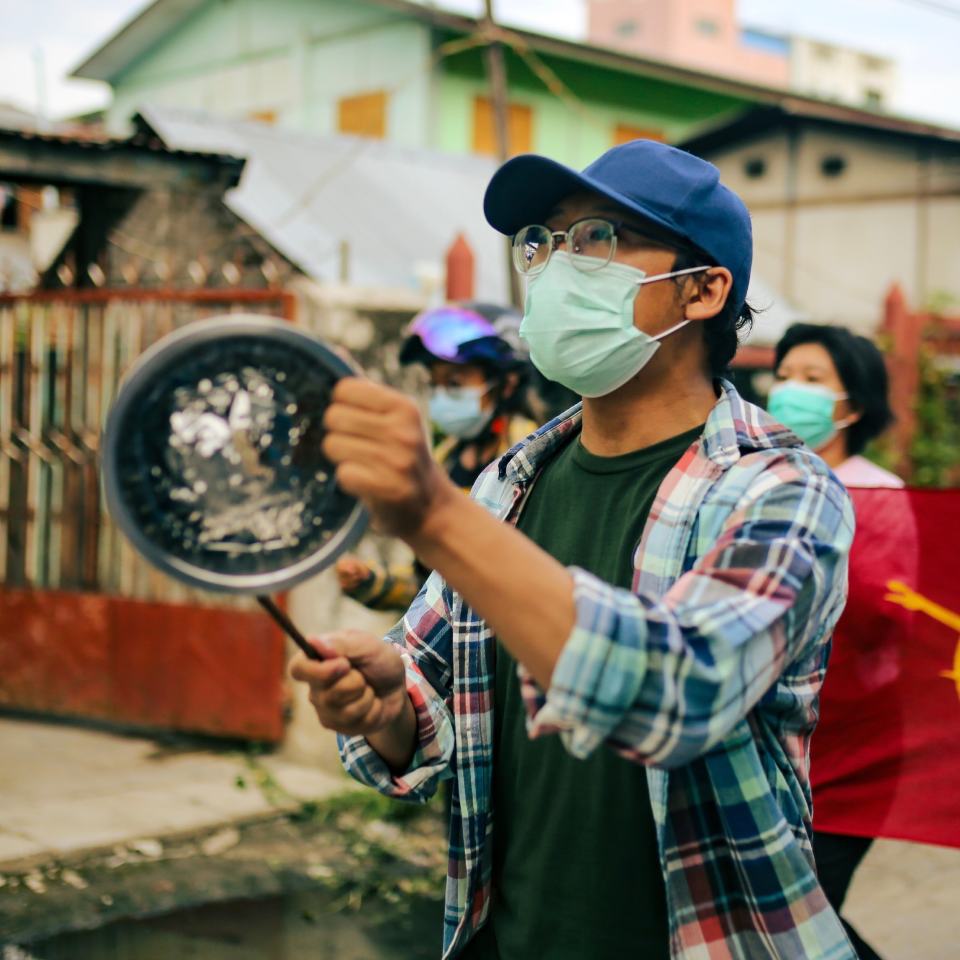
A Burmese protester bangs a pot in Mandalay during a demonstration against the military coup.
Photo credit: Sai Han One via Shutterstock
Creative expression became central to student resistance. Young people wore oversized T-rex inflatable suits to denounce the outdated way of thinking of older generation politicians, who were often called “dinosaurs.” One 15 year old high school student leader, Benjamaporn Nivas, likened the students to the meteorites that will crush the antiquated class of “dinosaur” politicians into extinction47. Other dinosaur-costumed performers paraded to the theme song of the Royal News, a nightly news channel that covers the Thai royal family, to mock the Thai regime’s long-standing practice of forcing people to consume one-sided news48. The Bad Student group, which opposed Thailand’s outmoded education system, used the hashtag #ByeByeDinosaurs to express their displeasure with the older-generation of politicians. Panusaya Sithijirawattanakul, a Thai activist, argues that youth-led movements fostered unprecedented levels of freedom of speech:
When we compare the social atmosphere in the past with today’s, (in the past), people could not even talk (about the monarchy). People must whisper to each other. Even if they stayed in the car, they had to whisper to each other anyway. It was an atmosphere of fear. But if we look at the current situation after we “broke the ceiling,” the social atmosphere was slowly opening.
Much like Hong Kong, a notable feature of recent youth-led movement protests in Thailand is their reference to global popular culture. Protesters have drawn comparisons between figures from popular movies and current political figures , such as cosplaying characters from the Harry Potter series, to draw comparisons between the antagonist Voldemort referred to as “He Who Shall Not be Named” whose name people refuse to utter out of fear and the Thai King who people can not insult at the risk of retribution of jail time for violating the lesé-majesté law that forbids any speech that “insults the King”49.
Activists also took to X to crowd-source ideas, which led to the proliferation of Hamtaro, a Japanese manga Hamster, as a protest symbol. Youth protesters used the manga’s theme song as an unofficial protest anthem, altering lyrics to criticize corruption in the government, singing “the most delicious food is taxpayers’ money. Dissolve the parliament! Dissolve the parliament! Dissolve the parliament!”50
The use of pop culture in protests has defined a new generation of youth activists who incorporate the pop culture that they consume in their everyday lives into their politics. The easily recognizable icons allow participants to band together under images that resonate with memories from childhood or pop cultural interests. In an age where culture has become globalized, fictional references provide the shared context that allow young people to effectively communicate a message and garner solidarity with broader, international audiences.
The Civil Disobedience Movement in Burma
Since the Burmese military seized power in a coup in February 202151, Burmese people from all walks of life came together to show their defiance against the authoritarian junta52. At the outset of the resistance, Burmese youth were instrumental in spearheading the movement53. This generation, having lived through a period of democratic change in their childhood and adolescence, was particularly resistant to propaganda and social injustice54. Among the various resistance efforts, the Civil Disobedience Movement (CDM) stood out as one of the most successful campaigns, largely due to the significant contributions of youth who used social media to mainstream the resistance and mobilize widespread participation55.
Healthcare professionals were among the first groups to launch a general strike mobilization against the coup, frequently referred to as the CDM56. From Nay Pyi Taw to Yangon, medical staff pledged to stop working in protest against the military coup57. Since then, the CDM has become a vital pillar of the resistance to military rule, involving hundreds of thousands of civil servants58. In Burma, the CDM is widely referred to as a strike in which civil servants refused to go to work to challenge the authoritarian regime59. The movement includes various forms of activities such as street protests, silent strikes, banging pots and pans at night, and boycotting military-linked businesses60. Youth leadership ignited the collective effort to mainstream the movement, ultimately giving rise to what is arguably the longest-running CDM in the world61.
Fueled by a deep-seated frustration over the country’s stagnation and grim future under the military rule, Burmese youth led an anti-coup movement that entailed mobilizing financial support for striking civil servants on social media and leading street protests to challenge the military regime62.
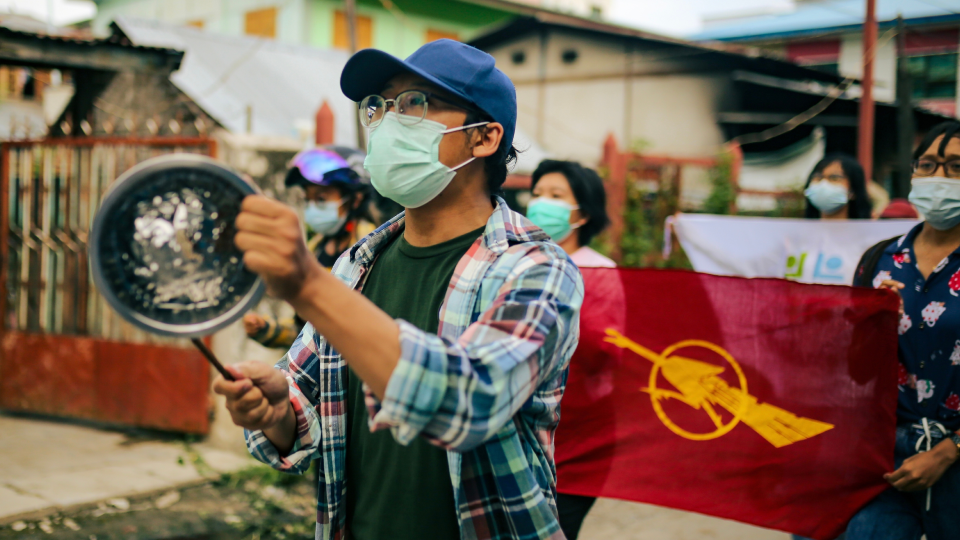
A Burmese protester bangs a pot in Mandalay during a demonstration against the military coup.
Photo credit: Sai Han One via Shutterstock
Young artists also used their skills to challenge the regime and spread awareness of the CDM63. During the demonstration in Yangon, members of the Myanmar Cartoonists Association carried cutouts of cartoons denouncing the coup64. Tech-savvy youth also popularized and sustained the movement through online campaigns, including the “Social Punishment Campaign”65. Internet users leveraged social media to identify and expose relatives of military generals, sharing information about their residences, occupation, and the foreign universities their children enrolled in66. The campaign called on the public to ostracize and shame these individuals, while also calling for a boycott of their businesses67. Win Ko Ko Aung, an exiled Burmese activist, social entrepreneur, and Global Bitcoin Adoption Fellow at the Human Rights Foundation, describes his role in galvanizing young people online:
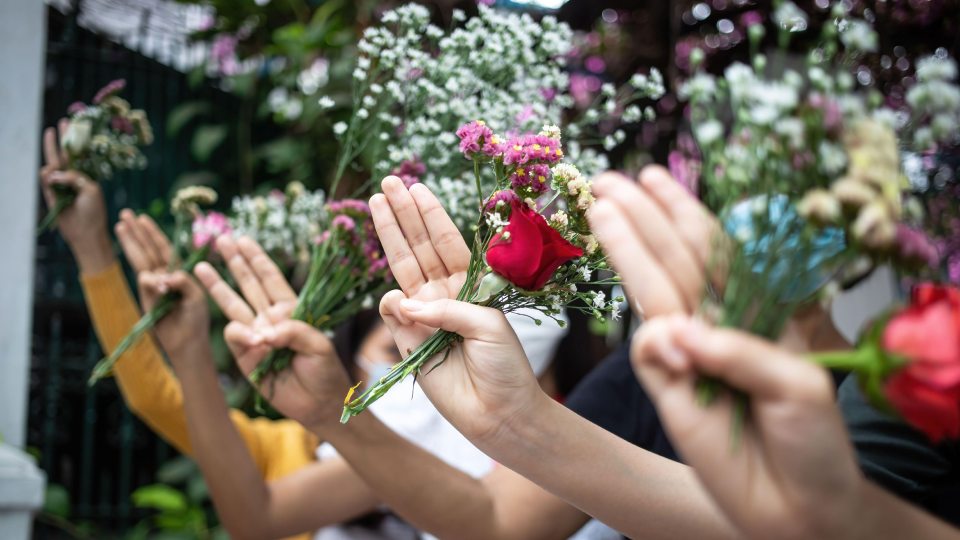
The Burmese people would lay flowers in public places as a part of a “flower strike” to commemorate the victims killed during the violent crack down following the February 1, 2021, coup.
Photo credit: Photo by Theint Mon Soe/ SOPA Images/ Sipa USA via Alamy
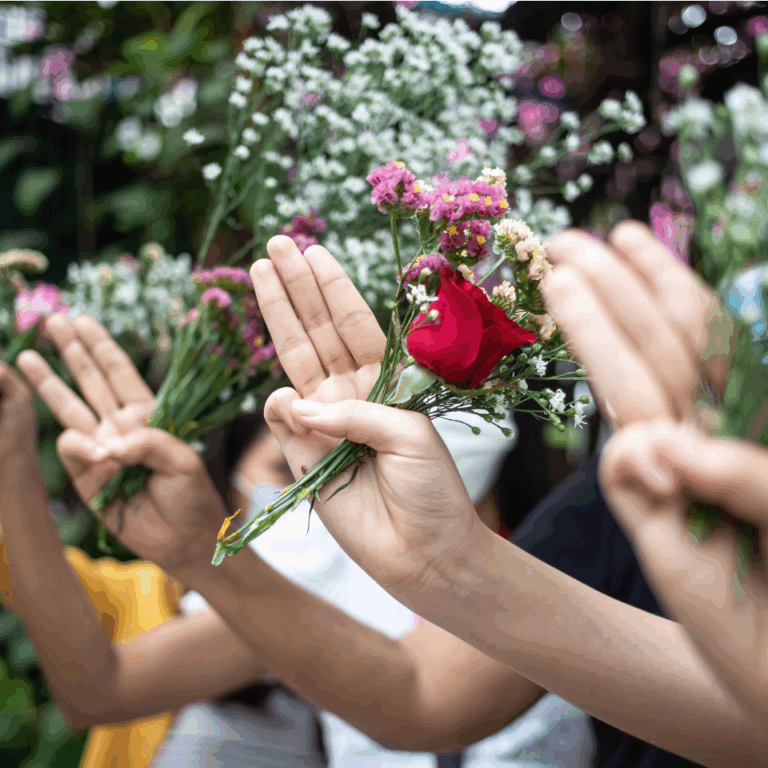
The Burmese people would lay flowers in public places as a part of a “flower strike” to commemorate the victims killed during the violent crack down following the February 1, 2021, coup.
Photo credit: Photo by Theint Mon Soe/ SOPA Images/ Sipa USA via Alamy
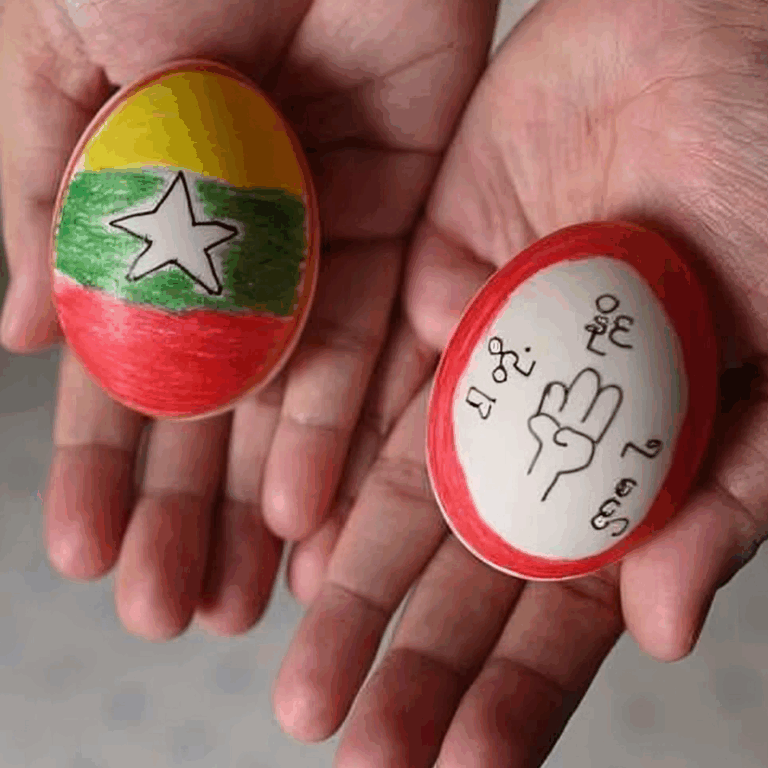
A protester holds up a three-finger salute with an Easter egg to speak out against the military coup.
Photo credit: Myat Thu Kyaw/ NurPhoto via Alamy
As protests continued to brew after the February 1 coup, the people of Burma stacked and strategically placed commonplace household items to show their resistance while maintaining their anonymity, and thereby, safety. The results were striking scenes of rows of stuffed toys carrying anti-junta signs, carefully arranged across a small street; a “flower strike” wherein rows of flowers were laid out to commemorate those slain by the brutal regime; protesters holding easter eggs with anti-junta slogans painted on them to reference the strike that took place on a Sunday. Some protesters held up pots and pans as protest signage, taping messages such as “pray for Myanmar’s democracy” and “free our leaders”77. The protest even garnered the attention of Pope Francis, who praised the Myanmar Youth for being “committed to supporting democracy and making their voices heard peacefully,” in his Easter Sunday address at St. Peter’s Basilica78. Young anti-coup demonstrators were exceptionally clever in selecting relevant themes for each rally or period of protest to unify protesters in demands for change, while resonating with broader audiences when images were shared online. Tapping into the imagery of easter eggs in a majority Buddhist country speaks to the ways in which protesters leveraged motifs with international recognition to catch the attention of a global audience.
Other protests paid homage to local themes and appealed to regional sensibilities. One protest consisted of placing thousands of dolls called pyit-tine-htaung in the streets79. The name loosely translates to “when it’s thrown or falls, it comes back up”80. Each doll, which was placed in front of a handwritten note, served as a symbol of the resilience of the Burmese people because the doll would right itself back up every time it was pushed over – similar to the Burmese people who continue to advocate for freedom even after numerous military coups and subsequent violence81. As the military junta increased their use of violence against demonstrators, protesters would rely on props to continue the rally. To replace human protesters, people would use toy cars, cardboard cutouts, and even helium-filled balloons with messages calling for international help to express themselves82.
Though the CDM did not lead to the immediate restoration of democracy, the movement significantly obstructed the administrative function of the regime. Since the coup, approximately 410,000 people or nearly half of the workforce, including healthcare workers, teachers, former security forces, and soldiers have joined the CDM.
With its impact on political development in the country, the CDM was nominated for the 2022 Nobel Peace Prize in recognition of its struggle for peace and democracy through non-violent means86.
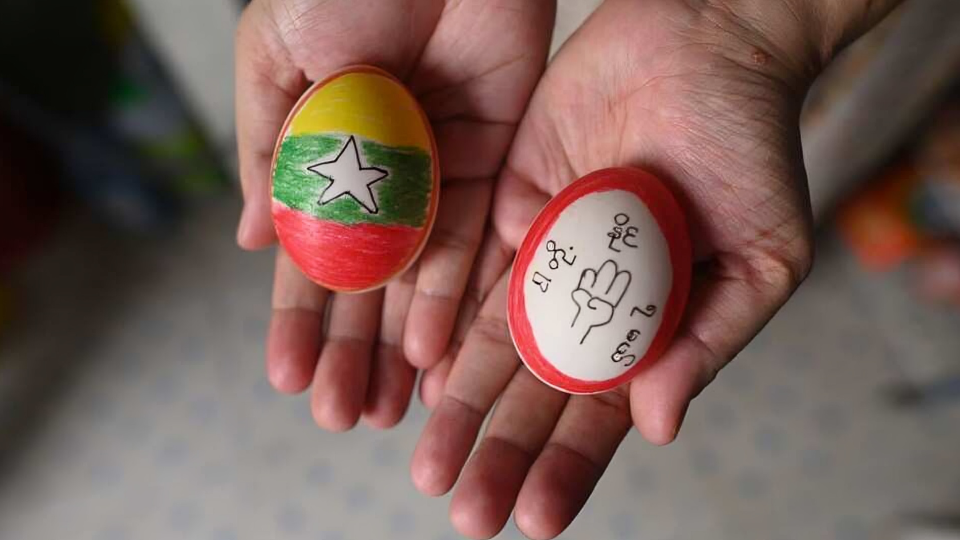
A protester holds up a three-finger salute with an Easter egg to speak out against the military coup.
Photo credit: Myat Thu Kyaw/ NurPhoto via Alamy
Cross-Movement Learning Across Asia
While certain symbols of protest originated from locally specific contexts, youth protesters also cited, shared, and adopted references used from movements across the continent to amplify their own messaging. These symbols were largely taken from global pop culture to create references that would easily resonate with a broader international community. These easily recognizable symbols came to characterize youth-led movements, as young people create a sense of solidarity across parallel demonstrations.
The rubber duck became an icon that demonstrated how a meme intended to troll the Chinese Community Party (CCP) transformed into a tangible tool of resistance across countries. The rubber first appeared when a mainland Chinese Sina Weibo user photoshopped a giant rubber duck onto the infamous ‘tank man’ photo to commemorate the Tiananmen Massacre, where the (CCP) rolled out military tanks to shoot down young pro-democracy protesters87. Even the term “big yellow duck” was censored, causing internet users of the Chinese-speaking world, including Hong Kongers, to use rubber ducks to poke fun at the CCP for its ridiculous censoring of harmless objects88.
Hong Kongers proceeded to incorporate the rubber duck, now a symbol of ridiculous government censorship, to their arsenal of protest pieces. In response to an incident in 2019 where Hong Kong police failed to prevent an alleged pro-CCP mob attack at a train station platform, protesters expressed their anger with police incompetence by washing the subway floors with detergent and setting rubber ducks afloat the station89.
Demonstrators in Thailand re-purposed the rubber duck both as a symbol of protest and protective gear. In a series of “coup prevention” drills, protesters practiced passing pool toy ducks over their heads90. The movement represented the military officials who passed over the will of the people and ignored demands for a new constitution and reform to the monarchy91. Protesters also keyed into the utility of the rubber duck, whose waterproof exterior protected front-line protesters against chemical-laced water cannons and tear gas92. Images of chemical-stained rubber ducks dripped with water resonated with the weary protesters who noted that the ducks mirrored their own state– weary and worn down, but still smiling93.
The symbol allowed individuals to easily visually indicate their support for the movement. Protesters would put duck clips in their hair or use duck bubble blowers to blow bubbles at police94. One duck bubble blower seller in Thailand even donated proceeds from her sales to volunteer medical teams at protests95.
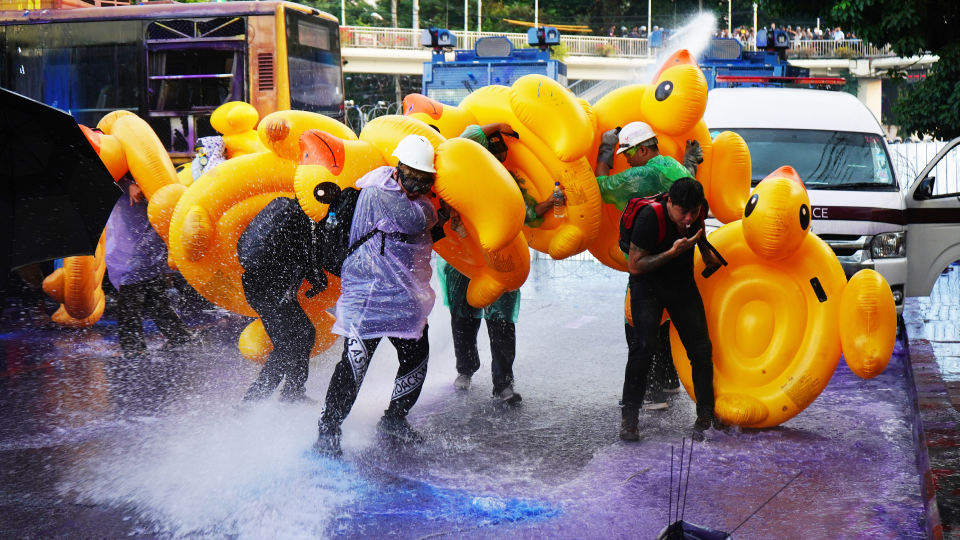
Protesters in Bangkok hold up rubber ducks to protect themselves from riot police firing water cannons, a tactic learned from Hong Kong activists.
Photo credit: Songpon Ruengsamut via Shutterstock
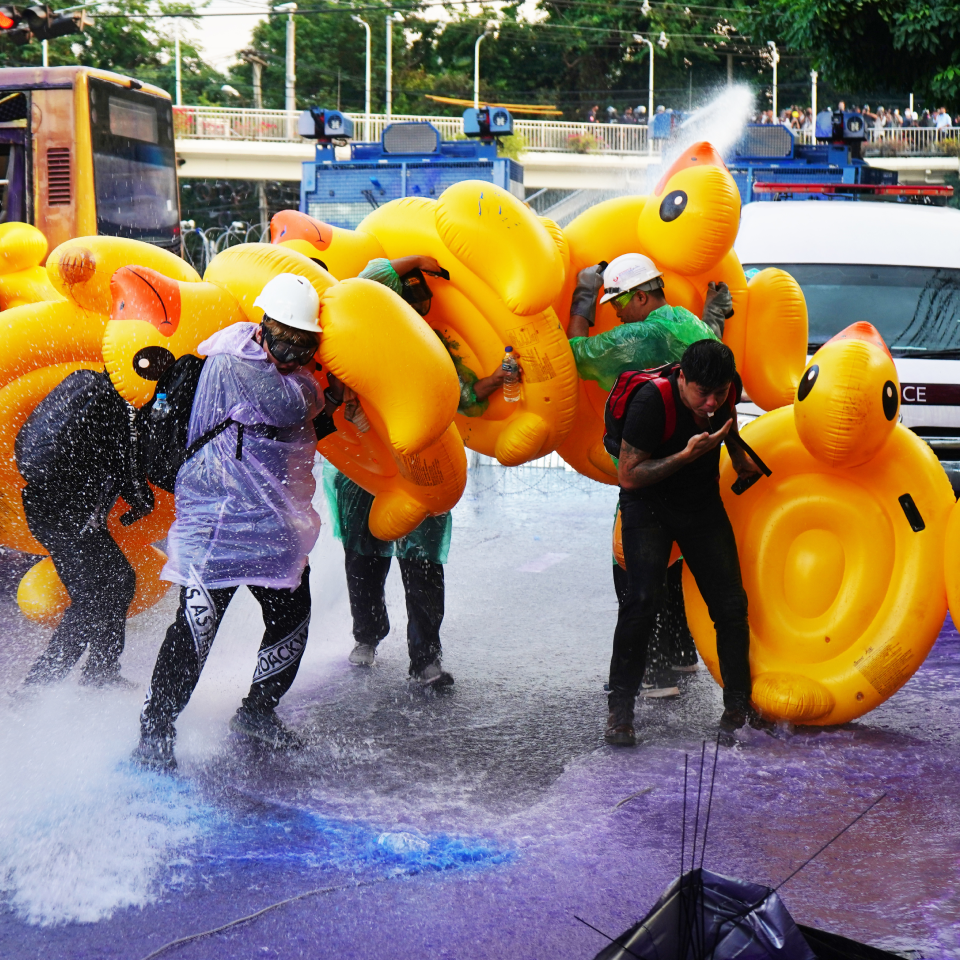
Protesters in Bangkok hold up rubber ducks to protect themselves from riot police firing water cannons, a tactic learned from Hong Kong activists.
Photo credit: Songpon Ruengsamut via Shutterstock
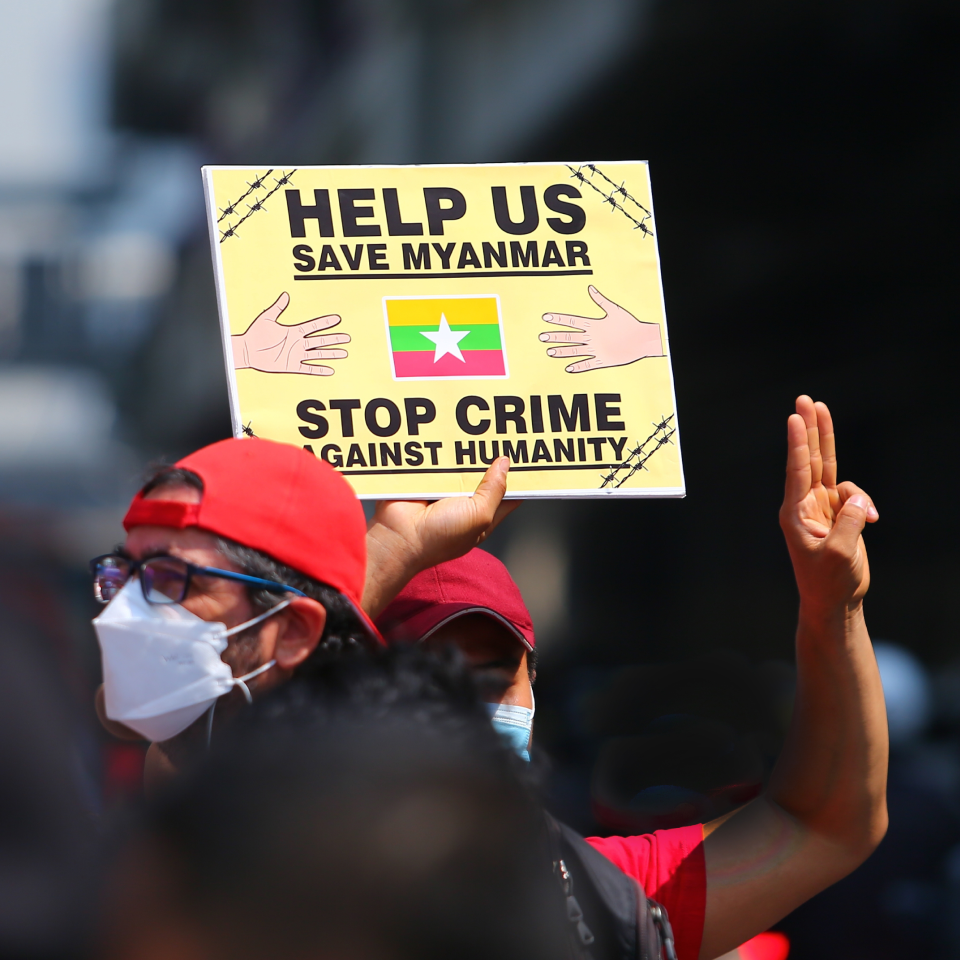
A Burmese protester holds up a three-finger salute outside the Myanmar embassy on the 2nd anniversary of the military junta coup.
Photo credit: Kan Sangtong via Shutterstock
Thai protesters also adopted symbols in pop culture, such as a three finger salute, in reference to the gesture frequently used in the dystopian fantasy movie, the “Hunger Games”96. The gesture represented solidarity amongst oppressed people in rebellion of the tyrannical ruling class, “The Capitol.” Similarly, Thai youth, who loosely coalesced under the “Free Youth” movement, saw the military junta as a tyrannical ruler who refused to hear out the voices of its citizens. As ordinary peasants in certain districts had no choice but to use body gestures to express their dissent for fear of violent retaliation by the authorities, so too did Thai youth resort to raising their three fingers to express their displeasure with a regime that has undertaken various efforts to silence any criticism. Thai social activist, Sombat Boonngam-anong, who helped organize anti-coup protests called on people to raise “3 fingers, 3 times a day” in public to “escalate the anti-coup movement”97.
Derived from fiction, the symbol allows protesters to infuse a number of meanings into the gesture based on their own interpretation. Some protesters said that the three fingers stood for values established by the French revolution: liberty, equality, and fraternity98. Others said each digit stood for freedom, election, and democracy99. One photo graphic online depicted each phalange with the words “No Coup”, “Liberty”, and “Democracy”100.
While the peak of the relevance of the Hunger Games has passed, the three finger salute has retained its utility for Thai students today. Even in 2020, students continued to hold up the three-fingered hand gesture, while adding their own flair of tying white ribbons to their apparel to express their political opinion101.
Inspired by the protests in Thailand, protesters across the region have taken to flashing the three fingers as a quick and identifiable way of expressing their support. In the 2019-2020 pro-democracy protests in Hong Kong, protesters were seen flashing the gesture in defiance of the police at rallies and at sit-ins outside government buildings102. While many protests in Asia have been inspired by the vigor and organization of youth in Hong Kong, Hong Kongers’ adoption of the symbol speaks to how dialogues between protesters have become reciprocal, wherein protesters mutually share and inspire iconography or tactics employed.
In Burma, the gesture was widely used in protests following the 2021 military coup. It was first used by medical workers, then youth protesters, and eventually became a visual staple of opposition protests across the country103. Eventually, Burmese artists and creatives even created a campaign hub titled Raise Three Fingers and the website threefingers.org to highlight the humanitarian crises in their home nation to the global art community104.
The symbol was encouraged by exiled Cambodian politicians of the since dissolved Cambodia’s National Rescue Party (CNRP) to express their support for protesters in Burma and Thailand105. Former VP of the CNRP, Mu Sochua, stated that the Cambodians want “freedom, justice, and true democracy” the way Burmese protesters do106. The call was then rebuked by the ruling Cambodian People’s Party, who wrote off the call for solidarity as “ridiculous,” denying the clear parallels drawn between Cambodia and Burma’s authoritarian regimes107. These symbols have re-imagined the visual library of protest, incorporating the pleasure and interests of youth into what can feel like an all-encompassing struggle for freedom and democracy.
Second to visual paraphernalia, songs also served as backdrops to these youth-led movements. Notably, “Do You Hear the People Sing?” from Victor Hugo’s Les Misérables, which had gained worldwide attention after the modern remake, became a staple soundtrack for protesters, who identified with the French revolutionaries, demanding the ruling class listen to the will of the people. Versions adapted to local languages have proudly been sung by Hong Kongers against the extradition bill, mainland Chinese citizens memorializing Dr. Li Wenliang who exposed the coronavirus outbreak to the world108, Thai students demanding monarchy reform, and Burmese protesters against the military junta109.
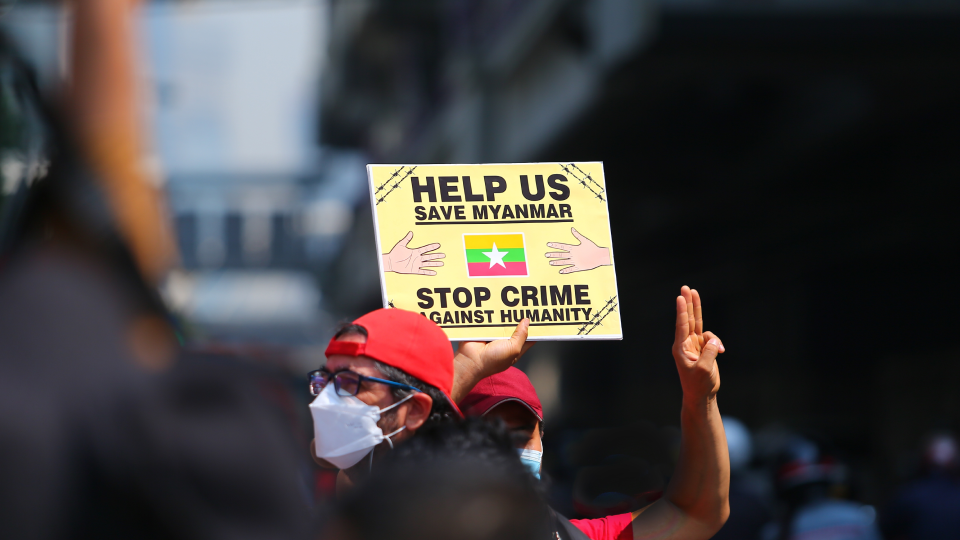
A Burmese protester holds up a three-finger salute outside the Myanmar embassy on the 2nd anniversary of the military junta coup.
Photo credit: Kan Sangtong via Shutterstock
White Paper Protests or the A4 “Revolution”
Due to the repressive environment and suffocation of civic space in China, there is virtually no room for youth to exercise their freedom of assembly and expression. However, the “White paper” or “A4” protests of 2022 offered a short but exceptional glimmer into how an opportune political moment can ignite people to collectively demand greater freedoms in a country as restrictive as China.
In an attempt to control the COVID-19 pandemic, the CCP regime implemented wide-sweeping measures to control the movements of its citizens, forcing many residents to be shuttered in their homes for months110. The “White Paper” or “A4” protests were triggered by a fire, which killed at least 10 and injured 9, in an apartment building in the city of Urumchqi in China’s northwestern Uyghur Region111. The tragedy prompted Chinese citizens across the nation to express their anger over the CCP’s stringent preventative course of action, which included regular lockdowns, endless Covid testing, and vigilant health checks112.
Young Chinese protesters took to the streets to express their anger over the COVID-19 restrictions across major cities and top universities113. Protesters would hold blank sheets of paper, often sized A4, to avoid having their faces captured by surveillance cameras114. The origins of using blank sheets of paper as protest gear is unclear, but it was also seen in the 2020 Hong Kong protests. A blank piece of paper, which has no specific meaning on its own, enables protesters to dissent without openly criticizing the regime115. It was also a challenge to the regime’s heavy restrictions on free speech, as if to signal that the regime cannot arrest participants for holding a sign that says nothing116.
The protests also bore witness to bold political slogans typical of more flagrant political protests, including chants that demanded President Xi Jinping and the ruling Chinese Communist Party (CCP) to step down117. On the eve of the 20th CCP National Congress, a congregation of China’s highest governing body, two banners were hung on Sitong Bridge in Beijing, one of which boldly read “We don’t need Covid tests, we need to eat; we don’t need lockdowns, we need freedom”118.
Under the brunt of restrictions placed on people’s freedom of movement and extreme censorship, young people tapped into modern internet technologies from encrypted messaging services to livestream that allowed the protests to reach wider audiences. The young generation of Chinese internet users are digitally savvy and able to navigate government censors. Some users showcased their clever and sardonic sense of humor, leaving ironic comments of praise (i.e. “good good good” or “yes yes yes”) on media of official Chinese regime accounts to express their frustration without being censored119. Many young people used VPNs to access forbidden apps and circulate videos and photos on non-Chinese platforms120. Others uploaded screenshots of text to avoid filters and automated detection systems121. One young protester recounts viewing sensitive content, such as the livestream of a vigil in Shanghai mourning the victims of the fire, by using banned apps such as Instagram and Telegram122.
Ultimately, the protests were short-lived, lasting a mere ten days before a slew of arrests, intimidations, and threats scared people back into silence123. But the world was already watching. Even when Chinese bots tried to flood X with obscene and pornographic content to skew search results and video footage of the protests, the rare sound of Chinese protest had been heard and memorialized on the internet124.

A protester raises a sheet of white paper as a symbol of protest while remaining anonymous.
Photo credit: Tutatamafilm via Shutterstock

A protester raises a sheet of white paper as a symbol of protest while remaining anonymous.
Photo credit: Tutatamafilm via Shutterstock
03
Digital Resistance:
The Online Battle against Censorship
In addition to the street protests, digital activism became a powerful form of resistance through which youth can rally support, share information, and exchange ideas. This digital strategy helped youth activists reach out to a wider audience while circumventing forms of censorship and oppression.
Memes, Hashtags, Emojis
Visual and textual shorthands such as memes, emojis, and hashtags have become popular means of political expression for youth in the digital age. In the face of authoritarianism, political content carrying either or all of these elements serves as a compelling and relatively safe form of resistance.
Memes, emojis, and hashtags are easy to proliferate and digest, allowing activists to break down nuanced subjects in layman terms, and circulate their perspectives with relative speed and in a culturally relevant manner. A lucid example is the anti-authoritarianism hashtag #MilkTeaAlliance that took social media by storm when it surfaced amid the 2019-2020 Hong Kong protests against the Chinese Communist Party (CCP) tyranny. Young pro-democracy activists across Thailand, Hong Kong, and Taiwan fashioned the hashtag as a response to backlash from pro-CCP accounts against a Thai actor’s repost of an image that referred to Hong Kong as a “country” as opposed to a constituent of China on his X125.
The hashtag grew into a movement intended to address the intractable debate about the CCP’s overarching influence in Hong Kong, which formally enjoys a degree of autonomy within China’s “one country, two systems” framework. Catalyzers of the movement successfully broke down the debate by introducing the milk tea, a popular beverage in many Asian countries, as a symbol of kinship with Hong Kong’s struggle for freedom and the broader efforts to resist authoritarianism in its regional neighbors. It proved effective. In April 2021, X revealed that the hashtag had been used in as many as 11 million tweets on its platform126. It subsequently released a milk tea emoji that would automatically appear in tweet mentions of the Milk Tea Alliance in English, Thai, Burmese, and Chinese (both simplified and traditional)127.
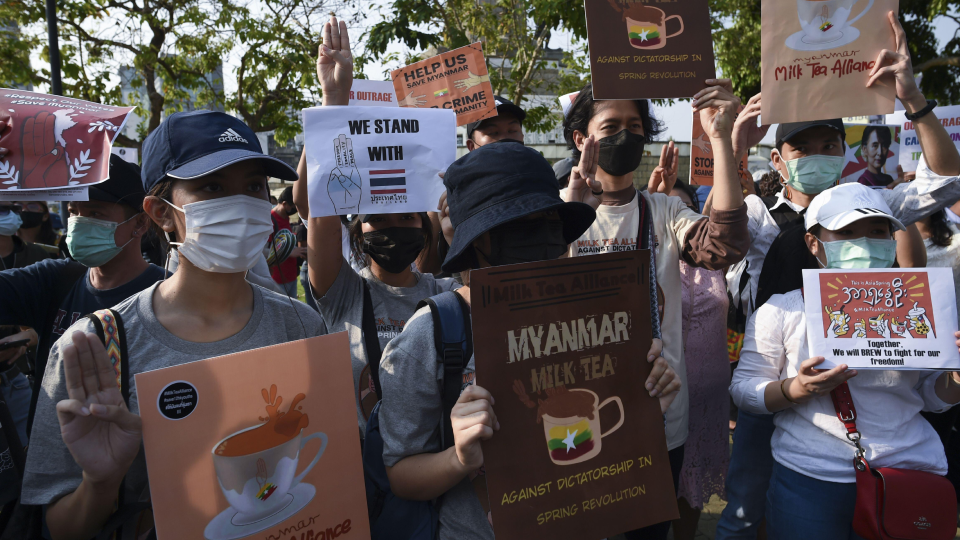
Protesters carrying “Milk Tea Alliance” placards gather in Bangkok, Thailand to show solidarity with Burma’s anti-coup movement on February 28, 2021.
Photo credit: Anusak Laowilas/ NurPhoto SRL via Alamy
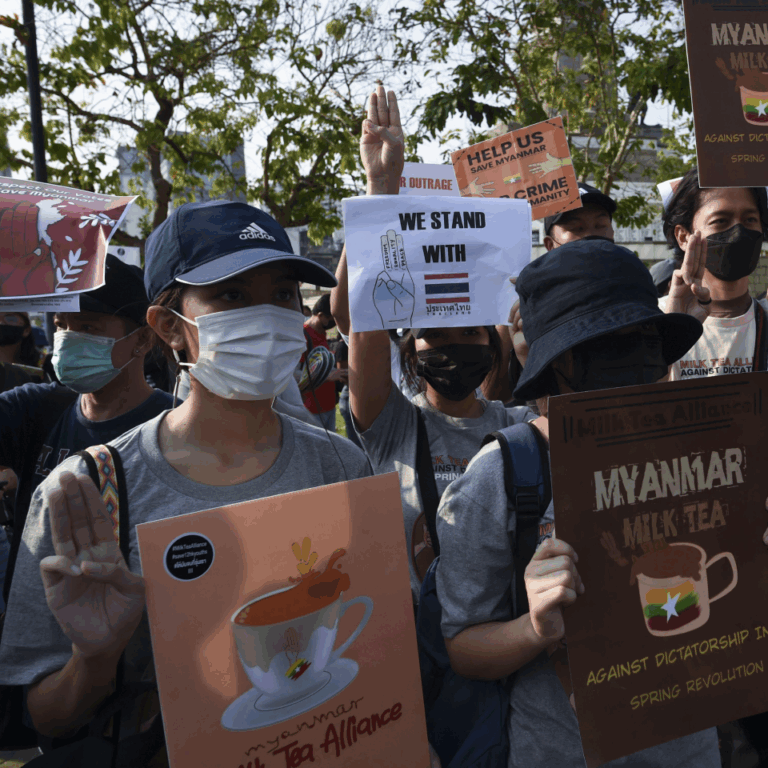
Protesters carrying “Milk Tea Alliance” placards gather in Bangkok, Thailand to show solidarity with Burma’s anti-coup movement on February 28, 2021.
Photo credit: Anusak Laowilas/ NurPhoto SRL via Alamy
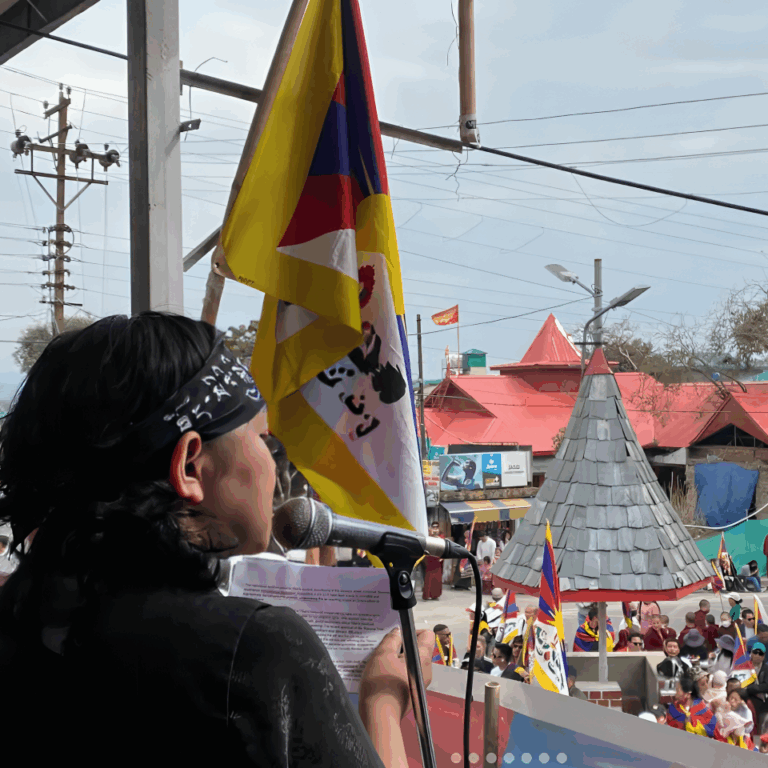
Students for a Free Tibet India Director Tenzin Passang speaks before a crowd waving the Tibetan flag on the 65th anniversary of the Tibetan National Uprising 1959 in the Himalayan town of Dharamsala, India.
Photo credit: Tenzin Passang viaon Instagram
The Milk Tea Alliance also helped young activists learn from each other’s activism playbook130. It taught Burmese and Thai protesters to adopt Hong Kong’s flash mob-style protest131. In Malaysia and Indonesia, thousands of internet users posted photos with #MilkTeaAlliance signs to show solidarity with those struggling for democracy in neighboring Burma132. Additionally, the movement later even extended beyond East and Southeast Asia to countries such as India, Belarus, and Iran133.
The Alliance revolutionized the fight against authoritarianism in the region. It linked disparate pro-democracy groups in various countries with the help of shared symbolisms and slogans. It was loud, infectious, and difficult to contain. As users on Hong Kong’s prominent pro-democracy forum LIHKG aptly described: “Hong Kongers can support Thai protesters’ without being subject to harsh lèse majesté laws that criminalize defamation of the king, and Thai protesters can promote Hong Kong’s struggle without facing potential repercussions under a draconian new national security law”134.
Today, the hashtag remains a potent memetic force in the activism realm, inspiring a deluge of pro-democracy rallies in and outside Asia, and being used in the advocacy of a wider range of causes beyond Hong Kong135.
Emojis also became an important, and more importantly quick, way to express grievances against repressive regime policies. In 2016, youth activist Joshua Wong called on his followers to leave angry face emojis on the Facebook page of former chief executive Leung Chun-Ying, who had been installed by a predominantly CCP-backed election committee. In the end, hundreds of thousands left angry faces on Leung’s profile picture and posts in a matter of weeks136. Likewise, the recognition of emojis as vessels of dissent prompted Tibetan activists to start #InsertTibetanFlag in 2018, a campaign pushing for the creation of a Tibetan flag emoji by the Unicode Consortium, of which big tech companies such as Google and Apple are part137. The Tibetan flag is often used as a token of the Tibet independence movement. The usefulness of technologies such as this to set youth activism apart from its precursors.
Young people are quick to adapt to new ideas and technological developments, allowing them to experiment with new forms of activism compared to older generations.
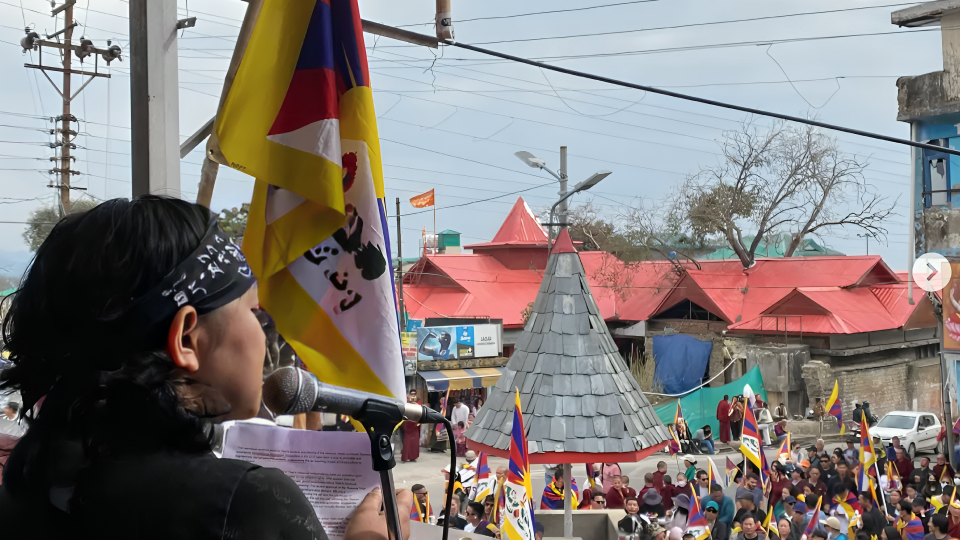
Students for a Free Tibet India Director Tenzin Passang speaks before a crowd waving the Tibetan flag on the 65th anniversary of the Tibetan National Uprising 1959 in the Himalayan town of Dharamsala, India.
Photo credit: Tenzin Passang viaon Instagram
Evading Regime Censors: The Chinese Case
Memes, hashtags, and emojis are difficult to censor. Not only do they diversify the authorship of a political message, they can also double as codes for the specific terms or phrases that would otherwise be picked up by regime censorship radars. When regime censors are sophisticated enough, however, such censorship may nevertheless be possible. China illustrates this best.
In 2017, news circulated of the Chinese Communist Party’s (CCP) decision to ban Winnie the Pooh138. The seemingly peculiar move was not without reason: For years, the beloved anthropomorphic bear had been compared to Xi Jinping by online users in ways that the CCP regime considered insulting, and was therefore an important symbol of youth resistance in China139. Posts on the Chinese messaging app WeChat and social media platform Sina Weibo, as well as on X that contained likening Winnie to the president, as well as pictures and animated gifs, were taken down by the regime’s online censors140. A photo depicting Xi during a parade side-by-side with Winnie inside a toy car became one of the most censored photos in the country141. Upon discovering that the censorship did little to stop people from making similar content, the regime stepped up its clampdown by banning the film “Christopher Robin” from screening in both China and Hong Kong142, editing Winnie out of a popular video game143, and jailed youth who posted the meme on their social media and used it to protest144.
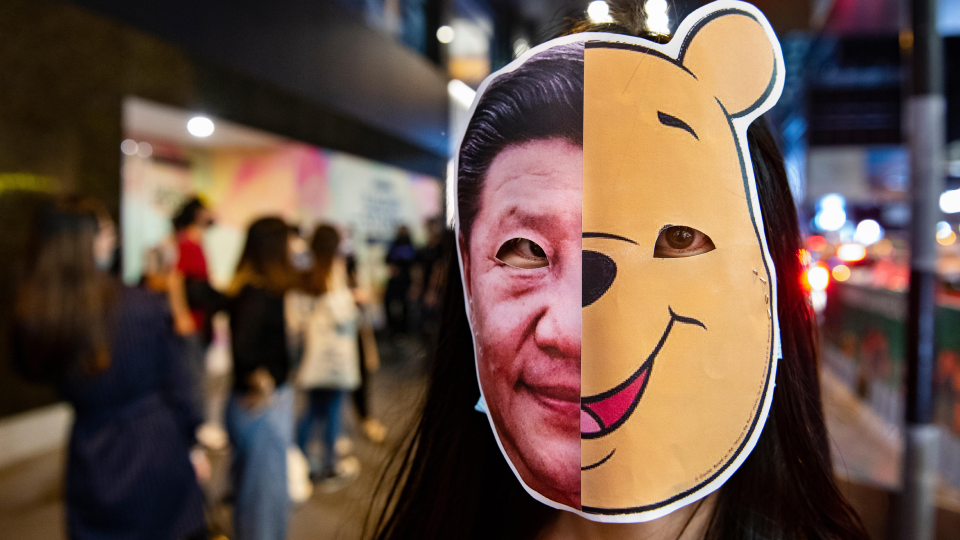
During the Hong Kong protests on Halloween night 2019, a protester wore a mask combining the faces of Winnie the Pooh and Chinese President Xi Jinping, a symbolic reference to the crackdown on dissent and censorship in the region.
Photo credit: Miguel Candela / SOPA Images via Shutterstock
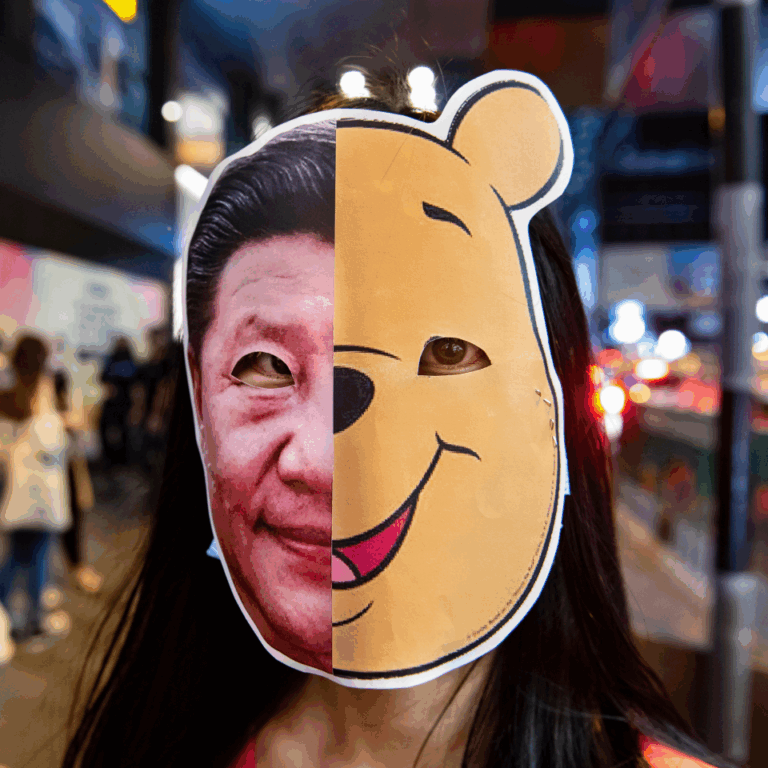
During the Hong Kong protests on Halloween night 2019, a protester wore a mask combining the faces of Winnie the Pooh and Chinese President Xi Jinping, a symbolic reference to the crackdown on dissent and censorship in the region.
Photo credit: Miguel Candela / SOPA Images via Shutterstock
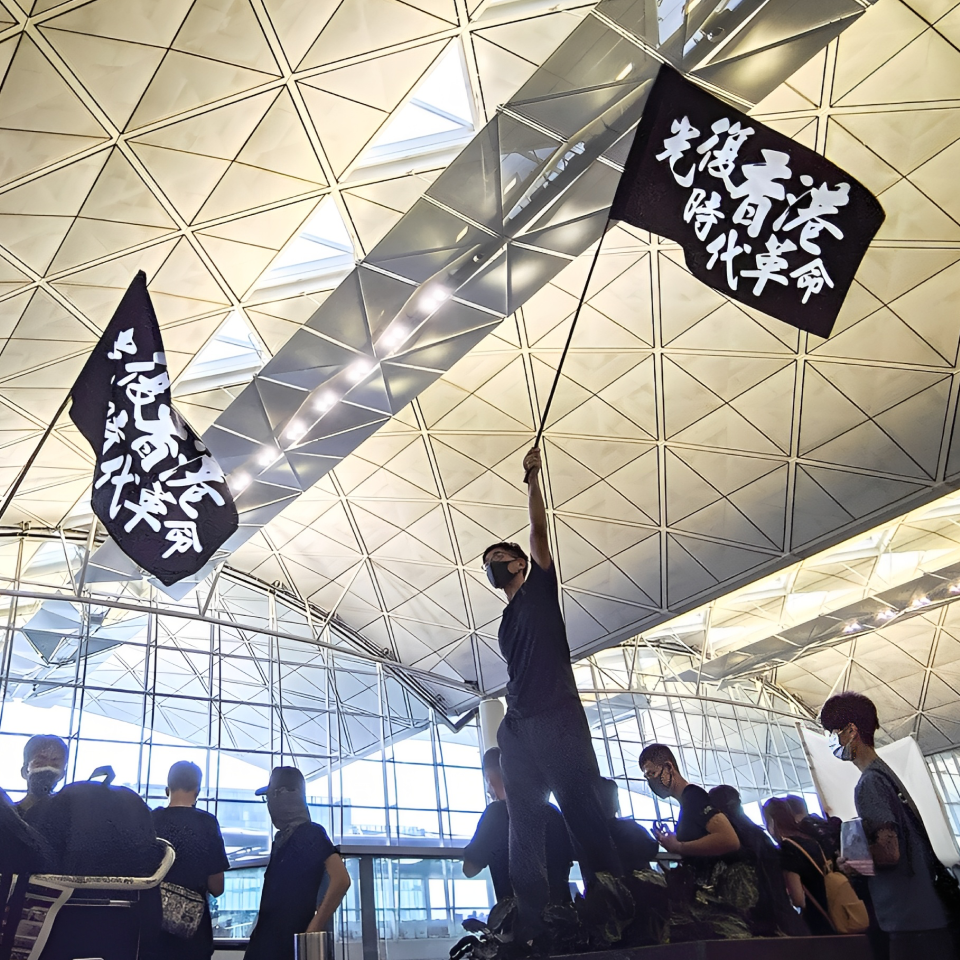
Youth protesters occupy Hong Kong International Airport in August 2019, waving black flags emblazoned with the ‘Liberate Hong Kong’ slogan banned by the National Security Law. This demonstration follows a violent incident where a womanfemale protester was shot in the eye with a projectile during clashes with police.
Photo credit: Studio Incendo via Wikimedia Commons
Censorship is one of the oldest tactics in the CCP’s digital repression playbook. It has been effective in stunting any attempt by the youth to mobilize for a cause. This was exactly the outcome of the regime’s extensive censorship of references to the Tiananmen Massacre. Its sensors are wired to detect keywords or phrases that point to the violent crackdown on pro-democracy protesters and the day it took place, June 4th, 1989. These include various number combinations and their Pinyin counterparts, such as “64,” “65-1,” or “35” which is shorthand for May 35th, another way that netizens have referred to the forbidden date145. Memes recreating the iconic “Tank Man” picture at the Tiananmen Square with rubber ducks and Lego pieces, as discussed in a previous section, were also automatically removed on Sina Weibo146. Censorship done in this manner is a concerted effort to commit historical erasure. According to Danwei, a Beijing-based media watchdog, those young after the events of 1989 “only have a faint notion of what happened” due to the minimum historical information available to them147. This is still the case today, with many young Chinese believing in the illusion that the regime is not capable of inflicting harm on them and choosing to focus more on the economic trappings of the modern world 148.
To circumvent the CCP’s censors, Chinese youth have experimented with homophonic memes. Take, for example, the “Grass Mud Horse” (cǎo ní mǎ, 草泥马) meme coined by Chinese netizens that became viral towards the end of the 2010s. The phrase is a wordplay of the Mandarin profanity “cào nǐ mā” (肏你妈), which literally translates to “f**k your mother.” The phrase is a backhanded censure of the CCP, who is often described as the “mother” of the people149. The meme included pictures of the mythical “horse” and lore about its habitat. Netizens claimed that the horses’ were endangered by invasive “river crabs” (héxiè, 河蟹), a reference to the CCP’s growing internet censorship as the word sounds similar to the Mandarin word for “harmony,” and the CCP has maintained that its internet censorship measures are aimed at creating a “harmonious society”150.
The reliance on homophonic hashtags and euphemisms has since remained a recurring form of political dissent among young Chinese netizens to avoid censorship in their activism. They were used in 2018, when the #MeToo movement to raise awareness of sexual harassment against women gained traction in China, prompting the regime to periodically block the hashtag, and take down pages and posts discussing key women’s rights issues151. Supporters of the movement then invented #RiceBunny (米兔), pronounced “mi tu” in Mandarin and similar sounding to the English pronunciation of “Me Too”152. They also used the bunny and rice bowl emojis to mobilize people behind the cause with minimum risk of detection153. Likewise, when the CCP regime’s sophisticated censors were to stifle online discussions regarding the COVID-19 outbreak by restricting content containing trigger words such as “Wuhan,” “crisis,” and “Hubei,” or a combination thereof, netizens countered by devising memetic codes to replace them. These include shorthand of the words, Mandarin characters that signify certain terms (such as the use of “red 十” or shí, meaning ten, to replace mentions of the Red Cross”), and euphemisms such as F4 to refer to the groups of politicians seen as those responsible for the outbreak154. These went on to become a collection of viral lexicon that sustained online criticisms surrounding the pandemic.
Hong Kongers have also long used word play to criticize the regime. In the wake of widespread protests against the Beijing-backed national security law in 2020, the local government declared illegal the popular protest slogan “Liberate Hong Kong, Revolution of Our Times.” The slogan represented the demands of Hong Kongers for greater autonomy from mainland China and the restoration of democratic norms. In response, netizens began using coded language to indirectly refer to the slogan and evade China’s censors. Those codes include the letters “GFHG, SDGM” – which abbreviates the Cantonese version of the slogan, “gwong fuk heung gong, si doi gak ming” – and the numbers “3219 0246,” whose Cantonese pronunciation mimics the tone and rhythm of the slogan155. Another version uses the phrase “seize back banana,” a play on the similar Pinyin characters for Hong Kong (xiānggǎng, 香港) and banana (xiāngjiāo, 香蕉)156. With these workarounds, Hong Kongers were able to keep the slogan alive throughout one of the most critical fights for democracy in their history.
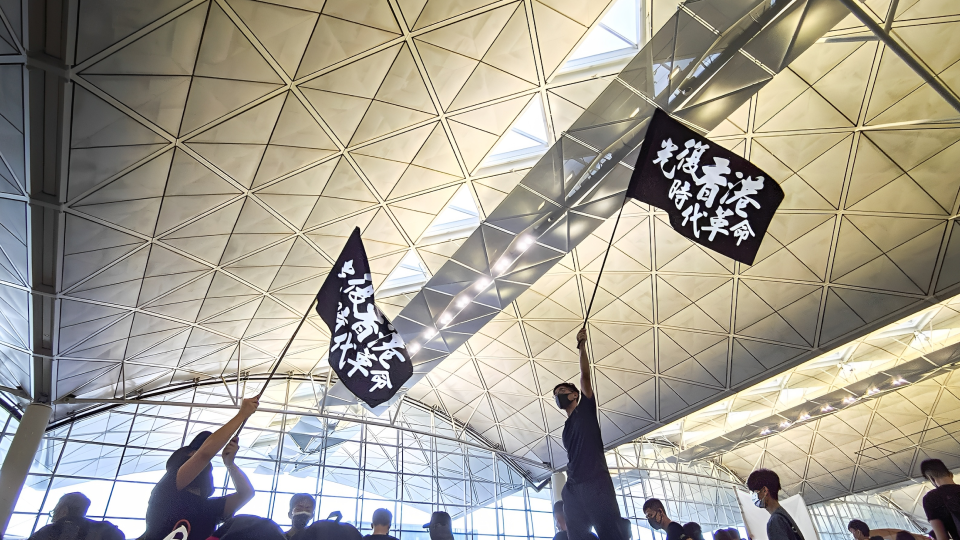
Youth protesters occupy Hong Kong International Airport in August 2019, waving black flags emblazoned with the ‘Liberate Hong Kong’ slogan banned by the National Security Law. This demonstration follows a violent incident where a womanfemale protester was shot in the eye with a projectile during clashes with police.
Photo credit: Studio Incendo via Wikimedia Commons
04
Facing the Storm:
The Challenges of Youth Activism
While youth-led movements in East and Southeast Asia have proliferated across movements and the terrains of multiple web spaces, regimes have relentlessly and ruthlessly cracked down on acts of dissent.
Repressive Legislation
As fearless youth across East and Southeast Asia have challenged authoritarian regimes, authoritarian regimes responded by employing vague and overly broad provisions that impose severe penalties on dissent. Hong Kong, Thailand, and Burma, in particular, have adopted a troubling approach of enforcing vague laws that grant officials extraordinary powers to conduct arrests without warrants, engage in extensive surveillance, and arbitrarily detain activists, among others. They provide regimes with undue justification to imprison and ultimately criminalize an entire generation of young people whose only crime is exercising their right to peaceful protest.
Hong Kong’s Draconian National Security Law
Young people were disproportionately targeted: over 75% of Hong Kong’s political prisoners are under the age of 30, 50% under the age of 25, and more than 15% are minors158.
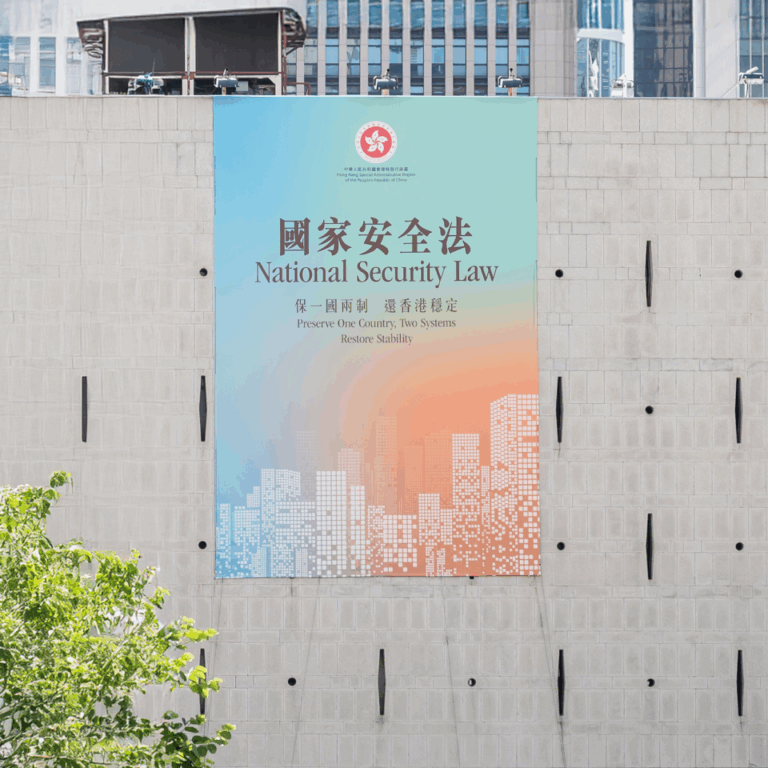
The Hong Kong government hangs a banner promoting the National Security Law.
Photo credit: Yu Chun Christopher Wong via Shutterstock
The unexpected resistance from Hong Kongers forced the Chinese regime to consider more powerful ways to control the situation. As a result, in June 2020, the Hong Kong government imposed the National Security Law (NSL), a draconian law that broadly targets four crimes: secession, subversion, terrorism and collusion with foreign forces to endanger national security. The NSL was covertly drafted in Beijing and passed swiftly – just 40 days after the introduction of the bill in late May 2020. It was only made public after its enactment159. The law’s sweeping provisions shocked the world and raised serious concerns about the erosion of Hong Kongers’ ability to dissent and the city’s overall autonomy160. Within three years of its implementation, approximately 265 people have been arrested for national security-related crimes under the NSL161.
The NSL removed many of the procedural safeguards defendants would usually enjoy during their trial to ensure a higher rate of conviction162. Before a trial even begins, the NSL broaden’s police investigatory powers to search a suspect’s homes, surveil them, freeze their assets, and censor their speech online deemed a threat to national security with limited judicial oversight163. The NSL also allows the chief executive to appoint a select group of judges to preside over national security trials without disclosure164; The law creates a presumption against bail, as opposed to the presumption in favor of bail commonly applied in criminal cases, meaning that it places the burden on the defendants to convince judges that they will not continue to commit acts that endanger national security165 Judges may conduct trials without a jury at the discretion of the Secretary for Justice166. The law seriously undermines judicial independence in Hong Kong and further entrenches Beijing’s intervention with the city’s legal system. As of April 2023, Hong Kong’s security minister reported nearly a 100 percent conviction rate in national security cases167.
The law has also enabled the police to pursue dissidents overseas. In December of 2023, Hong Kong police accused 13 overseas-based activists of violating the NSL and offered over HK$1 million in rewards for information leading to their arrest168. National security police also visited family members of these activists and reportedly took them away for questioning and interrogation, before releasing them169.
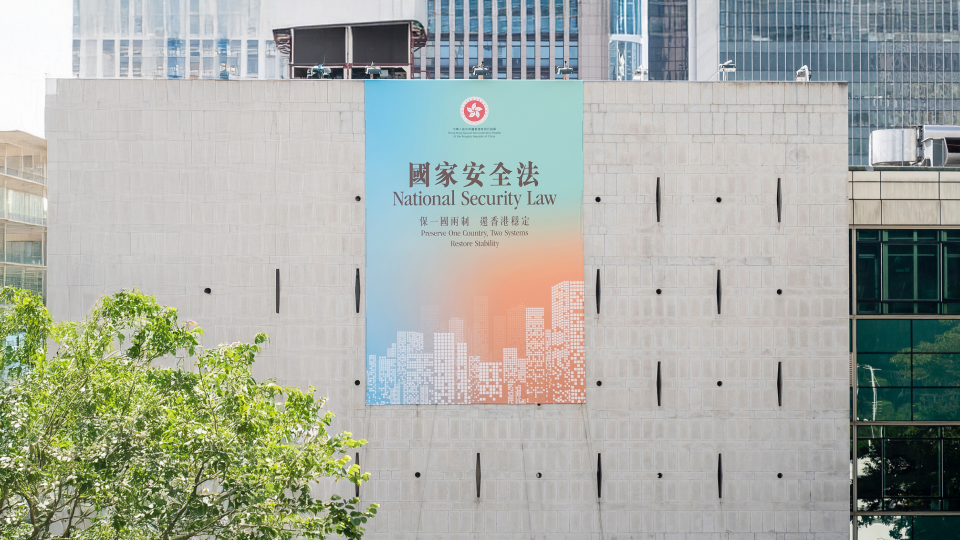
The Hong Kong government hangs a banner promoting the National Security Law.
Photo credit: Yu Chun Christopher Wong via Shutterstock
Capitalizing on the momentum of the NSL, the Hong Kong government introduced another national security-related law titled the Safeguarding National Security Bill, also known as Article 23170. The bill expands the definitions of sedition and state secrets, increases punishment for national security offenses, including life sentences, and allows defendants to be held without charge for up to 16 days, during which time they may not be granted access to a lawyer171. Prosecutors have paired charges under the NSL with Article 23 and other punitive laws, including colonial-era sedition laws, to lob multiple trumped-up charges against dissidents172. As of December 2024, a total of 19 overseas activists in exile have been issued arrest warrants173.
Both the NSL and Article 23 have effectively created a “parallel” legal system wherein national security cases are allowed to bypass due process and abandon fair trial standards174. They have helped the CCP accelerate its efforts to suppress dissent in Hong Kong, putting the city’s once-vibrant civil liberties landscape under the shadow of Beijing’s overarching influence.
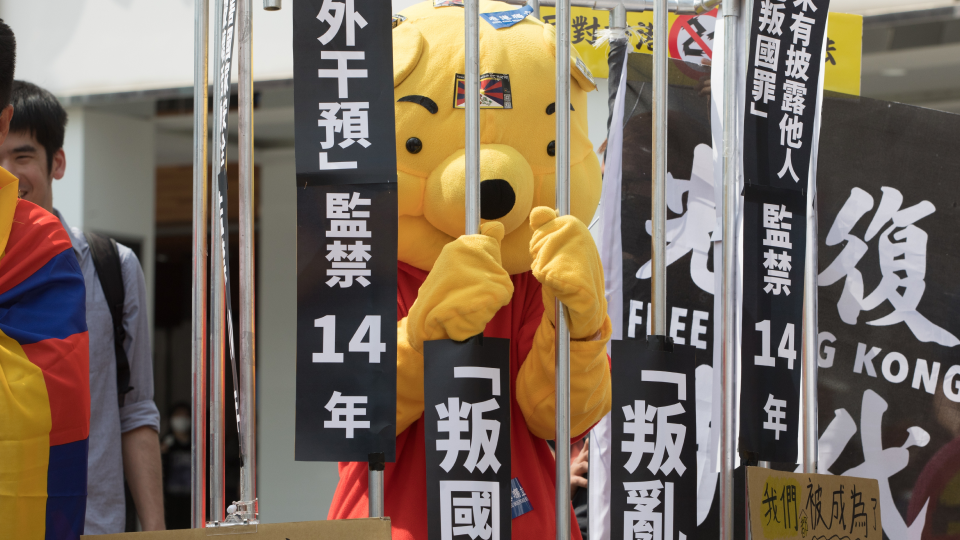
A protester in Taiwan dresses up as Winnie the Pooh behind a fake jail cell, to express solidarity with Hong Kongers against the draconian law, Article 23.
Photo credit: jamesonwu1972 via Shutterstock
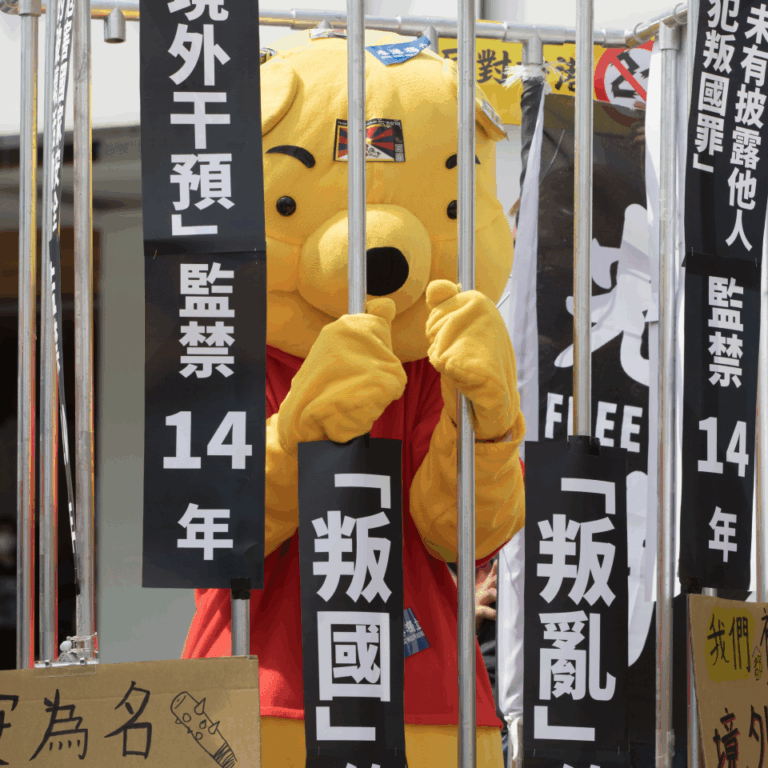
A protester in Taiwan dresses up as Winnie the Pooh behind a fake jail cell, to express solidarity with Hong Kongers against the draconian law, Article 23.
Photo credit: jamesonwu1972 via Shutterstock
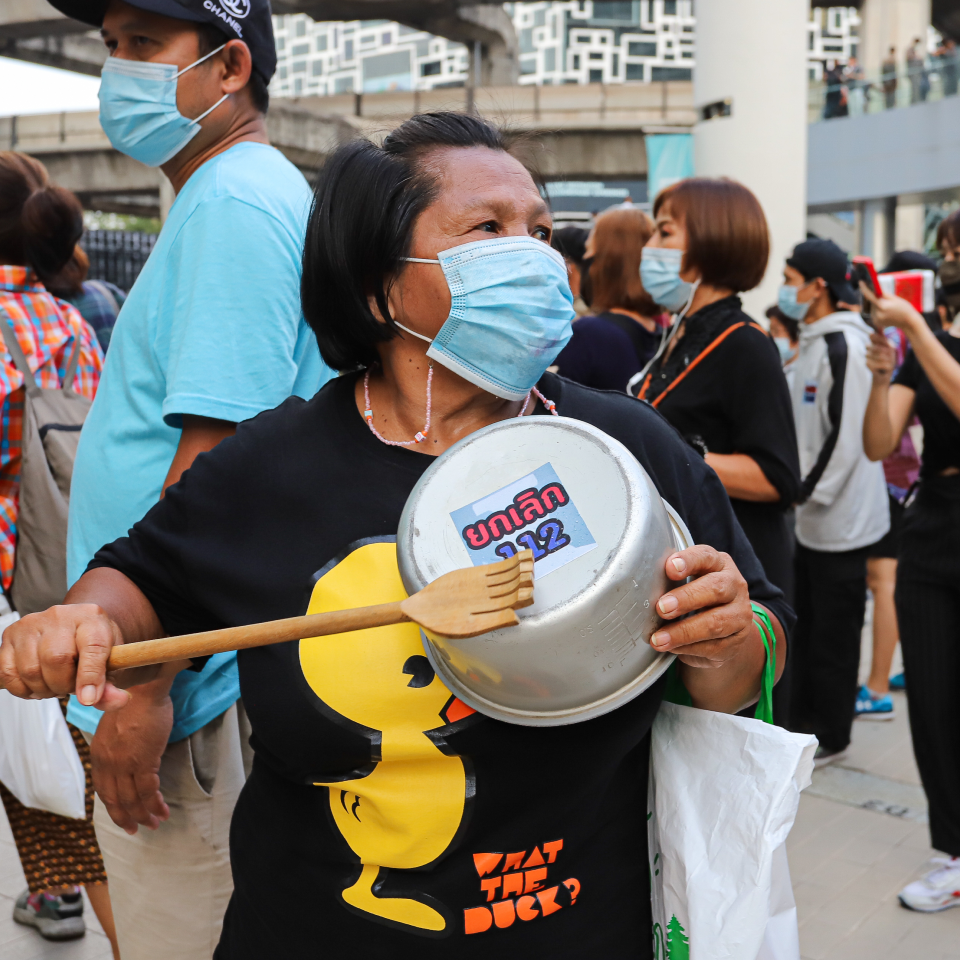
A protester bangs a pot in protest after the court denied bail to activists detained under Article 112.
Photo credit: Adirach Toumlamoon via Shutterstock
Burmese Junta’s Broadening of Punitive Laws Post-2021 Coup
After the Burmese military junta seized power in a 2021 February coup, it made significant changes to the Penal Code and the Criminal Procedure Code, including expanding existing offenses to target activists, journalists, student leaders, and those supporting or being members of the Civil Disobedience Movement175. The Burma military responded to the movement with intimidation and legal persecution176. Hundreds of CDM members were sentenced on bogus charges177, while dozens of their family members were taken hostage by security forces178. In August 2021, some CDM members who were in custody reported being sexually harassed or tortured to death179.
The junta also adopted a new legal provision, Section 505A, that may be used to silence those exercising their rights to freedom of expression or publicly criticize the military regime180. The new section criminalizes “causing fear, spreading false news, or agitating directly or indirectly criminal offenses against government employees”181. Not only does the new provision define punishable acts such as “causing fear” or “false news” in a vague and overbroad manner182, but it also grants the power to law enforcement officers to arrest anyone without a warrant183. Anyone who violates the law could face up to three years in prison, or a fine, or both184. Many detainees facing trials associated with protests or anti-coup activities have been charged under the amended 505A of the Penal Code185. According to Free Expression Myanmar (FEM), thousands have been criminalized under Articles 505 and 505A186. In September 2023, Sai Zaw Thaike, a photojournalist of local news outlet Myanmar Now, was sentenced to 20 years in prison by a military tribunal in Yangon following his report on the impact of Cyclone Mocha187. His initial indictment included allegations of incitement and misinformation under the Natural Disaster Management Law, and Section 505A of the Penal Code188.
Apart from the newly enacted 505A of the Penal Code, the Burmese military junta increasingly used the overbroad 2014 Counter-Terrorism Act, which grants the regime unchecked power to suppress, and target dissent189. The law has been used to target and silence all forms of resistance throughout the country and has enabled the junta to block digital resistance efforts190. After the coup, the Burmese junta amended the Act to crack down on activists191. Addendum to the law enables junta officials to surveil members of pro-democracy groups, confiscate their assets of the suspects, and cooperate with other regimes to arrest or deport them192. Thousands of human rights defenders have been detained on the basis of these laws and others relating to sedition and incitement. Many have been sentenced by military courts in closed-door trials and sentenced to lengthy prison terms, or even death194.
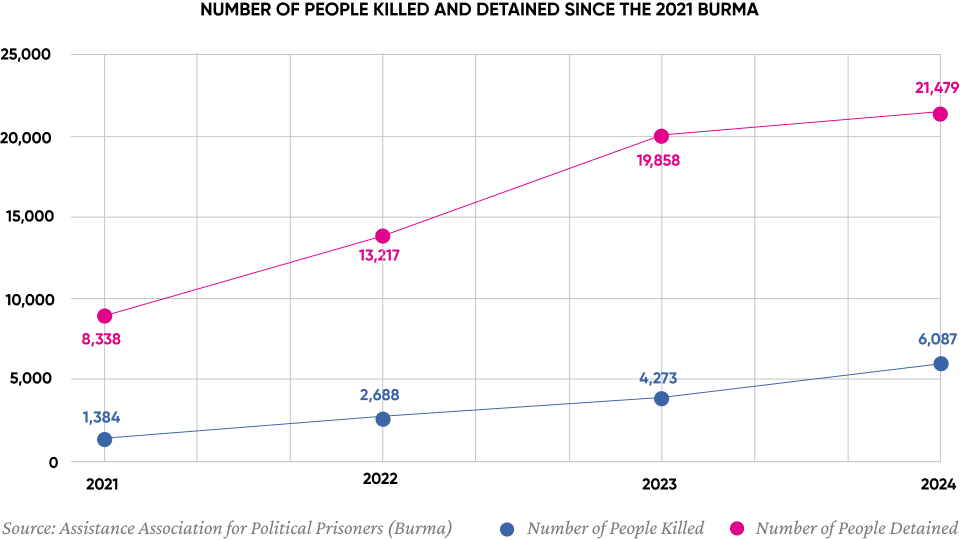
Political prisoners suffered from various forms of torture and ill-treatment, including denial of access to adequate medical treatment, sexual and gender-based violence, and other physical abuses196. Between February 2021 and January 2023, there were 1,009 deaths in custody, as reported by AAPP. Among the deceased were 67 children, ranging in age from 0 to 18 years old, and 265 individuals aged 19 to 30197. The Burmese military regime has shown no signs of ceasing its oppressive tactics against dissenters. Those who resisted the military continued to face severe persecution, including arbitrary detention, harsh interrogations, and inhumane treatment198. This relentless suppression serves as a reminder of the human cost of resistance under a brutal military regime, where even the young are not spared.
Thailand’s Misuse of Royal Defamation
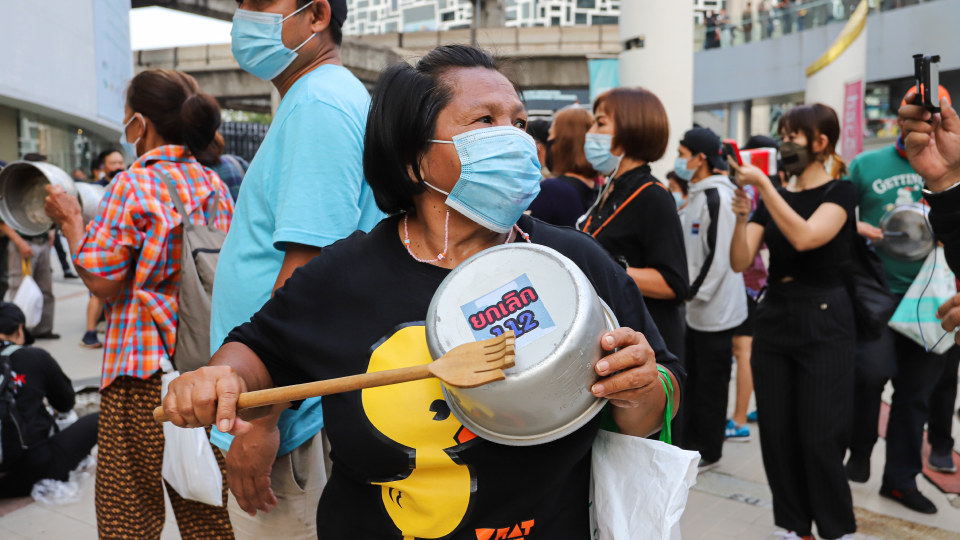
A protester bangs a pot in protest after the court denied bail to activists detained under Article 112.
Photo credit: Adirach Toumlamoon via Shutterstock
As activists shifted to online advocacy during the COVID-19 pandemic, Thai officials enforced the lèse-majesté law more strictly201. Lèse-majesté, defined by Article 112 of Thailand’s Criminal Code, states that “Whoever defames, insults, or threatens the King, the Queen, the Heir-apparent, or the Regent, shall be punished with imprisonment of three to fifteen years”202. The law has been criticized as a political tool to clamp down on freedom of expression203. In 2024, Mongkol “Busbas” Thirakot, an online clothing vendor, was sentenced to 50 years in prison under the lèse-majesté law for his social media comments perceived to criticize the monarchy204. His sentence is the longest on record of the lèse-majesté cases205. However, Mongkol’s case is only one of many individuals who have been detained for royal defamation and meted out disproportionate sentences. The Thai Lawyers for Human Rights reported that at least 262 people have been charged under the lèse-majesté law as of January 2024206. Many of these cases do not adhere to proper judicial procedures, with many people being denied bail or subject to pre-trial detention207.
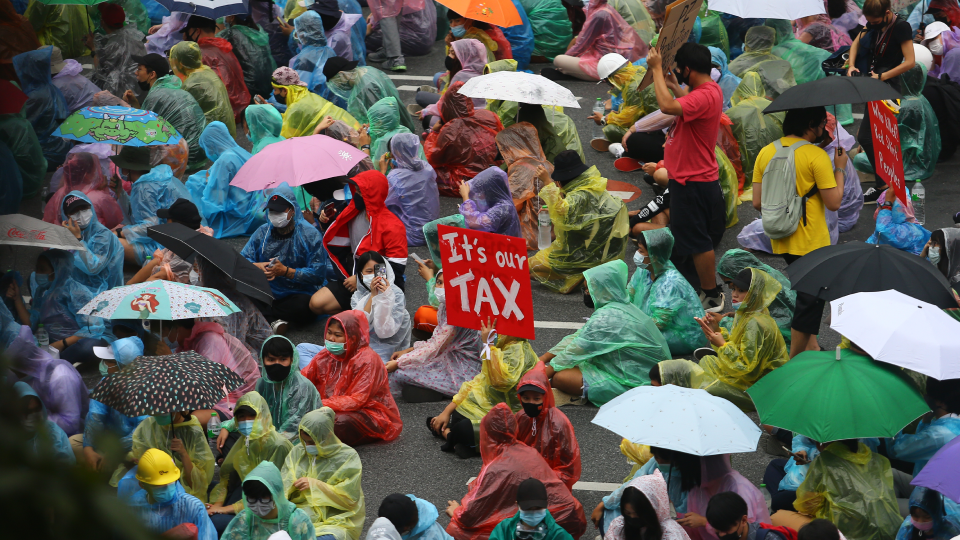
Pro-democracy protesters in Thailand occupy a road around the Victory Monument in Bangkok to demand the release of arrested protest leaders.
Photo credit: kan Sangtong via Shutterstock
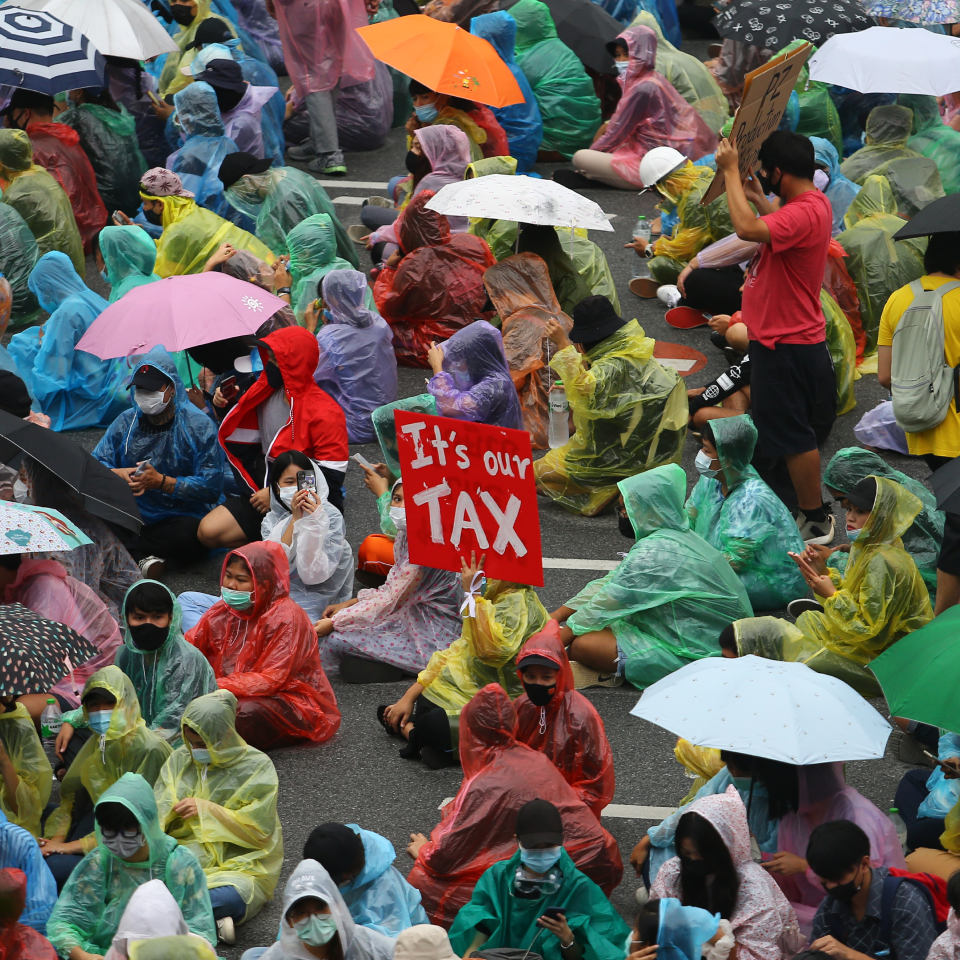
Pro-democracy protesters in Thailand occupy a road around the Victory Monument in Bangkok to demand the release of arrested protest leaders.
Photo credit: kan Sangtong via Shutterstock
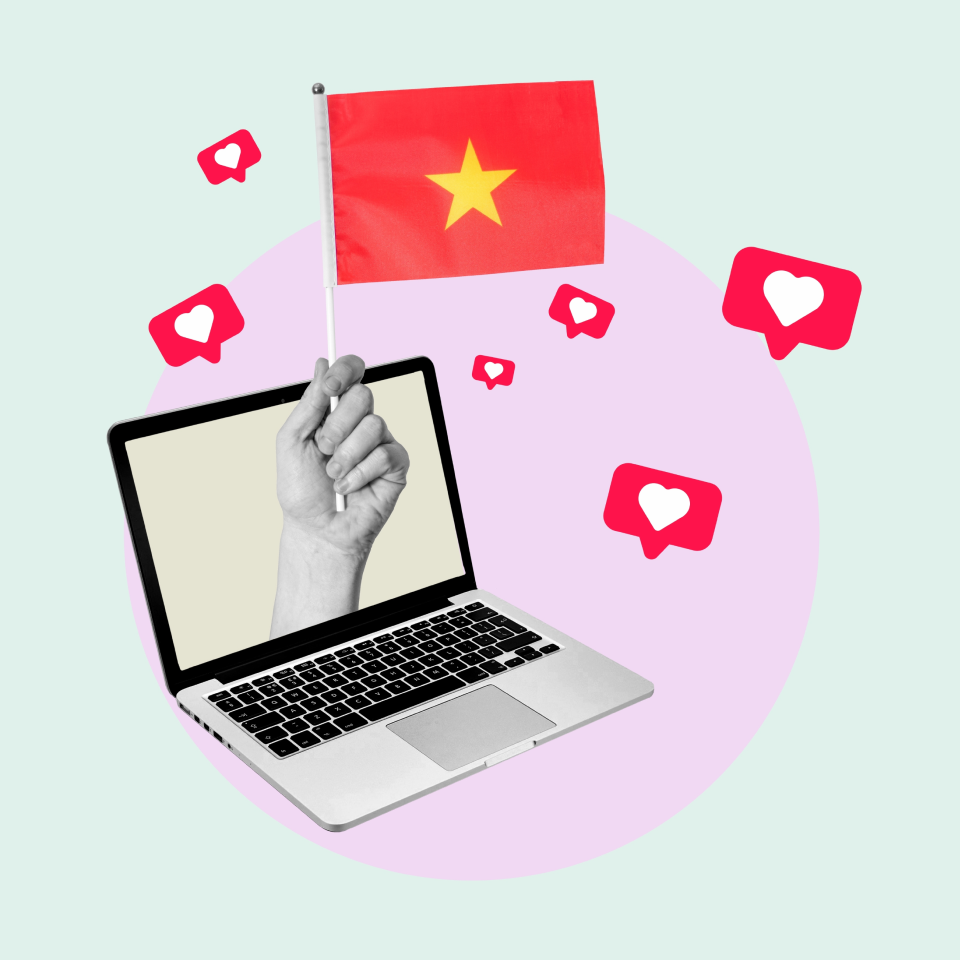
Authoritarian regimes such as Vietnam
employ cyber troops to create accounts and social media pages to promote content favorable to the regime and attack dissent online.
Photo credit: beast01 via Shutterstock
Tactics of Digital Repression
With increased reliance on digital means of activism, youth are vulnerable to regime surveillance in this space. Authoritarian regimes across Asia are exploiting advanced spyware and building cyber armies to monitor and suppress dissenting voices, and often without being detected.
In Thailand, the regime of coup leader-turned-PM Prayut Chan-o-cha acquired Pegasus Spyware from Israeli firm NSO Group that it ultimately used to spy on at least four members of a prominent youth movement, United Front Thammasat and Demonstration208. Panusaya Sithijirawattanakul, a Thai woman activist, recounts her firsthand experience of having her phone hacked, stating “[My phone] was hacked four times, and if you look at each round that was hacked, it was before the event (protest) took place.” In addition to hacking, she also notes being attacked online: “There were hateful comments in the various comment and message channels. Some told me to “go die.” Some called me horrible names.” In Cambodia, regime officials are increasingly monitoring the activities of young environmentalists, obstructing their activism209. In 2020, for instance, 14 youth and environmental activists were arrested and hit with spurious incitement charges for organizing, via Facebook, a peaceful protest for the protection of land rights along the border with Vietnam210.
In Burma, surveillance has led to widespread doxing targeting women and men alike. In February 2023, a Telegram channel run by junta supporters leaked an adult video bearing the flag of the State Administration Council (SAC) that features a 25-year-old woman accused of harboring pro-democracy views211. A CNN analysis found hundreds of similar pro-junta Telegram channels conducting such doxing activities – with their victims being predominantly women who opposed the coup, including activists – and flagged the possibility that some of those channels are coordinated alongside the military itself212. Thai woman activist Panusaya Sithijirawattanakul notes the gender-based nature of cyber attacks:
Many of those doxed and outed on social media were subsequently arrested213.
Authoritarian regimes have also discovered the benefit of delegating repression to cyber armies or trolls. In China, the CCP is known to have outsourced a sizable group of anonymous internet commenters dubbed the “50 Cent Party” – a name attributed to rumors that members are paid 50 cents for each comment they post – to debate regime critics and influence public opinion in its favor. A 2017 study found that members of the group are responsible for “astroturfing,” or the practice of posing as genuine social media users and leaving false social media comments that fiercely defend the regime. While the identities of the vast majority of members, as well as their precise number, remain unknown, the study revealed that some were civil servants working for various local bureaus214. Another study found that the term “50-cent gang” is often used to refer to young, radical patriots called the “angry youth” as well as their more subdued counterparts, the “little pinks,” who commonly engage internet users whose views they deem disrespectful of the motherland215. The little pinks, specifically, played a key role in derailing the celebration of the Democratic Progressive Party as the victor of the 2016 Taiwanese elections. Rather than scornful statements, however, they flooded online spaces with “funny and provocative internet memes” advocating mainland nationalism. These birthed a memes war with pro-Taiwan independence users that led to dozens of photos, slogans, and romantic metaphors portraying China and Taiwan as a broken family that needs to be reunited being distributed by different accounts216. While some have concluded that the little pinks are mostly self-mobilizing volunteers distinct from the CCP217, the latter has commended their actions218.
Cyber armies are not an exclusively Chinese phenomenon. Since 2016, Vietnam’s Force 47, a 10,000-strong military unit, has been waging an information war online and rebutting critics of the Communist Party219.
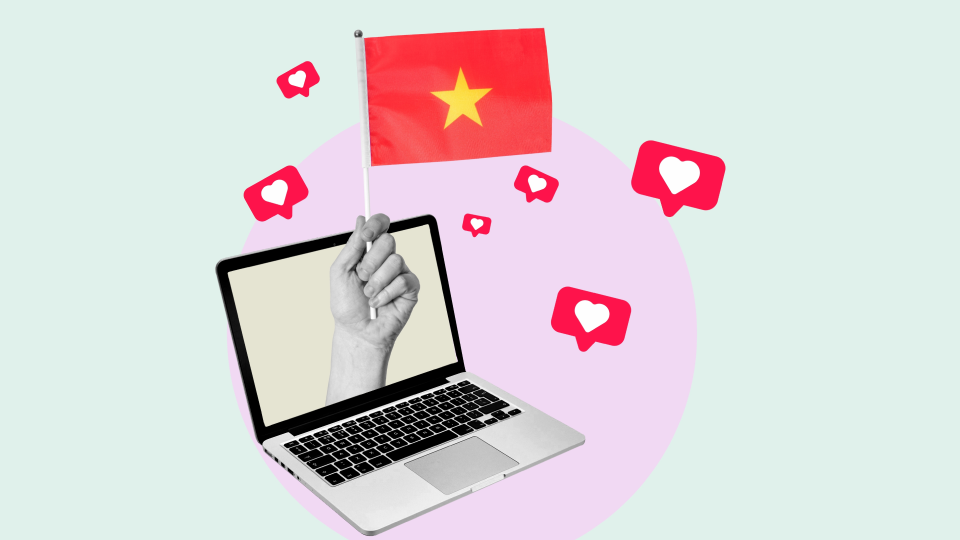
Authoritarian regimes such as Vietnam
employ cyber troops to create accounts and social media pages to promote content favorable to the regime and attack dissent online.
Photo credit: beast01 via Shutterstock
05
Youth Activism Away from the Homeland
China’s escalating authoritarianism has systematically obliterated space for political dissent, especially in Hong Kong, Tibet, the Uyghur Region, and increasingly so in Taiwan. The restrictive environment has precipitated the mobilization of diaspora movements outside of China, inadvertently fostering a collaborative network of youth activists united by the common objective of protecting their respective homeland against Chinese aggression.
There is a rich history of collaboration and solidarity between Hong Kong, Taiwanese, Tibetan and Uyghur communities as they amplify their collective voice against the Chinese Communist Party (CCP). After more than 144,400 Hong Kongers born after 1997 fled their homeland to continue their activism abroad223, they were supported by Taiwanese, Tibetans, and Uyghurs who also jointed protests224, organized solidarity campaigns225, jointly condemned various rights violations226, and reinforced their united stand against the CCP. Tenzin Passang, Director of Students for a Free Tibet India speaks to the importance of working together:
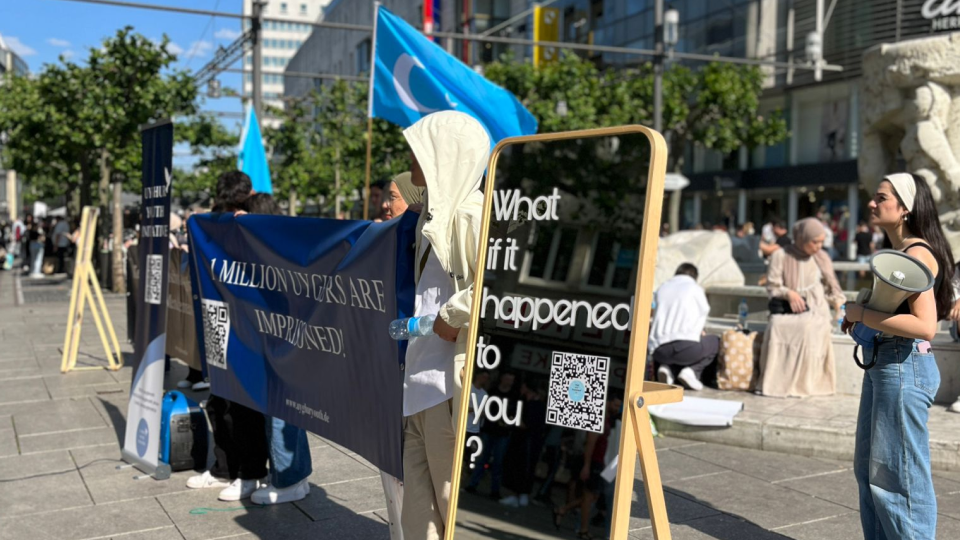
Uyghur Youth Initiative launches the “What If It Happened To You” Campaign.
Photo credit: Uyghur Youth Initiative
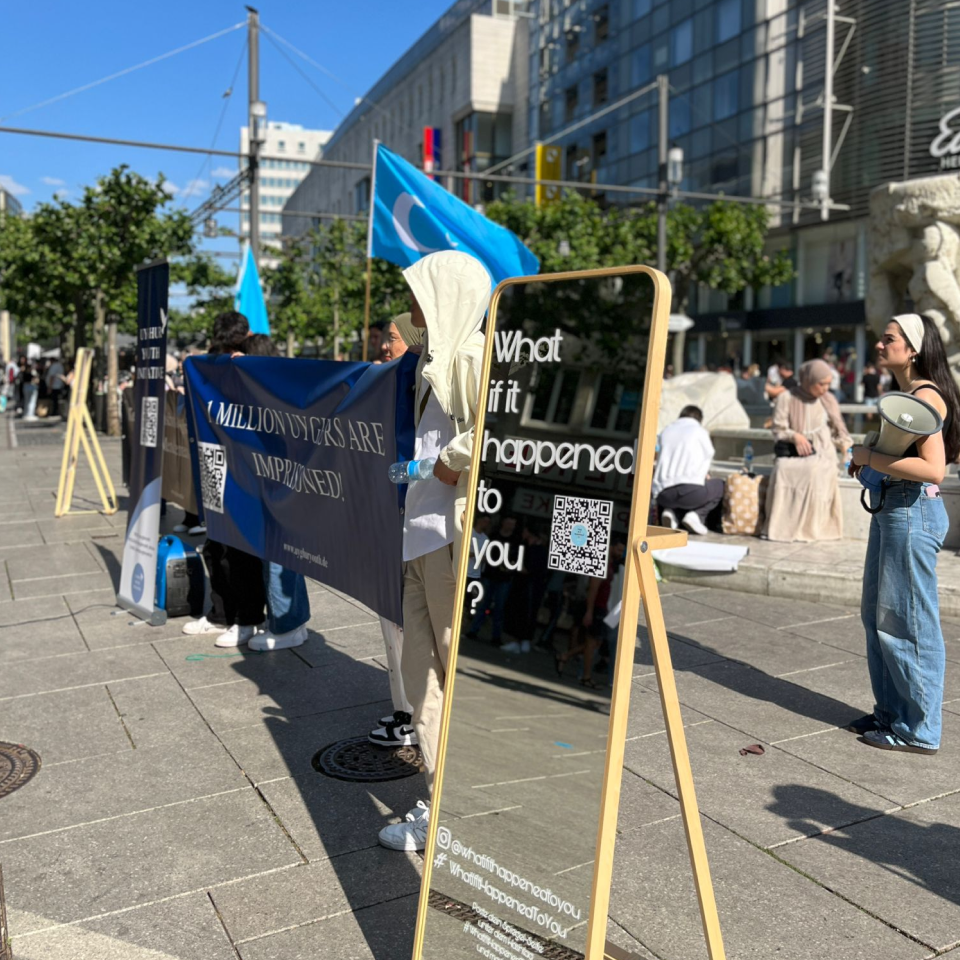
Uyghur Youth Initiative launches the “What If It Happened To You” Campaign.
Photo credit: Uyghur Youth Initiative
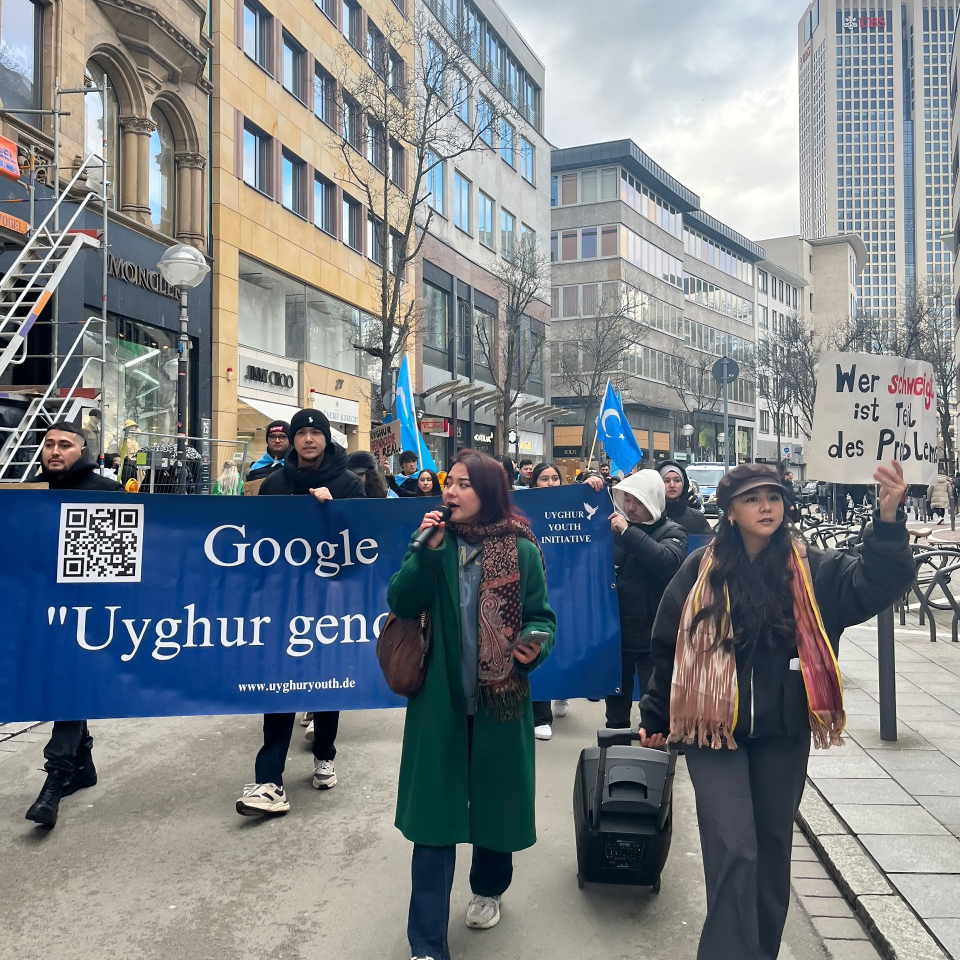
Uyghur youth protest in Frankfurt to raise awareness about human rights violations and genocide in the Uyghur Region.
Photo credit: Uyghur Youth Initiative
One such group that is playing a pivotal role in mobilizing youth is the Germany-based Uyghur Youth Initiative (UYI), which has organized impactful, creative campaigns, workshops, and cultural initiatives both online and offline233. Particularly on social media, they regularly recreate popular TikTok trends to highlight gross human rights abuses in the Uyghur Region234. They also co-produce creative digital content with their peers in the United States235 and across Europe236. These partnerships not only enhance the visibility and impact of their work, but also help advance the momentum of the broader youth advocacy effort.
One such group that is playing a pivotal role in mobilizing youth is the Germany-based Uyghur Youth Initiative (UYI), which has organized impactful, creative campaigns, workshops, and cultural initiatives both online and offline. Particularly on social media, they regularly recreate popular TikTok trends to highlight gross human rights abuses in the Uyghur Region. They also co-produce creative digital content with their peers in the United States and across Europe. These partnerships not only enhance the visibility and impact of their work, but also help advance the momentum of the broader youth advocacy effort.
Moreover, these collaborative efforts are also increasingly unfolding in partnership with Hong Kong and Tibetan youth groups in offline environments and developing into high-level capacity-building programs. Initiatives such as the United Nations Advocacy Training, provide a formal space for youth leaders from the Hong Kong, Tibetan and Uyghur movements to engage meaningfully with international stakeholders237. Youth groups such as Student for a Free Tibet (SFT), have also been a significant contributor in the global solidarity building effort with its annual Action Camps and Cross-Movement Roundtables that bring together like-minded allies to counter CCP repression. These ventures have enriched strategic alliances and enhanced global awareness, as evidenced by the joint protests led by all three groups during Xi Jinping’s visit to San Francisco during the 2023 Asia-Pacific Economic Cooperation (APEC) summit and Premier Li Qiang’s trip to Canberra, Australia, in mid-2024238. These joint protests and collaborative initiatives have empowered marginalized youth to connect with their peers and facilitated the proliferation of youth alliance groups and increased collaboration239.
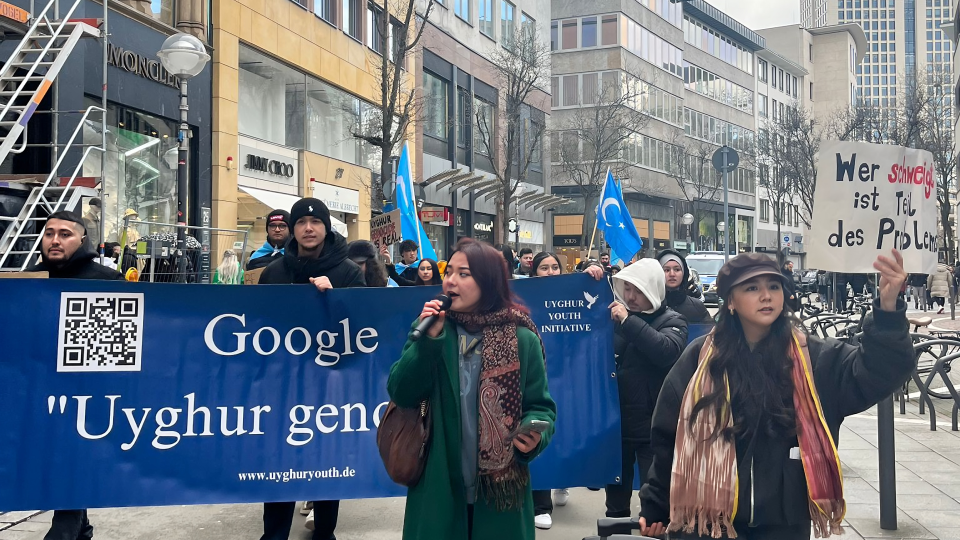
Uyghur youth protest in Frankfurt to raise awareness about human rights violations and genocide in the Uyghur Region.
Photo credit: Uyghur Youth Initiative
Conclusion
Recent years have seen a growing discourse on the reality that many young people around the world are becoming disenchanted with democratic governance, viewing it as inefficient, corrupt, and unequal.
These sentiments especially ring true for youth in emerging and established democracies who lack collective memories of authoritarian rule.
Against this backdrop, the youth-led movements that flourished in parts of Asia between 2019 and 2023 serve as a potent reminder of why democratic ideals are worth defending. East and Southeast Asia, in particular, are pivotal areas for these movements: although countries in the sub-regions have made strides in development, only three – Japan, South Korea, and Taiwan – are stable democracies240. The remaining nations, which account for 83% of the sub-regions241, have failed to escape despotic rule, struggled to consolidate their democratic institutions, or exhibited signs of authoritarian relapse following transitional periods.
Contemporary youth-led movements are also inseparable from technology. Social media, for example, served as a powerful tool to leverage support for the pro-democracy cause across the events we observed, while also evolving as a battleground for information warfare. However, the digital landscape presents vulnerabilities, with authoritarian regimes increasingly deploying sophisticated surveillance and censorship technologies to quash criticism. The experiences of activists facing cyber harassment and doxing highlight the precarious nature of digital activism.
A striking feature of contemporary youth-led movements is the spirit of solidarity among activists from diverse backgrounds. The collaboration between Hong Kongers, Taiwanese, Uyghurs, and Tibetans illustrates a collective rejection of authoritarianism that transcends geographic and cultural boundaries. The same can be seen in the emergence of pro-democracy protests under the mutual banner of the Milk Tea Alliance, which spread even to places like Burma, where protesting could be a choice between life and death.
Looking ahead, the challenges facing youth-led movements remain formidable. Young people are passionate changemakers. In their activism, they must navigate not only the complexities of regime repression but also skepticism, and sometimes resistance, from older generations.
In addition, the youth activists with whom we sat down pointed out cases where their colleagues withdrew from their cause, embattled by regime attacks and apprehensive about whether their efforts would bear fruit at all.
Nevertheless, democratic governments are best positioned to show that democracy still pays dividends. Free societies have the potential to significantly shape expectations for change in repressive contexts. Ultimately, those expectations determine whether democracy thrives or stagnates at the hands of younger generations, both in Asia and beyond.
Recommendations
To date, young activists living under the Burmese, Chinese, Hong Kong, and Thai regimes continue to face intimidation, oppressive laws, cyberattacks, and other state-sponsored campaigns of repression. The following are a series of recommendations for international civil society organizations and democratic governments on how they can bolster youth-led activism and policymakers to protect and promote freedom of expression and peaceful assembly in the region. There are also a set of domestic policy recommendations applicable to Burma, China, Hong Kong, and Thailand.
For International Civil Society Organizations
Enhance Capacity Building for Youth Activists
Strengthen transnational networks
Provide financial support to youth groups
Offer legal support
For Democratic Governments
Prioritize youth activism programs in foreign assistance
Democratic governments should provide sustainable funding, mentorship, and context-specific support for youth-led initiatives in countries with authoritarian regimes. Support includes comprehensive skill training on leadership, advocacy, digital security, media literacy, and peer learning networks.
Enhance security mechanisms for activists seeking refuge
Democratic governments should implement protection policies and offer legal protection, asylum, and emergency support to youth activists facing threats or reprisals in their home countries according to the principle of non-refoulement.
Support independent and grassroots media
Provide opportunities for youth activists to engage with democratic institutions abroad
Domestic Policy Recommendations
Repeal or reform laws that unduly restrict the freedom of dissent
HRF calls on the following regimes to repeal or amend laws that violate the rights to freedom of expression and peaceful assembly and ensure that they are aligned with international human rights laws and principles.
Burma
Hong Kong
• Amend the National Security Law 2020 to prevent the widespread misuse of the law. Clearly define broad and vague terms such as “secession,” “subversion,” “terrorism,” “and “collusion with foreign forces to endanger national security.”
• Reinstate procedural safeguards for defendants and restore fair trial standards and due process, especially in National Security Law cases.
• Reform the Safeguarding National Security Bill, or Article 23: Clarify the scope and meaning of the broadly worded “treason,” “sedition,” “espionage,” “state secrets,” and “external interference.”
• Abolish closed-door trials that permit police to detain suspects for up to 16 days without formal charges.
Thailand
Abide by international standards on protecting human rights
Support local civil society groups
Establish appropriate and accessible judicial and non-judicial redress mechanisms
The Burmese, Chinese, Hong Kong, and Thai regimes should ensure that there are sufficient safeguards against potential abuses of policies, laws, and regulations, and that individuals or groups who are adversely affected by them may access avenues to appeal or amend harmful legal provisions, as well as obtain fair and equitable remedies. These may include oversight authorities, independent human rights commissions, and mediation and conciliation procedures. Regular evaluations of such mechanisms should also be undertaken to ensure their consistency with prevailing human rights standards.
Thank You
References
The term “youth” lacks a universally accepted definition, varying across different entities and regions. In the countries covered by this report, definitions of youth also vary: according to Matkhao and Sooktawee, Thailand defines youth as individuals aged 14 to 25, Burma’s National Youth Policy defines youth as those aged 16 to 35, and China’s National Bureau of Statistics, defines youth as those aged 15 to 29. For the purposes of this report, the terms “youth,” “young people,” and “activists” are used interchangeably to encompass individuals aged 15 to 35, providing a broad framework to address the issues related to youth-led movements.
“Hong Kong students and residents reject national-education classes, 2012,” Global Nonviolent Action Database, Accessed March 14, 2025, https://nvdatabase.swarthmore.edu/content/hong-kong-students-and-residents-reject-national-education-classes-2012; Dan Glaun, “Chinese Legislature Tightens Control Over Hong Kong Elections,” PBS News, March 11, 2021, https://www.pbs.org/wgbh/frontline/article/chinese-legislature-tightens-control-over-hong-kong-elections/.
Mike Ives, “What Is Hong Kong’s Extradition Bill?,” The New York Times, June 10, 2019, https://www.nytimes.com/2019/06/10/world/asia/hong-kong-extradition-bill.html
Alex Hurley, “Encryption vs. Surveillance: How the NSL Is Changing Hong Kong’s Tech Landscape,” The China Guys, August 2020, https://thechinaguys.com/encryption-vs-surveillance-how-the-nsl-is-changing-hong-kongs-tech-landscape/.
Yong Ming Kow, Bonnie Nardi, and Wai Kuen Cheng, “Be Water: Technologies in the Leaderless Anti-ELAB Movement in Hong Kong,” CHI ’20: Proceedings of the 2020 CHI Conference on Human Factors in Computing Systems (2020): 3, https://doi.org/10.1145/3313831.3376634.
Ibid., 3-4.
Daniel Victor, “Hong Kong Protesters Love Pepe the Frog. No, They’re Not Alt-Right.,” The New York
Times, August 19, 2019,https://www.nytimes.com/2019/08/19/world/asia/hong-kong-protest-pepe-frog.html.
Emma Grey Ellis, “Pepe the Frog Means Something Different in Hong Kong—Right?,” WIRED, August
23, 2019, https://www.wired.com/story/pepe-the-frog-meme-hong-kong/.
India Bourke, “Hong Kong protesters transform alt-right Pepe the Frog into pro-democracy symbol,”
Hong Kong Free Press, October 3, 2019, https://hongkongfp.com/2019/10/03/hong-kong-protesters-transform-alt-right-pepe-frog-pro-democracy-symbol/.
Stephy Chung, “Future of political art in Hong Kong uncertain as Beijing tightens grip,” CNN, May 27,
2020, https://www.cnn.com/style/article/hong-kong-protests-political-art-intl-hnk/index.html.
“Dozens of Designers Work in Shifts to Create Hong Kong Protest Art. Here Are Some Examples of
Their Work,” Time Magazine, September 18, 2019,
https://time.com/5679885/hong-kong-protest-art-agitprop-illustration/.
Vivienne Chow, “The magical world of Japanese anime has become the reality of Hong Kong
protesters,” Quartz, November 14, 2019,
https://qz.com/1729995/japanese-anime-is-coming-to-life-in-the-hong-kong-protests.
Ibid.
“Dozens of Designers Work in Shifts to Create Hong Kong Protest Art. Here Are Some Examples of
Their Work,” Time Magazine, September 18, 2019,
https://time.com/5679885/hong-kong-protest-art-agitprop-illustration/.
Daniel Victor, “Hong Kong Protesters, Without an Anthem to Sing, Create One Online,” The New York
Times, September 12, 2019,
https://www.nytimes.com/2019/09/12/world/asia/glory-to-hong-kong-anthem.html.
Ibid.
Kris Cheng, “Plan for ‘Lady Liberty Hong Kong’ pro-democracy statue surpasses HK$200k crowdfunding goal within hours,” Hong Kong Free Press, August 31, 2019, https://hongkongfp.com/2019/08/31/plan-lady-liberty-hong-kong-pro-democracy-statue-surpasses-hk200k-crowdfunding-goal-within-hours/.
Kow, Nardi, and Cheng, “Be Water: Technologies in the Leaderless Anti-ELAB Movement in Hong
Kong,” supra note 5, 7.
“Dozens of Designers Work in Shifts to Create Hong Kong Protest Art. Here Are Some Examples of Their Work,” Time Magazine, September 18, 2019,
https://time.com/5679885/hong-kong-protest-art-agitprop-illustration/.
Benjamin Haas, “The new battle in Hong Kong isn’t on the streets; it’s in the apps,” MIT Technology
Review, September 10, 2019, https://www.technologyreview.com/2019/09/10/102646/the-new-battle-in-hong-kong-isnt-on-the-streets-its-in-the-apps/.
Kow, Nardi, and Cheng, “Be Water: Technologies in the Leaderless Anti-ELAB Movement in Hong
Kong,” supra note 5, 6.
Kow, Nardi, and Cheng, “Be Water: Technologies in the Leaderless Anti-ELAB Movement in Hong
Kong,” supra note 5, 8.
“Hong Kong mood darkens as hard hats replace yellow umbrella,” Financial Times, June 13, 2019,shttps://www.ft.com/content/b4eb3fb6-8d87-11e9-a1c1-51bf8f989972.
Vanessa Friedman, “The Color of Protest,” The New York Times, Published October 29, 2019; last
modified October 30, 2019, https://www.nytimes.com/2019/10/29/style/29china-ban-black-clothing-hong-kong-protests.html.
Kris Cheng, “In Pictures: 100s of Hong Kong civil servants criticise gov’t handling of protests and Yuen Long mob attacks,” Hong Kong Free Press, March 31, 2020,
https://hongkongfp.com/2019/07/25/pictures-100s-hong-kong-civil-servants-criticise-govt-handling-protests-yuen-long-mob-attacks/.
Isabella Steger, “Post-it notes are the new weapon of choice for Hong Kong’s protesters,” Quartz, July 9, 2019, https://qz.com/1660649/post-it-notes-spread-protest-message-on-hong-kongs-lennon-walls.
Ibid.
“Hongkongers use creativity against new security law,” Taiwan News, July 6, 2020, https://www.taiwannews.com.tw/news/3960846.
Mary Hui, “A guide to the most important chants of Hong Kong’s protests,” Quartz, September 2, 2019, https://qz.com/1699119/chants-and-slogans-of-hong-kongs-protests-explained.
Ibid.
Kow, Nardi, and Cheng, “Be Water: Technologies in the Leaderless Anti-ELAB Movement in Hong Kong,” supra note 5, 4.
Ilaria Maria Sala, “Hong Kong’s ‘be water’ protests leave China casting about for an enemy,” The Guardian, August 30. 2019, https://www.theguardian.com/world/2019/aug/30/hong-kongs-be-water-protests-leaves-china-casting-about-for-an-enemy.
Christy Choi, “’No tears, no blood’: Hongkongers stage huge laser show to protest against arrests,” The
Guardian, August 8, 2019, https://www.theguardian.com/world/2019/aug/08/no-tears-no-blood-hongkongers-stage-huge-laser-show
-to-protest-police-arrests
Erin Hale and Emma Graham-Harrison, “Hong Kong protesters join hands in 30-mile human chain,”
The Guardian, August 23, 2019, https://www.theguardian.com/world/2019/aug/23/hong-kong-protesters-join-hands-in-30-mile-human-chain
Ibid.
Kanokrat Lertchoosakul, “The rise and dynamics of the 2020 youth movement in Thailand,” Heinrich-Böll-Stiftung, February 2022,
https://www.boell.de/sites/default/files/importedFiles/2023/11/14/Thailand%25202020%2520youth%2520 movement_FINAL.pdf; Amy Searight and Brian Harding, “Thailand’s First Elections Since Its 2014 Coup,” Center for Strategic and International Studies, March 22, 2019, https://www.csis.org/analysis/thailands-first-elections-its-2014-coup.
Ibid., 8.
Ibid., 8.
Rebecca Ratcliffe, “Thai court dissolves opposition party Future Forward,” The Guardian, February 21, 2020, https://www.theguardian.com/world/2020/feb/21/thai-court-dissolves-opposition-party-future-forward.
Lertchoosakul, “The rise and dynamics of the 2020 youth movement in Thailand,” supra note 36, 9.
Lertchoosakul, “The rise and dynamics of the 2020 youth movement in Thailand,” supra note 36, 9-10
Lertchoosakul, “The rise and dynamics of the 2020 youth movement in Thailand,” supra note 36, 10.
Preeti Jha, “Thailand protest: Why young activists are embracing Hong Kong’s tactics,” BBC, October 22, 2020, https://www.bbc.com/news/world-asia-54626271; Marimi Kishimoto, “Tech-savvy Thai protesters take page out of Hong Kong’s playbook,” Nikkei Asia, October 30, 2020,
https://asia.nikkei.com/Politics/Turbulent-Thailand/Tech-savvy-Thai-protesters-take-page-out-of-Hong-Kong-s-playbook.
Ibid., BBC.
Marimi Kishimoto, “Tech-savvy Thai protesters take page out of Hong Kong’s playbook,” Nikkei Asia,
October 30, 2020, https://asia.nikkei.com/Politics/Turbulent-Thailand/Tech-savvy-Thai-protesters-take-page-out-of-Hong-Kong-s-playbook.
Ibid.
Matthew Tostevin and Petra Mahira, “Thai school students protest against ‘dinosaurs’,” Reuters,
November 21, 2020, https://www.reuters.com/article/us-thailand-protests-idUSKBN2810AA/.
Ibid.
Erin Handley, “Why Thai students use rubber ducks, dinosaurs and three-finger salutes as protest
symbols,” ABC News, November 24, 2020, https://www.abc.net.au/news/2020-11-24/thai-protests-rubber-duckies-dinosaurs-three-finger-salute/1291
1494.
Anthony Gramuglia, “Hamtaro Is Now a Protest Symbol in Thailand,” CBR, July 29, 2020, https://www.cbr.com/hamtaro-protest-symbol-thailand/.
Thet Swe Win, “The coup united the people of Myanmar against oppression,” Al Jazeera, October 1, 2021, https://www.aljazeera.com/opinions/2021/10/1/the-coup-united-the-people-of-myanmar-against-oppression
“Myanmar coup: Tens of thousands join largest protests since 2007,” BBC, February 7, 2021, https://www.bbc.com/news/world-asia-55967959.
Niharika Mandhana and Feliz Solomon, “A New Generation Takes the Lead in Myanmar Protests,” The Wall Street Journal, March 10, 2021 https://www.wsj.com/articles/a-new-generation-takes-the-lead-in-myanmar-protests-11615395087.
Su Mon Thant, “In the wake of the coup: how Myanmar youth arose to fight for the nation,” Heinrich-Böll-Stiftung, December 2021, https://www.boell.de/sites/default/files/importedFiles/2023/10/16/Myanmar%2520youth_FINAL.pdf.
“The Centrality of the Civil Disobedience Movement in Myanmar’s Post-Coup Era,” New Mandala,
October 19, 2021, https://www.newmandala.org/the-centrality-of-the-civil-disobedience-movement-in-myanmars-post-coup-era/; “Myanmar’s Youth After the Coup, A Primer,” ASEAN Youth Forum, June 2023, https://aseanyouthforum.org/myanmars-youth-a-primer/.
“After coup, medical workers spearhead civil disobedience campaign,” Frontier Myanmar, February 2, 2021, https://www.frontiermyanmar.net/en/after-coup-medical-workers-spearhead-civil-disobedience-campaign/
Ibid.
“The Centrality of the Civil Disobedience Movement in Myanmar’s Post-Coup Era,” supra note 55.
Ye Htet, “It’s time to re-think the CDM,” Frontier Myanmar, August 28, 2023, https://www.frontiermyanmar.net/en/its-time-to-re-think-the-cdm/.
“The Centrality of the Civil Disobedience Movement in Myanmar’s Post-Coup Era,” supra note 55.
“Myanmar’s Civil Disobedience Movement Carries On in Face of Increasing Junta Repression,” The Irrawaddy, January 24, 2022,
Emily Fishbein and Nu Nu Lusan, “Young, rebellious and the Myanmar military’s ‘worst enemy’,” Al Jazeera, October 5, 2022, https://www.aljazeera.com/news/2022/10/5/young-rebellious-and-the-myanmar-militarys-worst-enemy.
Syukron Subkhi, “The Youth Resistance Towards Myanmar’s Military Coup: Efforts of Young Generation Protest Through Art,” ASEAN Studies Center Universitas Gadjah Mada, September 24, 2021, https://asc.fisipol.ugm.ac.id/2021/09/24/the-youth-resistance-towards-myanmars-military-coup-efforts-ofyoung-generation-protest-through-art/.
Ibid.
“The Centrality of the Civil Disobedience Movement in Myanmar’s Post-Coup Era,” supra note 55.
Sithu Aung Myint, “‘Social punishment’ campaign turns the tables on military elite,” Frontier Myanmar, March 18, 2021,
https://www.frontiermyanmar.net/en/social-punishment-campaign-turns-the-tables-on-military-elite/.
Ibid.
Soe Htet and Tamas Wells, “Student Activism and Myanmar’s Revolution,” Australian Institute of International Affairs, August 4, 2023,
https://www.internationalaffairs.org.au/australianoutlook/student-activism-and-myanmars-revolution/.
Padone, “Enrolment in state-run universities down ‘70%’ since coup,” University World News, April 26, 2023, https://www.universityworldnews.com/post.php?story=20230426140655766.
Soe Htet and Wells, “Student Activism and Myanmar’s Revolution,” supra note 68.
“Myanmar junta threatens pot-banging protesters with treason,” France 24, January 25, 2022,
https://www.france24.com/en/live-news/20220125-myanmar-junta-threatens-pot-banging-protesters-withtreason.
Judith Beyer, “‘You messed with the wrong generation’: the young people resisting Myanmar’s military,” Open Democracy, February 11, 2021,
https://www.opendemocracy.net/en/you-messed-with-the-wrong-generation-the-young-people-resistingmyanmars-military/.
Naw Say Phaw Waa, “Universities, professors and students still under attack,” University World News, January 28, 2022, https://www.universityworldnews.com/post.php?story=2022012812432689.
MilkTeaAllianceCalendar (@MTA_Calendar), “Mon Cont’d: Alliance for Free Burma Solidarity’s event
“Remembering 8.8.88 Heroic Struggle: Supporting ongoing movement for justice and #democracy in
#Burma & In Myanmar the resistance is calling for a memorial for historic ‘8888 movement’ by banging
Pots & Pans! /5,” X, tweet, August 8, 2022, https://x.com/MTA_Calendar/status/1556377542461898759.
Lorcan Lovett, “The nights of pots and pans are back, on Myanmar’s fearful streets,” The Guardian, February 2, 2021,
https://www.theguardian.com/global-development/2021/feb/02/the-nights-of-pots-and-pans-are-back-onmyanmar-fearful-streets.
Phyu Phyu Oo, “The importance of Myanmar’s pots and pans protests,” Lowy Institute, February 11,
2021, https://www.lowyinstitute.org/the-interpreter/importance-myanmar-s-pots-pans-protests.
“’Humanless protests’ gain traction in Myanmar as crackdown casualties,” Reuters, March 22, 2021
https://www.reuters.com/article/us-myanmar-politics-protest-idUSKBN2BE205/.
Robin Gomes, “Pope to Celebrate Mass for Rome’s Myanmar Catholics on May 16,” Vatican News, May 4, 2021
https://www.vaticannews.va/en/pope/news/2021-05/pope-francis-myanmar-mass-may16-ascension.html#:~:text=More%20recently%2C%20in%20his%20Urbi,be%20dispelled%20only%20by%20love.%E2%80%9D.
Emiline Smith, “In Myanmar, Protests Harness Creativity and Humor,” Hyperallergic, April 12, 2021,
https://hyperallergic.com/637088/myanmar-protests-harness-creativity-and-humor/.
Pyit Taing Htaung Ornament: ပစ်တိငု ်းထေ ာင်.” Golden Land Solidarity Collective. Accessed April 9,
2025. https://shorturl.at/F7qs6.
Mimi Aye, “Revolutions Are Built on Hope. That’s Why I Believe Myanmar’s Protesters Will Succeed,”
TIME, April 8, 2021, https://time.com/5953413/myanmar-protests-hope/.
Joe Colquhoun, “Demonstrators in Myanmar ‘troll’ Police with Creative Forms of Protest ,” Famous Campaigns, March 23, 2021,
https://www.famouscampaigns.com/2021/03/demonstrators-in-myanmar-troll-police-with-creative-forms-of-protest/.
“Myanmar Civil Disobedience Movement ‘losing steam’ amid junta crackdowns,” Radio Free Asia, April
26, 2022, https://www.rfa.org/english/news/myanmar/cdm-04262022211343.html.
“The Centrality of the Civil Disobedience Movement in Myanmar’s Post-Coup Era,” supra note 55.
“Myanmar Civil Disobedience Movement ‘losing steam’ amid junta crackdowns,” supra note 82.
Nadarajah Sethurupan, “Myanmar’s CDM movement nominated for the Nobel Peace Prize,” Norway News, March 29, 2021,
https://www.norwaynews.com/myanmars-cdm-movement-nominated-for-the-nobel-peace-prize/.
Jasmine Chia, “How the Rubber Duck Became a Thai Protest Symbol,” Thai Enquirer, November 19,
2020, https://www.thaienquirer.com/20903/how-the-rubber-duck-became-a-thai-protest-symbol/.
Keith Wagstaff, “Why China is banning ‘big yellow ducks’ on the anniversary of Tiananmen Square,” The Week, Last updated January 9, 2015,
https://theweek.com/articles/463634/why-china-banning-big-yellow-ducks-anniversary-tiananmen-square
Chia, “How the Rubber Duck Became a Thai Protest Symbol,” supra note 86.
“Thai protesters practise ‘coup prevention’ in latest rally,” Al Jazeera, November 27, 2020,
https://www.aljazeera.com/news/2020/11/27/thai-protesters-practise-coup-prevention-in-latest-rally.
Ibid.
Chia, “How the Rubber Duck Became a Thai Protest Symbol,” supra note 86.
Chia, “How the Rubber Duck Became a Thai Protest Symbol,” supra note 86
“‘Rubber duck revolution’ takes off in Thailand,” Philippine Daily Inquirer, December 4, 2020,
https://newsinfo.inquirer.net/1368112/rubber-duck-revolution-takes-off-in-thailand.
Ibid.
Caleb Quinley, “Three-finger salute: Hunger Games symbol adopted by Myanmar protesters,” The Guardian, February 8, 2021,
https://www.theguardian.com/world/2021/feb/08/three-finger-salute-hunger-games-symbol-adopted-bymyanmars-protesters.
“Hunger Games salute banned by Thai military,” The Guardian, June 3, 2014,
https://www.theguardian.com/world/2014/jun/03/hunger-games-salute-banned-thailand.
Jocelyn Gecker and Thanyarat Doksone, “‘Hunger Games’ salute used as protest in Thailand,” AP, June 4, 2014, https://apnews.com/general-news-movies-a787f542a3e24a559149965098fca370.
Bill Dorman, “Asia Minute: Thailand’s Hand of Defiance,” Hawaii Public Radio, August 21, 2020,
https://www.hawaiipublicradio.org/asia-minute/2020-08-21/asia-minute-thailands-hand-of-defiance#stream/0.
“Hunger Games salute banned by Thai military,” supra note 96.
Wassana Nanuam, Mongkol Bangprapa and Aekarach Sattaburuth, “Prawit: 3-finger gesture is Scouts’ salute,” Bangkok Post, August 18, 2020,
https://www.bangkokpost.com/thailand/politics/1970387/prawit-3-finger-gesture-is-scouts-salute.
David Sim, “Hong Kong: Defiant protesters give Hunger Games’ three-fingered salute as police clear camp,” International Business Times, December 11, 2014,
https://www.ibtimes.co.uk/hong-kong-defiant-protesters-give-hunger-games-three-fingered-salute-police -clear-camp-1479120.
Quinley, “Three-finger salute: Hunger Games symbol adopted by Myanmar protesters,” supra note 95.
About,” Raise Three Fingers, Accessed March 30, 2022,
https://web.archive.org/web/20220330031408/https://www.threefingers.org/about.
Ben Sokhean, “Gov’t slams ex-opposition’s call to adopt ‘three-finger salute’,” Khmer Times, February 18, 2021,
https://www.khmertimeskh.com/50815235/govt-slams-ex-oppositions-call-to-adopt-three-finger-salute/.
Ibid.
Ibid.
David Jays, “You still hear the people sing: Les Mis protest anthem blazes from France to China,” The Guardian, February 13, 2020,
https://www.theguardian.com/stage/2020/feb/13/do-you-hear-the-people-sing-les-miserables-france-china.
“Song From ‘Les Misérables’ Has A Long History In Pro-Democracy Movements,” NPR, March 3, 2021,
https://www.npr.org/2021/03/03/973198208/song-from-les-miserables-has-a-long-history-in-pro-democracy-movements.
Nancy Qian, “The long tail of China’s zero-Covid policy,” Australian Strategic Policy Institute, November 21, 2023, https://www.aspistrategist.org.au/the-long-tail-of-chinas-zero-covid-policy/.
Dake Kang, “10 killed in apartment fire in northwest China’s Xinjiang,” AP, November 16, 2022,
https://apnews.com/article/china-fires-6a1b6902e6ccf87e064f1232045a2848.
Verna Yu, “Depressed, powerless, angry: why frustration at China’s zero-Covid is spilling over,” The Guardian, November 27, 2022,
https://www.theguardian.com/world/2022/nov/27/anger-mounts-as-chinas-zero-covid-policy-fails-to-curb-record-rise-in-cases.
Martin Quin Pollard and Brenda Goh, “Blank sheets of paper become symbol of defiance in China protests,” Reuters, November 28, 2022,
https://www.reuters.com/world/china/blank-sheets-paper-become-symbol-defiance-china-protests-2022-11-27/
Ibid.
“Hong Kong protesters let sheets of blank paper do the talking,” Rappler, July 8, 2020,
https://www.rappler.com/world/asia-pacific/266014-hong-kong-protesters-let-blank-signs-do-the-talking/.
Ibid.
“China anti-lockdown protesters call for Xi to step down,” DW, November 27, 2022,
https://www.dw.com/en/china-anti-lockdown-protesters-call-for-xi-to-step-down/a-63909531.
Kin-man Chan, “Unwritten Endings: Revolutionary Potential of China’s A4 Protest,” Sociologica 17, no.
1 (2023): 57-66. doi:https://doi.org/10.6092/issn.1971-8853/16877.
Liza Lin and Karen Hao, “New Symbol of Protest in China Roils Censors: Blank White Papers,” The Wall Street Journal. November 28, 2022
Jennifer Conrad, “How Chinese Netizens Swamped China’s Internet Controls,” WIRED. December 2, 2022. https://www.wired.com/story/how-chinese-protests-netizens-swamped-chinas-internet-controls/.
Ibid.
Kin-man Chan, “Unwritten Endings: Revolutionary Potential of China’s A4 Protest,” Sociologica 17, no.1 (2023): 57-66. doi:https://doi.org/10.6092/issn.1971-8853/16877.
Cate Cadell and Christian Shepherd, “Tracked, detained, vilified: How China throttled anti-covid protests,” The Washington Post. January 4, 2023.
https://www.washingtonpost.com/world/2023/01/04/china-surveillance-protests-security/.
Joseph Menn, “Twitter grapples with Chinese spam obscuring news of protests,” The Washington Post. November 27, 2022.
https://www.washingtonpost.com/technology/2022/11/27/twitter-china-spam-protests/.
Jazilah Salam, “Milk Tea Alliance: From Meme War to Transnational Activism,” last modified May 25, 2022, https://mediamanipulation.org/case-studies/milk-tea-alliance-meme-war-transnational-activism/.
Ibid. It is worth noting that Twitter’s firm solidarity with youth-led resistance did not begin with the Milk Tea Alliance. In October 2020, it unveiled an emoji to support the #EndSARS movement against police brutality in Nigeria that started with a group of youth and attracted thousands of participants across the country. See Magdalene Teiko Larnyoh, “Twitter unveils emoji in support of #EndSARS protests,” Business Insider Africa. October 16, 2020.
https://africa.businessinsider.com/local/lifestyle/twitter-unveils-emoji-in-support-of-endsars-protests/7emvggn.
Wanpen Pajai, “Junta to junta: As Milk Tea Alliance brews in Myanmar, how far can it go?,” Southeast Asia Globe. February 11, 2021. https://southeastasiaglobe.com/milk-tea-alliance-myanmar/.
Fanny Potkin and Patpicha Tanakasempipat, “‘Milk Tea Alliance’ activists across Asia hold rallies against Myanmar coup,” Reuters. February 28, 2021. https://www.reuters.com/article/idUSKCN2AS0HP/.
Jessie Lau, “Myanmar’s Protest Movement Finds Friends in the Milk Tea Alliance,” The Diplomat. February 13, 2021.
https://thediplomat.com/2021/02/myanmars-protest-movement-finds-friends-in-the-milk-tea-alliance/.
Ibid.
Leela Jacinto, “‘Milk Tea Alliance’ blends Asian discontents – but how strong is the brew?,” France 24. March 1, 2021.
https://www.france24.com/en/asia-pacific/20210301-milk-tea-alliance-blends-asian-discontents-but-how-strong-is-the-brew
“‘Milk Tea Alliance’ pushes for democracy vs China’s authoritarianism,” ABS-CBN, April 14, 2021,
https://www.abs-cbn.com/overseas/04/14/21/milk-tea-alliance-pushes-for-democracy-vs-chinas-authoritarianism.
Laignee Barron, “‘We Share the Ideals of Democracy.’ How the Milk Tea Alliance is Brewing Solidarity Among Activists in Asia and Beyond,” TIME. October 28, 2020.
https://time.com/5904114/milk-tea-alliance/.
Jasmine Chia and Scott Singer, “How the Milk Tea Alliance Is Remaking Myanmar,” The Diplomat. July 23, 2021. https://thediplomat.com/2021/07/how-the-milk-tea-alliance-is-remaking-myanmar/; “‘Milk Tea Alliance’ activists demonstrate across Asia against Myanmar coup,” France 24, February 28, 2021,
https://www.france24.com/en/asia-pacific/20210228-milk-tea-alliance-activists-demonstrate-across-asia-against-myanmar-coup; Jasmine Chia and Scott Singer, “How the Milk Tea Alliance Has Succeeded, and Why It May Fail,” Fulcrum. December 23, 2020.
https://fulcrum.sg/how-the-milk-tea-alliance-has-succeeded-and-why-it-may-fail/; Jill Li and Adrianna
Zhang, “#MilkTeaAlliance Brews Pan-Asian Solidarity for Democratic Activists,” Voice of America. August 28, 2020.
https://www.voanews.com/a/east-asia-pacific_milkteaalliance-brews-pan-asian-solidarity-democratic-activists/6195144.html.
Hermina Wong, “Student activist Joshua Wong criticised for urging fans to flood CY Leung’s page with angry emojis,” Hong Kong Free Press. March 1, 2016.
https://hongkongfp.com/2016/03/01/student-activist-joshua-wong-criticised-for-urging-fans-to-flood-cy-leungs-page-with-angry-emojis/.
“About,” Tibet Flag Emoji, accessed August 15, 2024. https://www.tibetflagemoji.com/about; Tibetan Flag Emoji (@tibetflagemoji), Instagram, https://www.instagram.com/tibetflagemoji/?hl=en.
Emily Rauhala, “The curious case of China’s ‘ban’ on Winnie the Pooh,” The Washington Post. July 22,2017.
https://www.washingtonpost.com/news/worldviews/wp/2017/07/22/the-curious-case-of-chinas-ban-on-winnie-the-pooh/; Louisa Lim, “China’s Top 5 Censored Posts in 2015,” Foreign Policy. December 31, 2015.
https://foreignpolicy.com/2015/12/31/china-top-5-censored-posts-2015-censorship-communist-party-xi-jinping-explosion-pooh/; Stephen McDonell, “Why China censors banned Winnie the Pooh,” BBC. July 17, 2017. https://www.bbc.co.uk/news/blogs-china-blog-40627855; Javier C. Hernández, “China Censors
Winnie-the-Pooh on Social Media,” The New York Times. July 17, 2017.
https://www.nytimes.com/2017/07/17/world/asia/china-winnie-the-pooh-censored.html.
Lily Kuo, “China’s Twitter erases John Oliver after scathing Xi Jinping skit,” The Guardian. June 21, 2018.
https://www.theguardian.com/tv-and-radio/2018/jun/21/chinas-twitter-erases-john-oliver-after-scathing-xi-jinping-skit
Supra note 137.
McDonell, “Why China censors banned Winnie the Pooh,” supra note 137.
Benjamin Haas, “China bans Winnie the Pooh film after comparisons to President Xi,” The Guardian. August 7, 2018.
https://www.aljazeera.com/economy/2023/3/21/winnie-the-pooh-film-dumped-in-hong-kong-amid-censorship-claims.
Brian VanHooker, “How banned is Winnie the Pooh in China, really?,” Mel. September 22, 2020.
https://melmagazine.com/en-us/story/winnie-the-pooh-china-ban.
Ng Yik-tung and Sing Man, “China Jails Student For Tweets Sent in US Showing President as Winnie
The Pooh,” trans. Luisetta Mudie, Radio Free Asia. January 23, 2020
https://www.rfa.org/english/news/china/tweets-01232020164342.html; Gu Ting, “Shanghai police detain young people over Halloween cosplay photos,” trans. Luisetta Mudie, Radio Free Asia. November 20, 2023.
https://www.rfa.org/english/news/china/halloween-shanghai-11202023134614.html.
Anne Henochowicz, “Sensitive words: 24th anniversary of Tiananmen,” last modified June 3, 2013,
https://chinadigitaltimes.net/2013/06/sensitive-words-24th-anniversary-of-tiananmen/.
Matthew Green, “How A Rubber Duck Meme Sidestepped Censorship on Tiananmen Square Anniversary,” KQED. June 3, 2016.
https://www.kqed.org/lowdown/13161/on-tiananmen-square-anniversary-using-creative-memes-to-circumvent-censorship.
Ibid.
Jamil Anderlini, “China’s rebellious youth has forgotten Tiananmen,” Politico. November 28, 2022.
https://www.politico.eu/article/chinas-rebellious-youth-has-forgotten-tiananmen/; Qiao Long, “China’s Young People ‘Know Little of 1989 Tiananmen Massacre,” trans. Luisetta Mudie, Radio Free Asia. June 3, 2021. https://www.rfa.org/english/news/china/people-06032021105724.html. See also Ye Liu, “Why youth activism has passed China by,” King’s College London (blog), June 25, 2020,
https://www.kcl.ac.uk/why-youth-activism-has-passed-china-by (“[t]he Chinese government’s focus on meritocracy has led millions of youth to become preoccupied with academic degrees, competitiveness and employability [preventing them] from engaging in activities devoted to the public good.”)
“Grass-Mud Horse,” China Digital Times, accessed August 18, 2024,
https://chinadigitaltimes.net/space/Grass-mud_horse.
“River Crab,” China Digital Times, accessed August 18, 2024,
https://chinadigitaltimes.net/space/River_crab.
WeChatscope, “Banned From WeChat: #MeToo Considered a Threat by Chinese Authorities,” The News Lens. March 27, 2019. https://international.thenewslens.com/article/116248; Leta Hong Fincher and Pin Lu,
“Feminist Voices in China: From #MeToo to Censorship,” interview by Rachel B. Vogelstein, Council on Foreign Relations, July 26, 2018. https://www.cfr.org/event/feminist-voices-china-metoo-censorship.
Jing Zeng, “From #MeToo to #RiceBunny: how social media users are campaigning in China,” The Conversation. February 6, 2018.
https://theconversation.com/from-metoo-to-ricebunny-how-social-media-users-are-campaigning-in-china-90860.
Margaret Andersen, “How Feminists in China Are Using Emoji to Avoid Censorship,” WIRED. March 30, 2018. https://www.wired.com/story/china-feminism-emoji-censorship/.
“Pho noodles and pandas: How China’s social media users created a new language to beat government censorship on COVID-19,” Amnesty International, March 6, 2020,
https://www.amnesty.org/en/latest/news/2020/03/china-social-media-language-government-censorship-covid/.
“Hongkongers use creativity against new security law,” Taiwan News, July 6, 2020,
https://www.taiwannews.com.tw/news/3960846.
“‘Hidden language’: Hongkongers get creative against security law,” The Guardian, July 4, 2020,
https://www.theguardian.com/world/2020/jul/04/hidden-language-hong-kong-security-law-residents-wordplay.
“Hong Kong Reaches a Grim Milestone:1,000 Political Prisoners,” Hong Kong Democracy Council, May 2022, 3, https://www.hkdc.us/_files/ugd/b76ce4_250b285a553e494483038075ef0b0777.pdf.
“New HKDC report documents the rapid rise of political prisoners in Hong Kong and calls for international response,” Hong Kong Democracy Council, May 2022,
https://www.hkdc.us/political-prisoner-report.
Lily Kuo, “Controversial Hong Kong national security law comes into effect,” The Guardian, June 30, 2020,
https://www.theguardian.com/world/2020/jun/30/controversial-hong-kong-national-security-law-comes-into-effect.
Ibid.
Natalie Wong, “Hong Kong’s national security law: 3 years on, more than 160 prosecutions, 8 bounties later, what else can the city expect?,” South China Morning Post, July 13, 2023, https://www.scmp.com/news/hong-kong/politics/article/3227486/hong-kongs-national-security-law-3-years-more-160-prosecutions-8-bounties-later-what-else-can-city.
Lydia Wong, Thomas E. Kellogg, and Eric Yanho Lai. “Hong Kong’s National Security Law and the Right to a Fair Trial,” Georgetown Center for Asian Law (2021): 2,
https://www.law.georgetown.edu/law-asia/wp-content/uploads/sites/31/2021/06/HongKongNSLRightToFairTrial.pdf.
Ibid., 3.
Ibid., 10.
“China (Includes Hong Kong, Macau, and Tibet): Hong Kong,” U.S. Department of State, 2021, https://www.state.gov/reports/2021-country-reports-on-human-rights-practices/china/hong-kong/#:~:text=In%20bail%20hearings%2C%20the%20NSL,case%20in%20most%20criminal%20matters;
Selina Cheng and Elliot Bently, “How China’s National Security Law Silences Hong Kong,” The Wall Street Journal, July 1, 2022,
https://www.wsj.com/articles/how-chinas-national-security-law-silences-hong-kong-11656673119.
Wong, Kellogg, and Lai, “Hong Kong’s National Security Law and the Right to a Fair Trial,” supra note 161, 19.
Kelly Ho, “Hong Kong security chief hails 100% conviction rate in national security cases,” Hong Kong Free Press, April 14, 2023,
https://hongkongfp.com/2023/04/14/hong-kong-security-chief-hails-100-conviction-rate-in-national-security-cases/.
Jessie Pang, “Hong Kong police expand dragnet on overseas pro-democracy activists,” Reuters, December 15, 2023,
https://www.reuters.com/world/china/hong-kong-police-issue-arrest-warrants-5-more-overseas-activists2023-12-14/.
Jessie Pang and James Pomfret, “Wanted Hong Kong activist’s relatives taken for questioning by police,” Reuters, July 12, 2023,
https://www.reuters.com/world/china/wanted-hong-kong-activists-relatives-taken-questioning-by-police2023-07-11/.
Lily Kuo, “Hong Kong fast-tracks law that once drew protests, cementing Beijing’s hold,” The Washington Post, March 20, 2024,
https://www.washingtonpost.com/world/2024/03/19/hong-kong-article-23-security-law/.
Helen Davidson, “Hong Kong’s article 23: what is the new national security law and what will it mean for human rights?,” The Guardian, January 30, 2024,
https://www.theguardian.com/world/2024/jan/30/hong-kong-article-23-new-national-security-laws-explained-what-do-they-mean.
“Jimmy Lai pleads not guilty to national security, sedition charges,” Al Jazeera, January 2, 2024,
https://www.aljazeera.com/news/2024/1/2/jimmy-lai-pleads-not-guilty-to-national-security-sedition-charges.
Frances Mao, “The A-level student who became an enemy of the Chinese state,” BBC, February 15, 2025, https://www.bbc.com/news/articles/c93lp2wd0qzo.
“One City, Two Legal Systems: Hong Kong Judges’ Role in Rights Violations under the National Security,” Congressional-Executive Commission on China, May 10, 2023, Law https://www.cecc.gov/publications/commission-analysis/one-city-two-legal-systems-hong-kong-judges%E2%80%99-role-inrights#:~:text=The%20NSL%20has%20created%20a,presumption%20of%20innocence%20are%20disregarded.
“Myanmar: Analysis of the Military’s Changes to the Penal Code,” Centre for Law and Democracy, May 10, 2021,
https://www.law-democracy.org/live/myanmar-analysis-of-the-militarys-changes-to-the-penal-code/; “Myanmar: Post-Coup Legal Changes Erode Human Rights,” Human Rights Watch, March 2, 2021,
https://www.hrw.org/news/2021/03/02/myanmar-post-coup-legal-changes-erode-human-rights.
“The Centrality of the Civil Disobedience Movement in Myanmar’s Post-Coup Era,” New Mandala, October 19, 2021, https://www.newmandala.org/the-centrality-of-the-civil-disobedience-movement-in-myanmars-post-coup-era/.
“Myanmar Civil Disobedience Movement ‘losing steam’ amid junta crackdowns,” Radio Free Asia, April 26, 2022, https://www.rfa.org/english/news/myanmar/cdm-04262022211343.html.
“The Centrality of the Civil Disobedience Movement in Myanmar’s Post-Coup Era,” New Mandala, October 19, 2021,
https://www.newmandala.org/the-centrality-of-the-civil-disobedience-movement-in-myanmars-post-coup-era/.
Ibid.
“Myanmar: Post-Coup Legal Changes Erode Human Rights,” Human Rights Watch, March 2, 2021,
https://www.hrw.org/news/2021/03/02/myanmar-post-coup-legal-changes-erode-human-rights.
Freed Prisoners in Myanmar Express Fear of Being Rearrested,” Voice of America, May 25, 2023,
https://www.voanews.com/a/7108599.html.
“Two years after Myanmar’s military coup, human rights violations continue to escalate,” ASEAN Parliamentarians for Human Rights, February 2, 2023,
https://aseanmp.org/2023/02/02/two-years-after-myanmars-military-coup-human-rights-violations-continue-to-escalate/; “Analysis: Amendments to the Penal Code by the State Administration Council,” Centre for Law and Democracy, May 2021: 6,
https://www.law-democracy.org/wp-content/uploads/2021/05/Myanmar.Penal-Code-Analysis.FINAL_.pdf.
Ibid., Centre for Law and Democracy, 6
Ibid., Centre for Law and Democracy, 6
“Our Numbers Are Dwindling:” Myanmar’s Post-Coup Crackdown on Lawyers,” Human Rights Watch, June 8, 2023,
https://www.hrw.org/report/2023/06/08/our-numbers-are-dwindling/myanmars-post-coup-crackdown-lawyers.
“New report: 505A Act of revenge,” Free Expression Myanmar, January 31, 2022,
https://freeexpressionmyanmar.org/505a-act-of-revenge/; “Freed Prisoners in Myanmar Express Fear of Being Rearrested,” Voice of America, May 25, 2023, https://www.voanews.com/a/7108599.html.
“Myanmar court jails photojournalist for 20 years,” Reuters, September 6, 2023,
https://www.reuters.com/world/asia-pacific/myanmar-court-jails-photojournalist-20-years-2023-09-06/;
“Myanmar: Photojournalist sentenced to twenty years imprisonment,” Interntional Federation of Journalists, September 7, 2023,
https://www.ifj.org/media-centre/news/detail/category/press-releases/article/myanmar-photojournalist-sentenced-to-twenty-years-imprisonment.
“Junta sentences Myanmar Now photojournalist to 20 years in prison,” Myanmar Now, September 6, 2023,
https://myanmar-now.org/en/news/junta-sentences-myanmar-now-photojournalist-to-20-years-in-prison/;
“Myanmar court jails photojournalist for 20 years,” Reuters, September 6, 2023,
https://www.reuters.com/world/asia-pacific/myanmar-court-jails-photojournalist-20-years-2023-09-06/.
“Our Numbers Are Dwindling:” Myanmar’s Post-Coup Crackdown on Lawyers,” supra note 184; Dhevy Sivaprakasam, Wai Phyo Myint, and Méabh Maguire, “Myanmar’s “counter-terrorism” by-laws must be denounced for what they are – illegal,” Access Now, April, 19, 2023,
https://www.accessnow.org/myanmar-counter-terrorism-law/.
Sivaprakasam, Wai Phyo Myint, and Maguire, “Myanmar’s “counter-terrorism” by-laws must be denounced for what they are – illegal,” supra note 188; “Myanmar Regime Extends Counterterrorism Law to Block Resistance Funding,” The Irrawaddy, March 17, 2023,
https://www.irrawaddy.com/news/burma/myanmar-regime-extends-counterterrorism-law-to-block-resistance-funding.html.
“The Impact of Counterterrorism Measures in Myanmar,” The International Center for Not-for-Profit Law, April 15, 2023, https://www.icnl.org/wp-content/uploads/Myanmar-CT-assessment-final.pdf.
Ibid. ; “Amendment grants Myanmar junta sweeping new powers under Anti-Terrorism Law,” Radio Free Asia, March, 15, 2023,
https://www.rfa.org/english/news/myanmar/amendment-03152023170207.html.
“Myanmar: As assault on human rights persist civil society calls for review of failed ASEAN strategy,” CIVICUS, May 19, 2023,
https://monitor.civicus.org/explore/myanmar-as-assault-on-human-rights-persist-civil-society-calls-for-review-of-failed-asean-strategy/.
Ibid.; “Our Numbers Are Dwindling:” Myanmar’s Post-Coup Crackdown on Lawyers,” supra note 184.
“Daily Briefing in Relation to the Military Coup,” Assistance Association for Political Prisoners (Burma), March 13, 2025, https://aappb.org/?p=31697.
“The Flow of Injustice,” Assistance Association for Political Prisoners (Burma), July 2023,
https://aappb.org/wp-content/uploads/2023/07/Final_Prison-Situational-Report-10-Jul-2023.pdf.
“Assistance Association for Political Prisoner’s Submission to Special Rapporteur on extrajudicial, summary or arbitrary executions: Call for input – Deaths in custody,” OHCHR, March 6, 2023,
https://www.ohchr.org/sites/default/files/documents/issues/executions/sr-sumex/cfi-deathincustody/submissions/subm-deaths-custody-cso-assistance-association-political-pri-burma.pdf.
“The Flow of Injustice,” supra note 195.
“New report highlights impact of the Computer Crime Act on online expression in Thailand,” Engage Media, June 10, 2022, https://engagemedia.org/2022/thailand-computer-crime-act/; “Thai authorities use excessive force, lese-majeste laws to clamp down on pro-democracy protests,” CIVICUS, December 2, 2020,
https://monitor.civicus.org/explore/thai-authorities-use-excessive-force-lese-majeste-laws-clamp-down-pro-democracy-protests/; “Thailand: Emergency Decree Pretext for Crackdown,” Human Rigths Watch, October 15, 2020, https://www.hrw.org/news/2020/10/15/thailand-emergency-decree-pretext-crackdown.
“December 2023: a total of 1,938 people have been politically prosecuted in 1,264 cases,” Thai Lawyers for Human Rights, January 17, 2024, https://tlhr2014.com/en/archives/63246.
“Thailand: UN experts alarmed by rise in use of lèse-majesté laws,” OHCHR, February 8, 2021,
https://www.ohchr.org/en/press-releases/2021/02/thailand-un-experts-alarmed-rise-use-lese-majeste-laws.
“Royal Family (Sections 107-112),” Thailand Law Library, Accessed March 13, 2025,
https://library.siam-legal.com/thai-law/criminal-code-royal-family-sections-107-112/.
“Lese-majeste explained: How Thailand forbids insult of its royalty,” BBC, October 6, 2017,
https://www.bbc.com/news/world-asia-29628191.
Jonathan Head, “Thailand: Man jailed for 50 years for defaming monarchy,” BBC, January 19, 2024,
https://www.bbc.com/news/world-asia-68020494; “Thai man faces a record 50 years in jail for royal insult,” Reuters, January 18, 2024,
https://www.reuters.com/world/asia-pacific/thai-man-faces-record-50-years-jail-royal-insult-2024-01-18/.
“Thai man faces a record 50 years in jail for royal insult,” Reuters, January 18, 2024,
https://www.reuters.com/world/asia-pacific/thai-man-faces-record-50-years-jail-royal-insult-2024-01-18/.
“December 2023: a total of 1,938 people have been politically prosecuted in 1,264 cases,”supra note 200.
“Thai courts hand jail terms to lawmaker and musician for royal insults,” The Straits Times, May 27, 2024,
https://www.straitstimes.com/asia/se-asia/thai-opposition-lawmaker-sentenced-to-2-years-in-jail-for-insulting-monarchy; “Thailand: Arbitrary detention of eight pro-democracy activists,” Interntional Federation for Human Rigths, August 12, 2021,
https://www.fidh.org/en/issues/human-rights-defenders/thailand-arbitrary-detention-of-eight-pro-democracy-activists; “Thailand : Sixth conviction of pro-democracy activist Anon Nampa under “lèse-majesté” charges,” Interntional Federation for Human Rigths, December 20, 2024,
https://www.fidh.org/en/issues/human-rights-defenders/thailand-sixth-conviction-of-pro-democracy-activist-anon-nampa-under.
Stephanie Kirchgaessner, “Dozens of Thai democracy activists targeted with Pegasus phone spyware,” The Guardian. July 18, 2022.
https://www.theguardian.com/world/2022/jul/17/dozens-of-thai-democracy-activists-targeted-with-pegasus-phone-spyware.
Huong Thien, “‘The police are watching’: In Mekong countries, eco defenders face rising risks,” Mongabay. December 18, 2023.
https://news.mongabay.com/2023/12/the-police-are-watching-in-mekong-countries-eco-defenders-face-rising-risks/.
“Cambodia: Free Detained Youth, Environmental Activists,” Human Rights Watch, September 11, 2020, https://www.hrw.org/news/2020/09/11/cambodia-free-detained-youth-environmental-activists.
Pallabi Munsi, “They released a sex video to shame and silence her. She’s one of many women in Myanmar doxxed and abused on Telegram by supporters of the military,” CNN World. February 7, 2023.
https://edition.cnn.com/2023/02/07/asia/myanmar-military-sexual-images-doxxing-telegram-as-equals-intl-cmd/index.html.
Ibid.
Htin Aung Kyaw (trans.), “Myanmar junta arrested more than 1,300 people for online criticism,” Radio Free Asia. October 13, 2023. https://www.rfa.org/english/news/myanmar/arrests-10132023171012.html.
Gary King, Jennifer Pan, and Margaret E. Roberts, “How the Chinese Government Fabricates Social Media Posts for Strategic Distraction, not Engaged Argument,” American Political Science Review 111, no. 3 (2017): 484-501. Publisher’s version copy https://tinyurl.com/ycvo9zog.
Ho Wing-Chung, “The Surge of Nationalist Sentiment among Chinese Youth during the COVID-19 Pandemic,” China: An International Journal 20, no. 4 (2022): 1-22. doi:https://doi.org/10.1353/chn.2022.0032. See also Anthony Tao, “China’s ‘Little Pink’ are not who you think,” The China Project. November 15, 2017.
https://thechinaproject.com/2017/11/15/chinas-little-pink-are-not-who-you-think/.
Kecheng Fang and M. Repnikova, “Demystifying ‘Little Pink’: The creation and evolution of a gendered label for nationalistic activists in China,” New Media & Society 20, no. 6 (2018): 2162-2185. doi:https://doi.org/10.1177/1461444817731923.
Ho Wing-Chung, “The Surge of Nationalist Sentiment among Chinese Youth during the COVID-19 Pandemic,” China: An International Journal 20, no. 4 (2022): 1-22. doi:https://doi.org/10.1353/chn.2022.0032 (“more [scholars] deem the nationalism featured by this group as ‘spontaneous’ and ‘non-state’ in the
sense that their patriotic actions are less anticipated by and, sometimes, not entirely in line with the state.”)
Zhuang Pinghui, “The rise of the Little Pink: China’s angry young digital warriors,” South China Morning Post. May 26, 2017.
https://www.scmp.com/news/china/society/article/2095458/rise-little-pink-chinas-young-angry-digital-warriors.
Michael Caster, “Vietnam: Confronting digital dictatorship,” ARTICLE 19. September 12, 2023.
https://www.article19.org/resources/vietnam-confronting-digital-dictatorship/; Raksha Kumar, “As more
Vietnamese get online, a new battlefront for the regime – social media,” Reuters Institute for the Study of Journalism at University of Oxford. August 10, 2021.
https://reutersinstitute.politics.ox.ac.uk/news/more-vietnamese-get-online-new-battlefront-regime-socialmedia.
Janjira Sombatpoonsiri, “‘We are Independent Trolls’: The Efficacy of Royalist Digital Activist in Thailand,” Fulcrum. January 14, 2022.
https://fulcrum.sg/we-are-independent-trolls-the-efficacy-of-royalist-digital-activism-in-thailand/.
Josh A. Goldstein, et al. “Cheerleading Without Fans: A Low-Impact Domestic Information Operation by the Royal Thai Army,” Freeman Spogli Institute for International Studies at Stanford University. October 8, 2020.
https://cyber.fsi.stanford.edu/publication/cheerleading-without-fans-low-impact-domestic-information-operation-royal-thai-army.
“Second Wave: The return of lèse-majesté in Thailand,” International Federation for Human Rights (FIDH), October 2021,
https://www.fidh.org/IMG/pdf/thailand_report_second_wave_774a_sg_au_210906.pdf.
Heather Rolfe, “General Election 2024: What are Hong Kong BNO voters looking for?,”UK in a Changing Europe. March 18, 2024.
https://ukandeu.ac.uk/general-election-2024-what-are-hong-kong-bno-voters-looking-for/.
Jodi Xu Klein, “Taiwan, Tibet and Uygur expats join Hongkongers in New York to show support for protests,” South China Morning Post. 11 August, 2019.
https://www.scmp.com/news/china/politics/article/3022319/taiwan-tibet-and-uygur-expats-join-hongkongers-new-york-show.
“Taiwanese, Tibetan students protest Chinese envoy’s speech at Harvard,” Focus Taiwan. April 22, 2024.
https://focustaiwan.tw/cross-strait/202404220007.
“Solidarity Statement For Joey Siu and Frances Hui,” Student for Free Tibet. December 15, 2023
https://studentsforafreetibet.org/joey-siu-and-frances-hui-solidarity/.
Syaru Shirley Lin, “Analyzing the Relationship between Identity and Democratization in Taiwan and
Hong Kong in the Shadow of China,” The Asian Forum. December 20, 2018.
https://theasanforum.org/analyzing-the-relationship-between-identity-and-democratization-in-taiwan-and-hong-kong-in-the-shadow-of-china/
Coalition of Students Resisting the CCP, https://www.coalition-studentsresistchina.org/
From a conversation with a Youth Uyghur community member who wishes to remain anonymous
From a conversation with a Youth Uyghur community member who wishes to remain anonymous
From a conversation with a Youth Uyghur community member who wishes to remain anonymous
From a conversation with a Youth Uyghur community member who wishes to remain anonymous
Uyghur Youth Initiative (uyghuryouth_initiative),
https://www.instagram.com/uyghuryouth_initiative?igsh=MXdpaHh6czAyY3Jtaw%3D%3D
Nuriman Abdureshid, “Tiktok video by 3 Uyghur women goes viral,” RFA. January 29, 2024.
https://www.rfa.org/english/news/uyghur/tiktok-video-01292024151123.html
Uyghur Youth Initiative Free Uyghur Now, “Outfit Check in Washington D.C. 🔥,” Instagram, May 26, 2024.
https://www.instagram.com/reel/C7amjVXuZ8V/?utm_source=ig_web_copy_link
Uyghur Youth Initiative SFT Netherlands, “The next generation of Uyghurs, Tibetans and Hongkongers continue to be resilient and resist against China’s repression…,” September 19, 2023.
https://www.instagram.com/reel/CxX0gInMaV7/?utm_source=ig_web_copy_link
Salomé Boucif,”Young Uyghur, Tibetan and Hong Konger defenders share their priorities with the UN’s human rights bodies in Geneva,”October 4, 2023. International Service for Human Rights.
https://ishr.ch/latest-updates/young-uyghur-tibetan-and-hong-konger-defenders-share-their-priorities-with-the-uns-human-rights-bodies-in-geneva/
“Hundreds of Tibetans Protest Chinese Premier Li Qiang’s Visit to Australia,” June 18, 2024. Central Tibetan Administration.
https://tibet.net/hundreds-of-tibetans-protest-chinese-premier-li-qiangs-visit-to-australia/
Coalition of Students Resisting the CCP (@coalition.src). “After their April protest of Chinese Ambassador Xie Feng, Harvard student activists felt terrified, unsupported, and unsafe…,” Instagram, July 24, 2024. https://www.instagram.com/reel/C9zr_v0h2dQ/?utm_source=ig_web_copy_link;
“Rise Up Against Xi: A Cross-movement Protest During the Biden-Xi Talk,”Student for a Free Tibet. November 10, 2023. https://studentsforafreetibet.org/rise-up-against-xi-press-release/;
HRF considers stable democracies as those that demonstrate a capacity to consistently hold free and fair elections, uphold fundamental liberties, and guarantee the independence of the judiciary in a predictable and secure political environment. A relative absence of extreme political turmoil, violence, or systemic corruption over a significant period of time is required under this definition.
There is a total of 17 countries in the sub-regions, including Taiwan.