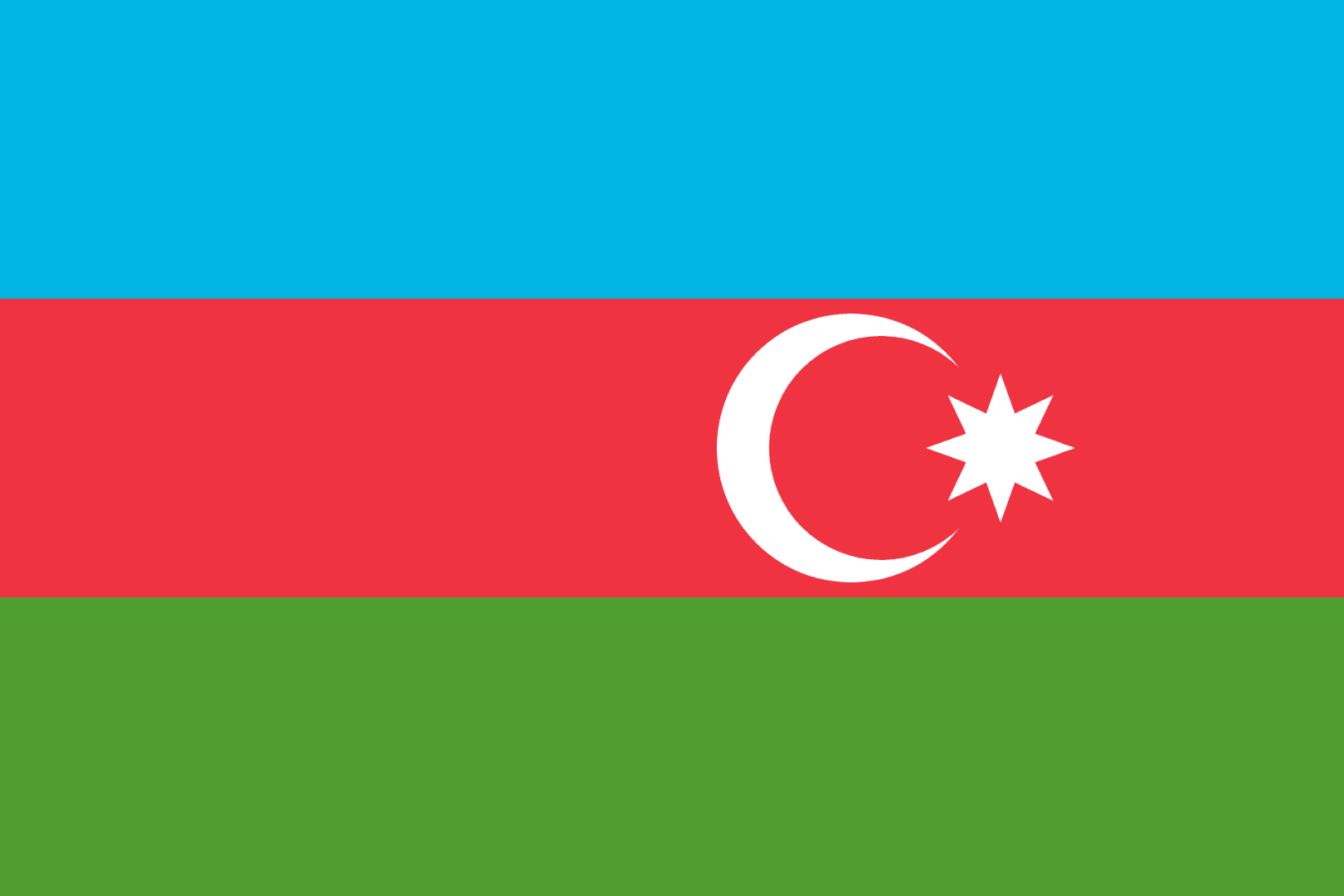
HRF classifies Azerbaijan as ruled by a fully authoritarian regime.
Azerbaijan declared independence in October 1991, amidst the dissolution of the USSR. Following the country’s only competitive presidential election in 1992, this brief democratic period ended when former KGB officer, Heydar Aliyev, seized power in a 1993 military coup. Formally, Azerbaijan is a presidential republic with a separation of powers defined by the constitution. Executive power is held by the President, who is both the head of state and head of government. Under the rule of strongman Ilham Aliyev, a successor to his father Heydar Aliyev, who governed autocratically until his passing in 2003, power has been concentrated within the executive branch and the Aliyev ruling family. Legislative authority is vested in the Milli Majlis (National Assembly), a unicameral parliament composed of 125 deputies, which plays a subordinate role. The judicial branch includes the Constitutional Court, the Supreme Court, and lower courts. In practice, however, the system is characterized by the absolute dominance of the executive branch. To further consolidate dynastic rule, a controversial constitutional referendum in 2016 created the post of First Vice President, to which Aliyev appointed his wife, Mehriban Aliyeva, in February 2017. In September 2023, the regime launched a military offensive in Nagorno-Karabakh, resulting in the forced displacement of the region’s entire ethnic Armenian population. The European Parliament and international human rights organizations have characterized this military operation and the subsequent exodus as ethnic cleansing conducted by the Aliyev regime.
Key Highlights
National elections in Azerbaijan are a sham, to the point where the real, mainstream political opposition does not have a realistic chance to compete and win. The regime maintains a fundamentally non-competitive electoral environment. It achieves this by preemptively eliminating genuine opposition candidates from the ballot and cultivating a heavily skewed playing field that compels remaining opposition forces to boycott elections. To manufacture its desired outcomes and claim overwhelmingly high vote shares, the ruling power relies on widespread voting irregularities and the complete suppression of political pluralism.
Independent media, political leaders, civil society leaders, organizations, and members of the general public face overt and systematic retaliation if they openly criticize or challenge the regime. The officials suppress independent voices by strictly censoring the information landscape through regulatory weaponization and violently shutting down public assembly. The regime utilizes the judicial system to imprison vocal critics on fabricated charges while dismantling independent civil society groups through legislative strangulation. This environment of severe retaliation is further compounded by the disproportionate persecution of ethnic minorities and the pursuit of exiled dissidents through lethal transnational repression.
Institutions largely fail to serve as independent checks on the regime. The executive branch exercises absolute dominance over the state apparatus, effectively neutralizing any independent institutional checks. The judiciary is utilized primarily to rubber-stamp the repression of political opponents and activists. Simultaneously, the regime restricts the legal profession and oversight mechanisms through targeted legislative reforms, actively retaliating against the few remaining legal professionals who attempt to defend victims of political persecution.