
Good morning, readers!
In India, financial officials confirmed that the digital rupee, the country’s central bank digital currency (CBDC), is now live and complete with spending controls. Officials touted restrictions on where and on what recipients can spend funds, revealing the extent to which central bank digital currencies (CBDCs) can centralize financial power.
In open-source news, DMND Pool, a Stratum V2-supported Bitcoin mining pool, opened for registration to all Bitcoin miners. This pool helps individual miners build their own block templates, thereby strengthening the Bitcoin network’s censorship resistance and decentralization and reducing the possibility of tyrants blocking transactions of human rights advocates.
A new HRF-supported research paper shows how the Chinese Communist Party (CCP) is using advanced AI systems to automate censorship and increase surveillance. As digital repression trends accelerate globally, the importance of open, privacy-preserving freedom tech, from Bitcoin to Nostr to open-source AI, has never been clearer. We end with an interview of Bitcoin educator Ben Perrin, who shares what secure Bitcoin self-custody looks like.
Now, here’s what you need to know this week.
Global News
India | NPCI Confirms CBDC is Live With Spending Controls
The National Payments Corporation of India (NPCI) confirmed that India’s digital rupee CBDC is live with partner banks and is being used by the state for subsidy payments. At India Blockchain Week, an NPCI consultant shared that the digital rupee can be restricted for specific purposes, approved merchants, and particular locations. For example, recent transfers of the programmable CBDC for farmers and livestock owners limited purchases to “approved inputs” with geographic tagging enabled. The CBDC is compatible with India’s state-run payment system, known as Unified Payment Interface (UPI), enabling users to pay with the digital rupee by scanning existing UPI QR codes.
In Context: This announcement demonstrates the extent to which the digital rupee is already deeply programmable and embedded, even in its pilot phase. Such tools provide infrastructure for real-time financial censorship, which could be used to restrict the activities of civil society, NGOs, journalists, or dissidents.
Russia | New Tax Hike Deepens Financial Pressure on Households and Small Businesses
Dictator Vladimir Putin has signed a tax overhaul raising Russia’s value-added tax (VAT) from 20 to 22 percent starting next year. The VAT threshold will also be reduced from 60 million rubles ($777,000) to 10 million rubles ($125,500), placing higher costs on already-strained small companies. Most businesses plan to pass the cost increase directly onto consumers, forcing ordinary Russians to absorb more of the financial burden of the state’s military actions.
Tunisia | Top Human Rights Advocate Arrested Amid Financial Repression of Civil Society
Tunisian police arrested opposition lawyer and human rights defender Ayachi Hammami after officials issued him a five-year prison sentence for “conspiracy against state security” in a case against more than 40 individuals. According to Hammachi’s family and international observers, the case was leveled against him for his work defending vulnerable communities and his long-standing criticism of President Kais Saied’s government. The arrests come amid an ongoing financial repression campaign against civil society. Authorities have suspended at least 14 NGOs, frozen assets, blocked foreign transfers, and opened financial investigations into refugee support groups, election monitors, and human rights organizations.
Iran | Currency Reaches Record Low
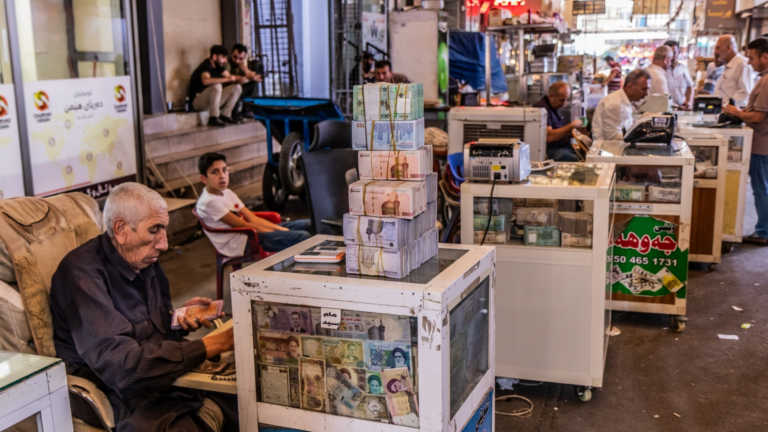
Iran’s currency fell to 1.2 million rials per U.S. dollar this week, its lowest level ever. The plunge has pushed up prices for essential goods, putting more pressure on households already struggling with years of inflation and wage stagnation. The rial traded at 32,000 per dollar in 2015, showing just how drastically Tehran’s drive for nuclear weapons has affected Iranians’ savings and purchasing power. Watch this presentation from Iranian activist and Bitcoin educator Ziya Sadr at the 17th annual Oslo Freedom Forum for a glimpse into the financial repression Iranians face and the need for inflation-resistant alternatives like Bitcoin and stablecoins.
China and Thailand | Shared Digital Payment System Established
China and Thailand launched a new cross-border QR payment system that lets Chinese tourists pay Thai merchants using UnionPay-linked apps. The rollout comes as Beijing accelerates concurrent efforts to embed its payment standards across Southeast Asia, including establishing an international operations center for its digital yuan CBDC. China’s state-owned UnionPay now has QR interoperability projects with Vietnam, Laos, and Indonesia, expanding its regional influence. For millions of tourists, the system offers easy payments. But locally, it raises questions about growing dependence on China’s financial infrastructure and the level of surveillance employed by the regime.
Recommended Content
The Party’s AI by the Australian Strategic Policy Institute
A new HRF-supported report from the Australian Strategic Policy Institute (ASPI) reveals how the CCP is weaponizing advanced AI, including large language models, to automate censorship, enhance surveillance, and pre-emptively suppress dissent. As autocracies adopt increasingly sophisticated digital repression, the need for open, rights-preserving freedom tech grows more urgent. HRF’s AI for Individual Rights program is working to ensure dissidents, not dictators, benefit the most from the next generation of AI. To follow this work, subscribe to HRF’s AI for Individual Rights newsletter.


Financial Freedom Webinar: Bitcoin for Nonprofits
HRF will host a free, three-day webinar from December 15-17 guiding human rights defenders and nonprofits on how to use Bitcoin to resist state censorship and financial repression. Sessions run daily from 10:30 A.M. to 12:00 P.M. EDT and are designed for all experience levels. The training will be co-led by Bitcoin educator Ben Perrin (BTC Sessions) and Financial Manager at the Anti-Corruption Foundation Anna Chekhovich, who will share practical tools for receiving donations, securing funds, and sustaining activism when bank accounts are frozen or surveilled.
Bitcoin and Freedom Tech News
DMND Pool | Full Public Launch
DMND, a Bitcoin mining pool built around the new Stratum V2 protocol, is now open to all miners. Stratum V2 support allows miners to choose which transactions to process, preventing large mining pools from bowing to authoritarian pressure to restrict payments. Its launch strengthens individual miners’ ability to participate in and secure the Bitcoin network and reinforce its permissionless and censorship-resistant foundations.
Why this matters: DMND’s launch expands the number of pools offering Stratum V2 support and strengthens individual miners’ access to the network. In turn, this improves the Bitcoin network’s decentralization and other properties that human rights defenders rely on for financial freedom.
Fedimint | Planned Implementation of Lightning Address Support
BULL Wallet, an open-source and self-custodial Bitcoin wallet with strong privacy features, released a new update with support for Blockstream Jade. This enables users to buy bitcoin directly into a hardware wallet and comes in addition to COLDCARD, Krux, and SeedSigner support. New privacy upgrades include a Tor proxy for users to connect to their own servers, as well as advanced privacy settings that allow users to choose their preferred privacy level before creating a wallet.
Why this matters: These upgrades strengthen BULL Wallet’s commitment to self-sovereign Bitcoin use by expanding hardware compatibility, improving privacy defaults for dissidents, and reducing reliance on proprietary firmware.
White Noise | New Updates Improve Privacy and Decentralization
White Noise, an encrypted messaging app built on Nostr, shipped key updates in November that make secure communication more reliable for those under authoritarian regimes. The app now supports encrypted image sharing to allow users to send photos without exposing them to unwanted eyes. It also plans to introduce a key-rotation mechanism for Nostr, which will let users safely update their cryptographic keys (which are used to log in) if they are ever compromised, which can prove essential for anyone at risk of device seizure or surveillance by dictators.
Why this matters: For activists, journalists, and citizens facing financial or political repression, private communication protects their ability to organize, share evidence, and move resources without interference. Tools like White Noise can help keep these channels open and secure.
bitcoin++ | Open Source Edition Announced in Kenya
During Btrust Developer Day and the Africa Bitcoin Conference in Mauritius last week, bitcoin++, a Bitcoin developer series conference, announced its first-ever open-source edition in Nairobi, Kenya, to be held on June 17-20, 2026. The four-day gathering will focus on hands-on Bitcoin development, open protocols, and contributions from African builders. The event aims to highlight how open-source collaboration is reshaping the developer landscape across the continent and expanding participation in global financial infrastructure, and it will provide a way for African activists from authoritarian regimes to more easily join the conversation around Bitcoin development.
OpenSats | Long-Term Support for Andrew Toth Announced
OpenSats, a public nonprofit that funds free and open-source software and projects, has awarded long-term funding to Andrew Toth, a veteran contributor to Bitcoin Core. Toth’s work makes Bitcoin nodes (computers running the Bitcoin software) smoother to run, speeds up the initial sync process, improves how nodes process new blocks, and reduces the time it takes for wallets and apps to sync information. He is also advancing silent payments via partially signed bitcoin transactions, to allow everyday users to donate to causes without revealing their identities on the public ledger.
Bitcoin Recommended Content
Don’t Lose Your Bitcoin Generational Wealth with BTC Sessions
In this episode of What Bitcoin Did, Bitcoin educator Ben Perrin (BTC Sessions) explains what secure Bitcoin self-custody looks like. From simple wallets to multisignature, Perrin describes how to build an inheritance plan you or your family can actually execute. He breaks down the trade-offs between popular hardware wallets, why over-engineering security can backfire, and what it takes to live entirely on Bitcoin. It’s a practical guide for anyone serious about protecting their finances and passing on financial freedom.