


Happy holidays, readers!
We begin this week with a stark case of transnational financial repression. Russian dissident and financial director of Alexei Navalny’s Anti-Corruption Foundation (ACF), Anna Chekhovich, reports that her US bank accounts were temporarily shut down after the Kremlin labeled her an “extremist.” This shows how authoritarian regimes can use political charges to target dissidents beyond their borders with financial repression.
In freedom tech news, Evento launched a new open-source, self-custodial Bitcoin and Lightning wallet built directly into its events platform. This new tool will make it easy for human rights defenders and pro-democracy organizers to exercise freedom of assembly with permissionless money.
We also feature a new essay examining why Bitcoin adoption in countries like Afghanistan, Iraq, and Lebanon reflects state monetary failure rather than speculation. It explains why people turn to permissionless money when governments erode human rights, leaving many with no safe way to store value, receive pay, or move money.
Let’s move into the full update.
Global News
Russia | Chase Closes Bank Accounts of Russian Dissident
Anna Chekhovich, a Russian dissident living in exile and the financial director of Alexei Navalny’s Anti-Corruption Foundation (ACF), reports that her US bank accounts were temporarily closed by JPMorgan Chase. The closure came after Vladimir Putin’s dictatorship labeled Chekhovich an “extremist” and ACF a “terrorist organization.” These designations are widely recognized as politically motivated and part of the Kremlin’s efforts to silence critics. Although the accounts have since been unfrozen, the case reflects a pattern of transnational repression, where authoritarian regimes extend their reach and control by exploiting international legal and financial systems.
In context: When institutions in democracies treat a dictator’s political labels as legitimate, dissidents living in exile can lose access to basic financial services. Chekhovich’s case sets a dangerous precedent that could expose more activists, journalists, and NGOs to financial exclusion and repression abroad.
Cuba | Regime Devalues Currency
Cuban officials sharply devalued the peso last week, introducing a new official exchange rate of 410 pesos per dollar. The move is an implicit admission that state financial controls have failed to stabilize the currency, bringing the official rate closer to the informal rate of around 440 pesos per dollar. The existing two exchange rates — 24 pesos per dollar for state enterprises and 120 pesos per dollar for the tourism industry — will remain in place. Historically, multi-tier exchange systems have fueled corruption and inequality by benefiting regime insiders while eroding ordinary citizens’ purchasing power.
In context: The new rate will likely immediately result in higher prices across the country as inflation accelerates and further erodes the value of people’s wages and savings. The move comes amid acute foreign currency shortages, collapsing tourism, fuel scarcity, and rolling electrical blackouts.
United Arab Emirates | CBDC Rolls Out as “Free” Amid Expanding Financial Surveillance
The United Arab Emirates’ central bank announced that the first phase of its Digital Dirham central bank digital currency (CBDC) will be offered free to users and small businesses, framing the rollout as a cost-saving upgrade to payments. But “free” at launch does not mean neutral. As a direct central bank liability, the Digital Dirham gives the state full visibility into transactions and the power to impose future fees, conditions, or negative interest rates once adoption is established. The news follows the UAE’s first state-to-state CBDC transaction conducted via the multi-CBDC mBridge platform, which links the UAE with China and other authoritarian states in a shared, programmable settlement system.
In context: This launch also comes alongside a recent regulatory decree that expands surveillance over digital assets through strict licensing requirements and places criminal penalties on unapproved financial tools like self-custody wallets. Taken together, the “free” Digital Dirham appears less like a public good and more like an on-ramp to deeper financial control.
Sudan | Conflict Fueled by Financial Predation and Resource Capture
Sudan’s civil war is increasingly sustained by resource capture and the financial gains of smuggling and trafficking networks. Armed factions fund their operations by smuggling gold, seizing oil infrastructure, and diverting humanitarian aid. Meanwhile, civilians face rampant inflation, food shortages, blocked deliveries of life-saving aid, and a collapsed banking system. With formal finance largely inaccessible, survival now depends on informal markets, checkpoints, and predatory fees imposed by armed groups. The war economy illustrates how financial breakdown and resource control can entrench repression and prolong conflict.
Recommended Content
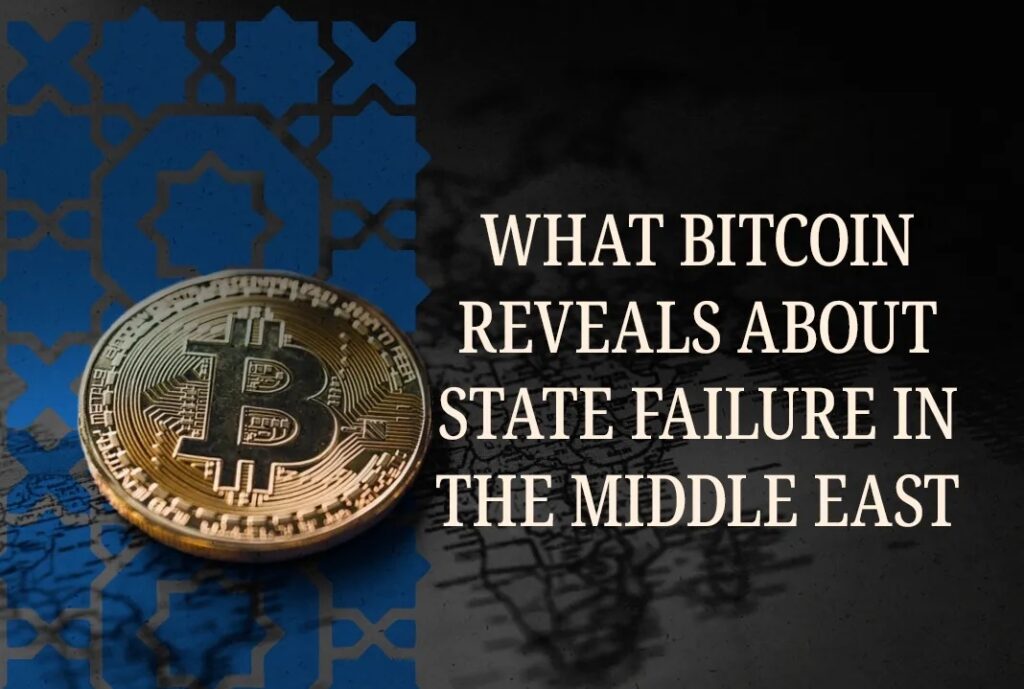
“What Bitcoin Reveals About State Failure in the Middle East” by Roya Mahboob and Faisal Saeed Al Mutar
This essay in Middle East Uncovered argues that Bitcoin adoption across Afghanistan, Iraq, and Lebanon has not been driven by ideology or speculation but by institutional collapse. Where banks are inaccessible, corrupt, or weaponized — especially against women and civil society — Bitcoin becomes basic financial infrastructure. The authors draw on real-world examples of how people “route around” state’s financial failures to store value, receive pay, and survive currency collapse.

Financial Freedom Webinar: Bitcoin for Nonprofits
HRF will host a free, three-day webinar from December 15-17 guiding human rights defenders and nonprofits on how to use Bitcoin to resist state censorship and financial repression. Sessions run daily from 10:30 A.M. to 12:00 P.M. EDT and are designed for all experience levels. The training will be co-led by Bitcoin educator Ben Perrin (BTC Sessions) and Financial Manager at the Anti-Corruption Foundation Anna Chekhovich, who will share practical tools for receiving donations, securing funds, and sustaining activism when bank accounts are frozen or surveilled.
Bitcoin and Freedom Tech News
Evento | Open-Source Wallet Released in Beta
Evento, a Bitcoin and Nostr event platform, launched the public beta of Evento Wallet, a fully open-source, self-custodial Bitcoin and Lightning wallet built directly into the platform. First tested at Btrust Developer Day in Mauritius, the wallet enables users to receive and send Lightning and on-chain payments and send one another “zaps” (tips in bitcoin) during a live event. It also supports buying and selling through recommended exchanges, earning satoshis from trusted partners, and spending via Bitrefill gift cards.
Why this matters: Embedding self-custodial Bitcoin payments into open community coordination tools like Evento lowers the barrier for activists, pro-democracy organizers, and grassroots groups to pair freedom of assembly with the ability to earn, share, and spend money without permission.
BTCPay Server | Subscriptions and Monetization Added
BTCPay Server, an open-source and self-custodial Bitcoin payment processor, introduced native subscriptions and a new monetization feature. The new subscriptions feature enables nonprofits and merchants to accept recurring donations or payments directly in Bitcoin, all natively within BTCPay Server. The monetization feature lets users who already host a BTCPay Server charge other users a recurring fee for server usage. Together, these drastically reduce barriers for nonprofits to accept Bitcoin, as they no longer need to set up a server and can instead opt to use others while still maintaining self-custody.
Why this matters: For nonprofits facing censorship, debanking, or funding instability in countries ruled by authoritarian regimes, this update enables recurring, self-custodial donations and reduces reliance on banks or payment processors, making fundraising more resilient, transparent, and sustainable.
Lightning Network | All-Time High Capacity Reached
Bitcoin’s Lightning Network capacity reached a new all-time high, surpassing 5,600 BTC held in payment channels. Lightning is Bitcoin’s fast, low-cost payment layer, designed for everyday transactions like remittances, donations, and micropayments. Rising capacity signals growing use. For people living under financial restrictions and repression, Lightning enables near-instant, cross-border transfers without relying on banks or payment processors.
Why this matters: A growing Lightning Network means more liquidity, reliability, and stronger censorship resistance. It shows Bitcoin evolving from a savings technology into a practical payment system that supports dissidents, nonprofits, and everyday users operating outside authoritarian financial rails.
Zeus Wallet | Nostr Wallet Connect Support Released
Zeus, a Bitcoin Lightning wallet, has integrated the Nostr Wallet Connect (NWC) protocol. This protocol allows apps to interact with Bitcoin Lightning wallets, boosting interoperability between Bitcoin and Nostr. Zeus’s NWC integration will enable users to link external wallets like Alby Hub or Cashu.me, improving transaction flexibility. It also enables sending zaps (tips via bitcoin micropayments).
Why this matters: For human rights defenders and civil society operating under censorship, zaps enable small permissionless payments and donations without relying on platforms or payment processors that dictators can coerce to monitor, block, or seize funds.
BULL Wallet | Support for Foundation Hardware Wallet Added
BULL Wallet has released a new update adding support for the Foundation Passport, an open-source and air-gapped Bitcoin hardware wallet. This allows users to buy bitcoin directly through BULL Wallet and send it straight to a self-custodial Passport device, mitigating counterparty risks of leaving funds on an exchange.
Why this matters: The update strengthens options for long-term self-custody by combining BULL Wallet’s non-custodial purchasing flow with Passport’s offline security model to the benefit of dissidents who need convenient and self-controlled access to freedom money.
Bitcoin Recommended Content
Building Bitcoin for Africans, by Africans — Anita Posch at the African Bitcoin Conference
In this talk from the 2025 Africa Bitcoin Conference, Bitcoin educator Anita Posch reflects on five years of hands-on work across Africa. She explains why real Bitcoin adoption must be locally driven, not imposed from abroad, and why self-custody, privacy, and permissionless access are essential in repressive or underbanked environments.